
Mostrando entradas con la etiqueta Hannu Lintu. Mostrar todas las entradas
Mostrando entradas con la etiqueta Hannu Lintu. Mostrar todas las entradas
jueves, 12 de noviembre de 2020

miércoles, 21 de octubre de 2020

martes, 22 de septiembre de 2020

jueves, 17 de septiembre de 2020

jueves, 6 de agosto de 2020
lunes, 20 de julio de 2020

jueves, 7 de mayo de 2020

sábado, 2 de mayo de 2020

lunes, 30 de abril de 2018
Christian Tetzlaff / Finnish Radio Symphony Orchestra / Hannu Lintu BARTÓK Violin Concertos Nos. 1 & 2

Star violinist Christian Tetzlaff performs Béla Bartók’s (1881–1945) two masterpieces in a new recording with Finnish Radio Symphony Orchestra conducted by Hannu Lintu. This recording continues both artists’ highly successful series of recordings on Ondine.
‘The two violin concertos of Béla Bartók (1881–1945), completed
thirty years apart in 1908 and 1938 respectively, celebrated
relationships with two Hungarian violinists: the first romantic, with
Stefi Geyer and the second artistic, with Zoltán Székely. Bartók’s 1st
Violin Concerto was published posthumously after the composer’s death
in 1956, but Bartók reused the opening movement as the first of his Two Portraits
for orchestra. He remarked in a letter written in late 1907 or early
1908 that ‘I have never written such direct music before’. Bartók
completed two movements that portray the character of Stefi Geyer to
whom the work was written to. Completed towards the end of 1938,
Bartók’s three-movement 2nd Violin Concerto was a much more
substantial concerto than his first essay in the medium and it was
dedicated ‘to my dear friend Zoltán Székely’. Székely’s name can also be
found in the of his Second Rhapsody. Bartók adopted a rather unusual
approach to the overall form of the Second Violin Concerto and the
impact of both rural folk music and urban verbunkos on his language can
be found in the Second Violin Concerto.
lunes, 2 de abril de 2018
Pekka Kuusisto / Finnish Radio Symphony Orchestra / Hannu Lintu SEBASTIAN FAGERLUND Darkness in Light

This is BIS’s third disc devoted to the music of the Finn Sebastian Fagerlund (b1972). David Fanning was not wholly convinced by the earlier orchestral release (including Isola
and the Clarinet Concerto, 9/11) but I warmed rather more to the
present pairing, in style not so dissimilar from his elder Swedish
contemporary, B Tommy Andersson.
The Violin Concerto Darkness in Light (2012) was
composed for and dedicated to Pekka Kuusisto, who gives a dazzlingly
virtuoso account of it here. The three movements, as might be inferred
from the title (derived from the writing of Haruki Murakami), explore
and try to reconcile mutually exclusive elements, heard at the outset in
the opposition of the dark writing for bass clarinets, timpani and tuba
with the solo violin and supporting group of upper winds and bright
percussion. Kuusisto navigates his way brilliantly through the gamut of
effects including multiple-stopping, microtones, harmonics et al, all
expressed within a broadly legato flow; even the more angular and hostile episodes serve to illuminate the music’s broader context.
Ignite (2010) is similarly a work of dark and light, its
structure dominated by spirals, the music calming to near stasis as it
approaches the centre before being flung out again into the turbulent
finale. It is an invigorating and virtuosically scored symphonic poem
and finds Lintu and the Finnish Radio Symphony Orchestra fully on their
mettle. Superb sound, as always from the black label. (Guy Rickards / Gramophone)
sábado, 24 de marzo de 2018
Ismo Eskelinen / Finnish Radio Symphony Orchestra / Hannu Lintu SEBASTIAN FAGERLUND Stonework - Drifts - Transit

Sebastian Fagerlund has been described as ‘a composer who commandingly
bridges tradition and modernity’ (Klassik-Heute.de) while his music is
‘modern and unorthodox, opulent and strange, masterfully composed and
orchestrated’ (MusicWeb-International). Previous acclaimed recordings on
BIS include the chamber
opera Döbeln, as well as orchestral works and concertos for clarinet,
violin and bassoon respectively. Another concertante work froms part of
the present programme: Transit for guitar and orchestra, written for
Ismo Eskelinen who also performs it here. He is partnered by the Finnish
Radio Symphony Orchestra and Hannu Lintu who have previously championed
Fagerlund’s music: the orchestra has commissioned several works,
including the guitar concerto as well as Drifts, the opening work here.
The disc takes its title from the third composition, Stonework, named
after those man-made stone structures that are found all over the world,
serving a range of purposes, from landmarks and navigational aids to
burial monuments.
domingo, 15 de octubre de 2017
Anne Sofie von Otter / Finnish Radio Symphony Orchestra / Hannu Lintu SIBELIUS Tapiola - En Saga - 8 Songs

This new release by the Finnish Radio Symphony Orchestra conducted by
Hannu Lintu is an all-Sibelius programme featuring internationally
acclaimed mezzo-soprano Anne Sofie von Otter. The album includes two
major tone poems by Jean Sibelius (1865–1957), Tapiola and En Saga,
combined with a set of songs orchestrated by Aulis Sallinen (b. 1935) in
2015. • Sibelius’ tone poem Tapiola, written shortly after the 7th
Symphony, may be regarded as the culmination of a period that began with
the Fifth Symphony, a period where Sibelius created music that grew
organically out of tiny germs into huge processes. It was completed in
1926 and remained Sibelius’s last great orchestral work. In Tapiola,
Sibelius appears to equate the primacy of nature with the value of art
for its own sake, the unattainable truths of which remain uneroded by
time or by the shifting ideals of mankind. Sibelius stated to his
private secretary: “My inspiration for Tapiola came wholly from nature,
or even more accurately from something inexpressible in words.”
The genesis of En Saga, originally premiered in 1892, is also
shrouded in mystery, and even later in life Sibelius was reluctant to go
into any detail regarding its content. It is among Sibelius’ earliest
orchestral works, and its original title in Swedish, En saga, refers to
ancient Nordic tales of heroes and gods. Although En saga is among the
most popular works by Sibelius today, the premiere of the work was not a
success and Sibelius revised the score in 1902.
On the occasion of the 150th anniversary of Sibelius’s birth in 2015
composer Aulis Sallinen (b. 1935) orchestrated a cycle of songs for
mezzosoprano Anne Sophie von Otter. This cycle of eight songs contains
several less known songs in a cavalcade juxtaposing human emotions and
innermost thoughts with the natural environment and experiences in
nature. (Ondine)
lunes, 4 de septiembre de 2017
Olli Mustonen / Finnish Radio Symphony Orchestra / Hannu Lintu PROKOFIEV Piano Concertos Nos. 1, 3 & 4

This is the second and final disc in a cycle of Sergei Prokofiev’s
piano concertos with pianist Olli Mustonen and the Finnish Radio
Symphony Orchestra conducted by Hannu Lintu. Of the first volume,
Gramophone wrote: 'How many times have I regretted a shortage of
fantasy, flair and fairy-tale imagination in recordings of the Prokofiev
piano concertos? Well, here is a disc that takes all those qualities to
the top'.
Upon reading the score of the 2nd Piano Concerto before its
premiere, composer Nikolay Miaskovsky wrote to Prokofiev: 'When I was
reading through your concerto tonight, lying in bed, I went almost crazy
with admiration: I jumped and cried out, so that if I had neighbours,
they’d have probably thought I’d gone mad'. Prokofiev wrote this magical
work just before World War I. The original score was destroyed during
the Russian revolution, and Prokofiev had to re-write the concerto in
1923. Prokofiev's Piano Concerto No. 5 is completely different in nature
than its predecessors. A stylistic change towards simplicity is evident
in the work. Although Prokofiev considered naming the work 'Music for
Piano and Orchestra' he produced in the end a challenging concerto that
tests any soloist’s technique. Prokofiev himself gave the first
performance in Berlin on 31 October 1932.
Pianist Olli Mustonen has recorded many works with Ondine,
including Respighi’s Concerto in modo Misolidio with Sakari Oramo and
the Finnish Radio Symphony and a critically acclaimed disc of Scriabin’s
solo piano music. Recent recordings by the Finnish Radio Symphony
Orchestra under Hannu Lintu on Ondine have been a fruitful
collaboration, gathering excellent reviews in the international press.
martes, 11 de julio de 2017
Kojo / Sundqvist / Aalto / Finnish Radio Symphony Orchestra EÖTVÖS - NIELSEN - SALLINEN Levitation

And then there is the rest of the programme. The notes tell us that each of the four movements of Peter Eöstvös’s piece explores different aspects of the subject of levitation. The first movement has street furniture - phone boxes and road signs - flying about in a hurricane, whereas the second evokes a recurring dream the composer has of his own body floating, horizontally, over a landscape. The third movement describes gondolas on - or presumably above - Venetian waterways, and the last has Petrushka, buoyant, high above the world that has dealt so cruelly with him. Since the notes, and presumably the composer, give so detailed a “programme” it seems logical to comment on it. In fact, there is not much in the way of contrast in this work. Each movement is a kind of mood painting, with no themes as such, but fragments, motifs, mostly without any discernible pulse. If there were no gaps between the movements I’m not sure that I should know which one I was in, at least, not for the first few hearings. Thus the first-movement conjures up the gentlest, most beguiling hurricane you could imagine, and you will listen in vain, in the third movement “barcarola”, for any suggestion of the characteristic rhythm that normally goes with the name. The writing for the three solo instruments - two clarinets and accordion - is completely without show or bravado. All this does not stop this piece creating a powerful impression. The sounds the composer finds within the ensemble are exquisite and, for the most part, astonishingly tranquil, restful, tender and subtle. Maybe it’s another of those pieces that one would appreciate more, or at any rate no less, if the composer gave no information about it. I enjoyed it enormously the first time I heard it, and it positively compels the listener to return to it.
Getting to know the music of Aulis Sallinen - I would recommend the opera The King Goes Forth To France (Ondine) or any of the symphonies in the admirable CPO series - is an ongoing pleasure that continues with the double concerto on this disc. Its three movements deal with issues related to man’s relationship with animals. The first is a gentle lament for two dolphins drowned in a fisherman’s net in the Baltic Sea, and the third pays homage to the noble bull destined to die in the arena. Only the middle movement, “Les Jeux”, which deals with games, seems to stretch the theme somewhat, the parallels between animals and humans appearing to extend no further than the fact that playing of any kind is unimportant for the survival of a species. The work opens with a duet, accompanied only by timpani, for the two soloists. Other instruments are added gradually, and the movement progresses, via a series of ravishing sounds, to create an unforgettable atmosphere of gentle sadness and regret. Anger at man’s treatment of animals appears in the final movement only in one or two rare passages of display for the soloists. Otherwise this is an expression of deep sorrow that we should be capable of such things. The middle movement is a rapid, colourful scherzo, brilliant and witty, beautifully written for the whole ensemble. The programme is revealed by the composer in the booklet note, with almost no reference to the music. At least the message is a simple one - no complex theorising, nor, thank goodness, any attempt to transform the shape of a dolphin into a musical cipher! And the music itself is at once challenging yet easy enough on the ear to be enjoyed even at first acquaintance, so commentary is scarcely necessary. Even so - and once again - there is no doubt in my mind that the work can be enjoyed just as much by a listener unaware of the message behind it.
This is a beautifully recorded CD, and the performances from all
concerned are exemplary. The side-drum player in the Nielsen is named in
the booklet, but not - a serious omission - the accordionist in the
Eötvös. Sallinen provides the short commentary on his own work, whereas
the informative notes on the other two pieces are by Jouni Kaipainen.
All the notes are translated into English by Jaakko Mäntyjärvi, whom
many readers will know as a distinguished composer in his own right,
especially of choral music. (William Hedley / MusicWeb International)
sábado, 10 de junio de 2017
Angela Hewitt / Valérie Hartmann-Claverie / Finnish Radio Symphony Orchestra / Hannu Lintu MESSIAEN Turangalîla-Symphonie

With the growing number of performances and recordings, Olivier Messiaen's
Turangalîla-symphonie has become his best-known orchestral work and
something of a hit, if such an expansive and influential work can be
narrowly categorized as such. Cast in ten movements for piano, ondes
Martenot (an instrument similar to the theremin), and large orchestra,
with many recurring themes and motives, Turangalîla-symphonie is a cyclic meditation inspired by Indian mysticism, as suggested by the
composite title, which Messiaen translated as, "All at the same time song of love, hymn to joy, time, movement, rhythm, life, and death." This performance by Hannu Lintu and the Finnish Radio Symphony Orchestra, featuring Angela Hewitt on piano and Valérie Hartmann-Claverie
on ondes Martenot, is an excellent presentation, full of vibrant
sonorities and vigorous playing, all captured in Ondine's spacious
multichannel recording. The hybrid SACD format offers the best way to
appreciate Turangalîla, because the massive orchestra should be heard
with all its parts distinctly separated, rather than as a thick,
homogenous mass, and this recording brings great clarity to all the
moving parts. But even more important than the internal details are the
shockingly vivid tone colors, which are among the most exciting in 20th
century orchestral music. In this area, Lintu draws out the most sharply defined sounds, and pays special attention to Messiaen's lush string and wind textures and sharply accented percussion. Highly recommended to newcomers and Messiaen aficionados alike. (Blair Sanderson)
sábado, 21 de marzo de 2015
Angela Hewitt / National Arts Centre Orchestra MOZART Piano Concertos No. 22 - No. 24

Replete with all the Angela Hewitt virtues—among them, unfailing
clarity, innate elegance, an unerring sense of proportion, a finely
honed mastery of style, melodic finesse and an unobtrusive grasp of
harmonic rhythm—these are exemplary performances. Stylistically, they
are very much of their time, falling midway between the 'Beethovenian',
'revisionist' tendency of the mid-20th century, repudiating the earlier
essentially miniaturist 'Dresden China' tradition, and the sometimes
rather antiseptic, musicologically-'enlightened' approach of the
century's final third. The prevailing tonal palette, from soloist and
orchestra alike, is appropriately lean but always beautifully focused
and elegantly applied. Operatic in the best sense, Hewitt is more
concerned with dialogue, not only between the two hands but within all
levels of the texture, than with conventional notions of 'vocal'
cantabile.
But what finally renders Mozart's operas supreme (and I maintain,
loosely, that he never wrote anything but opera) is not the matchless
subtlety and characterisation of the dialogue, but the continuous
development of the individual characters and the relationships between
them. What I most miss here, and I recognise that I may be in a small
minority, is precisely that feeling of development, which necessarily
relies on vivid and varied characterisation in the first palce. I feel
this throughout, though never more so than in the C minor Concerto,
especially the slow movement, where the uniquely Mozartian tension
between harmonically loaded melody and the essentially neutral, often
near-static nature of metre is spoiled by an excessive sense of
symmetry. (BBC Music Magazine)
viernes, 10 de octubre de 2014
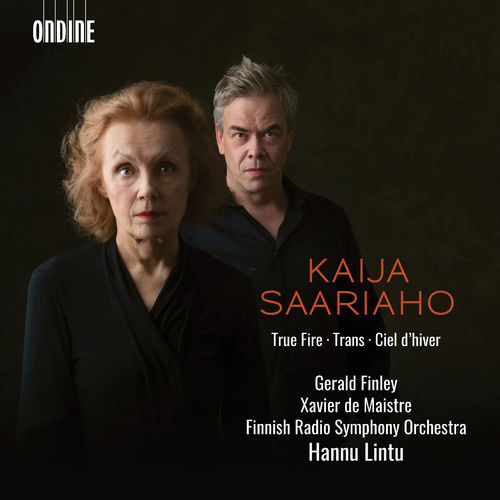
Anu Komsi / Avanti! / Hannu Lintu KAIJA SAARIAHO From the Grammar of Dreams
 Grammaire des Rêves (Grammar of Dreams, 1988-89) was born from my
curiosity about the relationship between human voice and instruments, a
subject which I had put aside for many years. As the title of the piece
indicates, another source of interest was the structural life of dreams.
Grammaire des Rêves (Grammar of Dreams, 1988-89) was born from my
curiosity about the relationship between human voice and instruments, a
subject which I had put aside for many years. As the title of the piece
indicates, another source of interest was the structural life of dreams.
Different ideas concerning the research of dreams (for example, how
our moving body affects our dreams, changing their directions or
interrupting them; in this piece the harp is imagined as a collection of
restless limbs, which by their movements direct the musical flow), are
drawn to the background during the compositional work, or are
transformed into purely musical form.
Another interest was to search for a fusion in this rather heterogeneous ensemble. For this reason the musical texture is maybe more simple than in some other of my recent pieces, and the more radical textural changes have been replaced by vibratos, trills, glissandi, dynamic evolutions and other gestures, used here as imaginary matrices, through which the instrumental parts are ‘filtered’.
Another interest was to search for a fusion in this rather heterogeneous ensemble. For this reason the musical texture is maybe more simple than in some other of my recent pieces, and the more radical textural changes have been replaced by vibratos, trills, glissandi, dynamic evolutions and other gestures, used here as imaginary matrices, through which the instrumental parts are ‘filtered’.
The major part of the text is a collage from the texts of Paul
Eluard. Some longer fragments have been used from his poem
‘Premierèment’ (‘L’Amour la Poésie’).
Grammaire des Rêves is dedicated to Jean-Baptiste Barrière; the first
performance was in Paris on the 23rd March 1989 by Ensemble
l’Itineraire with Esa-Pekka Salonen. (Kaija Saariaho)
domingo, 20 de julio de 2014
Angela Hewitt / Hannu Lintu / Deutsches Symphonie-Orchester Berlin SCHUMANN Piano Concerto

I’m not entirely sure which recording it was of the Schumann
Piano Concerto in A minor it was I listened to about 900 times
while tackling the work’s analytical nuances for O Level exams in the UK
in the early 1980s, but there have been so many recordings since it
hardly matters. One new one I’ve heard recently is that with Sophie
Pacini on the Onyx label, and this makes a nice comparison with Angela Hewitt’s Hyperion release as the differences are so palpable. Pacini is
urgent and dramatic in the
Allegro affetuoso first movement, exploring the poetry of the
gentler moments with probing notes which highlight each harmonic
progression. Hewitt on the other hand
is,
dare I say it, less old fashioned. Her approach seeks the flow in the
music, obtaining a legato in those accompanying moments where the
orchestra takes the lead and adding texture rather than making musical
points. The superb balance between piano and orchestra allows this to
happen naturally and with an easy grace which is a sheer delight. Hewitt
lingers lovingly at the chamber music moments in this movement and,
while more drama might be achieved at such points, her contrasts are
greater as a result - the rhythm of repose and triumphant thematic
elevation beautifully proportioned.
Proportion is an important buzzword in Hewitt’s Schumann. She holds plenty back, but always for a reason. That solo passage from 4:36 might seem a bit too reserved, the tempo too static, but did you ever hear that clarinet entry at 5:35 quite so movingly? All of those essential little tonal and timbral brushstrokes are expressed to perfection, and the drama at 6:06 is all the greater for that minute and a half of suspended expectation. With Hewitt, and of course the superb instrumental weighting brought out by Hannu Lintu, you hear the ‘Bach’ in Schumann as well as the turbulent romanticism. That main theme never sounded quite so much like a Bach chorale than here, and there are little moments all over the place where, if your associative baggage allows it, a penny or more will drop and an ‘ah…’ moment will occur where it probably hadn’t before with other recordings.
Proportion is an important buzzword in Hewitt’s Schumann. She holds plenty back, but always for a reason. That solo passage from 4:36 might seem a bit too reserved, the tempo too static, but did you ever hear that clarinet entry at 5:35 quite so movingly? All of those essential little tonal and timbral brushstrokes are expressed to perfection, and the drama at 6:06 is all the greater for that minute and a half of suspended expectation. With Hewitt, and of course the superb instrumental weighting brought out by Hannu Lintu, you hear the ‘Bach’ in Schumann as well as the turbulent romanticism. That main theme never sounded quite so much like a Bach chorale than here, and there are little moments all over the place where, if your associative baggage allows it, a penny or more will drop and an ‘ah…’ moment will occur where it probably hadn’t before with other recordings.
I wasn’t
entirely uncritical of Angela Hewitt’s solo Schumann programme from
Hyperion, but have few if any such reservations in this piano/orchestra
release. Her next release in the Mozart concertos series will also be
conducted by Hannu Lintu, and so also promises to be something more than
a bit special. This Schumann release, complete with excellent booklet
notes by the soloist and its strikingly atmospheric Caspar David
Friedrich illustration for the cover, is highly desirable and extremely
rewarding. (Dominy Clements, MusicWeb International)
miércoles, 11 de diciembre de 2013
Angela Hewitt / Orchestra Da Camera Di Mantova MOZART Piano Concertos No 17 K453 - No 27 K595

Angela Hewitt turns to two of Mozart’s greatest and most popular
concertos for her latest album. Together with her frequent
collaborators, the Orchestra da Camera di Mantova and brilliant Finnish
conductor Hannu Lintu, she presents these works in performances which
are both elegantly stylish and profoundly felt. This release is
completed by a personal reflection on the music by Hewitt herself in the
accompanying booklet.
'The sound is wonderfully clean and focused, with an ideal balance
between Hewitt's customary Fazioli piano and the orchestra. … [K453
finale] Here Lintu starts the movement with light-footed grace, using
minimal vibrato on the strings, Hewitt taking her cue with playing of
elegance and buoyancy … The attention to musical contrast and stylistic
integrity is similar throughout. Hewitt's own illuminating notes in the
booklet are a bonus, making this a Mozart release to cherish' (The Daily
Telegraph)
The success of her performances of K595 and the G major, K453, rests in
part on Hewitt's feeling for Mozart's remarkable harmonic and tonal
range in both works … Mozart gives us plenty more surprises … Hewitt
relishes these, as if freshly exploring and delighting in them … These
characteristics of intelligent delight in the music also mark Hewitt's
performance of the G major Concerto … It is brilliantly done, and this
is a brilliant performance all round' (International Record Review
Suscribirse a:
Entradas (Atom)

-
Music Is The Key will be closing soon. Over the last year maintaining this site and keeping it up to date has become an expensive and tim...

