
Mostrando entradas con la etiqueta Anne-Sophie Mutter. Mostrar todas las entradas
Mostrando entradas con la etiqueta Anne-Sophie Mutter. Mostrar todas las entradas
domingo, 22 de agosto de 2021

martes, 27 de julio de 2021
Anne-Sophie Mutter JOHN WILLIAMS Violin concerto No. 2 (Video)

Jessie Montgomery: Starburst
John Williams: Violin concerto No. 2 (World Premiere)
John Williams: New arrangements of film themes “Across the Stars“
Aaron Copland: Quiet City
Igor Stravinsky: Suite from “The Firebird“ (1919 Edition)
miércoles, 19 de agosto de 2020

viernes, 3 de abril de 2020

viernes, 30 de agosto de 2019
Anne-Sophie Mutter JOHN WILLIAMS Across the Stars

Legendary film composer John Williams and superstar violinist Anne-Sophie Mutter have announced a new album, Across The Stars.
Released on 30 August, the album will feature Williams conducting new
arrangements of some of his iconic movie themes, including pieces
written for the Star Wars and Harry Potter movies. Across The Stars was
recorded at the historic Sony Pictures Scoring Stage in Hollywood,
where many great film soundtracks of the past were recorded, including The Wizard Of Oz, Gone With The Wind, Singin’ In The Rain, Lawrence Of Arabia, and ET.
“There is only one John Williams,” said Anne-Sophie Mutter. “What he
writes is just extraordinary. Every time I go to one of his films and
there is a violin or cello, I think, I would like to play that! And now I
have his wonderful translations of all these iconic themes.” She added
it was a “a tremendous honour” to work so closely with John Williams –
and that the recording conditions for this album were the finest since
she collaborated with Herbert von Karajan.
“Working with Anne-Sophie on this recording has been a pure
inspiration,” added Williams. “She has brought vibrant life to these
familiar themes in new and unexpected ways, which has been a great joy
for me as a composer.”
John Williams explained that for this project he revisited themes
from many of his existing scores and completely transformed them.
“Presented on the violin, they become a different emotional experience,”
he said. One example is his newly arranged version of ‘Hedwig’s Theme’
from the Harry Potter films, which he and Mutter describe as “Harry Potter meets Paginini”, and “a Carmen Fantasy for the 21st century”. The music ranges from Star Wars motifs such as ‘Yoda’s Theme’, from The Empire Strikes Back, to more recent pieces such as ‘Sayuri’s Theme’ from Memoirs Of A Geisha.
John Williams – who has won five Oscars, four Golden Globes, five
Emmys and 24 Grammys – is the most successful film composer of all time.
He has composed some of the most popular, recognisable and
critically-acclaimed film scores in cinematic history. Anne-Sophie
Mutter is universally considered to be one of the greatest violinists of
modern times. They both consider Across The Stars to be a milestone recording.
“These are melodies which touch us so deeply, they just stay with
you,” said Mutter. “That’s the wonderful thing about John’s music – even
without the film it has a life of its own.”
jueves, 3 de enero de 2019
120 YEARS DEUTSCHE GRAMMOPHON - THE TOKIO GALA CONCERT
 Deutsche Grammophon is marking the 120th anniversary of its company foundation on 6 December 1898 with a carefully curated global programme of DG120 live concerts, special events, record releases and much more. The world’s oldest and best-known classical label will use its anniversary year to continue building a lasting legacy. The company’s unprecedented DG120 programme has been designed to reach existing fans worldwide, attract new followers in Asia and beyond, and share its peerless catalogue with as many people as possible. It has already attracted new audiences in search of great recordings and performances, as well as garnering extensive international media coverage.
The birthday celebrations began with the spectacular DG 120 – The Tokyo Concert, held at Tokyo’s legendary Suntory Hall last night, 5 December, in the presence of the Japanese imperial family. Anne-Sophie Mutter joined Seiji Ozawa, Diego Matheuz and the Saito Kinen Orchestra for a programme of works by Bach, Beethoven, Saint-Saëns and Tchaikovsky.
domingo, 2 de diciembre de 2018
DIE KLASSIK-BESTEN
 "Klassik-Besten" presents the highlights of the current classical music scene and combines the glamor of big stars with the stars of tomorrow in the starry sky of classical music. The exclusive double CD presents famous melodies - interpreted by outstanding world-class artists. The sexy spectrum ranges from classic top stars like Anna Netrebko and Lang Lang to young stars like Sheku Kanneh-Mason and offers only the best of the best in the classical world: With Cecilia Bartoli, Jonas Kaufmann, Anne-Sophie Mutter, Daniil Trifonov, Andrea Bocelli , David Garrett, Daniel Hope, Joyce DiDonato, Il Divo, Sol Gabetta and many more.
Selected masterpieces invite to sensual experience, immersion and relaxation. In addition to Beethoven's fabulous "Moonlight Sonata" or "Solveig's Song" from the Peer Gynt Suite, the excellent selection features immortal moving melodies, such as the enchanting "Ave Maria" by Bach and Gounod, the famous aria "Nessun dorma" by Puccini or Benny Andersson World Success "Thank You For The Music". Both classical and curious people can discover and enjoy great masterpieces with this high-quality album - a glittering firework of classical music.
viernes, 10 de agosto de 2018
Anne-Sophie Mutter HOMMAGE À PENDERECKI
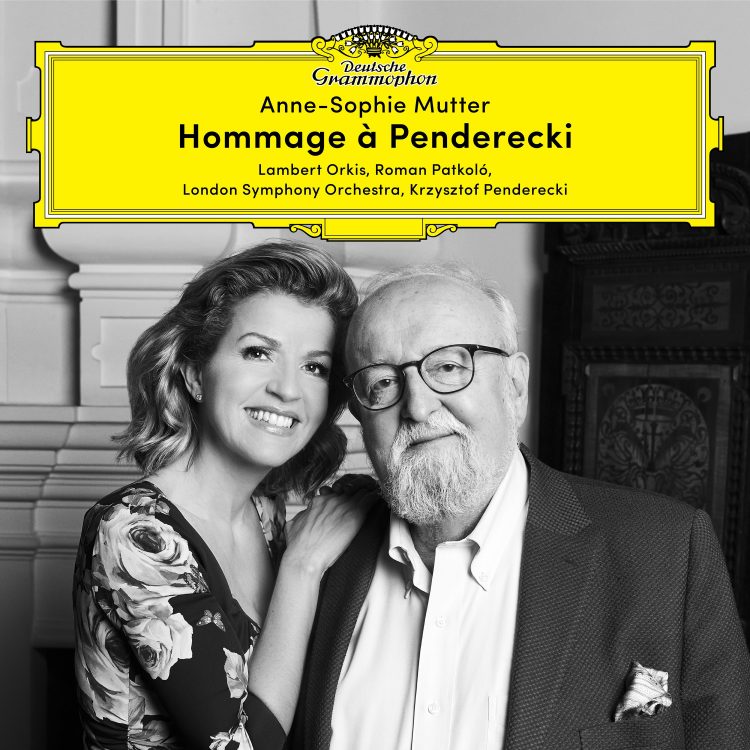
The violinist Anne-Sophie Mutter and the composer and conductor
Krzysztof Penderecki are among the leading musical figures of our age.
For more than thirty years these two outstanding musicians have been
close friends, and during that time their friendship has proved a
fruitful one, repeatedly inspiring and challenging both parties. To mark
the composer’s eighty-fifth birthday Deutsche Grammophon is now
releasing a very special double album featuring Anne-Sophie Mutter both
as a soloist and in partnership with a number of colleagues. All the
works that are included here reflect Penderecki’s unique musical
language in fascinatingly intense and multifaceted ways. The result is a
sensitive and moving homage on the part of the violinist to a musical
friend whose Second Violin Sonata she has recorded for the first time.
Penderecki’s works have an existential depth to them that goes far
beyond the sheer sensuousness of the musical world that they inhabit.
Anne-Sophie Mutter compares their complex, multifaceted nature to the
canvases of Pablo Picasso, so varied, extreme and contrastive are they.
For the composer himself these works are the end result of a creative
process that is both tireless and extremely demanding. As he himself
puts it: “I like travelling uncharted pathways. I have to do this
whenever I compose, otherwise nothing comes out. I start somewhere in
the middle of a work, before moving to the right or left and time and
again having to get back on course, which often means retracing my
steps. I continue to compose until it becomes clear to me that I could
really do it much better. I then start at the beginning.” Penderecki has
retained this self-critical attitude right up to the present day. It is
an attitude that places enormous demands on him. The works that have
come into existence in this way afford impressive proof of his
uncompromising dedication to music and provide thrilling evidence of his
ability to explore the emotional extremes of human existence.
This double album brings together various pieces that Penderecki has
written for the violin and that are performed by Anne-Sophie Mutter in
ways that bring out their wealth of tone colours and captivating
expressivity, while also striking a personal note. In addition to La Follia,
a virtuoso set of variations for unaccompanied violin, and the
dialogue-like concert duet for violin and double bass that Anne-Sophie
Mutter has recorded with the bass player Roman Patkoló, it is two
large-scale, complex works that are at the heart of the present release.
Both reflect Penderecki’s multilayered and hugely expressive art of
composition. Laid out along symphonic lines, the Second Violin Concerto –
subtitled Metamorphosen – was premiered by Anne-Sophie Mutter
in 1995: “For me this task is physically and psychologically
challenging, but it is a challenge that I am grateful to accept,” says
the violinist about the extremely demanding and contrastive work, in
which Penderecki provides a virtuoso amalgam of the most varied styles.
Like the Second Violin Concerto, the Second Violin Sonata is dedicated
to Anne-Sophie Mutter, who has recorded it for the present album with
the pianist Lambert Orkis. The piece is in five movements and resembles a
dramatic disquisition on life that ultimately leaves the listener
emotionally moved.
Penderecki and Mutter have been friends for many years. It is a
friendship that has proved inspirational. They first got to know each
other in the early 1980s, although it was not until 1988 that they began
to work together closely. This was the year in which the then
twenty-five-year-old violinist played Prokofiev’s First Violin Concerto
under Penderecki’s direction. From the outset the conductor was
fascinated by her musical maturity. Their musical association has lasted
until the present day. For Anne-Sophie Mutter, it is “far more than
mere admiration that has bound me to Krzysztof Penderecki’s works for
several decades. I am shaken to the very roots of my being by the depth
of emotion that issues from them – almost more than I am by his genius
as a composer.” With this double album, Hommage à Penderecki, the violinist pays touching tribute to a truly exceptional composer and to their mutual friendship.
martes, 31 de julio de 2018
Anne-Sophie Mutter / Berliner Philharmoniker / Manfred Honeck DVORÁK

jueves, 2 de noviembre de 2017
Anne-Sophie Mutter / Daniil Trifonov FRANZ SCHUBERT Trout Quintet

Anne-Sophie Mutter’s long-established recital partnership with Lambert
Orkis is set to continue, yet she notes how she has often performed
chamber music with other pianists, Alexis Weissenberg, André Previn and
Yefim Bronfman among them. The opportunity to make her first recording
of the “Trout” Quintet with Daniil Trifonov, she says, was too good to
miss; the pianist, likewise, embraced the project with wholehearted
enthusiasm. He sees Schubert, one of the great Classical composers, as
an inventor of the purest melodies and a master of formal structure.
“The sincerity of his musical expression captivates audiences and
performers alike,” notes Trifonov. “When I first learned that
Anne-Sophie wanted to record this music, I was incredibly happy. I’ve
only recorded Schubert in Liszt’s transcriptions of his songs before, so
it was a great joy to work on one of the composer’s greatest works with
four fantastic colleagues. The more we played together, the more
possibilities opened up. Something different happened every time and
that always expands your awareness of what is possible. And then you
become more comfortable with an interpretation which reveals itself in
the moment.”
martes, 13 de diciembre de 2016
Anne-Sophie Mutter MUTTERISSIMO The Art of Anne-Sophie Mutter

Universally considered as one of the greatest violinists of our time, Anne-Sophie Mutter’s stunning and multi-faceted music-making extends across masterworks from the full breadth of the violin repertoire.
Mutterissimo – The Art of Anne-Sophie Mutter is a selection of highlights from her discography, personally picked by Mutter herself, bringing together recordings that date for the most part from the last twenty years. It invites listeners to undertake two tours of Anne-Sophie Mutter’s multiple worlds of music:
The first explores the highways and byways of the core repertory and features well-known works for violin and orchestra by Dvořák and Schumann alongside less familiar pieces. The second one, often with Mutter’s long-standing piano partner, Lambert Orkis, combines virtuosity and light-heartedness; the popular and the surprising; and emotion and rhythmic energy.
For many years Anne-Sophie Mutter has performed not only in major international concert halls but recently also in clubs, where a young audience, largely unconcerned with traditional rituals, reacts to the music much more spontaneously. It is only logical, therefore, that she increasingly uses social media to engage in a dialogue with her fans.
viernes, 25 de septiembre de 2015
Anne-Sophie Mutter / Lambert Orkis THE SILVER ALBUM
 Chemistry is one of the most mysterious aspects of the performing arts,
especially when it comes to music. In athletics, the chemistry among
teammates is almost always right before us. When Larry Bird made
eyes-closed, over-the-head, backwards passes to Kevin McHale or Robert
Parish, we had the benefit of watching slow-motion replays. And even
before television, when the early 20th Century Chicago Cubs turned a
double play, going from "Tinkers to Evers to Chance" (as a famous poem
says), the North Side crowd in the stands could see that unspoken
understanding among the three players at work before their eyes.
Chemistry is one of the most mysterious aspects of the performing arts,
especially when it comes to music. In athletics, the chemistry among
teammates is almost always right before us. When Larry Bird made
eyes-closed, over-the-head, backwards passes to Kevin McHale or Robert
Parish, we had the benefit of watching slow-motion replays. And even
before television, when the early 20th Century Chicago Cubs turned a
double play, going from "Tinkers to Evers to Chance" (as a famous poem
says), the North Side crowd in the stands could see that unspoken
understanding among the three players at work before their eyes.
Musical chemistry, when right, is almost impossible to discern. Two
musicians with an innate, natural understanding of interpretation and
expression meld together seamlessly when that chemistry is at its best.
Such is the case with violinist Anne-Sophie Mutter and pianist Lambert
Orkis. To be clear, either one of these two raises the level of any
collaboration to new heights. But when combined, their vision is as one,
reaching a transcendence few other duos can match.
They first worked together in 1988, and to mark the occasion of a
quarter-century of shared musical experiences, they've released The Silver Album.
Over the course of two discs, the duo treats us to sonatas by
Beethoven, Brahms, Mozart, and Fauré. A few of the lovely encores by
Fritz Kreisler make for a sweet palette cleanser, including Schön Rosmarin, Caprice viennois, and Liebeslied. And a dose of spice kicks in with a few Hungarian Dances by Brahms.
Two recent works, both dedicated to Anne-Sophie Mutter, give the collection a variety only music of our time can provide. La Follia was written by Krzysztof Penderecki last year as the composer celebrated his 80th birthday (which included a visit to the Boston Symphony Orchestra). And André Previn's Sonata for Violin and Piano No. 2, completed in 2011, received its first performance only six months ago.
According to Gavin Plumley at Sinfini Music, The double-disc survey opens with a punchy rendition of Beethoven’s
Seventh Violin Sonata, in which the pair offers fiery counterpoint and
lustre in more lyrical passages. It’s an approach that pays equally
impressive dividends in Brahms’s Second Sonata and Hungarian Dances, as
well as Penderecki and Previn’s new works for the duo. The solo La Follia,
by the Polish composer, is full of Baroque flash and finesse, while
Previn’s Second Violin Sonata bridges past and present with considerable
panache. (WGBH)
miércoles, 2 de septiembre de 2015
Anne-Sophie Mutter THE CLUB ALBUM Live from Yellow Lounge

In May 2015 Anne-Sophie Mutter put her noble, impressively named “Lord Dunn-Raven” Stradivarius through more than its usual paces. For a change, rather than standing on stage in one of the world’s renowned grand concert halls, she spent two evenings playing in a tiny graffiti-scrawled nightclub in the Friedrichshain district of Berlin. The name of the club was Neue Hei- mat, or “new home”, and on two evenings in early summer it was jam-packed with hip young people. The atmosphere heated up in the usual way for such clubs, but not in the usual way for Anne- Sophie Mutter’s concerts. As she later put it: “It wasn’t good for the Strad’s wood. I’m the sort of person who usually sweats discreetly beneath my clothes. But it was extremely hot in the club, and in the long run it put a big strain on the varnish. So to prevent the original varnish from becoming damaged we applied a thin protective coat to the Strad where it touches my bare skin. But any instrument over 300 years old is bound to show signs of wear and tear.”
But what’s a Strad doing in a Berlin nightclub? And how did a world-famous violinist wind up in such a place? What looks at first glance like a mistake is, in fact, nothing more than a logical next step for a musician who has always wanted to move forward and who knows that her genre, so called “classical music”, must explore new venues and fresh strategies lest it be mothballed as yesterday’s art. Where is classical music, whose very name spells tradition, headed in the age of Facebook, Twitter and Instagram? To a posh concert hall or sometines even to a stylish
nightclub? “It felt like I was in the lion’s den. But I definitely wanted to put the audience in touch with the music I love and believe in, music that packs such a huge emotional punch. An audience which, sad to say, I’ll never find in the Philharmonie. So I thought to myself: OK, if there’s a bunch of people who’ll never go to the Philharmonie, I’ll have to go to them. I’ll ‘stalk’ them, so to speak, and go to their club.”
The first challenge was to find a repertoire suitable for a club gig. How demanding should it be? How “easy” should it not be? Difficult questions, to be sure, and no wonder that the choice of repertoire was at the top of Ms Mutter’s agenda: “I looked at a lot of repertoire, and I really mean a lot. The result was a kaleidoscopic view of the variety of music history, and the variety of music for the violin.” Anne-Sophie Mutter was accompanied on both club appearances by pianist Lambert Orkis and her own Virtuosi, young scholarship holders from her foundation for up- and-coming talent: “I definitely wanted to put my Virtuosi on stage. They’re an integral part of my life. They come from Austria, Poland, the United States, South Korea, the Netherlands, France, Germany, Russia and Spain, and they have ideas as to what music can accomplish in society. In the final analysis, the point is to come together with music and to build bridges, not between generations, but between the cultural differences we’ve erected, between the religious and sometimes dogmatic walls that stand between us. As Heine so nicely put it, ‘Beneath our clothes we’re all naked’.”
And so the Yellow Lounge programme came about, ranging from the Baroque to the present day. Obviously Vivaldi, the master of tone-painting, had to be there with his Four Seasons. Then came the Bach-Gounod Ave Maria, the Jamaican Rumba, Gershwin’s Preludes, Aaron Copland’s country fiddling and the title theme from Schindler’s List. An expertly prepared journey from past to present.
Even so, the world star had butterflies in her stomach when it was about to begin. “I was very tense, and I’m otherwise never nervous. It was perhaps the first time in my life that I had to struggle with expectations.” But as soon as she stepped onto the stage, surrounded by her musicians and an attentive audience, and tucked her trusty Strad under her chin, she seemed completely present and yet remote, engrossed in her playing. The music she otherwise plays behind a sort of cordon sanitaire in the world’s great concert halls acquired an incredible intensity, if only from her proximity to the listeners. She guided her musicians through the programme with passion and sangfroid, chatted and joked with listeners in a manner barely imaginable in the places where classical music is normally at home. All this did the music a good turn, emphasizing its vitality and, yes, it’s modernity. The audience, to Ms Mutter’s great joy, was equally euphoric in its response: “The applause was moving. But the other side of emotionality in a concert is the sharing of silence, listening with subtlety, tension, perhaps even amazement. And that’s something I sensed particularly strongly in the club. It’s precisely what music builds on, what it waits for: to grow from the intimacy of silence, from completely personal and sometimes whispered meaning into a giant flower, a grand message. I will always cherish the enthusiasm of the audience in these two intimate club appearances – that we managed to become truly one in the silence and the sharing of this very intimate moment.”
And the Strad? It had to be sent for maintenance work to what its owner calls “The Spa”, where everything about the noble instrument would be tidied up to meet the challenges of new centuries and exciting new venues.
(Christoph Dallach)
jueves, 19 de marzo de 2015
Anne-Sophie Mutter / Lambert Orkis PROKOFIEV - CRUMB - WEBERN - RESPIGHI Recital 2000 (CD 23 / ASM35)
 This is a live recording, made at a pair of concerts in May, and ‘live’
is undoubtedly the word for it. All the performances have an
improvisatory quality, interpretative decisions seemingly made before
your very ears. At the beginning of the Prokofiev it is as though Mutter
and Orkis, realising that the audience in the Beethovensaal are already
uncommonly silent and attentive, had decided after a quick glance at
each other to begin the Sonata almost confidingly, with quiet tenderness
and muted colour. Once or twice they take risks: the third and most
epigrammatic of the Webern pieces is played with a mere thread of tone;
in the hall it must have approached the limits of audibility. But this
approach powerfully distils the intimate but intense emotions of these
pieces; there is something close to pain in the second of them.
This is a live recording, made at a pair of concerts in May, and ‘live’
is undoubtedly the word for it. All the performances have an
improvisatory quality, interpretative decisions seemingly made before
your very ears. At the beginning of the Prokofiev it is as though Mutter
and Orkis, realising that the audience in the Beethovensaal are already
uncommonly silent and attentive, had decided after a quick glance at
each other to begin the Sonata almost confidingly, with quiet tenderness
and muted colour. Once or twice they take risks: the third and most
epigrammatic of the Webern pieces is played with a mere thread of tone;
in the hall it must have approached the limits of audibility. But this
approach powerfully distils the intimate but intense emotions of these
pieces; there is something close to pain in the second of them.Once in a while the risks show. Not long after the opening of the Prokofiev there is an abrupt, stabbed accent that you suspect Mutter would have had second thoughts about in a studio recording, and an equally sudden expressive scoop in the slow movement – hauntingly poignant as she phrases and colours it – robs her intonation of its purity for a moment. There are similar but less hazardous extremes in the big gestures and expansive palette of the Respighi; fewer in George Crumb’s evocative, post-Bartokian Nocturnes, with their striking use of plucked, brushed or drummed piano strings. Throughout the recital Mutter’s playing is nervously intense, emotionally searching, and you are bound to refer this to the fact that she dedicates the disc to the memory of her husband, who died five years ago. It is vulnerable music-making, not always comfortable, but deeply expressive and often moving. The recording is spacious, the audience hushed.' (Gramophone)
viernes, 29 de noviembre de 2013
Anne-Sophie Mutter / Trondheim Soloists / Valery Gergiev BACH / GUBAIDULINA (CD 37 / ASM35)
 In February 2007 the Russian composer Sofia Gubaidulina – she was born in
Chistopol in Tatarstan in 1931 and has lived in Germany since 1992 – was awarded
Hamburg’s prestigious Bach Prize: as a “pioneer of contemporary classical music”
who has forged a link between Eastern and Western music.
In February 2007 the Russian composer Sofia Gubaidulina – she was born in
Chistopol in Tatarstan in 1931 and has lived in Germany since 1992 – was awarded
Hamburg’s prestigious Bach Prize: as a “pioneer of contemporary classical music”
who has forged a link between Eastern and Western music.
Her own music has
been inspired by that of Johann Sebastian Bach in more ways than one, with the
result that it seemed obvious for Anne-Sophie Mutter to record two of Bach’s
concertos alongside her worldpremiere recording of Gubaidulina’s most recent
violin concerto, a piece dedicated to Mutter. “There is a profound spiritual
affinity between Gubaidulina and Bach,” says the violinist. “Like Bach, she too
draws not only a great deal of strength from her faith in God, but ultimately
also a musical language all of her own.”
Written in 2006 – 07, the violin
concerto is the first piece by the Russian composer that Anne-Sophie Mutter has recorded. “I knew about Paul Sacher’s commission and have been waiting patiently
for ‘my’ work since the 1980s. Not that this means that I haven’t taken every
opportunity to follow Sofia Gubaidulina’s career very closely, although I got to
know her personally only just before the first orchestral rehearsal in Berlin,
when I played In tempus praesens for her. It was a very moving moment for me.
She is undoubtedly one of the most fascinating of all composers, in that every
note reveals such great depths of emotion. She truly lives to compose and
doesn’t compose to live.”
Sofia and (Anne-)Sophie – the similarity between
the two names inspired Gubaidulina. “During this whole time, I was accompanied
by the figure of Sophia – divine wisdom. It was all entirely spontaneous: our
names are the same – it was this that provided the basis for this association,”
the composer explains. For Gubaidulina, Sophia is the figure revered by orthodox
Christianity, the personification of wisdom who has laid the foundations for all
creativity and intellectual effort in the history of creation, preparing the way
for all that develops organically in the world. She is the fountainhead of art
and of the artist’s engagement with the lighter and darker sides of human
existence. (Selke Harten-Strehk)
domingo, 10 de noviembre de 2013
Anne-Sophie Mutter / Gewandhausorchester Leipzig / Kurt Masur MENDELSSOHN (CD 36 / ASM35)

To mark the bicentenary of Mendelssohn’s birth, Anne-Sophie Mutter is honouring the composer with a very personal tribute combining symphonic music and chamber works on CD and DVD: the Violin Sonata in F major of 1838, the Piano Trio in D minor op. 49 that was completed in 1839 and the Violin Concerto in E minor of 1845, a work which even today has lost none of its fascination.
Mendelssohn was born in Hamburg on 3 February 1809, the son of a well-to-do Jewish banker, but grew up in Berlin. A brilliant pianist, he was also a conductor and an impassioned chamber musician. Not infrequently he himself gave the first performances of his own works, and this was also the case with his Piano Trio op. 49. Anne-Sophie Mutter admires Mendelssohn for a number of reasons: “He was a man of many parts, but also one with many obligations and duties who showed great commitment to all that he did. His importance to the history of music is clear not least from the fact that he played a significant part in the Bach Revival. He was the baptized Jew who 80 years after Bach’s death reintroduced the St. Matthew Passion to the whole of Europe and ensured its lasting popularity. Another of his great merits was his pronounced sense of social responsibility. It was in his keenness to ensure that a musical education was not just the luxurious preserve of members of the upper classes that he helped to set up the Leipzig Conservatory. He was also an eminent man of letters, with a fluent command of Italian, English and Latin, and, finally, he was a magnificent painter, who produced some wonderful watercolours.”
The E minor Violin Concerto received its first performance in Leipzig in 1845, when the soloist was the Gewandhaus Orchestra’s concertmaster, Ferdinand David. The work was written with David in mind, and the solo part was in fact substantially influenced by him. Anne-Sophie Mutter first recorded this work in 1980, at the start of her career, with the Berliner Philharmoniker under Herbert von Karajan. For her second recording she travelled to Leipzig, the scene of the work’s first performance, where Ferdinand David led the Gewandhaus Orchestra for more than 30 years. Even though the original Gewandhaus building no longer exists, there is still a Gewandhaus Orchestra that can look back on a long and distinguished tradition and that worked regularly with Mendelssohn between 1835 and his death in 1847. More recently, its music director was Kurt Masur, whose 26-year tenure is fondly remembered by Anne-Sophie Mutter. In particular she recalls “the transparency and elegance of the sound and the understanding of the need for an inner balance”, for the musicians “not only play together, they also feel together and breathe together”. Her work with Kurt Masur is “a bit like flying”, a comment prompted by an experience that the virtuoso violinist recently had with Masur and the New York Philharmonic: “We were recording the Beethoven Violin Concerto and had reached a passage in which the orchestra needs to listen and accompany. Masur said: ‘Just let her fly!’, which is exactly what I feel when I play Mendelssohn, for example, with Kurt Masur. Especially in a concerto that involves so much tempestuous and propulsive passion.”
For Anne-Sophie Mutter, this “Sturm und Drang” element in Mendelssohn’s music is extremely important, not least in the Violin Concerto: “It is striking that the performance marking appassionato occurs very often in Mendelssohn’s output, not only in the opening movement of the Violin Concerto but also in the final movement of the Piano Trio.” This sense of urgency and vitality also inspired her interpretation of the slow movement of the Violin Concerto, an interpretative decision for which she received decisive encouragement from Kurt Masur, who drew her attention to the Venetianisches Gondellied op. 57 no. 5 of 1842: the same accompanying figure is found in the piano part here as in the orchestral writing in the concerto. “Central to the gondolier’s song is his wish to flee with his lover, it is all about burning desire and this youthful sense of impulsiveness”, placing considerable demands on the interpreter, who is required “to combine purity of expression with the impatience of Mendelssohnian passion”.
The violinist regards the concerto’s final movement as “entirely typical of Mendelssohn”, a kind of elfin dance similar to the one that he devised for his Octet op. 20 of 1825 and that he repeatedly used in his later quick movements and scherzos. “This scurrying, gossamery, ghostly element is enormously virtuosic, its lightness of tone representing a real challenge for the interpreter.” Anne-Sophie Mutter believes that the success of the Violin Concerto is grounded in the music itself, “which combines everything that constitutes great music: passion, virtuosity, purity of expression, depth of emotion and an unconditional surrender to the musical expression. It is a stroke of genius, and this music is immortal.”
Like the E minor Violin Concerto, the F major Violin Sonata of 1838 was written for Ferdinand David. This demanding three-movement work by the mature composer is notable for the impassioned and raptly triumphal tone of its outer movements, while its central Adagio is a captivating dialogue between violin and piano. The work’s genesis suggests in fact that Mendelssohn struggled long and hard to resolve various compositional and, above all, technical details in the violin part. Although he played through the piece with Ferdinand David, he made little progress on revising it, his alterations being limited to the opening movement. Possibly his manifold artistic obligations as a soloist and conductor and his often extended and exhausting concert tours simply left Mendelssohn with no time to undertake a final, thorough revision of the piece. As a result, there is no authorized version of the sonata, which remained unpublished during its composer’s lifetime. Not until 1953 did Yehudi Menuhin publish a version based on the initial draft and on the revisions to the opening movement, and this remains the only edition of the work. It is also the one used by Anne-Sophie Mutter: “There’s no doubt that it’s an authentic piece, but one that was not fully revised by Mendelssohn. Many other great works, including the ‘Italian’ Symphony, for example, suffered the same fate. It would be an immeasurable loss if these works were not performed.”
Completed in 1839, the Piano Trio in D minor op. 49, conversely, was not only published during Mendelssohn’s lifetime but was also held in high regard. It was first performed in Leipzig on 1 February 1840, when the performers were the composer himself on the piano, Ferdinand David on the violin and Carl Wittmann on the cello. A profound and substantial piece, it was described by Robert Schumann as “the master trio of the present day”, a work that “will delight our grandchildren and great-grandchildren”. Anne-Sophie Mutter shares Schumann’s enthusiasm: “For some time I have been absolutely wild about Mendelssohn, and this is palpable in the Trio.”
The opening movement is an animated and elaborate Molto allegro that is followed by a songlike Andante and by what Anne-Sophie Mutter describes as a “breathtakingly virtuosic Scherzo that strikes a note both elegant and playful”, its scurrying elfin strains recalling the incidental music to A Midsummer Night’s Dream. The work ends with a thrilling rondo-finale.
The first of Mendelssohn’s two completed piano trios, the present piece is notable for its successful balance between melody, harmony and translucency. The piano part is clearly more weighty and more independent than the parts for the two string instruments, with which it acts as a foil: the writing in general aims not to create a sense of integration between the three instruments, as is the case with Beethoven’s piano trios, for example, but to establish a sense of contrast between the piano on the one hand and the strings on the other. In André Previn’s hands, the independent piano part, bearing the weight of the musical argument, is contrasted with the interplay of equals between Anne-Sophie Mutter and Lynn Harrell, a partnership typified by “spontaneity and a multiplicity of tone colours”. All three players achieve a sense of balance by dint of a premise that is by no means self-evident: “We trust each other, listening to one another and performing as of one mind.” (Susanne Schmerda)
viernes, 8 de noviembre de 2013
Anne-Sophie Mutter / New York Philharmonic RIHM Lichtes Spiel / CURRIER Time Machines

Time and again she seeks out the challenge of a first performance –
perhaps, too, because she regards the chance to engage in a dialogue
with living composers as a form of refuge before she returns to a
repertory she has known for thirty years and which she nonetheless feels
each time is a terra incognita. Above all, however, Anne-Sophie Mutter
is motivated by the desire to keep on rediscovering the violin. That is
why she seeks out composers who can coax new sounds from her instrument,
finding new musical languages and awakening a new sensuality.
She also enjoys returning to musicians she knows. “In the
life of a soloist there’s more than just one facet. After premiering a
concerto, I generally want a chamber work. This was the case with
Krzysztof Penderecki’s Metamorphosen and would also have been the case with Witold Lutosławski if he hadn’t died first.” Wolfgang Rihm’s violin concerto from 1991, Gesungene Zeit, was initially followed by a second orchestral work, Lichtes Spiel,
which received its first performance in New York in 2010. But this
last-named work was followed almost at once by a piece of chamber music:
Dyade. The differences between the two orchestral works are clear for all to hear and see. For Lichtes Spiel,
Anne-Sophie Mutter wanted a Mozart orchestra. “For years I’ve been
conducting Mozart’s concertos from the violin. I wanted to compare and
contrast these wonderful pieces with an alternative work that would be
similarly orchestrated but which would contain new markings for the
violin.” She had hoped that the resultant restrictions would inspire
her, and in this she was to be proved right. “The decision to forgo a
vast body of percussion instruments and an elaborate brass department
leads necessarily to a greater concentration on the innermost quality of
the principal instrument, which is the violin’s singing tone.” This
singing tone is central to Rihm’s work, which is subtitled “A Summer
Piece”. For Anne-Sophie Mutter, the “light game” conjures up
associations of a summer night, a midsummer night’s dream, while the
flashing accents of the score recall Shakespeare’s will-o’-the-wisps.
“Time and again the flickering lights illuminate an almost romantic
in-between state. Perhaps this is where the idea for Lichtes Spiel originates. I find these flickering accents typical of Rihm’s work in general – they were already present in Gesungene Zeit.
The manner in which an emotion suddenly flares up and an interval
abruptly comes to the forefront of our attention, only for it to
withdraw again, is characteristic of Rihm’s musical language in Dyade, too.” (Oswald Beaujean)
miércoles, 23 de octubre de 2013
Anne-Sophie Mutter / Lambert Orkis BRAHMS The Violin Sonatas (CD 38 / ASM35)

Anne-Sophie Mutter: The first time I came across the Brahms sonatas was very much at the beginning of my musical life, I’d just started to play the violin. I was five and a half years old, and David Oistrakh visited Basle. He was playing the three Brahms sonatas with Frieda Bauer, I was totally immersed in the music. And it was not only David Oistrakh’s personality, the warmth of sound and the lushness of expression, and of course the love for the violin, which was deepened by this concert, but it was Brahms’s music which was engraved from that moment on as something perfectly suited for the violin, understanding the singing quality of this instrument. When I was fifteen or sixteen, I started to play the Brahms sonatas. There have always been cycles in my life where I’ve dedicated time to one particular composer, like the Mozart cycle we did a few years ago, or the Beethoven cycle in ’98. So there was this period in my early teenage years where I was very dedicated to Brahms - the Violin Concerto, the Double Concerto, because I recorded them with Herbert von Karajan, and the Brahms violin sonatas.
Lambert Orkis: As far as my first experiences with the violin sonatas go, it was not so much of a listening but a playing experience. It was at Curtis. I was a young man, maybe fourteen or fifteen, and a fellow student needed a pianist to read through the “Rain” Sonata for his lesson. I went in there basically thinking I was going to sight-read this piece. And it was: Oh, my! This is more than I bargained for. Brahms’s pianism is very rich. I didn’t know then but realize now that it was very much influenced by his choral writing. The voice-leading is fantastic in Brahms. And don’t you find that these sonatas are quite different from the Beethoven and Mozart sonatas for the same combination? It’s not that there’s a lack of dialogue, but there tends to be more of a realization of what each instrument is really best at doing. And he certainly knows how to create moods using the various abilities of the instruments. You can whisper so much. The piano can whisper, too, but I also have the pedal to create this almost Impressionistic gloss. And those moments of quiet, when that whispering comes in with this kind of mist that the piano’s capable of creating, that’s Brahmsian.
Anne-Sophie Mutter: Beethoven was a rotten composer for the fiddle in terms of comfort. But Brahms really knew how to embrace the violin, and he learned quite a bit from knowing Joseph Joachim from the age of twenty.
Lambert Orkis: However, Brahms was a pianist, not a violinist. It’s a kind of truism that Brahms’s piano writing is not necessarily pianistic. In fact, in many ways it’s considered clumsy. There are just fistfuls of notes, and they don’t serve any kind of self-glorification. Rather, it’s serving musical functions. And Brahms would send these sonatas to Clara Schumann. He really trusted her instincts. With the D minor Sonata he goes so far as to say that, if you don’t like it, I won’t play it. Of the three sonatas, that is probably the most complex for the piano, especially the first movement and the last movement.
Anne-Sophie Mutter: I can’t say which of the three sonatas is the most difficult one for me as a violinist because each has its very specific characteristics, which you have to meet.
Lambert Orkis: Sometimes I hear that you’re more concerned about the G major, just from an instrument’s health point of view, whether or not you’re going to have whistles because of the humidity, dryness . . .
Anne-Sophie Mutter: That’s true, because I have to play it so delicately that the horse hair of the bow is very much under the influence of humidity.
Lambert Orkis: That influences my playing of the G major as well, the last movement with those very delicate raindrops: if the humidity rises or falls, it can really affect how the repetition on the piano works. People ask why we rehearse so much: because of these changes.
Anne-Sophie Mutter: To me, the G major holds a very special place because it’s such a private piece; it uses Clara Schumann’s favourite Regenlied punctuated theme for all three movements. Clara had just lost another child, and her son Felix had tuberculosis. So she was in a very bad state of mind, and Brahms wanted to give her this sonata to comfort her.
Lambert Orkis: He sent it to her, and apparently she was so taken with it that she was in tears.
Anne-Sophie Mutter: The A major Sonata, which was written eight years later, is much sunnier. Brahms had his eye on a soprano and was once again on vacation on Lake Thun. He was tremendously fond of composing while on holiday. All three sonatas were written in this way. The A major Sonata is very open, very joyous, the exact opposite of the G major piece, with two very difficult Vivaces and a wonderfully cantabile final movement that sounds almost like a welcome greeting to Frau Spies, whose arrival he was expecting. The D minor Sonata was begun at the same time and can be described as a concerto for violin and piano, with very dark features, almost demonic, a wonderful Adagio, an eerie Scherzo and a Presto just like a tornado, which Lambert and I regularly throw ourselves into at the end of a long evening.
Lambert Orkis: There’s more complexity in a certain way in the D minor, and maybe he’s getting more clever with the use of his materials. Brahms has always been somewhat clumsy for the piano. In the D minor Sonata he achieves his musical demands with the usual great leaps on the keys and lots of big chords. But it’s written in a much more masterly fashion. It’s as though he has finally discovered a better way of achieving his musical goals.
Anne-Sophie Mutter: For the violin I can’t say such a thing, it’s just as equally perfectly shaped, maybe because it wasn’t his instrument and Joachim was such a tremendous influence. We have played these sonatas for twenty years. Of course, my view of Brahms, my view on anything I play today has changed. I have a deeper understanding of music and, if you want it or not, life does leave its marks not only in your brain but in your heart and in your soul, the understanding of things deepens. And in the case of the sonatas I do see in the interaction between us much more awareness for details, for sound colours, for interwoven dialogues.
Lambert Orkis: We’ve learned them, we’ve lived with them, and we’ve played them on various continents together, and we go through life experience, and now we’d bring it all to this music. Brahms is a composer who’s not showing off: he’s showing life, beauty, art. It’s wonderful.
(The conversation was recorded on 4 December 2009)
domingo, 20 de octubre de 2013
Anne-Sophie Mutter / Daniel Müller-Schott / André Previn MOZART Piano Trios K. 502, 542, 548 (CD 35 / ASM35)

Anne-Sophie Mutter describes Mozart as “the composer I have grown up
with, who was always there waiting for me at every juncture of my
career”; and she quotes with approval Tchaikovsky’s description of
Mozart’s music as “filled with unapproachable, divine beauty”. For this
latest instalment of her Mozart project, conceived to mark the 250th
anniversary of the composer’s birth, she has chosen the three finest
works among his half-dozen completed trios for violin, cello and piano.
In these, he developed the medium beyond its original conception as an
accompanied keyboard sonata, giving the cello and, especially, the
violin a much greater degree of independence, and so putting the latter
on what Ms. Mutter calls “a level of equality” with the piano. She adds:
“This is Mozart writing for pure enjoyment – his own included – in the
best sense of the word.”
There is a hint that Mozart might have partaken of that enjoyment
as a player in the postscript of a letter he wrote to his friend and
fellow-Freemason Michael Puchberg in June 1788, around the time he
completed the E major Trio, K.542: “When are we to have a little musical
party at your house again? I have composed a new trio!” But his relish
for private music-making during his later years in Vienna must have been
clouded by his recurring financial problems. The same letter to
Puchberg also contains a plea for a loan to be repaid over the next year
or two, and for an immediate advance to help him out of a temporary
difficulty. These three piano trios were presumably composed with the
primary intention of improving Mozart’s long-term financial situation,
since he sold them to his regular Viennese publisher Artaria: they were
issued in November 1788 as his op. 15.
In fact, this set was completed at the same time as Mozart was
composing his last three symphonies, nos. 39 to 41, which may also have
been written with one eye on the possibility of publication. And, with
the trios as with the symphonies, Mozart seems to have gone out of his
way to create a triptych of pieces with strongly defined and
differentiated characters – something which he ensured not least by his
choice of keys.
The first of the three, completed well before the others in
November 1786, is in B flat major – a key which seems to have been
something of a favourite of Mozart’s, and one which usually conveys a
sense of robust well-being. An oddity of Mozart’s use of it is the
number of sonata-form first movements in B flat in which the first and
second subjects are closely related, but a brand new theme is introduced
at the start of the development section – as happens here, with the
initial idea in sweet parallel thirds dominating the opening exposition
section, and a new lyrical melody on the violin at the double-bar. The
slow movement, in the warm, solid key of E flat major, is in triple
time; its recurring main theme begins with an upbeat of three quavers
(eighth-notes), and so do the themes of the subsidiary episodes, which
makes possible some neat overlapping between sections and, later,
between individual phrases. The finale has a main theme in gavotte time
with two crotchet (quarter-note) upbeats; as Alfred Einstein pointed out
in his study of the composer, this movement begins “like the rondo of a
concerto, as if with a solo passage, piano, answered by a tutti
passage, forte, but without any sacrifice of the finely wrought detail
of chamber music”.
The key of the second trio, E major, is rare in the classical
period and has something ethereal about it, as if its distance from more
common tonalities removes the music from everyday reality. In the
opening movement – in a smoothly flowing triple time, like the first
Allegro of the Symphony no. 39 in E flat which Mozart also wrote in June
1788 – this feeling of remoteness is pointed up by an unexpected
modulation towards the end of the exposition, from B major to the more
down-to-earth G major; Mozart repeats this exactly in the
recapitulation, from E to C, so that we can again enjoy the surprise,
and appreciate the ingenuity with which he works his way back to his
tonal starting-point. The delicate central movement, in a 2/4 version of
gavotte time, is in a limpid A major, with a middle section in A minor
which includes a haunting series of key-changes anticipating Schubert’s
poetic use of modulation. The rondo finale, with its jaunty violin
triplets and brilliant piano passage-work, makes a more determined
attempt at jollity than the other two movements; but even here the
violin’s C sharp minor melody in the central episode strikes a note of
tender seriousness which is never wholly dispelled.
Mozart entered the last of the three trios in his catalogue of his
works in July 1788 – less than a month before his last symphony, the
so-called “Jupiter”, which is in the same open, serious, ceremonial key
of C major. The first movement of the Trio indeed shows some affinities
with that of the Symphony, in its strong opening gesture, followed by a
gentle answer, and in the restlessness of its development section. The
slow movement, like that of the Symphony, is an Andante cantabile in F
major and in 3/4 time; its serene flow is merely ruffled by patches of
lightly touched-in demisemiquavers (thirty-second-notes), but is
disturbed for a moment by the sternly dramatic octaves after the
half-way double-bar. The last movement, rather than adopting the sonata
form and fugal texture of the “Jupiter” finale, is a rondo in dancing
6/8 time – though it is still closely worked in the manner of the
Symphony, with the arpeggio figure of the main theme passed round all
three members of the ensemble almost to the end.
Anthony Burton
Suscribirse a:
Entradas (Atom)

-
Music Is The Key will be closing soon. Over the last year maintaining this site and keeping it up to date has become an expensive and tim...

