Mostrando entradas con la etiqueta Stuttgarter Kammerorchester. Mostrar todas las entradas

miércoles, 19 de junio de 2019

Keith Jarrett / Stuttgarter Kammerorchester / Dennis Russell Davies MOZART Piano Concertos K.271, 453, 466 - Adagio and Fugue K.546

Pianist Keith Jarrett and conductor Dennis Russell Davies - musical collaborators for 20 yerars - have both singled out this second round of Mozart Piano Concertos as an exceptional experience in their recording history. Jarrett: 'I feel it's some of the best work I've done. There were things happening that were magic. The orchestra was taken by surprise, Dennis was taken by surprise, I was taken by surprise.' The emphasis is on communicative interplay between the soloist and the Stuttgart Chamber Orchestra under the inspired direction of Davies.

martes, 6 de noviembre de 2018

GREAT BACH SINGERS

2018 marks 333 years since the birth of Johann Sebastian Bach; music in Bach’s time went far beyond the superficial process of just placing pleasing harmonies on manuscript paper – it had religious significance and meaning built into its very structure. Of particular prominence in some of Bach’s music are references to the number three, reflecting the important doctrine of God’s Tri-unity which lies at the core of Bach’s Lutheran faith. So for Bach at least, 333 would have had real significance.

jueves, 29 de junio de 2017

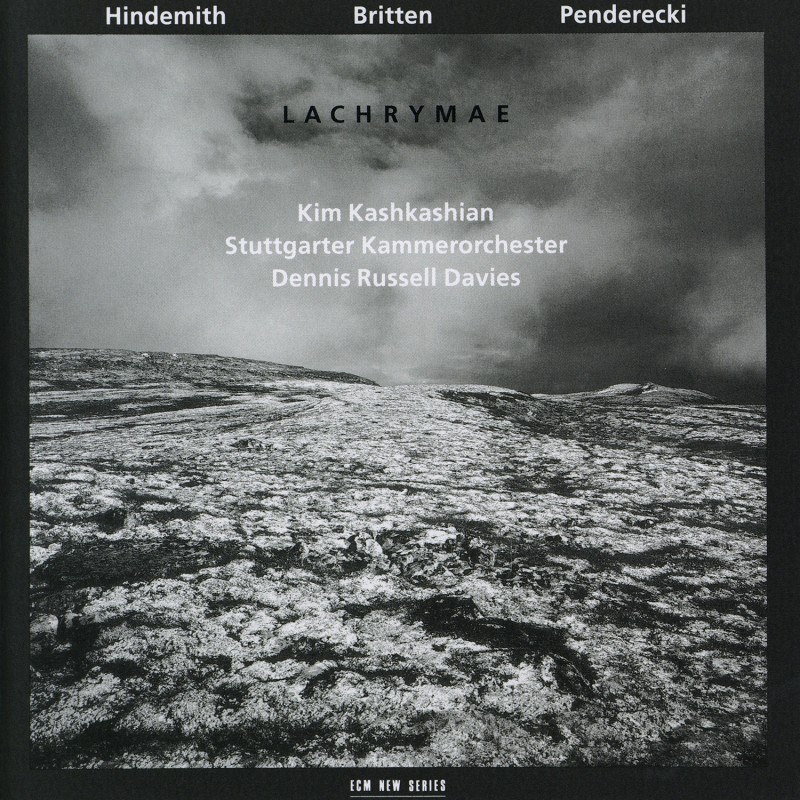
Kim Kashkashian / Stuttgarter Kammerorchester / Dennis Russell Davies LACHRYMAE

Lachrymae was my second exposure to the brilliance of violist Kim Kashkashian, after her ECM recording of Paul Hindemith’s viola sonatas. It has long been one of my favorites of hers, as its emotional and tonal complexities are high points of the New Series catalog. The program here is modest—consisting of only three pieces—but heavy. The opening strains of Hindemith’s Trauermusik paint a grave and darkening picture. Composed in a six-hour stretch of creative fervor in the afternoon following the death of King George V in 1936, the piece mourns the fall of the monarchical figurehead by describing a musical effigy in his place. Hindemith gave the premier performance that very evening in a special BBC live broadcast. And indeed, the music has that very quality: a lost message somehow regained and spread across the airwaves in a time of great sorrow.
The album’s title work comes from Benjamin Britten and is performed here in its glorious 1975 orchestrated version (for the earlier viola/piano version, check out Kashkashian’s Elegies, also on ECM). Britten has subtitled the work “Reflections on a Song of John Dowland,” thereby lending it a rather bold intertextual potency. And while it goes without saying that Kashkashian’s soloing is first rate here, the Stuttgart Chamber Orchestra casts an even more enchanting spell as it binds each motivic cell with fluid grace.
Which brings us to Krzysztof Penderecki’s Konzert für Viola und Kammerorchester. The result of a 1983 commission from the Venezuelan government in honor of freedom fighter Simón Bolívar, the concerto marks a distinct shift in the composer’s aesthetic of virtuosity. Much in contrast to the density of his earlier concertos, here Penderecki cultivates a more intimate sound palette. Yet none of the color his work is known for is lost. We still get a meticulously constructed object adorned with all manner of timbres and percussive details.
In my opinion, Lachrymae showcases some of the most powerful music written for the viola. And who better than Kashkashian to wring out every last tear from this trio of captivating scores? This music is wrought in sadness and refined through a nurturing touch from its composers and musicians alike. It is not the spirit made manifest, but the manifest made spirit. (ECM Reviews)

martes, 27 de junio de 2017

Kim Kashkashian / The Hilliard Ensemble / Dennis Russell Davies / Stuttgarter Kammerorchester GIYA KANCHELI Abii Ne Viderem

My first exposure to the music of Giya Kancheli, with which the composer once said, “I feel more as if I were filling a space that has been deserted,” was through Exil, which remains in my opinion the finest ECM New Series release to date. Much in contrast to the tearful beauty of that most significant chamber album, the orchestral arrangements on Abii ne viderem—drawn as they are from the same thematic sources—lend extroverted articulation to essentially “monastic” material. This music may speak the same language, but in a far more distant dialect. The Life without Christmas cycle, from which two pieces bookend the present recording, is central to the Kancheli oeuvre. Not only is it his wellspring, but it also comprises, it would seem, the overarching worldview under which he musically operates. It is the gloom of a life of displacement, the full embodiment of what Hans-Klaus Jungheinrich calls “measured gravity,” which may perhaps be likened to the heavy emptiness of Tarkovsky’s Stalker. As in said film, every gesture makes a footprint, a remnant of human presence left to sink into the submerged wasteland of a silent future.
Morning Prayers (1990) is immediately distinguished by an angelic boy soprano, whose taped voice is never fully grounded but which hovers throughout. The piano adds another haunting element, seeming to pull at the barbed ends of nostalgia even as it pushes the orchestra down a flight of descendent chords. Occasional violent moments startle us into self-awareness and only serve to underscore the power of the prayers that surround them. The most profoundly effective moment occurs when the piano echoes in a dance-like theme, the orchestral accompaniment slightly off center—a distant memory ravaged by time and circumstance.
The title of the album’s central piece, Abii ne viderem (1992/94), translates to “I turned away so as not to see.” The more one listens to it, the question becomes not what is being turned away from but what is being observed upon turning. Its paced staccato bursts are linked by a profound silence, escalating with every reiteration. This silence eventually opens into a full orchestral statement, italicized again by the piano’s audible pulse. We find ourselves caught in the middle of a larger web of sentiments, until we can no longer see ourselves for who we are but only for who we have been. Personally, I find this piece to be a touch overbearing, if only because the import of its ideas is easily crushed by the heft of its dynamic spread.
The presence of the Hilliard Ensemble rescues Evening Prayers (1991) from the didacticism of its predecessor. It is a more fully unified narrative, linked by a lingering alto flute. A gorgeous “ascension” passage marks a rare contrapuntal moment for Kancheli, while David James’s voice creates magic, ever so subtly offset by a skittering violin. Occasional bursts, some punctuated by snare drum, break the mood and ensure that our attention is held. Inevitably, the piece ends like a ship sailing into a foggy ocean, leaving behind only a blank map to show for our travels.
Don’t let any comparisons to Arvo Pärt lure you astray. Kancheli’s music, while transcendent, cannot be divorced from its rootedness in upheaval. And while this album may be filled with beautiful moments, I cannot help but feel that something gets elided in these grander arrangements. I say this with the gentlest of criticisms, and perhaps only because my first foray into this world was on such a small scale. The sound of Exil stays with me, and sometimes I just cannot hear it in any other context, and for those wishing to hear this composer for the first time I would recommend starting there. That being said, the scale of these pieces makes them no less evocative for all their historical understatements and sensitivity. And perhaps that is Kancheli’s underlying observation: that, in our current climate of convalescent ideologies, all we have to hold on to are those rare flashes of fire in which our communion with something greater has transcended the rising waters of sociopolitical corruption. (ECM Reviews)

martes, 18 de abril de 2017

Dennis Russell Davies / Stuttgarter Kammerorchester SHOSTAKOVICH - VASKS - SCHNITTKE

Russell Davies, who really feels his Eastern Europeans, contrasts Shostakovich's lament for Dresden and humanity with Yuri Bashmet's sensitive arrangement of Schnittke's elegiac String Trio and introduces us to a powerfully moving piece by Latvian Vasks ­ Musica dolorosa. It's a pre-glasnost work whose tonal dramas linger long in the mind. Benefiting from charismatically brilliant playing, poetic phrasing and spiritiually involving bass resonances, this is an anthology not to be missed.' (Alex Orga, BBC Music Magazine) 

'The lamenting climaxes of the Vasks make an unforgettable impression here, and the link with Shostakovich is even more pertinent in the Schnittke where memories of music of the distant past (Russian chant, Schubert, Mahler) are paraded before the listener like shadows in the night. Throughout the three works, the Stuttgart Chamber Orchestra deliver highly charged performances, and the recording balances warmth of tone with admirable clarity of detail.' (Erik Levi, Classic CD)

'Among recent releases from ECM, the stunning label that records the works of Pärt and others, is Dolorosa, a collection of three works by 20th century dissident composers from the former Soviet Union. These works are profoundly moving testaments to the power of the human spirit to resist oppression. Vasks' title cut, and the recording's centrepiece, was written to both express and 'console' the suffering of the Latvian people. Admittedly bleak, at times very dramatic, it is also gorgeous ­ a near-perfect expression from a 'saddened optimist' searching for a way out of the crisis of his time, towards affirmation, towards faith. Music grounded in the mire of real life that can lift the soul toward the transcendent.' (Dwight Ozard, Prism) 

martes, 5 de enero de 2016

Olga Scheps / Stuttgarter Kammerorchester / Matthias Foremny CHOPIN Piano Concertos

Along with the Stuttgart Chamber Orchestra under the direction of Matthias Formeny Olga Scheps creates a harmonious and complex atmosphere, as it could be possible possible with a small orchestra.The accompaniment by the small ensemble condenses the effect of the piano and flatters without degenerating into decorative padding, as it is often heard in the criticism of the orchestration.
But the biggest compliment deserves Olga Scheps.She fully lives up to a Standard as superb Chopin performer with this recording, which was created in Stuttgart SWR Radio Studios. Her tone clear and sparkling in this highly romantic oeuvre, of which the second one especially, which was created erlier to the E minor Concerto, however is notorious for his technically intricate passages. 
She copes all tripping hazards with pianistic finesse and concentrates fully on the introspection of this voluptuous dreamy work. With its lightweight, vocal tone she satifies the audience with the introverted passages as well as with the dance driven ones. And then she follows the final traces of the third set with a noble virtuosity rather than crude sensationalism of impetuous passion of the young Chopin, who has already published this concert at the age of 19, in the seemingly endless runs, she visualizes her obviously great performance as a Chopin interpreter. (Birgit Schlinger)

viernes, 17 de julio de 2015

Stuttgarter Kammerorchester / Dennis Russell Davies WITOLD LUTOSLAWSKI - BÉLA BÁRTOK Musique Funèbre

Conductor Dennis Russell Davies leads the Stuttgart Chamber Orchestra in a program of music by, and dedicated to, Béla Bartók. The disc opens in the latter vein with Witold Lutosławski’s Musique funèbre, composed between 1954 and 1958 for the 10th anniversary of Bartók’s death. The title, often erroneously translated as “Funeral music,” is better rendered as “Music of mourning,” and connotes homage to one of Lutosławski’s greatest inspirations, if not the greatest, for he never dedicated a work to another composer. Although the piece’s overarching development resembles Bartók’s Music for Strings, Percussion and Celesta, the opening cellos closely prefigure the robust, overlapping memorial of Henryk Górecki’s Symphony No. 3, even if they do chart a vastly different geography, from collective to individual landing. That initial feeling of density and weight gives way to a dark airiness. Motives bend and sway—at moments pliant, at others sharply angled. Darting violins bring us closer to a sense of inner turmoil and bold reckoning. The Bartókian flavor is clear yet faged, and falls back where it began: in the solemn cellos. Ashes to ashes.
As Wolfgang Sandner observes in this album’s liner notes, for Bartók the music of Hungary’s peasants “was the source of a radical new musical system, not material for reverting to a nostalgic transfiguration of the original sounds.” In light of this, we might reckon his Romanian Folk Dances of 1917 not as an archival storehouse but, more like Estonian composer Veljo Tormis’s choral arrangements, as an experiment made fresh by extant impulses. While for me the reference recording by Midori and Robert McDonald (1992, Sony Classical) gets to the core of the music in ways I’ve not since heard, the Stuttgarters’ soaring performance of this 1937 arrangement for string orchestra by Arthur Willner articulates the orbits of its moons with surprising precision. A delicate piece of nevertheless sweeping proportions, it moves by a hand unseen. The solo violin stands out like a red rose among a field of black, its changes organic, even a touch mournful, in the present setting. As the mosaic evolves, it gives light to the translucent cells of its becoming. The flute-like strings in the enlivening finale give us reason to rejoice in the shadows.
So, too, does the Divertimento. Composed 1939 in dedication to Paul Sacher (who commissioned the work) and the Basler Kammerorchester, it achieves novel balance of spiritedness and restraint under Davies’s direction. Its unmistakable beginning lures with its insistent rhythm but would just as soon fragment into multiple galaxies of melodic thought. There is a smoothness of execution in the tutti passages and a paper-thin delicacy to the solo strings. While one might expect that energy to be sustained, it waxes and wanes in a most natural, thought-out-loud sort of way that lends especial insight into Bartók’s compositional process. The second movement proceeds slowly at first, but then, with the coming of dawn, stretches its gravity. The lower and higher strings forge an implicit harmony, an acknowledgment of the invisible forces connecting them both. The contrast between double basses and violins is one not of tone but of purpose: the lowers an unstable fundament, the uppers a firmament in turmoil. This chaos they share as if it were blood. The final movement returns the promise of that dance with wit. There are, of course, intensely lyrical and slow-moving parts, with the violin carving surface relief, but always returning with that whirlwind of fire.
In the wake of this dynamism, selections from Bartók’s 27 Two- and Three-Part Choruses (1935-41) come as something of a breather. They are not adaptations of folksongs, but were composed in such a style at the behest of Zoltán Kodály. With evocative titles like “Wandering,” “Bread-baking,” and “Jeering,” each is a vignette of imagined life. A snare drum pops its way through the choral textures, by turns martial and lyrical, adding colors of interest throughout. And while these pieces hardly hold a candle to his a capella choruses (the orchestral writing feels at points superfluous), they provide welcome contrast to the veils that precede it with gift of vision.

martes, 19 de mayo de 2015

Keith Jarrett / Dennis Russell Davies MOZART Piano Concertos K. 467, 488, 595 - Masonic Funeral Music K. 477 - Symphony in G minor K. 550

Keith Jarrett evidently has carte blanche to do anything he wants at Manfred Eicher's ECM label -- and thus encouraged, he takes ample risks in a field that is swamped with able and formidable competitors. Mozart's piano concertos may be relatively easy to play but they are notoriously hard to interpret -- that's where the true music-making comes in -- and brave intentions aside, Jarrett cannot do very much with this music beyond playing the notes accurately and cleanly. He brings nearly nothing of his own to the "Concerto No. 23"; much of it is precious and monochromatic, though he finally does generate some animation in the "Finale." Jarrett's tempo for the opening movement of the "Concerto No. 27" isn't out of line, it just seems much slower than it actually is due to his stolid, doggedly literal playing; the larghetto is actually a bit fast, and the rondo lacks point and wit. The adagio movement of the "Concerto No. 21" has the tune that became famous after being used in the film Elvira Madigan yet Jarrett resists poetry of any kind, pounding out the chords in the left hand stiffly. Next to Artur Schnabel's old yet still-treasurable recordings of pointed, imaginative eloquence -- or Daniel Barenboim's renderings of expression and depth -- Jarrett is simply a non-starter in numbers 21 and 27. Another problem is the way Jarrett's piano is miked; it sounds distant, with little in the way of dynamic contrast, surrounded with a slight halo of reverb. One wonders if the engineering is actually fighting Jarrett's sporadic attempts to characterize the music. Dennis Russell Davies and the Stuttgart Chamber Orchestra come off somewhat better in the deal, with streamlined, flowing, somewhat soft-focused introductions influenced ever so slightly by period-instrument bowing practices that became prevalent in the late 20th century. But at least they use modern instruments, for which many now turned off by grating period-instrument recordings should be thankful. The two-CD set is filled out by Davies leading sturdy, moderately paced, very well-played performances of Mozart's magnificent "Symphony No. 40" and the dolorous "Masonic Funeral Music." (Richard S. Ginell)

martes, 10 de febrero de 2015

GIYA KANCHELI Diplipito

“If you can imagine a flower that makes its way through asphalt, that’s exactly what you find in my compositions. In my works I’m always trying to get the flower through the asphalt.”
Giya Kancheli

The present disc features premiere recordings made – as has been the case with all of Kancheli’s ECM recordings – with the participation of the composer. “Valse Boston”, written in 1996, bears two dedications, one to its conductor and pianist Dennis Russell Davies, the other to the composer’s wife (“with whom I have never danced”). If Kancheli has made a point of avoiding the dancefloor he has created a piece that moves uniquely, if not in ¾ time, and makes sometimes devastating use of the abrupt dynamic contrasts that have become almost a trademark. Hans-Klaus Jungheinrich in the liner notes:
“The metaphor of ‘dancing’ should be interpreted less as a profound than as an ironic comment – but it is also an allusion to the vast distance that separates Kancheli’s music from the apotheosis or demonic fury of the dance. The Boston Waltz is generally associated with the louche, slightly faded realm of urbane entertainment; for Kancheli this is at most a ‘distant echo’ buried beneath the rubble of the ages.” Kancheli has, however, said that he was inspired, in writing this piece, by the visual image of Davies conducting this piece from the piano stool, half standing, gesturing with a free arm or nods of the head while playing; this was also a dance of sorts. Jungheinrich: “Three-quarter time is never used as the vehicle, elixir and essence of dance-like energy. What does occur at the beginning is a slow triplet movement; but instead of introducing spirited movement, the consistently gentle sonorities retain a heavy, clinging, glutinous quality. The first violins seem to want to counter the persistent, grinding slowness of the tempo with their own abandoned song, a mercurial line in the highest register.”
Davies and the Stuttgart Chamber Orchestra have included “Valse Boston” in their touring programmes on both sides of the Atlantic. The Chicago Tribune wrote, “Don't let the innocuous title fool you: Giya Kancheli's ‘Valse Boston’ is a powder keg of a piece. It is a secular prayer veering between extremes of dynamics, tempo and mood. One moment the piano is goading the strings to produce angry, stabbing dissonances. The next moment, it is quieting the orchestra with tiny fragments of waltz-time, deceptively merry. Nobody conjures troubled landscapes in sound like Kancheli. He has given us a bleak, very Eastern view of modern existence, but the effect is cleansing.”
“Diplipito, written in 1997, is named for the little, high-tuned Georgian drums – in the range of the darbouka or the bongos – that are frequently used to accompany dancing. And the percussive syllables that Kancheli gives to American countertenor Derek Lee Ragin are a kind of concrete poetry inspired by the drum’s rhythm patterns. Giya Kancheli was greatly impressed by Ragin in 1999 when he sang the world première of the composer’s “And farewell goes out sighing”, alongside Gidon Kremer with the New York Philharmonic Orchestra under Kurt Masur and the countertenor was an essential choice for the recording of “Diplipito”, where he is partnered with Thomas Demenga. Ragin makes his New Series debut here while Demenga has been a mainstay of the label since its inauguration.
Jungheinrich: “The vocal part in ‘Diplipito’ finds an equal partner in the solo cello. The orchestra rarely play tutti, there are no winds or brass at all, and the guitar, piano and percussion come in individually, functioning alternately as solo and secondary presences. The terse, tentative figures in the cello contrast with the cluster-like chords typifying the piano line. For long stretches, the sonic space is chromatically measured – often in small, careful interval steps…. The mood of tranquillity, even latent immobility, that dominates the first half of the piece is suspended by the entry of a vigorous ornamental figure on the guitar (which is immediately picked up by the cello), followed by several explosive fortissimo passages. The soft murmur of a bongo rhythm increases the restlessness. This is the preparation for the final phase, the disembodiment of sonic materiality.”  (ECM Records)