
Mostrando entradas con la etiqueta Jan Lisiecki. Mostrar todas las entradas
Mostrando entradas con la etiqueta Jan Lisiecki. Mostrar todas las entradas
sábado, 14 de agosto de 2021

martes, 24 de marzo de 2020

miércoles, 18 de septiembre de 2019
Jan Lisiecki / Academy of St Martin in the Fields BEETHOVEN Complete Piano Concertos

Getting a head start on the impending Beethoven 2020 festivities, Canada's Jan Lisiecki has today surprised us with Beethoven: Complete Piano Concertos, his fifth album for the Deutsche Grammophon label.
The three-CD set was recorded in December 2018 at Berlin's
Konzerthaus, one of the stops on Lisiecki's tour with the Academy of St.
Martin in the Fields, when he was filling in for an indisposed Murray
Perahia.
"The substitution for Murray Perahia was presented to
me as a proposal to play any two Beethoven concertos," Lisiecki
explained to CBC Music recently. "When I understood the concept of the
tour, I requested that if I am indeed to substitute, the original
structure would be upheld and I would play all five concertos on tour
and in Berlin."
The recording, produced in a matter of a few days, was quickly chosen by Lisiecki's label, Deutsche Grammophon, to launch its Beethoven 2020 rollout. "The recording is entirely live, we could only record the rehearsal and the concert; no touch-up sessions were available. The final result, I hope, is a reflection of a very successful and dynamic live cycle of these concertos."
As with his February 2019 Mendelssohn release
with the Orpheus Chamber Orchestra, for this set of Beethoven
concertos Lisiecki and the Academy of St. Martin in the Fields performed
without a conductor.
"I love working with a conductor, and I also thoroughly enjoy
working directly with the orchestra musicians," he notes. "The vigour,
the focus, the musicianship are all heightened by the direct contact
between the musicians and the soloist, and we do everything as one. It
is often said that all orchestral performances are an enlarged form of
chamber music, but I think this holds true especially in such a
compressed setting."
jueves, 31 de enero de 2019
Jan Lisiecki / Orpheus Chamber Orchestra MENDELSSOHN
 Despite his youth, twenty-three-year-old Canadian pianist Jan
Lisiecki has already built up a long list of achievements. Having
skipped four grades, he graduated from high school at the age of
fifteen. He began performing in public as a child, recorded his first
album as a teenager, and made his Carnegie Hall debut in 2016, when he
was still only twenty.
Felix Mendelssohn was a year younger than Lisiecki is now when he
wrote his First Piano Concerto in G minor; the work was dedicated to the
seventeen-year-old pianist Delphine von Schauroth, then the object of
the young composer’s affection. Cast in three movements, it is a lively,
spirited work, at times requiring lightning-quick playing. Lisiecki
finds it remarkable that the concerto begins as if “in the middle of a
piece”, and particularly appreciates the buoyancy of this early work –
he thinks of it as like “a nature trip” and notes that its “lightness of
touch ... reminds [him] very much of playing Mozart”.
Lisiecki sees the Second Piano Concerto in D minor, which Mendelssohn
wrote immediately after his honeymoon in 1837, as providing a certain
contrast with the First. “The Second Concerto has darker and deeper
emotions,” he says. “It’s less secure, it’s uncertain, it’s not so
confident, it’s searching.” He adds that it reminds him in some ways of
Schumann, with its “rapid emotional changes and unprepared character
swings”. He found it the more challenging of the two to record, not only
because of its shifting moods, but also because of the intricacies of
its orchestral accompaniment – as he points out, compared to the First
Concerto, in the Second there is “more dialogue between the piano and
the individual instruments”.
He chose to record the concertos with one of the world’s leading
chamber ensembles, the Orpheus Chamber Orchestra. This elite group of
players from New York are unusual in that they rehearse and perform
without a conductor. “Everybody was involved in the musical process,”
explains Lisiecki. “That was quite amazing to see. Usually it’s the
conductor and I who are listening, but here you have a group of twenty
people all listening to what was just done and hearing for themselves
what they will change. That was a different experience.”
Lisiecki is opposed to the idea of albums that are essentially
“collages” of the works in his repertoire, preferring to bring together
works that complement one another programmatically or in terms of their
character. On this occasion he has chosen to complement the two
concertos with three of Mendelssohn’s finest works for the solo
instrument: the Variations sérieuses, the Rondo capriccioso and the “Venetian Boat Song” (Venetianisches Gondellied) from the Lieder ohne Worte.
All three are works that mean a great deal to Lisiecki, and he was
delighted to be able to include them on this album and give listeners
further insight into the composer’s dazzling keyboard writing. (Deutsche Grammophon)
sábado, 11 de marzo de 2017
Jan Lisiecki CHOPIN Works for Piano & Orchestra
 I think Chopin felt the most comfortable writing for the piano, though it was not necessarily his favorite instrument. He was simply able to use it to its full potential and to express everything that he imagined in his mind. In many ways his writing for piano and orchestra is just and extension of that. It’s not symphonic writing. It’s not writing that uses the full potential of the orchestra. It’s his imagination for the piano enlarged by the writing with orchestra. It adds colors to the piano. We are given endless possibilities already at our instrument. But Chopin uses the capabilities of the winds and the strings, their richness, their sound quality to add to the piano’s possibilities and color palette. It’s a gift that he gave us with these orchestral pieces.
In a Mozart or Beethoven piano concerto if you removed the orchestra and told the pianist to play their part alone you’d be left with a bare bones structure. There would be some beautiful themes, some beautiful moments, and then there would be these very dull and uninspiring passages because you would be missing the core of the work. Now in Chopin if you take away the orchestra for the most part you would still end up with a fully-fledged and well-developed work. When the orchestra comes in it adds something- another layer- not instead of the piano, not in place of one of the piano themes or capabilities, but yet another relayer, and more beauty. (Jan Lisiecki)
viernes, 8 de enero de 2016
Jan Lisiecki / Orchestra dell'Accademia Nazionale di Santa Cecilia / Antonio Pappano SCHUMANN

Jan Lisiecki turns to the music of Robert Schumann for his third
Deutsche Grammophon album. The 20-year-old Canadian pianist presents
strikingly mature and imaginative interpretations of the composer’s
complete concertante works for piano and orchestra. Jan Lisiecki: Schumann – Works for Piano and Orchestra,
set for international release on 8 January 2016, opens with the
evergreen Piano Concerto in A minor op. 54. It also contains the Introduction and Allegro appassionato op. 92, Träumerei op. 15 no. 7 and the rarely heard Introduction and Allegro
op. 134, the latter entering the DG catalogue for the first time in the
yellow label’s 117-year history. Lisiecki is partnered by the Orchestra
dell’Accademia Nazionale di Santa Cecilia and Sir Antonio Pappano, with
whom he made his debut at the 2013 BBC Proms in Schumann’s Piano
Concerto. “This proved to be a performance of extraordinary
accomplishment,” noted the Guardian at the time.
Jan Lisiecki’s personal vision of Schumann’s poetic works has evolved
over several years, backed by meticulous preparation and deep immersion
in the music. His approach to the Piano Concerto and the other
concertante works has also gained from Antonio Pappano’s guidance and
encouragement. The album reflects the rapport shared by soloist,
orchestra and conductor. Recorded in September 2015 under studio
conditions in Rome, it renewed a musical relationship forged three years
earlier when Lisiecki, then aged 17, performed Schumann’s Piano Concerto with Pappano and his Santa Cecilia forces during a five-concert
European tour in which he alternated as soloist with Martha Argerich.
“These
pieces demand an incredibly close collaboration in order to accomplish
what Schumann desired,” comments Lisiecki. “I believe the sound of the
Santa Cecilia Orchestra matches mine in the best possible way.” The
Piano Concerto and other concertante works, he adds, are concerned above
all with subtle shades of expression and intimate dialogue between
soloist and orchestra. “Of course the Piano Concerto is virtuosic. But
it’s virtuosic in a way that’s in the background, and that’s what speaks
to me.”
Antonio Pappano, himself an accomplished pianist and
tireless supporter of young musicians, recalls his first experience of
hearing Lisiecki’s pianism. “I’ll admit that I was overwhelmed with envy
when I first heard Jan play. What is so refreshing is that there are no
fake layers of age added on – just youth,” he notes. “We’ve now worked
together many times and this Schumann project provided a perfect
opportunity to work on two pieces that are so rarely heard in concert,
as well as to revisit a concerto that is a shared favourite.”
Jan
Lisiecki’s previous releases as an exclusive Deutsche Grammophon
artist, comprising piano concertos by Mozart and Chopin’s Études opp. 10
& 25, have attracted critical acclaim and strong international
sales. In 2013 he received the Leonard Bernstein Award at the
Schleswig-Holstein Music Festival and was also named as Gramophone’s “Young Artist of the Year”.
The
pianist’s forthcoming engagements include two tours of the United
States this January, the first with the Toronto Symphony Orchestra and
Peter Oundjian, the second with the Philadelphia Orchestra and Yannick
Nézet-Séguin. During the latter Lisiecki will make his debut in the main
auditorium at New York’s Carnegie Hall, performing Beethoven’s Piano
Concerto No.4. His schedule for the remainder of the 2015/16 season also
includes an extensive tour of Germany and Switzerland with the Zurich
Chamber Orchestra, and concerto performances with the Cleveland
Orchestra and San Francisco Symphony Orchestra. (Deutsche Grammophon)
lunes, 4 de enero de 2016
Jan Lisiecki / Christian Zacharias / Symphonieorchester des Bayerischen Rundfunks MOZART Piano Concertos Nos. 20 & 21
 The Deutsche Grammophon label has offered a series of teenage prodigies, not all of whom have lived up to their billing. This release by Polish-born Canadian pianist Jan Lisiecki, just 17 and looking not entirely unlike Justin Bieber, may make a bigger splash than most. You might guess from the sheer daring of the interpretations, especially that of the Piano Concerto No. 20 in D minor, K. 466, that you were dealing with extreme youth here, but no insufficiency of technique or tone gives it away. The Piano Concerto No. 20 is really impressive. Lisiecki and conductor Christian Zacharias, leading the Bavarian Radio Symphony Orchestra, set out to create a real old-school recording of this most stormy of Mozart's concertos, and they succeed in forging something that's quite detailed and coherently worked out. It might also be called over the top, but that's something to be decided by the individual listener Lisiecki deploys a big sound, and he and Zacharias add on tempo variations, ornaments, and sudden dramatic gestures, topping the whole thing off with Beethoven's underutilized cadenza for the first movement. It's sort of as if one of the big Russian-schooled pianists of the middle part of the last century had decided to record the work with Leopold Stokowski as conductor, and Zacharias' contribution is key: he ruffles the orchestra's strings into spiky little attacks. In the Piano Concerto No. 21 in C major, K. 467, they are not quite as distinctive, but the breadth and control of Lisiecki's playing is nevertheless impressive, and in a world in which young students are disinclined to take chances he deserves all kinds of credit. (James Manheim)
sábado, 16 de noviembre de 2013
Jan Lisiecki CHOPIN Études
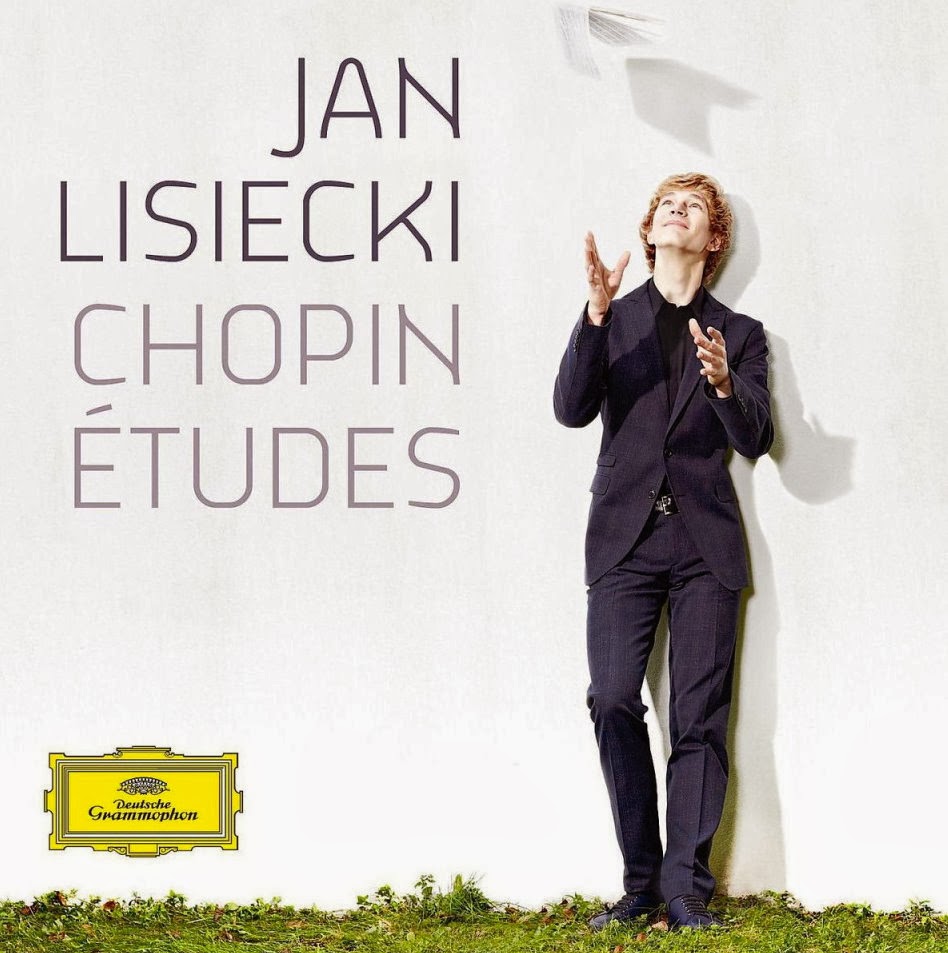 Young pianist Jan Lisiecki has been studying at the Glenn Gould School of Music in Toronto and it seems the Canadian genius’s flair and sense of adventure has rubbed off on the 18-year-old.
When Deutsche Grammophon decided to record Chopin’s Études as a follow-up to his debut album of Mozart’s Piano Concertos Nos 20 and 21, the Calgary-born youngster felt firmly on home ground. He had already recorded Chopin’s Piano Concertos in F and E Minor in Poland for the Fryderyk Chopin Institute and has a natural affinity for the music. What showed Gould-like daring however was his decision to do each of the 24 pieces in one take. Not only that but he would warm up before each take by playing something completely different – a Bach Goldberg Variation or a little Messiaen. “That would change the mood, in the same way as a different piece would in a live performance,” Lisiecki says. This latest disc shows why he was so quickly snapped up by the German label. Lisiecki’s touch is light and fluid, much like Chopin’s was reported to be by his contemporaries. He manages a mysterious, distant feel in the Op 10, No 6, but still with a subtle sense of yearning. But the young Canadian muscles up for the many stormy challenges, registering a thrilling defiance in the so- called Revolutionary which closes the Op 10 set with four defiant chords, and chilling us to the bone in the Winter Wind Étude.
The lovely Cello Étude (Op 25, No 7), the longest of the works, is played with beautiful balance. Sometimes described as a conversation between two lovers – with the male left hand getting all the best lines – Lisiecki brings out the mini-drama which plays out in just under six minutes: the love, the raised voices and then the consoling embrace.
The listener is very much ‘in the moment’ as this glorious slideshow of works rolls out with a superb sense of freshness under Lisiecki’s fingers. First class.
(Copyright © Limelight Magazine. All rights reserved)
Suscribirse a:
Entradas (Atom)

-
Music Is The Key will be closing soon. Over the last year maintaining this site and keeping it up to date has become an expensive and tim...

