
Mostrando entradas con la etiqueta London Philharmonic Orchestra. Mostrar todas las entradas
Mostrando entradas con la etiqueta London Philharmonic Orchestra. Mostrar todas las entradas
lunes, 5 de abril de 2021

martes, 8 de diciembre de 2020

viernes, 20 de noviembre de 2020

miércoles, 10 de junio de 2020

domingo, 17 de mayo de 2020

lunes, 21 de octubre de 2019
George Li TCHAIKOVSKY Piano Concerto No. 1 LISZT Solo Piano Works

George Li gained international attention in 2015 when he won the silver
medal in the International Tchaikovsky Competition in Moscow. Now he has
recorded one of Tchaikovsky’s greatest and best-loved works, the Piano
Concerto No 1 with the London Philharmonic Orchestra and conductor
Vasily Petrenko. The New York Times has called him a “real revelation”
in the work. It is complemented by three solo pieces by Liszt, a
composer who featured on his debut Warner Classics recital, judged “a
winner” by International Piano magazine.
lunes, 20 de mayo de 2019
Michael Fabiano / London Philharmonic Orchestra / Enrique Mazzola VERDI - DONIZETTI

American star tenor Michael Fabiano presents a spectacular set of
scenes taken from late Donizetti and middle Verdi operas, revealing the
strong ties between these two composers. The album documents a
paradigmatic shift in Italian opera, from the beautiful lines and
crispness of belcanto to a richer, more dramatic musical universe. The
historical line stretches from Donizetti’s Lucia di Lammermoor, Poliuto
and Maria di Rohan to mature Verdi operas such as Rigoletto, Un ballo in
maschera and Don Carlos. In many cases, Fabiano has selected original,
rarely-heard versions, including the thunderous ‘Qual sangue sparsi’
from the original St. Petersburg edition of La forza del destino.
Together, these arias and scenes constitute a world full of heartfelt
tenderness and fire-laden drama. After numerous successes on the opera
stage, this is Michael Fabiano’s debut album on PENTATONE.
viernes, 22 de marzo de 2019
London Philharmonic Orchestra / Vladimir Jurowski RACHMANINOFF The Isle of the Dead - Symphony No. 1
 Recorded live at Southbank Centre’s Royal Festival Hall, London on 3
October 2014 (The Isle of the Dead) and 14 December 2016 (Symphony No.
1).
Recorded live at Southbank Centre’s Royal Festival Hall, London on 3
October 2014 (The Isle of the Dead) and 14 December 2016 (Symphony No.
1).
“Jurowski drove The Isle of the Dead forward... drawing exceptional intensity from the LPO.” - The Guardian, 2014
The performance of The Isle of the Dead was widely critically
acclaimed. Bachtrack noted Vladimir Jurowski’s “hypnotic” conducting,
noting particularly that “the clarity and control he exercised in [The
Isle of the Dead] were very fine. He drew a sonorous cello sound, later
matched by lower woodwinds, and the harp and pizzicato strings...
brought an eerie chill to the Festival Hall.”
Rachmaninoff’s youthful Symphony No. 1 is not frequently performed or
recorded. This is the first time it has been released on the label.
This is the second recording of The Isle of the Dead on the LPO’s own
label. It was recorded live as part of the opening concert of the
London Philharmonic Orchestra’s highly praised 2014-15 season
Rachmaninoff: Inside Out, which explored the life and works of the
composer.
Symphony No. 1 was also recorded live in concert. The Financial Times
described the performance as “a fascinating experience” and Colin
Anderson, in Classical Source, noted “The LPO was in superb form.”
London Philharmonic Orchestra / Kurt Masur BEETHOVEN Symphonies 3 & 5

Recorded live at Southbank Centre’s Royal Festival Hall, London on 24
November 2004 (Symphony No. 3) and 27 November 2004 (Symphony No. 5).
This recording features former Principal Conductor of the London
Philharmonic Orchestra Kurt Masur, who conducted more than 150
performances in London and internationally during his tenure.
Masur inaugurated the launch of the LPO’s own label in 2005 with live performances of Shostakovich’s Symphonies Nos. 1 and 5.
Kurt Masur was renowned for conducting Beethoven with insight and
cohesion; these concert performances were conducted from memory. He
sadly passed away in December 2015; this captivating pair of concert
recordings from 2004 pays tribute to his musical legacy.
The concert performances of these symphonies were praised at the
time. The Daily Telegraph said of the Fifth Symphony “it was the joyous
conclusion of the Fifth, with all Beethoven’s guns blazing, that left
the packed audience in a euphoric mood… Masur shaped the whole symphonic
drama... with the hands of a master.” - The Daily Telegraph
lunes, 31 de diciembre de 2018
ACCARDO PLAYS PAGANINI - COMPLETE RECORDINGS

6CDs presenting Salvatore Accardo's legendary
Paganini cycle for Deutsche Grammophon, including the complete violin
concertos recorded with Charles Dutoit and the London Philharmonic
Orchestra.
Noted for his exquisite, beautiful playing and a technical wizardry
carried off with disarming nonchalance, Accardo is most readily
associated with Paganini – though technical wizardry for its own sake
holds little fascination for him: "Of course for young violinists it is
always a challenge to be able to play the 24 Caprices, but as I got
older I understood that what was important in his music was its almost
operatic qualities."
jueves, 6 de diciembre de 2018
Christian Svarfvar BRUCH - STENHAMMAR

Christian Svarfvar has emerged as one of Scandinavia's most sought after
concert violinists. His 2013 debut album on Sterling Records was
praised by the Financial Times who insisted, ''we must hear more from
him.'' Svarfar has worked with the Royal Stockholm Philharmonic, London
Philharmonic Orchestra, Simon Bolivar Orchestra, Borusan Istanbul
Philharmonic Orchestra and Swedish Radio Symphony Orchestra. He has
collaborated on chamber projects with contemporary composers including
Steve Reich, Kaija Saariaho, Howard Shore and Anders Hillborg. On his
first album for Rubicon, Svarfar features one of the best loved of all
19th century concertos, Max Bruch's evergreen Violin Concerto No.1.
Wilhelm Stenhammar's warmly romantic Violin Sonata and Sentimental
Romances complete the recording.
lunes, 10 de septiembre de 2018
Ray Chen THE GOLDEN AGE
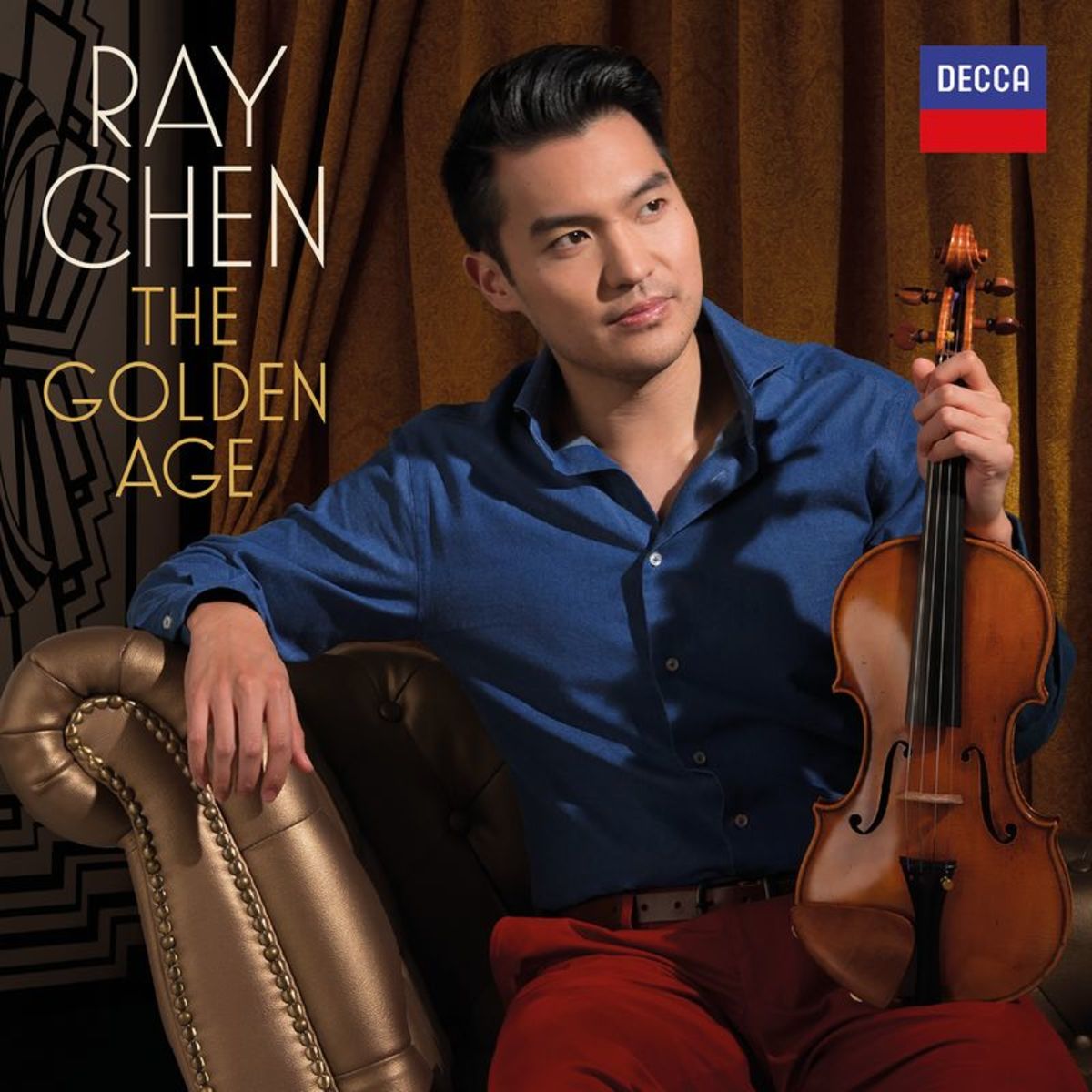
Recognized as a musician of “phenomenal talent” by The Washington Post,
Chen has handpicked a selection of works for his new album which
celebrates the ‘golden age’ of the violin – not only in terms of
repertoire, but also in performance style and ingenuity. The centrepiece
is Max Bruch’s Violin Concerto which was recorded in August last year
with the London Philharmonic Orchestra and conductor Robert Trevino.
The album opens with a piece for string quartet which has already
garnered over 50,000 hits on Chen’s YouTube channel. Titled, “A New
Satiesfaction”, it features “Gymnopédie No.1” by Erik Satie with an
allusion to Rossini’s “William Tell Overture”. Performed by Chen and his
Made in Berlin quartet, the arrangement of “A New Satiesfaction” is
done by the group’s cellist, Stephan Koncz. The other violinist in the
quartet is Noah Bendix-Balgley while Amihai Grosz plays viola. All of
Chen’s collaborators in the group are members of the Berlin Philharmonic
and they recorded together in the city last November.
The album also features compositions and arrangements by such
legendary violinists as Fritz Kreisler and Jascha Heifetz, which Chen
performs with pianist Julien Quentin. Among them are Kreisler’s
“Syncopation and Schön Rosmarin” and Cyril Scott’s “Lotus Land”, plus
Heifetz’s transcriptions of “Estrellita” by Manuel Ponce and George
Gershwin’s “Summertime”. Stephan Koncz has also arranged Debussy’s Clair de lune and the traditional Australian favourite “Waltzing Matilda” (Ray hails from Australia and Taiwan).
Chen teased The Golden Age with a custom-built computer game: http://umusic.digital/goldenviolin/.
“This album acknowledges the various styles of the past, but also
retains one important philosophy: as long as we keep inspiring and
producing, perhaps what we create now will one day be deemed worthy of
being named a golden age,” says Chen.
Chen is among the most compelling young violinists today. He has
performed with many of the world’s leading musicians in concert halls
across the globe and he has also amassed a huge online following
(including more than 2 million fans on SoundCloud) through quirky,
self-made videos and engaging social media posts.
sábado, 21 de abril de 2018
David Aaron Carpenter / London Philharmonic Orchestra MOTHERLAND

For his second Warner Classics album, David Aaron Carpenter - "a star
violist" in the words of the Los Angeles Times - brings together
concertos by Dvořák, Bartók, Walton and a dance cycle by contemporary
composer Alexey Shor. Carpenter identifies a connecting theme of "a
longing for the homeland … a reverence for native musical folk tunes and language." He is accompanied by the London Philharmonic Orchestra under
three distinguished conductors: Kazushi Ono, Vladimir Jurowski and
David Parry.
martes, 13 de febrero de 2018
Leticia Moreno / Andrés Orozco-Estrada / London Philharmonic Orchestra PIAZZOLLA
 Piazzolla is a journey through the musical universe of one of the most genuine and fascinating composers of the twentieth century.
Together with the London Philharmonic Orchestra under the
baton of Andrés Orozco-Estrada and his quintet (Remy van Kesteren, Pablo
Mainetti, José Gallardo and Janne Saksala), Moreno explores Piazzolla's
endless sound possibilities and offers a vital and renewed vision of
his most emblematic works.
Piazzolla is the third album by the violinist for Deutsche Grammophon; a recording that pays homage to the composer on the 25th
anniversary of his death and a project that Moreno will perform live in
the best concert halls in Europe, the United States and Asia during the
2017/18 and 2018/19 seasons.
The studio album was recorded at the legendary Abbey Road
Studios (London) and Meistersaal (Berlin). Forthcoming concert
highlights include the premiere of J. López-Aurora’s Violin Concerto
with Houston Symphony as well as a tour with St Petersburg Philharmonic
Orchestra and Yuri Temirkanov in Rimini.
domingo, 23 de julio de 2017
London Philharmonic Orchestra / Neeme Järvi DVORÁK Stabat Mater

Dvorak - Stabat Mater.pdf
domingo, 26 de febrero de 2017
Vanesa Benelli Mosell RACHMANINOV Piano Concerto No. 2 - Corelli Variations
 Following the success of her first two albums, which established
Vanessa Benelli Mosell as a successful classical artist (pupil of
Stockhausen and devotee to the development of classical music), her
third album with Decca focusses on mainstream repertoire.
Following the success of her first two albums, which established
Vanessa Benelli Mosell as a successful classical artist (pupil of
Stockhausen and devotee to the development of classical music), her
third album with Decca focusses on mainstream repertoire.
Accompanied
by the London Philharmonic Orchestra and conducted by Kirill Karabits,
this album presents Rachmaninov’s Piano Concerto No.2, considered one of
the most popular pieces for piano. Featured in several films (including
The Seven Year Itch), it appears very often in concert programmes
worldwide.
The concerto is coupled with one of
Rachmaninov’s most popular pieces for solo piano, Variations on a Theme
of Corelli, Op. 42, which traditionally combines strong virtuosic
playing with deep thinking. (Presto Classical)
lunes, 25 de enero de 2016
Andrey Boreyko / London Philharmonic Orchestra HENRYK GÓRECKI Symphony No. 4
 The recording was made during the 2014 world premiere
performance at Royal Festival Hall with co-commissioner London
Philharmonic Orchestra conducted by Andrey Boreyko. The piece, which
pays homage to Górecki’s fellow Polish composer Alexsander Tansman, was
incomplete at the time of Górecki’s 2010 death and thus missed its
previously scheduled premiere. However the score had precise indications
for orchestration, which Górecki’s son Mikolaj, also a composer, used
to complete it. The Daily Telegraph said the piece "caps
Górecki's reputation as an orchestral composer, but it also contains
some surprises. The music … features some brutal juxtapositions of
massively powerful music with slow, intimate passages for solo
instruments, including prominent parts for piano and organ."
The recording was made during the 2014 world premiere
performance at Royal Festival Hall with co-commissioner London
Philharmonic Orchestra conducted by Andrey Boreyko. The piece, which
pays homage to Górecki’s fellow Polish composer Alexsander Tansman, was
incomplete at the time of Górecki’s 2010 death and thus missed its
previously scheduled premiere. However the score had precise indications
for orchestration, which Górecki’s son Mikolaj, also a composer, used
to complete it. The Daily Telegraph said the piece "caps
Górecki's reputation as an orchestral composer, but it also contains
some surprises. The music … features some brutal juxtapositions of
massively powerful music with slow, intimate passages for solo
instruments, including prominent parts for piano and organ."
Symphony No. 4 will be released individually and as part of Henryk Górecki: A Nonesuch Retrospective, a seven-disc box set containing all Nonesuch recordings of Górecki works—Lerchenmusik; Symphony No. 3; String Quartets Nos. 1, 2, and 3; Miserere; Kleines Requiem für eine Polka; Harpsichord Concerto; and Good Night.
Born in 1933, Henryk Górecki spent most of his life in southern
Poland. He was a leading composer of the Polish avant-garde in the 1950s
and later reached a worldwide audience in the 1990s thanks to the
success of his Symphony No. 3. The work was composed in 1976, and was at
that time shocking in its tonality and simplicity, but it was with the
release of the 1992 Nonesuch recording of the piece, featuring Dawn
Upshaw and the London Sinfonietta, that it attracted international
attention, selling more than a million copies and climbing to the top of
the classical music charts in both the US and the UK. On the unexpected
popularity of the piece, the composer remarked, "Perhaps people find
something they need in this piece of music ... somehow I hit the right
note, something they were missing. Something somewhere had been lost to
them. I feel that I instinctively knew what they needed."
The London Philharmonic Orchestra was founded in 1932 by Sir Thomas
Beecham. Since then, its principal conductors have included Sir Adrian
Boult, Sir Georg Solti, Klaus Tennstedt, and Kurt Masur. In 2007,
Vladimir Jurowski became the Orchestra’s principal conductor. The London
Philharmonic Orchestra has been performing at Southbank Centre’s Royal
Festival Hall since it opened in 1951, becoming resident orchestra in
1992. It also has residencies in Brighton and Eastbourne, and performs
regularly around the UK. The Orchestra frequently tours abroad:
highlights of the 2014–15 season included appearances across Europe,
including Iceland, and tours to the USA (West and East Coasts), Canada,
and China. The Orchestra broadcasts regularly on television and radio,
and has recorded soundtracks for numerous films including The Lord of
the Rings. In 2005 it began releasing live, studio, and archive
recordings on its own CD label.
Symphony No. 4 received its US premiere in January of this year, by
co-commissioner Los Angeles Philharmonic, and was performed in February
by the Netherlands Radio Philharmonic Orchestra at the Concertgebouw
(which is home to the piece’s third co-commissioner, the ZaterdagMatinee
concert series). This recording was supported by the Adam Mickiewicz
Institute as part of the Polska Music program. (Nonesuch)
sábado, 5 de diciembre de 2015
London Philharmonic Orchestra RAVI SHANKAR Symphony

This is one of those
CDs you almost feel lucky to have in existence, as it preserves a moment
in time and a work that may be a game-changer for future composers
wishing to coalesce Western and Indian music. Ravi Shankar, one of the
world’s music legends—partly for the right reasons, and partly for the
wrong reasons—composed this work in which he united his two lifelong
passions, Western classical
music (his early idols included Enescu, Toscanini, Heifetz, Paderewski,
Casals, Kreisler, and Chaliapin) and Indian ragas. What’s significant
about this work is that he waited until he was 90 years old to write it.
One might think that an Eastern classical musician schooled in a different discipline would have difficulty, at 90 or any age, in fusing the two types of music, but Shankar has always been able to understand and intellectualize the differences between them. He has known for decades that the Western ear is attuned to harmony, modulation, and counterpoint, thus when he gave his sitar concerts—even way back in the 1960s—he patiently explained the differences to his Western audiences before playing.
This recording is the actual premiere, given at London’s Royal Festival Hall in July 2010. The demanding and highly virtuosic sitar solos are played by his daughter, Anoushka, who by contrast with her father had celebrated her 29th birthday less than a month earlier.
“This was conceived entirely for the Western symphony orchestra, so I had to eliminate the traditional Indian instruments but transfer some of their spirit onto the Western instruments,” Shankar told BBC radio on the day of the premiere. “I wrote it in Indian notation, which David Murphy, who is a student of mine and a wonderful conductor, has interpreted very well.” (Lynn René Bayley)
One might think that an Eastern classical musician schooled in a different discipline would have difficulty, at 90 or any age, in fusing the two types of music, but Shankar has always been able to understand and intellectualize the differences between them. He has known for decades that the Western ear is attuned to harmony, modulation, and counterpoint, thus when he gave his sitar concerts—even way back in the 1960s—he patiently explained the differences to his Western audiences before playing.
This recording is the actual premiere, given at London’s Royal Festival Hall in July 2010. The demanding and highly virtuosic sitar solos are played by his daughter, Anoushka, who by contrast with her father had celebrated her 29th birthday less than a month earlier.
“This was conceived entirely for the Western symphony orchestra, so I had to eliminate the traditional Indian instruments but transfer some of their spirit onto the Western instruments,” Shankar told BBC radio on the day of the premiere. “I wrote it in Indian notation, which David Murphy, who is a student of mine and a wonderful conductor, has interpreted very well.” (Lynn René Bayley)
jueves, 27 de febrero de 2014
Miloš Karadaglić / London Philharmonic Orchestra ARANJUEZ

For his third album on Mercury Classics/Deutsche Grammophon,
international chart-topping classical guitarist Miloš Karadaglić takes
the world-famous Concierto de Aranjuez as the starting point for a
journey across the Spanish landscape, paying tribute to the great
composers and musicians who placed the modern classical guitar firmly on
the international stage.
The Concierto de Aranjuez was written
by Joaquín Rodrigo for the Spanish guitarist Regino Sainz de la Maza and
very soon became not just the most famous Spanish guitar concerto but
also the most famous guitar concerto of all time; its ravishing slow
movement was taken up and arranged by musicians of all genres, from
Miles Davis, Chick Corea, Jim Hall to Herb Alpert, from Frank Sinatra to
José Carreras. And now, Miloš has produced a standalone new
interpretation of Aranjuez; the definitive version for our time.
Miloš
sees the work as “the holy grail of the guitar repertoire and an
endless source of inspiration. The first and last movements sparkle with
energy and rhythm. They paint the landscape of nature, happiness and
love. The legendary second movement takes us to a different reality,
where emotions overflow and a string becomes a voice.”
For the
recording of the new album Aranjuez, Miloš was joined by the London
Philharmonic Orchestra under the baton of Yannick Nézet-Séguin at the
world-famous Abbey Road Studios in London. Miloš recalls that “Yannick’s
energy is infectious and our collaboration was the most electric
experience. When we met before the recording sessions to run through the
music together, he taught me things I shall always be grateful for. For
example, he asked me to rethink my approach to Rodrigo’s notorious
scale passages. He suggested that, instead of focusing on each note, I
should think of them as gestures – taking each one in a different
direction as if they were brushstrokes. At that moment I relaxed
completely; I had found the final piece of a puzzle, a piece I had been
looking for all along.”
Aranjuez is a celebration of the most popular Spanish works for guitar and orchestra, which includes Rodrigo’s
Fantasía para un gentilhombre, and it explores the birth and
recognition of the modern guitar in the 20th century. “The guitar as we
know it today emerged only at the end of the 19th century, after
centuries of various transformations. The Spanish guitar maker Antonio
de Torres constructed an instrument larger in size and tone than its
predecessors, and that marked the beginning of a new age. The guitar was
ready to leave the elegant aristocratic salon for the concert
platform…”
For Miloš it has been a long journey from Montenegro,
where he was born and at eight started playing the guitar. Now a
household name, he has become among his generation one of the most
successful champions of his instrument. London, where he now lives,
played a decisive role in his career, particularly during his years as a
student at the Royal Academy of Music.
viernes, 1 de noviembre de 2013
Janine Jansen PROKOFIEV

Janine Jansen is the most subtle of interpreters, and always a sensitive
partner. In the Second Violin Concerto, she keeps sentiment at bay,
holding back for a sense of mystery in the first movement's counter
subject, and capturing an icy purity in the Concerto's central song. She
responds cannily to Prokofiev's pared-back orchestral forces. This is
not the usual patchwork of ideas, but an argument that Vladimir Jurowski
keeps urgently on the move with the LPO soloists . . . Jansen's
colleagues in the companion pieces are her equals, too. Boris Brovtsyn
marches her otherworldly poise in the first and third movements of the
Sonata for two violins. In Prokofiev's dark, masterful Violin Sonata No.
1, the moments of headlong attack are . . . fully realised by pianist
Itamar Golan. (David Nice,
BBC Music Magazine)
This splendidly recorded performance of the Second Concerto accentuates
its stark and sudden contrasts -- the first movement's swings of mood
and texture, the Andante's pairing of romantic melody with mechanical
accompaniment . . . Jansen's playing, notable for its confident manner
and wide expressive nuance . . . persuades us of the validity of her
view of the concerto . . . In the Sonata for two violins, Jansen and
Brovtsyn employ a wide range of tone colour, matching each other in
expansiveness and virtuosity. In the quicker movements they allow the
tempo to slow down for quieter passages . . . For me, the highlight of
the disc is the Violin Sonata, surely one of Prokofiev's greatest works.
Its sombre power is fully revealed in Jansen and Golan's account, from
the first movement's anguished double-stopping, brittle pizzicato and
icy scale passages, through the ferocious combat and sweet regret of the
two middle movements, to the finale's manic energy and intensity.(Duncan Bruce,
Gramophone)
. . . her silvery tone and searching musicianship ensure maximum
intelligence and beauty . . . simple, unaffected magic . . . [Concerto]:
splendidly played by a soloist in happy harness with the London
Philharmonic and Vladimir Jurowski, a conductor who understands
Prokofiev's changing moods better than most . . . equally gripping
accounts of the Sonata for Two Violins of 1932 and the dark and worried
Sonata for Violin and Piano . . . Itamar Golan (piano) and Boris
Brovtsyn (violin) play with Jansen as if joined at the hip. Whether the
music's fiery or delicate, this superb disc, gorgeously recorded, should
give lasting pleasure. (Geoff Brown,
The Times)
Suscribirse a:
Entradas (Atom)

-
Music Is The Key will be closing soon. Over the last year maintaining this site and keeping it up to date has become an expensive and tim...

