
Mostrando entradas con la etiqueta Susan Manoff. Mostrar todas las entradas
Mostrando entradas con la etiqueta Susan Manoff. Mostrar todas las entradas
lunes, 17 de febrero de 2020

viernes, 13 de abril de 2018
Sandrine Piau / Susan Manoff CHIMÈRE

After a number of appearances in Alpha productions Sandrine Piau now joins the label for
several recordings. With Chimère, she invites us on a voyage into the
intimate and infinite territory of dreams. ‘Chimera: an illusory,
unsatisfied quest, the graveyard of our illusions...’ She and her long
standing partner, the pianist Susan Manoff, have thought up a programme
combining the German lied (Hugo Wolf, one of Schumann’s Mignon songs, a
scene from Goethe’s Faust by Carl Loewe), Mélodies by Debussy and Poulenc (his Banalités), and Art Songs by Barber along with discoveries
of more rarely heard composers like Ivor Gurney and the Dickinson Songs
of André Previn – the celebrated American conductor is less well-known
for his compositions, which include this magnificent cycle written for
Renée Fleming. Equally at home in French, German and English, Sandrine
Piau is at the peak of her artistry. Fantoches, Clair de Lune, Solitary
Hotel, Will there really be a morning?: set out for the world of dreams
following this unique poetic itinerary. ‘The land of chimeras is the
only one in this world worth living in’ (Jean-Jacques Rousseau).
lunes, 10 de julio de 2017
Sandrine Piau / Susan Manoff ÉVOCATION

Soprano Sandrine Piau has an ideal voice for this music--true and lovely across her range, with no points of harshness, no weakness of technique. And especially in the French repertoire, her ability to phrase and impart feeling is consistent with her statement in the notes that this is her "most personal and intimate" album. Although she does a nice job with the Strauss songs, they don't seem to flow as naturally as, for instance, those by Chausson (of which Le Colibri--"the hummingbird"--for me was the highlight of the disc). Piau is fortunate to have such a musical soul-mate in pianist Susan Manoff, a superb partner who also knows about nuances of color, from the softest shades to tones more bold and emphatic.
There's much to savor here--it would be difficult to name an inferior song among the program's 30 selections--but the rarely-heard Strauss Mädchenblumen, Schoenberg's beautiful and affecting Vier Lieder Op. 2 (from 1899), and Koechlin's Sept Chansons pour Gladys (to his own very strange texts) are of particular interest. And you've never heard a more gently endearing song than Zemlinsky's Frühlingslied or a more perfectly evocative musical creation than Debussy's Fleur des blés, depicting a breeze rippling through a cornfield, a whispering bird, cascading hair, sunshine, and flowers. The sound is nicely balanced and complementary to both voice and piano, with a comfortably positioned listener perspective (not always the case with voice/piano recitals!). Highly recommended. (David Vernier / ClassicsToday.com)
jueves, 6 de julio de 2017
Sandrine Piau / Susan manoff APRÈS UN RÊVE
 Sandrine
Piau was recently forced to withdraw from both Glyndebourne and this
year's Proms after sustaining a knee injury, so if you admire her work,
then you're going to have to make do, I'm afraid, with her latest album.
It thoughtfully examines images of night, sleep, dreams and waking in
post-Romantic and modern song. Piau treats the subject metaphorically as
well as literally, which allows her to include Poulenc's settings of
surrealist poetry, Strauss's Morgen, and Britten's The Salley Gardens,
which deals with waking up to reality after disappointment in love. She
also gives us Vincent Bouchot's Galgenlieder – an eerie new song cycle
that pitches settings of Christian Morgenstern somewhere between
nightmare and nursery rhyme – together with some rarely heard
Mendelssohn and familiar numbers by Chausson and Fauré. At 58 minutes,
the disc is a bit short, and a preponderance of reflective material
results in an occasional sameness of mood. But there's exquisite playing from Susan Manoff, and no mistaking the beauty of Piau's voice, or her
hypnotic way with words. This is singing that sends shivers down
your spine. (Tim Ashley / The Guardian)
Sandrine
Piau was recently forced to withdraw from both Glyndebourne and this
year's Proms after sustaining a knee injury, so if you admire her work,
then you're going to have to make do, I'm afraid, with her latest album.
It thoughtfully examines images of night, sleep, dreams and waking in
post-Romantic and modern song. Piau treats the subject metaphorically as
well as literally, which allows her to include Poulenc's settings of
surrealist poetry, Strauss's Morgen, and Britten's The Salley Gardens,
which deals with waking up to reality after disappointment in love. She
also gives us Vincent Bouchot's Galgenlieder – an eerie new song cycle
that pitches settings of Christian Morgenstern somewhere between
nightmare and nursery rhyme – together with some rarely heard
Mendelssohn and familiar numbers by Chausson and Fauré. At 58 minutes,
the disc is a bit short, and a preponderance of reflective material
results in an occasional sameness of mood. But there's exquisite playing from Susan Manoff, and no mistaking the beauty of Piau's voice, or her
hypnotic way with words. This is singing that sends shivers down
your spine. (Tim Ashley / The Guardian)Karen Vourc'h / Susan Manoff TILL SOLVEIG...
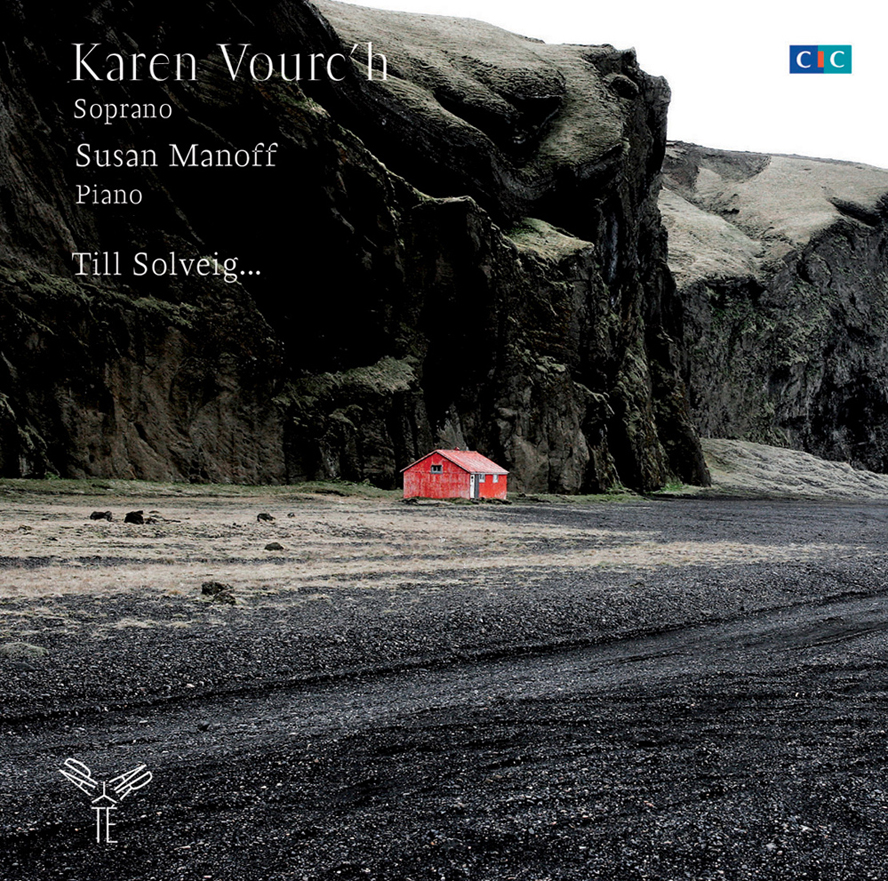 The predominantly Scandinavian repertory on this album might seem an odd choice for a French soprano, but Karen Vourc'h, a former physics student, is of partly Norwegian background A few of the Grieg songs, such as Solveig's Song (track 5), are familiar recital items, but much of Vourc'h's material is unusual. The Grieg songs, even where originally in other languages, are sung in Norwegian. A group of songs by Jean Sibelius is in Swedish, and Vourc'h makes a good case for these little-known, rough-hewn pieces. Lesser known still is Ture Rangström's Pan (track 9), a gorgeous interlude of deep summer in the middle of the program. Vourc'h returns to more familiar ground with a set of Debussy songs at the end. What's most impressive is how she modulates her voice
among the various styles present in this little vocal recital, with a
soft, luxuriant sound in the Grieg, a rougher edge in the Sibelius, and a classic repose in Debussy's concluding Beau soir. There isn't a dull moment in this performance of largely fresh material, and Vourc'h makes it seem both personal and perfectly controlled. Highly recommended. (James Manheim)
The predominantly Scandinavian repertory on this album might seem an odd choice for a French soprano, but Karen Vourc'h, a former physics student, is of partly Norwegian background A few of the Grieg songs, such as Solveig's Song (track 5), are familiar recital items, but much of Vourc'h's material is unusual. The Grieg songs, even where originally in other languages, are sung in Norwegian. A group of songs by Jean Sibelius is in Swedish, and Vourc'h makes a good case for these little-known, rough-hewn pieces. Lesser known still is Ture Rangström's Pan (track 9), a gorgeous interlude of deep summer in the middle of the program. Vourc'h returns to more familiar ground with a set of Debussy songs at the end. What's most impressive is how she modulates her voice
among the various styles present in this little vocal recital, with a
soft, luxuriant sound in the Grieg, a rougher edge in the Sibelius, and a classic repose in Debussy's concluding Beau soir. There isn't a dull moment in this performance of largely fresh material, and Vourc'h makes it seem both personal and perfectly controlled. Highly recommended. (James Manheim) jueves, 1 de junio de 2017
Véronique Gens / Susan Manoff HAHN - DUPARC - CHAUSSON Néère

The soprano Véronique Gens might be thought a natural for the French art song repertoire. But Néère, taking its title from the opening song by Reynaldo Hahn
(the reference is to the Greek nymph known in English as Neaera, "white
as a fine marble statue, with her rosy cheeks"), is one of just a few
albums in the genre she has released. Get hold of it without delay: it's
gorgeous. The French mélodie is not a high-register genre, and for a
singer like Gens
these songs reside in the lower part of her range, where she now brings
just a bit of sultriness and smoke with devastating effect. The program
includes three composers of the late 19th century who are closely
related but contrasting in their individual styles: in the words of
annotator Nicolas Southon "the melancholic Henri Duparc, the elegiac Ernest Chausson, the charmer Reynaldo Hahn." You could really dip in anywhere, but sample track 15, Hahn's A Chloris, for a taste of what Gens can do. The playing of accompanist Susan Manoff seems welded to Gens'
vocal line, which even with all the voluptuous, erotic beauty has a
kind of steely concentration that grows stronger and more impressive as
the album proceeds. An absolute gem. (James Manheim)
martes, 21 de julio de 2015
Patricia Petibon / Susan Manoff LA BELLE EXCENTRIQUE
 The compact disc as a physical
object, whether the music is classical or pop, is of interest to very
few people nowadays. One response from musicians has been an adjustment
to the new climate of downloadable single tracks and bite-sized clips
that don’t suffer from being part of a shuffle. Patricia Petibon’s new
disc does exactly the opposite. Her program happens to contain nearly
thirty tracks, but they all go together as a single performance, and
they need to be heard in the order in which she presents them. The
program is at its core a song recital, but Petibon and pianist Susan Manoff have invited some off-the-cuff participation from a second
pianist, a second vocalist, an accordion player and a percussionist. The
structure is something of an after-dinner talent show, with relentless
high spirits to start, a passing moment halfway through when everybody
gets a little soupy and sentimental as the Pernod kicks in, a strategic
regrouping for a few big numbers, and one sad song too many at the end
to send everybody to the pile of coats on the bed. At times, there’s a
deliberately amateurish quality. The second vocalist is Olivier Py, who
is not quite a singer (he is quite a director, having mounted a
production of Berg’s Lulu for Petibon), and the percussion
parts give the illusion of improvisations that non-musicians might toss
in from the sidelines.
The compact disc as a physical
object, whether the music is classical or pop, is of interest to very
few people nowadays. One response from musicians has been an adjustment
to the new climate of downloadable single tracks and bite-sized clips
that don’t suffer from being part of a shuffle. Patricia Petibon’s new
disc does exactly the opposite. Her program happens to contain nearly
thirty tracks, but they all go together as a single performance, and
they need to be heard in the order in which she presents them. The
program is at its core a song recital, but Petibon and pianist Susan Manoff have invited some off-the-cuff participation from a second
pianist, a second vocalist, an accordion player and a percussionist. The
structure is something of an after-dinner talent show, with relentless
high spirits to start, a passing moment halfway through when everybody
gets a little soupy and sentimental as the Pernod kicks in, a strategic
regrouping for a few big numbers, and one sad song too many at the end
to send everybody to the pile of coats on the bed. At times, there’s a
deliberately amateurish quality. The second vocalist is Olivier Py, who
is not quite a singer (he is quite a director, having mounted a
production of Berg’s Lulu for Petibon), and the percussion
parts give the illusion of improvisations that non-musicians might toss
in from the sidelines.
There are a few of the French
repertoire’s greatest hits, by Fauré and Poulenc, but most of the music
is unfamiliar. There’s a good deal of Satie, including two of the zippy Sports et Divertissements
(piano only, without the sardonic words). If Petibon is perfectly
capable of singing two un-ironic love songs, she nonetheless might
separate them with a Satie can-can. But Satie can also have a side that
is quietly aghast, and his brief “Désespoir agréable” makes a perfect
piano transition into the set of downcast numbers that begins with
Fauré’s “Spleen.” There is a particularly clever transition where
Satie’s “Grande Ritournelle” for piano four-hands at first seems to be a
gussied-up version of Poulenc’s song “Les gars qui vont à la fête,” but
it is the real thing, and the real Poulenc song follows. Among the
discoveries are Reynaldo Hahn’s “Pholoé,” a rare song about aging, and
the music of Léo Ferré, who turns out to be right up there with Michel
Legrand.
Petibon is having such a good time
managing to be loose and crazy even though this is a studio production
that she disarms criticism. She can be dirty without being sleazy in the
duets with Py. She can drip crocodile tears at the end of “Les gars”
but then sing Poulenc’s “Voyage à Paris” without mocking it and deliver
two of those quietly devastating Poulenc songs, “Hier” and “Aux
Officiers de la Garde Blanche,” with equilibrium. It’s perhaps worth
noting that a tiny Manuel Rosenthal song about a zoo elephant who wets
his pants has been turned into something impossibly grand by the full
company here, and it is funny. But Régine Crespin used to stop the show
with this number by underplaying it. Times change, and I love this
album. Twice, by the time Rosenthal songs came up, I felt that one piece
too many had all that extra percussion. And then twice, just as I do
when the cantina tune keeps coming back in Milhaud’s Le Boeuf sur le Toit,
I succumbed unreservedly with a giggle. Madoff, among many virtues,
totally gets the deadpan, unreadable quality of Satie’s accompaniments,
and the idiomatic English translations of Susannah Howe and James
Harding add immeasurably to the considerable enjoyment of this release. (William R. Braun)
Suscribirse a:
Entradas (Atom)

-
Music Is The Key will be closing soon. Over the last year maintaining this site and keeping it up to date has become an expensive and tim...

