Mostrando entradas con la etiqueta Andris Nelsons. Mostrar todas las entradas
Mostrando entradas con la etiqueta Andris Nelsons. Mostrar todas las entradas
viernes, 10 de septiembre de 2021


martes, 27 de julio de 2021
Anne-Sophie Mutter JOHN WILLIAMS Violin concerto No. 2 (Video)

Jessie Montgomery: Starburst
John Williams: Violin concerto No. 2 (World Premiere)
John Williams: New arrangements of film themes “Across the Stars“
Aaron Copland: Quiet City
Igor Stravinsky: Suite from “The Firebird“ (1919 Edition)
sábado, 26 de junio de 2021

martes, 9 de febrero de 2021

martes, 14 de enero de 2020


jueves, 10 de octubre de 2019
Andris Nelsons / Wiener Philharmoniker BEETHOVEN Complete Symphonies

Andris Nelsons, the leading conductor of his generation, has recorded
all nine Beethoven symphonies with the Vienna Philharmonic. Their cycle
promises to reveal the compelling partnership between the conductor and
the most renowned Beethoven orchestra in the world. Beethoven: Complete Symphonies,
released 4 October 2019, is presented in a deluxe box set featuring
five CDs and a single Blu-ray Audio disc in TrueHD sound quality. The
release marks the start of Deutsche Grammophon’s celebration of the
250th anniversary of Beethoven’s birth next year.
Beethoven has been central to Andris Nelsons’ work since he began his
career in the early 2000s. The Latvian conductor received outstanding
reviews for his 2013-14 Beethoven cycle with the City of Birmingham
Symphony Orchestra and was critically acclaimed for more recent
Beethoven performances as Music Director of the Boston Symphony
Orchestra and Leipzig Gewandhausorchester. In March and April this year
he joined the Vienna Philharmonic, the world’s supreme Beethoven
orchestra, for a series of concerts including works by the composer in
Vienna, Hamburg and Hanover, and for the final recording sessions of
their complete symphony cycle at the Vienna Musikverein. Nelsons said it
was an honour and a privilege to be invited to perform and record the
symphonies with the Vienna Philharmonic.
“The journey of interpreting Beethoven’s symphonies signifies a great
opportunity, responsibility and challenge, but in the end, it’s not
about me, it’s purely about the genius and universal quality of
Beethoven’s music, which speaks to each and every individual,” explained
Andris Nelsons. “Of course, I need to have a vision, and our task as
musicians is to find a fulfilling way of presenting Beethoven’s ideas to
listeners, but this will always be very subjective and deeply
personal.”
lunes, 6 de mayo de 2019
Gewandhausorchester / Andris Nelsons BRUCKNER Symphonies Nos. 6 & 9
 Andris Nelsons’ revelatory readings of Bruckner’s symphonies are
permeated by his understanding of the many contradictions within the
composer’s character – not least the opposition between an essential
awareness of his own talent and the insecurity that compelled him to
rework his scores again and again. Set for release on 3 May 2019, the
latest title in the Latvian conductor’s ongoing cycle for Deutsche
Grammophon, performed with his Gewandhausorchester Leipzig, prefaces
Bruckner’s Sixth and Ninth Symphonies with Wagner’s Siegfried Idyll and Prelude to Parsifal
respectively. Light and dark, triumph and tragedy, life and death
coexist here in a state of uneasy tension, resolved but never
reconciled.
Andris Nelsons’ revelatory readings of Bruckner’s symphonies are
permeated by his understanding of the many contradictions within the
composer’s character – not least the opposition between an essential
awareness of his own talent and the insecurity that compelled him to
rework his scores again and again. Set for release on 3 May 2019, the
latest title in the Latvian conductor’s ongoing cycle for Deutsche
Grammophon, performed with his Gewandhausorchester Leipzig, prefaces
Bruckner’s Sixth and Ninth Symphonies with Wagner’s Siegfried Idyll and Prelude to Parsifal
respectively. Light and dark, triumph and tragedy, life and death
coexist here in a state of uneasy tension, resolved but never
reconciled.
Bruckner’s symphonies are a minefield of multiple versions, confusing
revisions and clashes between manuscript and published sources. Nelsons
has opted to follow Leopold Nowak’s critical edition for these
performances. The Sixth Symphony (1879-81), notable for its structural
economy and clarity, was one of Bruckner’s favourites among his own
works. Much of the work is striking for its dynamism, but at its
emotional centre is the dark and troubled Adagio, whose music, as
Nelsons observes, anticipates the soundworld of Mahler. While the Sixth
was written within two years and spared from later revision by the
composer, Bruckner laboured on his ninth and final symphony for much of
the final decade of his life. Nelsons has followed convention to perform
the Ninth in its three-movement form. The closing Adagio echoes the
rising melody of the so-called “Dresden Amen” in homage to Wagner, who
made prominent use of the theme in Parsifal.
As he told Gramophone in April 2018, Nelsons is determined,
above all, “to show Bruckner the human being, with all his doubts,
obsessions, as well as Bruckner the man who is very religious and lives
according to certain strong rules, and how that sometimes conflicts with
and sometimes fulfils his approach in his music.”
The Gewandhausorchester players bring the ambiguities inherent in
Bruckner’s scores vibrantly to life. The composer is in the orchestra’s
collective DNA. It embraced him when it gave the world premiere of his
Seventh Symphony in 1884 and made history again soon after the First
World War by performing the first complete cycle of his nine symphonies.
“The Gewandhausorchester’s ability to play this music is very special”,
says Nelsons, “there’s a sensitivity and intimacy that I like very
much.”
lunes, 25 de febrero de 2019
Andris Nelsons / Boston Symphony Orchestra DMITRI SHOSTAKOVICH Symphonies Nos. 6 & 7 - Incidental Music to "King Lear"

After the scandalously successful (Sunday Times) Symphony No. 10 in
2015, the sheer expressive beauty (Gramophone Magazine) of Symphonies
Nos. 5, 8, 9 from 2016, and the overbearing vividness (The Guardian) of
the most recent Symphonies Nos. 4 & 11, Nelsons and the BSO continue
the Grammy-winning cycle with Symphonies Nos. 6 & 7. The symphonies
are complemented by two other works by Shostakovich, the Suite from the
Incidental Music to King Lear, Op. 58a and the Festive Overture, Op.
96.
miércoles, 19 de septiembre de 2018
Boston Symphony Orchestra / Andris Nelsons DMITRI SHOSTAKOVICH Symphonies Nos. 4 & 11 "The year 1905"

Deutsche Grammophon proudly continues the widely acclaimed, Grammy
winning Shostakovich Symphony cycle with Music Director Andris Nelsons
and the Boston Symphony Orchestra.
Andris Nelsons is the Music Director of the Boston Symphony Orchestra
and new Gewandhauskapellmeister of the Gewandhausorchester Leipzig.
With both appointments, and in leading a pioneering alliance between
these two esteemed institutions, he is firmly underlined as one of the
most renowned, exciting and innovative conductors on the international
scene today. After the “scandalously successful” (Sunday Times) Symphony
No. 10 in 2015 and “the sheer expressive beauty” Gramophone Magazine)
of Symphonies Nos. 5, 8, 9 from 2016 Andris Nelsons and his Bostonians
turn their attention to the extrovert Fourth and dramatic Eleventh -
both recorded live for the third instalment of this long-term
collaboration of the Boston Symphony Orchestra – “America's most
cultured orchestra” (BBC Music Magazine).
viernes, 6 de abril de 2018
Gewandhausorchester / Andris Nelsons BRUCKNER Symphony No. 7
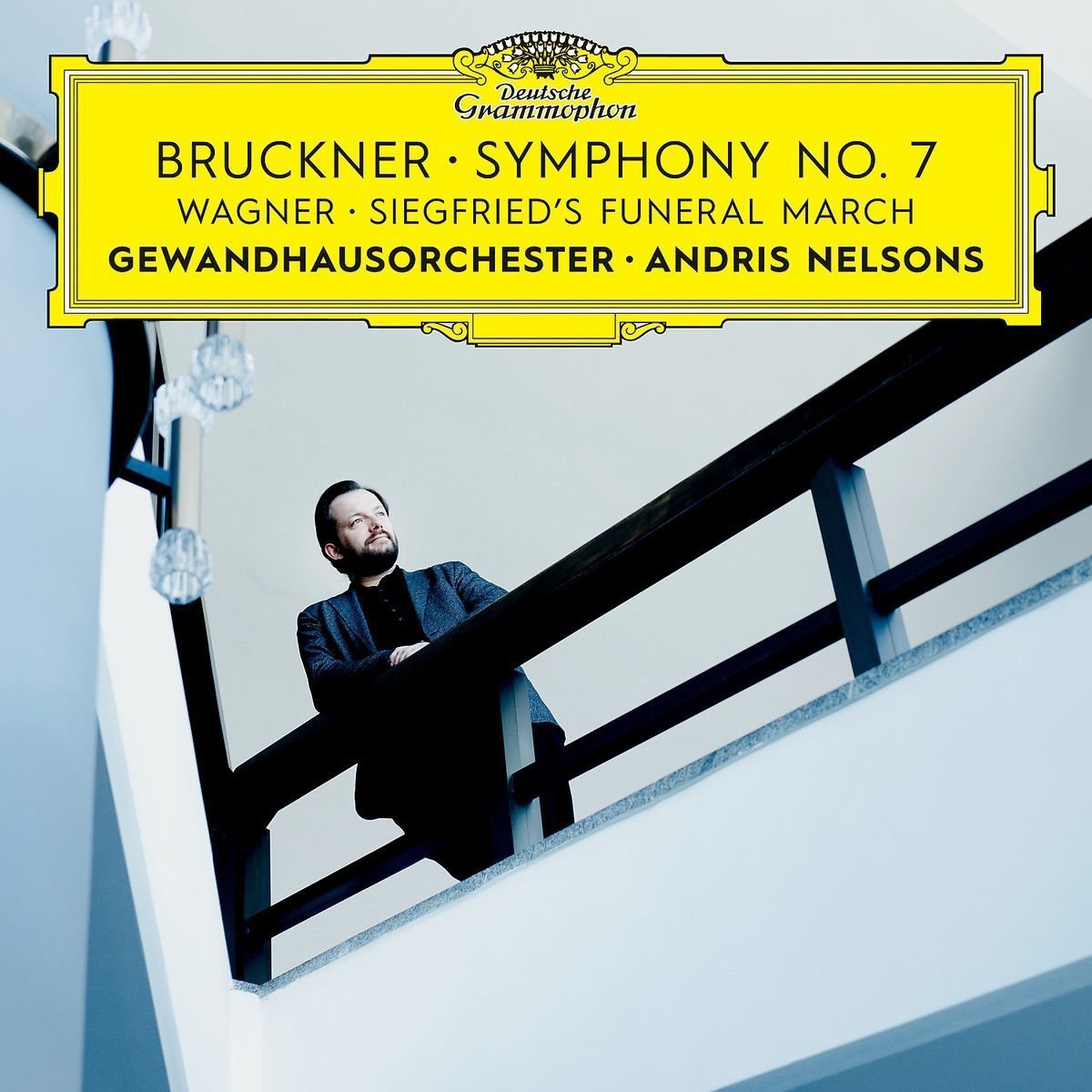 ...“Wagner’s music, like Bruckner’s goes way beyond the intellectual,”
observes Nelsons. “Both composers use their work to address existential
questions and open up new spiritual dimensions.” This is music of
concentrated, raw emotion, music that goes straight to the heart, and it
is hard to think of any orchestra capable of interpreting it with
greater intensity than the Gewandhausorchester. As Nelsons adds, “The
orchestra’s incredible variety of sounds is particularly vividly
displayed in Bruckner’s compositions. I hope through our recordings to
further cultivate and disseminate this immense spectrum of colours and
the orchestra’s special authority in the Romantic repertoire.”
...“Wagner’s music, like Bruckner’s goes way beyond the intellectual,”
observes Nelsons. “Both composers use their work to address existential
questions and open up new spiritual dimensions.” This is music of
concentrated, raw emotion, music that goes straight to the heart, and it
is hard to think of any orchestra capable of interpreting it with
greater intensity than the Gewandhausorchester. As Nelsons adds, “The
orchestra’s incredible variety of sounds is particularly vividly
displayed in Bruckner’s compositions. I hope through our recordings to
further cultivate and disseminate this immense spectrum of colours and
the orchestra’s special authority in the Romantic repertoire.”
Andris Nelsons himself is one of the most dynamic and innovative
conductors of our time. As Music Director of the Boston Symphony
Orchestra he has already broken new musical ground, and his inauguration
as Gewandhauskapellmeister represents another major milestone in his
career. “It is an extraordinary honour to be part of this tradition,” he
says, adding that the orchestra should aim to keep evolving. Their
mission together, as he sees it, is to look to the future by
commissioning new works as well as respecting the past and keeping the
music of the great masters alive.
That aim is reflected in Leipzig’s upcoming four-week festival, whose
programmes embrace past and present, with music by composers ranging
from Bach to Tchaikovsky, to Jörg Widmann. Shortly after these
celebrations, Nelsons will embark on his first European tour with the
Gewandhausorchester, performing at such prestigious venues as Hamburg’s
Elbphilharmonie, the Amsterdam Concertgebouw and the Vienna Musikverein.
All in all, it promises to be a rousing start to a new era in Leipzig’s musical history. (Deutsche Grammophon)
sábado, 17 de febrero de 2018
Boston Symphony Orchestra / Andris Nelsons BRAHMS The Symphonies

In a personal booklet note for this set Andris Nelsons celebrates the
recorded legacy of Brahms in Boston, referencing complete cycles from
Leinsdorf and Haitink and recordings of individual symphonies under
Koussevitzky, Munch and Ozawa. Only a conductor supremely confident in
his own identity would venture to do so, of course, and Nelsons is
nothing if not his own man in this repertoire, confounding expectations
in some respects while confirming them in others. His Brahms is as
vital, impulsive and rhythmic as all his work strives to be – though not
as sheerly dynamic as one might have imagined – but there is blend and
bloom, too, with Symphony Hall, Boston, seeming to accommodate this
music from the bass lines upwards; a deep and sonorous sound.
Nelsons talks of finding precisely the right character for each
movement and in that he truly listens to the music, feeling its pulse
and allowing the phrasing to evolve with as little intervention or
‘shaping’ as possible. He is generous without indulgence, muscular
without vulgarity. Just occasionally one senses him harnessing his
natural dynamism in deference to the music’s noble pedigree. Perhaps I
was expecting a higher degree of tension and excitement from the opening
movement of the First Symphony. The promise is there in the tragically
underpinned sostenuto of the opening – giving way as it does to the enticing woodwinds of the second lyric idea – but maybe the main Allegro could be a shade more imperative.
That’s the thing about this music: you don’t want to unduly drive it
but nor do you want to simply luxuriate in it. The second movement of
the First brings to the fore the distinguished Boston woodwinds and a
sense of the music evolving in the playing of it. And then there is the
finale, with storm clouds famously clearing with the BSO’s refulgent
solo horn and a chorale of trombones to die for. Now the main Allegro
here is liberating for sure, and perhaps Nelsons had been intentionally
holding something in reserve because the climax leading to the return
of the ubiquitous horn theme is rollicking indeed.
Anyone who thinks that Brahms was the conservative and Wagner
the radical needs to think again. The evolution of the Second
demonstrates how mindful Nelsons is of that. The myriad twists and turns
and underlying threat of the autumnal first movement (where the
deviation from and contortion of form is so pronounced) is boldly
chronicled, and the second movement – with wonderful string-playing – is
likewise gripping in the way Nelsons appreciates how daringly the
material is developed. But the sun comes out again in the bracing finale
and Nelsons is definitely off the leash. The return of the second
subject is the warmest of hugs and the coda is exuberantly rip-roaring,
descending trombones cutting through the texture like noisy bell chimes.
The Third Symphony is gorgeous. The first movement has what the Viennese might call Schwung
(Nelsons includes the exposition repeat) and the development really
earns its climax. In the slow movement the aforementioned naturalness
and fluidity of Nelsons’s phrasing (what musicality this man has) is
possessed of a spontaneity that repays his belief in the music. The
Bostonians really sing. And the celebrated Poco allegretto of the
third movement has the appropriate ache of nostalgia. Note, too, the
magical evaporation of the finale’s coda: Nelsons’s Wagner tellingly
referenced.
And so to the great Fourth. Again, don’t expect Toscanini. Nelsons
builds the first movement’s head of steam by stealth, measuring its
expansive lyricism – and grandeur – with a growing resolve. The measured
processional of the second movement evolves into something quite
ravishing, with the return of that second theme in the chest register of
the Boston strings especially memorable. A similar voluptuousness
arrives with the first variant of the chaconne finale and you can almost
feel Nelsons channelling Brahms in the way he moves from one inspired
improvisation to the next.
So, much to enjoy from an orchestra who seem to have found the
perfect soulmate for this stage in their ongoing journey. The mutual respect and like-mindedness is palpable in each of these performances
and, whatever you may feel about this choice or that, there’s always a
very real sense of music-making happening ‘in the moment’ and for that
one time only. (Edward Seckerson / Gramophone)
viernes, 16 de febrero de 2018
Gewandhausorchester / Andris Nelsons BRUCKNER Symphony No. 4
 Spring 2018 sees the release of two new albums by the Leipzig
Gewandhausorchester and Andris Nelsons on the Deutsche Grammophon label,
coinciding with the orchestra’s 275th anniversary and the
conductor’s inauguration as the new Gewandhauskapellmeister. These live
recordings, each coupled with pieces from Wagner operas, form part of a
complete Bruckner cycle on the yellow label. Bruckner’s Symphony No.4
will be released on 16 February, Symphony No.7 on 6 April 2018.
Spring 2018 sees the release of two new albums by the Leipzig
Gewandhausorchester and Andris Nelsons on the Deutsche Grammophon label,
coinciding with the orchestra’s 275th anniversary and the
conductor’s inauguration as the new Gewandhauskapellmeister. These live
recordings, each coupled with pieces from Wagner operas, form part of a
complete Bruckner cycle on the yellow label. Bruckner’s Symphony No.4
will be released on 16 February, Symphony No.7 on 6 April 2018.
In Leipzig, past and present have always gone hand in hand, a
successful fusion that will soon be encapsulated in a very special
four-week-long music festival. Taking place in the city between 18
February and 24 March, the festival will mark both the 275th anniversary of the Leipzig Gewandhausorchester, and the official inauguration as the 21st Gewandhauskapellmeister
of the exceptional Latvian conductor Andris Nelsons, one of the most
exciting musicians on the world stage today. Deutsche Grammophon is
joining in the celebrations by releasing two new albums that not only
showcase Nelsons and his new orchestra, but also continue the
long-established links between Leipzig and Bruckner.
The first of these albums, scheduled for release on 16 February 2018,
features Bruckner’s Fourth Symphony alongside the Prelude to Wagner’s Lohengrin.
The pairing reveals the remarkable affinities between the two
composers’ idioms. Rich in contrast and musical imagery, both works have
the power to captivate their listeners, a quality enhanced by Nelsons’
highly focused and sensitive interpretations.
The second Bruckner/Wagner album to appear this spring will feature
the Austrian composer’s Seventh Symphony, a work more closely connected
with Leipzig and the Gewandhausorchester than virtually any other ever
written. Under the baton of the then Gewandhauskapellmeister Arthur
Nikisch, the orchestra gave the symphony’s world premiere in the city’s
municipal theatre in 1884, and the Seventh has been performed in Leipzig
countless times since. It was therefore an obvious choice to include
this legendary work in the orchestra’s 275th anniversary gala
concert which Andris Nelsons will conduct on 11 March 2018. Captured
live, this unique performance will be released on 6 April in Germany and
20 April worldwide, in a pairing with Siegfried’s Funeral Music from
Wagner’s Götterdämmerung.
Both albums are part of Deutsche Grammophon’s upcoming complete
Bruckner cycle with Nelsons and the Gewandhausorchester. In each case,
the Bruckner symphony in question will be complemented by an excerpt
from one of Wagner’s operas, an innovative programming decision which,
along with the high-calibre performers involved, gives the new cycle a
distinctive edge. Coupling the symphonies with music by Wagner enables
listeners to discover two composers of contrasting character whose works
nevertheless display some fascinating similarities of conception. (Deutsche Grammophon)
Gewandhausorchester / Andris Nelsons BRUCKNER Symphony No. 3

With a strong sense of emotional involvement Nelsons breathes life into
this wonderful score directing a performance of elevated quality. With
ideal weight the cultured playing of the Gewandhausorchester has a
steadfast unity of a grade rarely achieved but it never comes at the
cost of expression. Impressive too is how Nelsons shapes the phrases
with such authority. Glorious too is the quality of the intonation and
vibrant tone colour achieved by the orchestra, conspicuously the brass
section with its gleaming golden hue . . . In the opening movement
Nelsons conveys a strong feeling of grandeur, bold and positive in mood
providing a convincing forward momentum. The treasurable second movement
Adagio is exquisitely performed by the Leipzig players with Nelsons
setting an ideal pace . . . Nelsons' uplifting Scherzo in the dramatic
passages is punchy in its urgency and contrasts with the delightful,
feathery Austrian "Ländler". It's easy to savour the sense of Alpine
majesty that Nelsons creates in the remarkable final movement,
sustaining an especially splendid flow which feels persuasive. The
section with the joyous Polka over the solemn Chorale sounds especially
impressive and after the conclusion of the symphony I can't resist
repeating this section again . . . [Wagner]: In a gripping performance
Nelsons conducts the "Tannhäuser Overture" with surefire conviction. The
Gewandhausorchester respond to his lead with all the expressive zeal
and breath-taking virtuosity which one has come to expect. Exceptional
is the velvety legato and tonal beauty of the prominent horns. Nelsons
interpretation is first class . . . (Michael Cookson /MusicWeb International)
martes, 15 de agosto de 2017
Barbara Hannigan HANS ABRAHAMSEN / PAUL GRIFFITHS Let Me Tell You

“As this filtration process is itself worked through Abrahamsen’s
half-hour score, however, the idea has undergone another transformation.
The spare yet pregnant lines of text meet Abrahamsen’s finely spun
textures and each word feels felt and weighed in music. Possibly you
don’t even need to know that Barbara Hannigan is singing Ophelia’s words
any more, yet her vehemence and passion suggest she thinks justice is
finally being done to a woman who never did get much chance to tell her
side of the story.
Hannigan premiered the piece in 2013 (then it was performed by the Berlin Philharmonic under Andris Nelsons; now the Latvian has recorded it with the Bavarian Radio Symphony Orchestra) and had reportedly coached the composer on the intricacies of vocal music for what was his first sung work. One imagines these sessions produced the use of stile concitato emphases on repeated syllables, a flick of Monteverdi added to a more usual Hannigan repertoire of jarring leaps and plunges across her formidable range.
The Bard’s Ophelia drowned in the brook; this one wanders into the snow, her tread hypnotically evoked by paper softly rubbed around the skin of a bass drum. It’s a tiny, tragic Winterreise, but its final sung echoes are defiant: ‘I will go on’. The rest is silence.” (Gramophone, February 2016)
Hannigan premiered the piece in 2013 (then it was performed by the Berlin Philharmonic under Andris Nelsons; now the Latvian has recorded it with the Bavarian Radio Symphony Orchestra) and had reportedly coached the composer on the intricacies of vocal music for what was his first sung work. One imagines these sessions produced the use of stile concitato emphases on repeated syllables, a flick of Monteverdi added to a more usual Hannigan repertoire of jarring leaps and plunges across her formidable range.
The Bard’s Ophelia drowned in the brook; this one wanders into the snow, her tread hypnotically evoked by paper softly rubbed around the skin of a bass drum. It’s a tiny, tragic Winterreise, but its final sung echoes are defiant: ‘I will go on’. The rest is silence.” (Gramophone, February 2016)
viernes, 7 de abril de 2017
Hélène Grimaud PERSPECTIVES
 She could be called a Renaissance woman for our times. Hélène Grimaud is
not just a deeply passionate and committed musical artist whose
pianistic accomplishments play a central role in her life. She is a
woman with multiple talents that extend far beyond the instrument she
plays with such poetic expression and peerless technical control. The
French artist has established herself as a committed wildlife
conservationist, a compassionate human rights activist and as a writer.
She could be called a Renaissance woman for our times. Hélène Grimaud is
not just a deeply passionate and committed musical artist whose
pianistic accomplishments play a central role in her life. She is a
woman with multiple talents that extend far beyond the instrument she
plays with such poetic expression and peerless technical control. The
French artist has established herself as a committed wildlife
conservationist, a compassionate human rights activist and as a writer.
The word ‘perspective’ has a Latin root that means ‘to look through’. It
is a word that readily applies to Hélène Grimaud’s way of making music
and conceiving programs. She never plays a piece simply for the sake of
playing it. She ‘looks through’ a composition, scrutinizing its
components, its implications, its ambiguities, its position within that
particular composer’s output, its commonalities with other like-minded
works, and its tactile, spiritual and emotional resonances. For Grimaud,
this collection is a retrospective offering new perspectives through a
very personal choice of repertoire which creates enlightening new echoes
between works. From Bach to Rachmaninov, Mozart to Chopin, Grimaud’s
own selection of highlights from her albums reflects her artistic
journey through the piano’s most famous solo and concerto repertoire in a
series of interpretations that never fail to offer new perspectives on
even the most familiar music – to be released in April!
sábado, 28 de mayo de 2016
Andris Nelsons / Boston Symphony Orchestra DMITRI SHOSTAKOVICH Symphonies Nos. 5, 8 & 9 - Suite from "Hamlet"

. . . played with insight and panache . . . [the performance Andris
Nelsons] coaxes from his musicians is at the highest level and the deep
soundstage of the recording makes it an excellent album for headphones .
. . [Shostakovich 5]: Nelsons conducts with a storyteller's eye for
detail. A passage near the end of the first movement . . . is
dramatically poignant. In Nelsons' transparency, the soft pluck of a
harp and the ping of a glockenspiel come into focus. Even menacing
moments are judged for clarity . . . [Shostakovich 8]: Nelsons has a way
with the BSO woodwinds as well . . . piccolos glare, double reeds
converse in intimate asides and English horn player Robert Sheena gets
plenty of space to breathe in his plaintive first movement solo . . . [Shostakovich 9]: [Nelsons lets] the BSO strings dance and sing while
the brass wink and snarl . . . (Tom Huizenga / 19. May 2016)
[Shostakovich 9]: A stern-sounding fanfare -- the BSO horns have played
brilliantly of late under the direction of the former trumpeter Nelsons
-- makes the fourth movement, Largo, sound dramatic, but not tragic. The
finale is a piece of concluding genius, played with professional
exuberance . . . [Shostakovich 5]: The music is gripping, innately
classical in concept, and full of originality. From the opening . . .
listeners are engaged. (Keith Powers / 26. May 2016)
martes, 12 de abril de 2016
Stephen Hough / Andris Nelsons / City of Birmingham Symphony Orchestra DVORÁK - SCHUMANN Piano Concertos

Andris Nelsons and the CBSO clearly relish the symphonic nature of
the piece and their playing is one of the great pleasures here. The
concerto’s opening theme could be by no one else, though the mood soon
darkens with a cautionary figure sounded first by violas and cellos.
Nelsons imbues this with an affecting resignation, Kleiber sounding more
openly disturbed. Hough enters the conversation with great subtlety and
he’s certainly unafraid to point out the score’s lyrical beauties,
allowing the music to unfold with suppleness without underplaying its
drama or, where required, heft.
The glorious slow movement, which
is launched by a New World-like horn solo, needs careful pacing: get it
wrong and the question-and-answer writing can sound forced and overly
sectionalised. Richter and Kleiber dare to take a slightly more
drawn-out approach than this new recording, but both versions are
compelling, and the CBSO players relish Dvořák’s unfettered
wind-writing. Another black spot is the Risoluto (tr 2, 3'31" on the new
CD); in the wrong hands its accented motif—first in the major, then the
minor—can sound trite but Hough gives it a playful quality, to which
the orchestra gleefully respond. Another highlight is the very end of
the slow movement, where the piano-writing ascends, drawing the
orchestra up with it.
I slightly prefer Richter’s way with the
foot-stomping theme that opens the finale, which is superbly
complemented by the earthiness of Kleiber’s orchestra. Hough sounds just
a tad deliberate by comparison (compared to Piemontesi too, who is
fearless here). This is a hideously ungrateful movement for the pianist
and Hough is remarkable in not having a note out of place. And he
certainly brings the house down at the end, setting the seal on a
performance that is full of panache.
From a work at the margins
of the repertoire to one that is absolutely centre stage. The Schumann Concerto is, in Hough’s hands, both boldly symphonic and utterly
flexible, the pianist hardly making life easy for the conductor—though
Nelsons is completely unfazed. The opening is strong and bold,
adjectives that apply equally to the first movement’s cadenza, which has
grandeur as well as excitement. Sample tr 4 from 4'50" and this will
give you a taster: Hough, first solo and then as chamber musician, is
ravishing but also dangerously becalmed. But for me a bigger stumbling
block is the way he turns Schumann’s Intermezzo into something
altogether more languorous (the stretched-out cello theme at 1'21" will
give you an idea); just compare Shelley in this movement—to my mind
pretty much unsurpassed among modern-day recordings. Symphonic breadth
triumphs over Mozartian lightness in the finale, yet that weight is
offset by some superbly delicate figuration from Hough.
So a
slightly mixed bag; but this version of the Dvořák should put it on the
map for a new generation. Personal and heartfelt notes from Steven
Isserlis and a superbly natural recording complete the package. (Gramophone)
miércoles, 5 de agosto de 2015
Andris Nelsons / Boston Symphony Orchestra SHOSTAKOVICH Symphony No. 10
 For the first instalment of a Shostakovich
series titled Under Stalin’s Shadow, Andris Nelsons has chosen the
composer’s monumental Tenth Symphony, prefaced with the startling
“Passacaglia” from Lady Macbeth of the Mtsensk District.
For the first instalment of a Shostakovich
series titled Under Stalin’s Shadow, Andris Nelsons has chosen the
composer’s monumental Tenth Symphony, prefaced with the startling
“Passacaglia” from Lady Macbeth of the Mtsensk District.
It’s a programme that effectively bookends Shostakovich’s relationship
with Stalin: at the dictator’s behest, Lady Macbeth of the Mtsensk
District was denounced in 1936 as a “deliberately dissonant, confused
stream of sound” – yet there’s no confusion discernible here, as
lowering horns, brooding strings and dramatic percussion combine to
drive home the air of looming menace.
But Shostakovich struggled to rehabilitate his reputation through his
wartime symphonies, culminating in 1953 with Symphony No 10, which
shares the mood of menace in “Passacaglia”. (Andy Gill)
martes, 1 de octubre de 2013
Hélène Grimaud BRAHMS Concertos

With a nod of recognition to the composer – who himself let twenty-two years go by after completing his First Piano Concerto before starting on the Second – Hélène Grimaud notes that she’s needed every bit of the fifteen years that have passed since she recorded Brahms’s First to prepare herself for recording No.2. The explanation behind the sheer length of this musical journey lies in the particularly close relationship she enjoys with the D minor Concerto which, among other things, was the first work by Brahms she ever heard. Grimaud can still clearly recall that discovery, though her feelings about it are hard to put into words: “It’s something that completely consumes you, leaving no room for anything else at all – a new universe opens up to you and you just dive right in without a second thought.”
To her, the Concerto represents life itself, our very existence: “You land right in the heart of the action of that existence and there’s no turning back”. She acknowledges that it’s a work she needs, both physically and mentally, highlighting the unadorned, uncompromising side of its nature: “It gives the impression of having been written at one sitting, even though we know that’s not the case”. With reference to the second movement, dedicated to Clara Schumann, Grimaud pinpoints one impassioned, almost prayer-like moment, which has to be played with both intellectual and emotional honesty if the truth of the work is to be brought out: “You can only truly touch an audience if you play with sincerity. Even then, there’s no guarantee, given that we all perceive things in different ways. No single performance can touch every member of an audience in exactly the same way, but at the very least that basic parameter of sincerity has to be present.”
Her relationship with the Second Piano Concerto, meanwhile, is more complex, and somewhat paradoxical. For a long time it seemed less vital to her than the First. She felt its finale, however sublime, was surplus to requirements. “If many people prefer the Second, that’s perhaps because of its intensity of expression. It looks at what life has been, what it is and what it could have been. There’s a kind of nostalgia there, as well as a slightly bitter strain of tenderness.”
Even so, the idea of never broaching the work was unthinkable. She couldn’t imagine going through life without it – because of her relationship with Brahms, an affinity dating back to her childhood. His music gives her a sense of intimacy that she simply accepts, without attempting to explain or justify it in any way.
She began work on the B flat Concerto in 2007, but it took time for her to feel completely at home with it, as she herself recalls: “I was very wary of it. It was as if I were observing both the work and myself in relation to it. There was a distance between us that wasn’t conducive to a truly successful outcome. I learned it, performed it twice, then said to myself, ‘well, mission accomplished, that’s enough for now’.”
Another five years went by before she felt irresistibly drawn to go back to the Second Concerto, and this time to embrace it fully, without reservations. And as she embarked on this new relationship, she also began to feel a similar urge to revisit the First. The thought of one without the other, of recording the Second without the First resurfacing, had become inconceivable.
And so this album project took shape. Grimaud is keen to point out, however, that she did not deliberately set out to reinterpret Concerto No.1: “That’s not the way I work. As you evolve, as you experience certain things, you filter a familiar piece of music t
hrough your new experiences and encounters. In some ways your interpretation changes, in others it stays the same. It’s the idea of reconciling opposites.”
She recorded Concerto No.1 with the Bavarian Radio Symphony Orchestra and No.2 with the Vienna Philharmonic – her first recording with this prestigious orchestra – both led by Andris Nelsons, a conductor she greatly admires, and with whom she has a strong fellow-feeling. She pays him tribute, saying, “You sense that musicians would do anything for him. I spoke earlier about the essential role played by intellectual honesty when you’re performing, and that’s true here as well. There’s a purity about him which I think inspires a different reaction from his musicians … He has intensity, musical intelligence and a sense of freedom, but there’s also something that emanates from him which has to do with instinct and that purity of intent – and it makes you want to give your all.”
(Jean-Michel Dhuez)
Suscribirse a:
Entradas (Atom)


