
Mostrando entradas con la etiqueta Karol Szymanowski. Mostrar todas las entradas
Mostrando entradas con la etiqueta Karol Szymanowski. Mostrar todas las entradas
lunes, 1 de marzo de 2021

lunes, 25 de enero de 2021

lunes, 30 de noviembre de 2020

sábado, 30 de mayo de 2020

sábado, 23 de mayo de 2020

miércoles, 20 de mayo de 2020

domingo, 15 de septiembre de 2019
Miyako Arishima TAKEMITSU - SZYMANOWSKI - CHOPIN - SEROCKI Works for Solo Piano

Steinway & Sons releases the debut album from up-and-coming
Japanese pianist Miyako Arishima. The album blends two
vastly different, yet kindred worlds: the Romantic, embodied by the
music of Frédéric Chopin, and the twentieth century, represented by the
works of Toru Takemitsu, Karol Szymanowski, and Kazimierz Serocki.
Although the record heavily features Polish repertoire, Rain Tree
Sketch by Toru Takemitsu, arguably the greatest Japanese composer of the
twentieth century, kicks off the album. This piece, written in 1982,
reflects the essence of Takemitsu’s composition style, blending Western
themes with Japanese cultural roots. Although the piece is short, it
focuses on the relationship between meticulously produced notes and
silence.
There are two pieces by Polish composer Karol Szymanowski featured on
this record: Métopes, Op. 29: Nausicaa, and 2 Mazurkas, Op. 62. The
first of the two, Nausicaa, was written while the composer was under the
sway of aesthetic impressions from Doric temple friezes at the Palermo
museum, and as a result was heavily inspired by Greek mythology. The
second, 2 Mazurkas, are later works which form the final opus of
Szymanowski, and are distinct from the composer’s earlier works in their
softer rhythmic contours and distinct arabesque character.
Three works by Frédéric Chopin, including 4 Mazurkas, Op. 33, the
sixth of the composer’s mazurka sets, showcases the signature liveliness
of the mazurka, a traditional Polish dance set in triple time, through
nostalgic, popular melodies and elaborate minor-mode settings.
Rounding out the recording is the seven-part Suite of Preludes by
Kazimierz Serocki, who would later become a radical representative of
the Polish avant-garde. This piece is notable for its unorthodox
incorporation of Arnold Schönberg’s famous twelve-tone serialism, and
its blend of the Chopin-era and post-Chopin musical traditions.
martes, 23 de abril de 2019
Rosanne Philippens MYTH

What a surprise it was when my friend the pianist Julien Quentin
introduced me to the music of Szymanowski several years ago. A world
full of myths opened up, a landscape with fast streaming rivers where
frightened nymphs timidly glanced back at lascivious satyrs with goat
hooves. And full of colourful stories about the shepherd’s boy
seduced by a princess, and the firebird hiding in the bushes. In the
three myths I recognised Ovid’s Metamorphoses. I managed to track down
the poems of Szymanowski’s countryman Tadeusz Micinski, which inspired
him. In pursuit of the composer’s roots, I visited his villa Atma, where
I heard the wonderful music of the mountains of Zakopane, which had
moved him as well. And so ‘Myth’ came into being, an issue imbued with
the Polish soul, and including, from further afield, some Russian myths
as well.
viernes, 25 de enero de 2019
Rafał Blechacz / Bomsori Kim FAURÉ - DEBUSSY - SZYMANOWSKI - CHOPIN

Bomsori Kim and Rafał Blechacz present their first recording as new
duo partners with works by Fauré, Debussy, Chopin and Szymanowski.
New duo partners decided to explore French and Polish repertoire on
their first album together, showcasing the enthralling combination of
Blechacz’s structural vision and Bomsori's lyrical
music-making.
miércoles, 2 de enero de 2019
Radosław Sobczak SZYMANOWSKI

Piano works by
Karol Szymanowski
pose a considerable challenge to their performers. Although the composer himself was an active
instrumentalist, he never thought about his works in a purely pianistic way. This work is full of textural complexities which, in
combination with numerous compositional indications, regulating tempo and dynamics, do not facilitate interpretation. A recording of a
pianist who earned a reputation as promoter of Polish music,
Radosław Sobczak
, shows that even the most difficult textural traps do
not pose any difficulty for this artist. The album programme consists of: Piano
Sonata No. 2 in A major. Op. 21
,
2 Mazurkas from Op. 50
,
Etude in B flat minor, Op. 4 No. 3
, and rarely performed
Preludes, Op. 1.
jueves, 27 de diciembre de 2018
Anna Szałucka A CENTURY OF POLISH PIANO MINIATURES

“‘A century of Polish Piano Miniatures' summarizes years of work and
research just as Poland comes to its 100th anniversary of independence.
My goal was to explore and present to the audience the real jewels of Polish piano literature from the post-Chopin era. Every piece covers a
historically significant moment taking the listener on a fascinating
journey through wars, conflicts and victories. Leaving Poland myself
over five years ago it was very important for me to see how the new
generation of composers take over both inside and (mostly) outside the
country. It was also crucial for me to include works written by female
composers. I am pleased to share this music with a wider international
audience.” (Anna Szałucka)
miércoles, 7 de noviembre de 2018
Lilit Grigoryan VARIATIONS SÉRIEUSES

Award-winning Armenian pianist Lilit Grigoryan explores the art of the
variation in her new recording with Orchid Classics entitled Variations
Serieuses. In stunning interpretations combining both virtuosity and
integrity, Lilit Grigoryan takes the listener on a journey through this
art form, from Busoni’s breathtaking re-imagining of the majestic
Chaconne from J.S. Bach’s D minor violin Partita, to Beethoven’s 32
Variations, which range between extreme technical difficulty and
expressive moments of quiet simplicity, to Mendelssohn’s grand
Variations sérieuses. Alongside these giants of the repertoire are some
more rarely-heard gems: Bizet’s sinuous and innovative chromatic
variations, and youthful late-Romantic colour from Polish composer
Szymanowski.
Born in Yerevan, Armenia in 1985, Lilit Grigoryan started
to play piano at the age of seven at the Al. Spendiaryan Music School.
She was a student at the Komitas Yerevan State Conservatory before she
entered the Hochschule für Musik und Theater Rostock in the class of
Prof. Matthias Kirschnereit in April 2014. She graduated in Rostock with
the highest distinction. From 2012 to 2016 Lilit Grigoryan was also
Artist in Residence at the Queen Elisabeth Music Chapel in Belgium.
miércoles, 3 de octubre de 2018
Wojciech Pyrć EKIER - SZYMANOWSKI Piano Music

The composers presented on the CD – Jan Ekier and Karol Szymanowski - were united by fascination with Chopin’s music, as well as inspiration from folk music, particularly the highlander folklore. Szymanowski’s influence on the entirety of the Polish music was not to be overestimated and it also left its mark on the artistic sensitivity of
young Ekier. He also occupies a particular place on the artistic path of a young pianist, Wojciech Pyrć, a graduate of the Fryderyk Chopin University of Music, laureate of numerous Polish and international competitions. He interprets piano miniatures by Ekier, as well as Szymanowski’s works, including the daunting and rarely performed Fantasy in C major.
miércoles, 12 de septiembre de 2018
Matthias Roth MIROIRS

The two composers on this Genuin Classics recording represent their
country as figureheads of colour and sound: The Pole Karol Szymanowski
and the Frenchman Maurice Ravel. The Swiss pianist Matthias Roth has put
together an exquisite programme for his GENUIN debut CD, which he has
recorded with a crystal-clear sound and lively articulation that is
unrivaled in terms of quality. You don't know what to admire more: the
great works of Ravel that one knows well but experiences anew, or the
unexplored beauty of Szymanowski's works, which are worth the exciting
voyage of discovery in every moment!
sábado, 1 de septiembre de 2018
Jiyoon Lee / Henry Kramer MYTHES

martes, 7 de agosto de 2018
Pöntinen plays SZYMANOWSKI

Roland Pöntinen’s recital illustrates graphically three distinct sides
of Szymanowski’s multifaceted genius. First, a selection from the 22
Mazurkas which are like Chopin seen through a distorting mirror while at
the same time reflecting the composer’s love of the Tatra district of
his native Poland. Second, his turning away from heavy German influences
to an ornate impressionism capturing his devotion to Mediterranean
myths and legends (Métopes and Masques). And finally, in
the Third Sonata, a close amalgam of influences, notably Scriabin (the
more problematic Sonatas Nos 6-10) and Stravinsky. All this is a far cry
from Szymanowski’s first style in, say, his Op 1 Preludes or Op 4
Etudes, or in the massive Second Sonata (sufficiently daunting to have
alarmed Arthur Rubinstein who gave its world premiere). Here the
influences remain but are fragmented into a kaleidoscope of glancing
lights and colours, creating ferocious aural and technical demands.
Certainly it needs a very special pianist to embrace fully such
intricacy, and Pöntinen is more than equal to his task. He is as
memorably lucid and evocative in the Sonata’s central Adagio mesto as he is commanding in the finale’s formidably long fugal subject. Try the concluding Vivace assai in Masques and
you will hear a total assurance repeated in the Mazurkas – never more
so than in the other-wordly quality of Op 62. Piotr Anderszewski’s
Award-winning disc of much of the same repertoire (Virgin, 9/05) and
Marc-André Hamelin’s complete set of the Mazurkas (Hyperion, 9/03)
provide dazzling competition and if Pöntinen is not quite their equal he
runs them remarkably close on this finely recorded album. (Bryce Morrison / Gramophone)
lunes, 9 de octubre de 2017
Anne Akiko Meyers FANTASIA
 Last December I travelled to Finland to play Fantasia for
Violin and Orchestra, written by the great composer, Einojuhani
Rautavaara, which I will be premiering with Michael Stern and the Kansas
City Symphony this upcoming season. Sadly with Rautavaara’s recent
death, this will be a posthumous world premiere.
Last December I travelled to Finland to play Fantasia for
Violin and Orchestra, written by the great composer, Einojuhani
Rautavaara, which I will be premiering with Michael Stern and the Kansas
City Symphony this upcoming season. Sadly with Rautavaara’s recent
death, this will be a posthumous world premiere.
Rautavaara was a legendary Finnish composer who wrote eight
symphonies, 14 concertos, and numerous other works for chamber ensembles
and choir. He was a protégé of Sibelius, active until age 87, and was
best known for writing Symphony No 7, Angel of Light and the beautifully haunting work, Cantus Arcticus: concerto for birds and orchestra, a piece that took my breath away the first time I heard it.
In my early twenties, I regularly went to record and sheet-music
stores, looking through items one at a time in the hope of discovering
music that would make the hairs on my neck stand up. It was then I first
discovered Rautavaara’s music, and for years, dreamed of commissioning
him to compose more music for violin. In 2014, I inquired if Rautavaara,
with the wonderful support of Boosey & Hawkes, would be interested
in writing a fantasy for violin and orchestra. I was beyond elated when
he responded that indeed he would and worked quickly. I received a
handwritten draft of the score in the fall of last year, and
breathlessly ran to my music studio to play through it.
I think there are similar qualities to the Angel of Light and Cantus Arcticus
and Rautavaara’s signature soulful sound permeates throughout the
piece, with fluid harmonies and deep moods -much like flowing large
movements of water and majestic scenes from nature.
In December, I flew to Helsinki to meet Rautavaara and perform the
work for him. We met at the apartment he shared with his wife, and the
apartment was flooded with a special light that only seems to exist at
the edge of the earth, overlooking the sea. He stood with a walker and
was incredibly gentle and kind. Smiling and laughing, we spoke about
how Sibelius liked the fact that Rautavaara owned an automobile, as well
as his time in New York, studying at the Juilliard School where I also
went to school.
After I played Fantasia, he looked at me and repeatedly
said, 'I wrote such beautiful music!' We all laughed and agreed. He
apologized for what he felt were his lazy bow markings and was so happy
that I took the liberty to change the bowings to punctuate the phrasing
the way I thought would bring his poetry out best. I was amazed that he
made no changes to any notes or dynamics. Everything was in place just
the way he wrote it.
Fantasia is transcendent and has the feeling of an elegy
with a very personal reflective mood. Rautavaara’s music will live on
forever and I thank him from the bottom of my heart for writing a
masterpiece that makes me cry every time I listen to it. (
miércoles, 12 de julio de 2017
Piotr Tarcholik / Monika Wilińska-Tarcholik GEMS OF EASTERN EUROPE

martes, 6 de junio de 2017
Cédric Tiberghien SZYMANOWSKI Masques - Métopes - Études Op. 4 - Études Op. 33

Karol Szymanowski was never a concert virtuoso but knew the piano
inside out, writing music that, despite its often complex textures, is
always beautifully laid out for the hands. It has never caught the
imagination of the general public, with perhaps the exception of the
dolorously lovely B flat Étude from Op 4, clearly modelled on Chopin’s B
minor Prelude. This early set was composed between 1900 and 1902, when
Scriabin was a major influence, though the bitonal opening of the last
of the four hints at wrhat was to come. The distance travelled can be
measured by the second set of (12) Études from 1916, dedicated to Alfred
Cortot: epigrammatic (none lasts more than two minutes), tonally
enigmatic, extremely difficult and played as a sequence without break.
The three Métopes
from 1915 (a metope here is a sculptured panel in a Doric
frieze)—‘L’île des Sirenes’, ‘Calypso’ and ‘Nausicaa’—recall ‘the
leavening, salutary influence of Ravel’s and Debussy’s weightless,
diaphanous textures’ (to quote Francis Pott in his booklet-note) and
rely ‘upon a performer of fastidious polyphonic instincts and acute
subtlety’. The studied spontaneity of the three Masques
(1915-16)—‘Shéhérazade’, ‘Tantris le Bouffon’ and ‘La Sérénade de Don
Juan’—again defy structural analysis, their titles having no immediately
obvious connection with the music.
But if I personally find it
hard to respond positively to these elusive tone-poems, one can have no
reservations about Cédric Tiberghien’s playing throughout this absorbing
disc.
His quite extraordinary tonal palette and acute
observation of the composer’s fastidious notation are beyond reproach, a
masterclass in refined virtuosity. (Jeremy Nicholas / Gramophone)
miércoles, 29 de marzo de 2017
Duo Brüggen-Plank SZYMANOWSKI Works for Violin and Piano
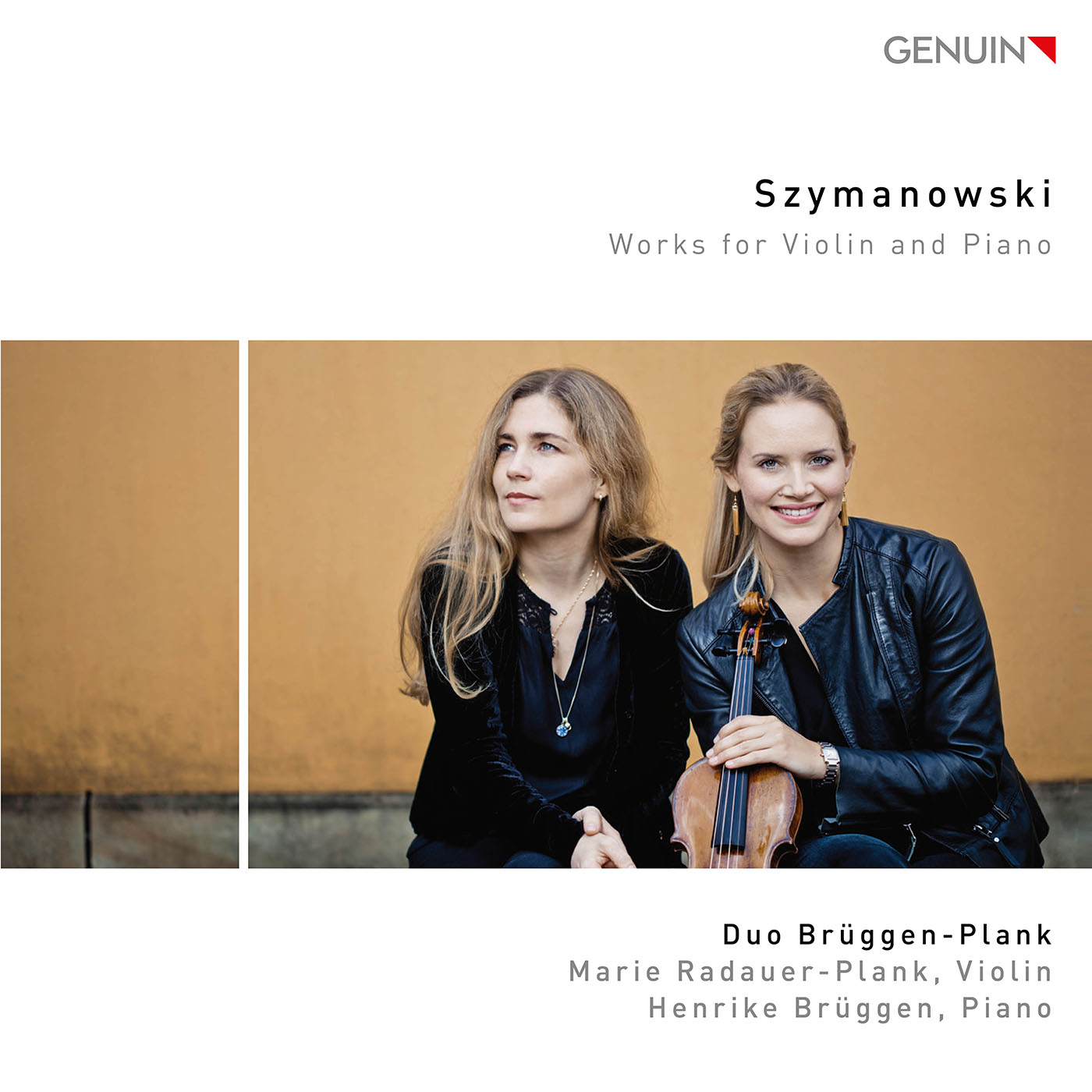
While studying the works of Szymanowski, we quickly discovered the powerful attraction his music exerted on us. It felt as though we had found our own channel for expressing ourselves musically. His language immediately fascinated and thrilled us and we have regularly featured the works of this composer in our recitals since rst performing as a duo in 2007. We are both interested in how human emotional states are addressed, their diversity, expression, homophony and the compatibility of emotionality with today’s “functional” world. Where are the boundaries of what a person can feel, express and communicate? Szymanowski’s works open up new horizons in this area and we hope to be able to convey this richness to all people who are open to this extremely intensive, not always easy to listen to, poetic and fantastic music.
(Henrike Brüggen, Marie Radauer-Plank)
The thrilling contrasts in a composer’s oeuvre are presented by Marie
Radauer-Plank and Henrike Brüggen on their first GENUIN release. The two
artists bring the world of the great Karol Szymanowski, whose death
anniversary will be commemorated on March 29, 2017, to life before our
ears. His music reflects the spirit of his time while drawing
inspiration from ancient sources. It derives its power from the
traditions of his homeland, but remains universal. And all of this can
be heard in the playing of the two young, international prize-winning
musicians: sophisticated yet down-to-earth, incredibly sensual yet
clearly structured – a true discovery!
Suscribirse a:
Entradas (Atom)

-
Music Is The Key will be closing soon. Over the last year maintaining this site and keeping it up to date has become an expensive and tim...

