Mostrando entradas con la etiqueta International Contemporary Ensemble. Mostrar todas las entradas
Mostrando entradas con la etiqueta International Contemporary Ensemble. Mostrar todas las entradas
viernes, 28 de agosto de 2020

sábado, 29 de diciembre de 2018
STEVE REICH Pulse / Quartet
 One of the great minimalists alongside Philip Glass and Terry Riley, Steve Reich
remains heroically unafraid of the blank page. The 81-year-old may no
longer rewrite the rules of modern composition as he did with
revolutionary works such as Piano Phase, Drumming and Music for 18 Musicians, but happily continues to be inspired by younger artists. His Radio Rewrite (2012) evolved from a meeting with Radiohead guitarist Jonny Greenwood, while Pulse uses electric bass to nod to Giorgio Moroder via Daft Punk. The International Contemporary Ensemble make the wistful Pulse
(premiered 2015) sing, with its spiralling, inquisitive strings,
completely free of the tense nervousness of some of Reich’s more
repetitive work. It’s a less complex listen than Quartet (2013), a lightly jazzy essay in key-confounding hypnosis on piano and
vibraphone, written for and performed by Reich’s favourite
percussionists, Colin Currie Group. (Damien Morris / The Guardian)
One of the great minimalists alongside Philip Glass and Terry Riley, Steve Reich
remains heroically unafraid of the blank page. The 81-year-old may no
longer rewrite the rules of modern composition as he did with
revolutionary works such as Piano Phase, Drumming and Music for 18 Musicians, but happily continues to be inspired by younger artists. His Radio Rewrite (2012) evolved from a meeting with Radiohead guitarist Jonny Greenwood, while Pulse uses electric bass to nod to Giorgio Moroder via Daft Punk. The International Contemporary Ensemble make the wistful Pulse
(premiered 2015) sing, with its spiralling, inquisitive strings,
completely free of the tense nervousness of some of Reich’s more
repetitive work. It’s a less complex listen than Quartet (2013), a lightly jazzy essay in key-confounding hypnosis on piano and
vibraphone, written for and performed by Reich’s favourite
percussionists, Colin Currie Group. (Damien Morris / The Guardian)martes, 20 de noviembre de 2018
International Contemporary Ensemble ANNA THORVALDSDOTTIR Aequa

“Internally, I hear sounds and nuances as musical melodies and in my music I weave various textures of sounds together with harmonies and pitched lyrical material. The music is written as an ecosystem of sounds and materials that are carried from one performer — or performers — to the next throughout a progress of a work. As a performer plays a phrase, harmony, texture or a lyrical line it is being delivered to another performer as it transforms and develops, passed on to be carried through until it is passed on again to yet another. All materials continuously grow in and out of each other, growing and transforming throughout the piece.
My music is often inspired in an important way by nature and its many qualities, but I do not strive to describe or literally incorporate elements from nature in my music. To me, the qualities of the music are first and foremost musical — so when I am inspired by a particular element that I perceive in nature, it is because I perceive it as musically interesting. The qualities I tend to be inspired by are often structural, like proportion and flow, as well as relationships of balance between details within a larger structure, and how to move in perspective between the two — the details and the unity of the whole.” (Anna Thorvaldsdottir)
miércoles, 22 de agosto de 2018
International Contemporary Ensemble MARCOS BALTER Æsopica
 ICE’s new release on its in-house label, TUNDRA, highlights a fruitful
seven-year collaboration between the ensemble and Brazilian born
composer Marcos Balter, featuring five world premiere recordings of
works commissioned and championed by the group. Balter’s music absorbs
techniques and aesthetics from across the compositional spectrum,
adapting them to a sensibility that is consistently sensual, colorful,
and immediate. The connection between ICE and Balter runs through
Chicago, where he served on the composition faculty at Columbia College.
Wicker Park, written for ICE saxophonist and former Chicago
resident Ryan Muncy, celebrates a Chicago neighborhood known for its
bohemian spirit and DIY arts scene. Codex Seraphinianus, for
flute, soprano saxophone, viola, and bassoon, is an eleven movement
suite inspired by an encyclopedia of imaginary objects by Italian
designer Luigi Serafini. The Art Institute of Chicago asked Claire Chase
to commission a composer to write a work inspired by the musuem’s
permanent collection. The result, inspired by Cy Twombly’s Return from Parnassus, is Balter’s Descent from Parnassus,
a tour de force solo flute work that is two pieces happening
simultaneously — a virtuoso flute solo and a breathless recitation of
Book One of Dante’s Canto Paradiso at the same time. ligare for six instruments employs subtle microtones and whistling to create an atmospheric, disembodied soundscape. The final work, Æsopica, was Balter’s first large ensemble piece for ICE. Based on Aesop’s fables, Æsopica
sets this famous work for children through contemporary music, as
Balter draws on his wide pallette to paint whimsical vignettes of sound
and fantasy. This disc, then, is a partial compendium of Balter’s work
over recent years, indeed, in the liner notes, he writes, “My music for
ICE is very much like a diary of my own trajectory as a composer.”
ICE’s new release on its in-house label, TUNDRA, highlights a fruitful
seven-year collaboration between the ensemble and Brazilian born
composer Marcos Balter, featuring five world premiere recordings of
works commissioned and championed by the group. Balter’s music absorbs
techniques and aesthetics from across the compositional spectrum,
adapting them to a sensibility that is consistently sensual, colorful,
and immediate. The connection between ICE and Balter runs through
Chicago, where he served on the composition faculty at Columbia College.
Wicker Park, written for ICE saxophonist and former Chicago
resident Ryan Muncy, celebrates a Chicago neighborhood known for its
bohemian spirit and DIY arts scene. Codex Seraphinianus, for
flute, soprano saxophone, viola, and bassoon, is an eleven movement
suite inspired by an encyclopedia of imaginary objects by Italian
designer Luigi Serafini. The Art Institute of Chicago asked Claire Chase
to commission a composer to write a work inspired by the musuem’s
permanent collection. The result, inspired by Cy Twombly’s Return from Parnassus, is Balter’s Descent from Parnassus,
a tour de force solo flute work that is two pieces happening
simultaneously — a virtuoso flute solo and a breathless recitation of
Book One of Dante’s Canto Paradiso at the same time. ligare for six instruments employs subtle microtones and whistling to create an atmospheric, disembodied soundscape. The final work, Æsopica, was Balter’s first large ensemble piece for ICE. Based on Aesop’s fables, Æsopica
sets this famous work for children through contemporary music, as
Balter draws on his wide pallette to paint whimsical vignettes of sound
and fantasy. This disc, then, is a partial compendium of Balter’s work
over recent years, indeed, in the liner notes, he writes, “My music for
ICE is very much like a diary of my own trajectory as a composer.”lunes, 9 de julio de 2018
Patricia Kopatchinskaja MICHAEL HERSCH End Stages - Violin Concerto

Virtuoso violinist Patricia Kopatchinskaja, for whom Michael Hersch's
Violin Concerto was composed, wrote recently of the piece that it ''is
an open wound, there is no other way to say it.'' She continued, the
work ''is so convincing ... moves me so deeply, makes me speechless,
tolerates neither doubt nor objection. It is like a mountain one can't
ignore ... everything is crystal clear, there is no decoration, no
superficial beauty, no compromises. Everything is exactly in place, has
found its perfect form.'' A follow up to his haunting ''Images from a
Closed Ward'', New Focus releases Hersch's Violin Concerto, performed by
Kopatchinskaja with the International Contemporary Ensemble (ICE), and
end stages in a performance by the Orpheus Chamber Orchestra. With both
pieces, Hersch reinforces his reputation as a composer of gripping
music, unafraid to tackle through sound the most vulnerable and
difficult corners of the human psyche. Patricia Kopatchinskaja displays
remarkable versatility in her diverse repertoire, ranging from baroque
and classical often played on gut strings, to new commissions and
reinterpretations of modern masterworks. Called ''America's foremost new
music group'' by The New Yorker, the ICE is an artist collective that
is transforming the way music is created and experienced. As performer,
curator, and educator, ICE explores how new music intersects with
communities across the world. Committed to innovation and artistic
excellence, Orpheus is considered among the finest chamber ensembles in
the world. Orpheus was founded in 1972 by a group of like-minded young
musicians determined to combine the intimacy and warmth of a chamber
ensemble with the richness of an orchestra.
domingo, 30 de agosto de 2015
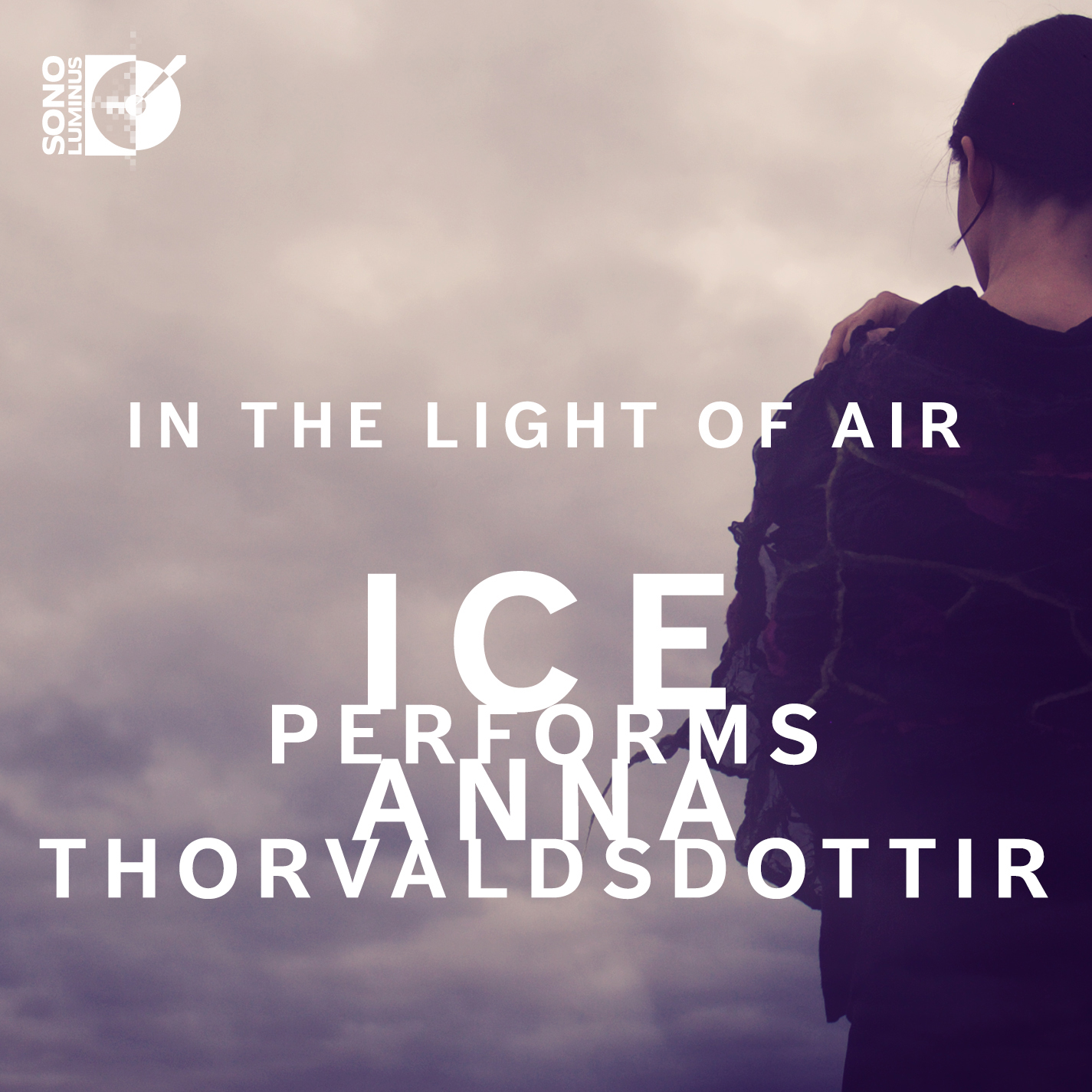
International Contemporary Ensemble ANNA THORVALDSDOTTIR In The Light Of Air

And while we’re on the topic of ICE, let it be known that they are not your average ensemble. With a modular makeup of 35 leading instrumentalists, the group performs contemporary classical music in forces ranging from solos to large ensembles. In fact, they make it their mission to advance the music of the 21th century by pioneering new musical works and multimedia strategies for audience engagement.
In 2011 they created ICElab, an innovative new musical project which places teams of ICE musicians in collaboration with emerging composers to develop works that push the boundaries of the classical genre.
ICE’s latest album, titled “In the Light of Air: ICE Performs Anna Thorvaldsdottir,” is just a single product of that collaborative project. The album features two gorgeously enigmatic pieces: “In the Light of Air” for viola, cello, harp, piano, percussion, and electronics, and “Transitions” for solo cello. The performers on the album are ICE members Kyle Armbrust on viola, Michael Nicolas on cello, Nuiko Wadden on harp, Cory Smythe on piano, and Nathan Davis on percussion.
The title track is a tetralogy of works that together form a unified
structure—the four main movements are connected by texturally
fascinating transitions and framed by a prologue and epilogue. The first
movement is an airy, delicate sound world aptly titled “Luminance.” The
percussion and electronics provide a slowly rumbling bass part beneath a
gradually shifting texture of sound materials, melodic fragments, and
harmonies.
The second movement, titled “Serenity,” is an entire ocean of sound:
infinitely varied yet beautifully unified in its ever-changing timbres
and textures. The translucent calm sparkles with gorgeous harp details
and gentle piano echoes, the vast and limitless soundscape punctuated
with delicate, misty whispers of simple melodies.
The third movement is much shorter than the rest. Clocking in at less
than four minutes, “Existence” is a slow and pensive journey, each bow
stroke in the strings a deliberate, measured step through an atmospheric
sound mass of deep drones and rumbling echoes.
The piece ends with “Remembrance,” a movement which delicately
balances the lyrical, long-breathed melodies of the strings with the
harmonic depth of piano and the textural interest of percussion. In
fact, the percussion part features an installation of metallic ornaments
which Thorvaldsdottir designed specifically for use in this particular
movement. The ornaments, called Klakabönd (which is Icelandic for “a bind of ice”), were created by artist Svana Jósepsdóttir.
The other piece on the album is “Transitions,” which was commissioned by
cellist Michael Nicolas in 2014. The single movement work explores the
theme of man and machine, both of which are represented through
contrasting cello parts. Nicolas soars through the organic lyricism and
expressive melodies of man while also excelling at the metallic timbres
and technical accuracy of machine. Through his sensitive balance and
imaginative interpretation of each role, he showcases the cello’s rich
tone, wide pitch range, and stunning timbral depth. (Maggie Molloy)
Suscribirse a:
Entradas (Atom)

-
Music Is The Key will be closing soon. Over the last year maintaining this site and keeping it up to date has become an expensive and tim...