
Mostrando entradas con la etiqueta Royal Scottish National Orchestra. Mostrar todas las entradas
Mostrando entradas con la etiqueta Royal Scottish National Orchestra. Mostrar todas las entradas
lunes, 6 de septiembre de 2021

martes, 3 de noviembre de 2020

sábado, 24 de octubre de 2020

miércoles, 27 de mayo de 2020

domingo, 17 de mayo de 2020

martes, 5 de mayo de 2020

domingo, 26 de abril de 2020

jueves, 16 de mayo de 2019
Royal Scottish National Orchestra / John Mauceri / Sandy Cameron DANNY ELFMAN Violin Concerto "Eleven Eleven"

Violin Concerto (Eleven Eleven) And Piano Quartet are the sensational
new works on the new album from the Grammy winning, four time Oscar
nominated composer Danny Elfman. Danny Elfman has composed more than 100
film and television scores these include the critically acclaimed films
Men In Black, Good Will Hunting, Nightmare before Christmas and
Spider-man. The Violin Concerto (Eleven Eleven) is performed by the
internationally renowned Royal Scottish National orchestra and the
outstanding violinist Sandy Cameron. Also featured on this album is the
Piano Quartet performed by members of the incredible Berlin Philharmonic
Orchestra.
domingo, 16 de diciembre de 2018
Xiayin Wang / Royal Scottish National Orchestra / Peter Oundjian TCHAIKOVSKY Piano Concerto No.1 - Piano Concerto No. 3 SCRIABIN Piano Concerto

Following her acclaimed recording of Tchaikovskys Piano Concerto No. 2
in 2016 (Editors Choice, Gramophone), Xiayin Wang here completes the
trio with No. 1 and the posthumously published No. 3, alongside
Scriabins only concerto. Whether Tchaikovsky gave his consent to the
virtuoso Alexander Ziloti to revise his Piano Concerto No. 1 is unknown,
but Wang here presents the lesser-recorded original version. Piano Concerto No. 3 was originally begun as a symphony, all of which except
the first movement was ultimately abandoned; that surviving movement was
later completed as a singlemovement concert work for piano and
orchestra. Scriabin finished his piano concerto in only a few days,
although it took months to orchestrate it before the 1897 premiere.
Sensitively played by Wang, the concerto shows a naïve charm that even
Scriabin, at his most translucent, would struggle to recapture once his
career got underway.
lunes, 14 de mayo de 2018
Jan Vogler / Mira Wang / Royal Scottish National Orchestra / Peter Oundjian DOUBLE CONCERTOS

On 11 May 2018, German cellist Jan Vogler will release his new CD with
Sony Classical: Together with violinist Mira Wang and the Royal Scottish
National Orchestra conducted by Peter Oundjian they have recorded
double concertos by Johannes Brahms, Wolfgang Rihm and John Harbison.
Through Jan Vogler’s initiative two renowned contemporary composers –
American John Harbison and German Wolfgang Rihm – were each to compose a
work for violin, violoncello and orchestra, which will now be released
as world premiere recording.
Both pieces – Wolfgang Rihm’s “Duo Concerto” as well as John Harbison’s “Double Concerto” – were premiered by Jan Vogler and his wife, violinist Mira Wang in the USA.
Both pieces – Wolfgang Rihm’s “Duo Concerto” as well as John Harbison’s “Double Concerto” – were premiered by Jan Vogler and his wife, violinist Mira Wang in the USA.
Jan Vogler and Mira Wang about this new recording:
"Brahms’ singular master work stood alone for over a century, without notable challenge by new compositions for the same unique instrumentation. We are happy and proud to have helped to bring two beautiful and strong double concertos to life. Wolfgang Rihm’s virtuous double concerto in one movement and John Harbison‘s poetic and symphonic work are framing Brahms’ double concerto on this CD. For us it feels like a completed circle, from the first idea through the creations and premieres, to the presentation on this recording."
"Brahms’ singular master work stood alone for over a century, without notable challenge by new compositions for the same unique instrumentation. We are happy and proud to have helped to bring two beautiful and strong double concertos to life. Wolfgang Rihm’s virtuous double concerto in one movement and John Harbison‘s poetic and symphonic work are framing Brahms’ double concerto on this CD. For us it feels like a completed circle, from the first idea through the creations and premieres, to the presentation on this recording."
sábado, 5 de mayo de 2018
Doric String Quartet / Royal Scottish National Orchestra / Peter Oundjian JOHN ADAMS Naive and Sentimental Music - Absolute Jest

As part of his final year as Music Director and following a
two-season celebration of the Orchestra’s 125th anniversary, Peter
Oundjian and the RSNO here present their second recording of music by
John Adams, with the exceptional participation of the Doric String
Quartet.
Written for a large orchestra including six percussionists, keyboard sampler, and amplified steel-string guitar, Naive and Sentimental Music
is a sweepingly symphonic masterpiece, full of contrasts and clashes.
It reflects the dichotomy between ‘naive’ and ‘sentimental’ poetry as
analysed by Friedrich Schiller in his 1795 essay Über naive und sentimentalische Dichtung,
as well as the ‘bipolar’ musical life of Esa-Pekka Salonen, the
dedicatee of this piece, who conducted the first performance with the
Los Angeles Philharmonic in 1999.
Absolute Jest is a large-scale scherzo for amplified string
quartet and orchestra, heavily inspired by the music of Beethoven, which
Adams has always deeply admired. The quartet of soloists, a late
addition to the score, emphasises the echoes of Beethoven’s music
(mainly his string quartets) and facilitates a ‘hyperspace rate’ of
virtuosity, which the Doric String Quartet here perfectly demonstrates.
miércoles, 7 de marzo de 2018
Xiayin Wang / Royal Scottish National Orchestra / Peter Oundjian TCHAIKOVSKY Piano Concerto No. 2 KHACHATURIAN Piano Concerto
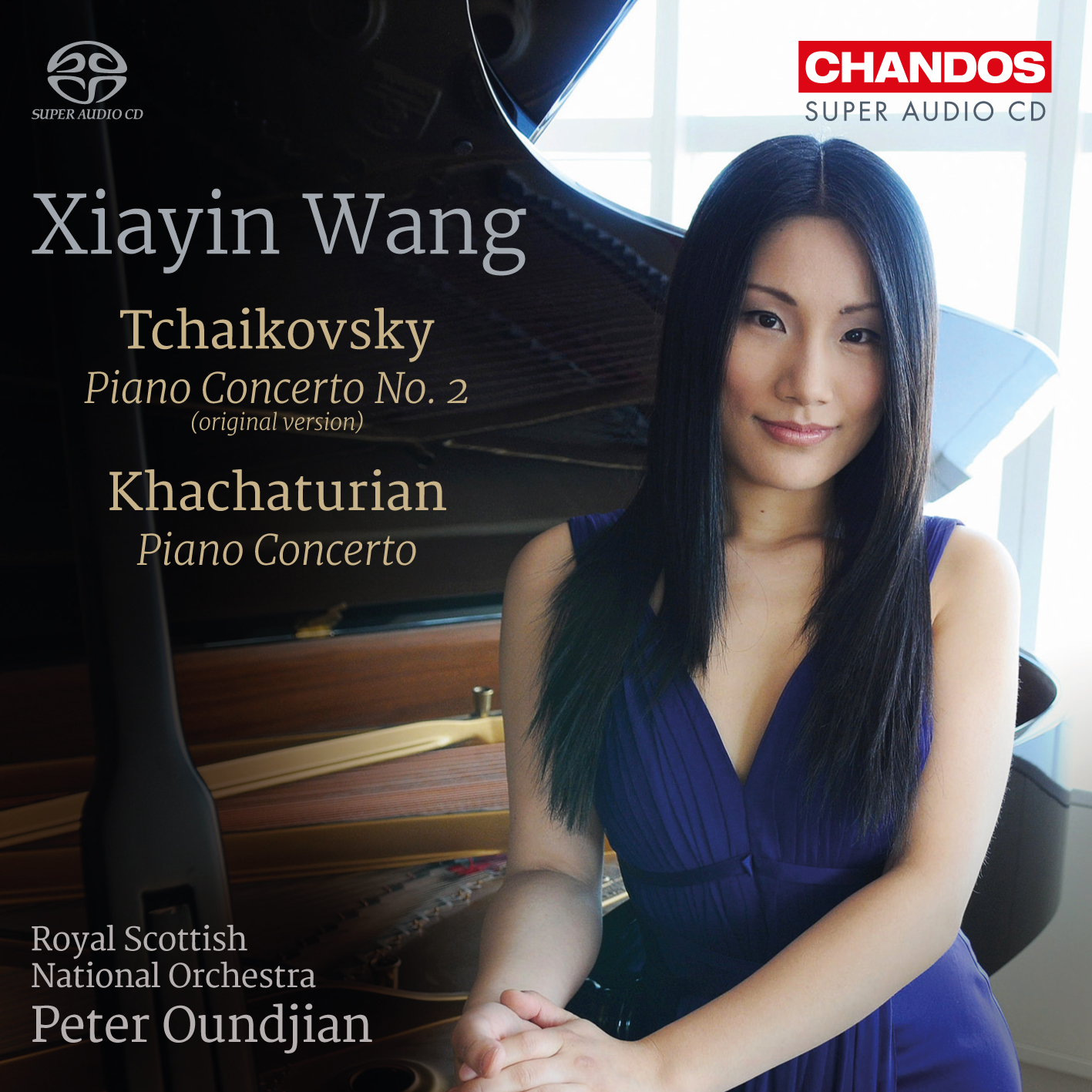
It’s always a pleasure when, like Fry’s Five Boys Chocolate (if
you’re old enough to remember), realisation exceeds anticipation. From
the first bar (no chocolate pun intended), you know that this brilliant
Chinese-American pianist is the business. As on her earlier concerto
disc of Copland, Barber and Gershwin with the same partners, she
leads from the front throughout to exhilarating effect.
For those to whom such things are important (as I know they are
from a review I penned last year of Denis Matsuev in the Tchaikovsky
Second), the score is played complete in its original version – ie no
cuts in the first movement and with the 16 bars included at the end of
the second movement which Tchaikovsky removed in its revised form. To
help us find our way during the lengthy first movement, Chandos has
helpfully added three entry points. The two soloists in the second
movement are credited, unlike those on Matsuev’s recording, who,
however, I marginally prefer for their more espressivo solos.
The Khachaturian is, presumably, a replacement for Chandos of its
well-regarded recording with Constantine Orbelian, Neeme Järvi and the
same orchestra. Sumptuously engineered, the newcomer, unlike
several other much-vaunted versions (Berezovsky) in inferior sound
(Kapell, Lympany), takes Khachaturian at his word as far as tempi are
concerned, markedly similar to the live performance conducted by the
composer with Nikolai Petrov in 1977. Chandos, as
before, has gone to the trouble of hiring a flexatone for the spectral
second movement (the player, alas, is not credited). Xiayin Wang plays
the stamina-sapping solo part with all the conviction and exuberance
needed, though no one has ever quite matched the climax of the first
movement cadenza as recorded by Peter Katin, the LSO and Hugo Rignold
back in 1959 – a thrilling moment ‘captured in
one lucky take,’ so Katin once told me. If you do not have a recording
of the Tchaikovsky, then this is up with the very best; likewise the
Khachaturian. Paired together, it’s a no-brainer. (Jeremy Nicholas / Gramophone)
lunes, 19 de febrero de 2018
Royal Scottish National Orchestra / Stéphane Denève GUILLAUME CONNESSON Cosmic Trilogy - The Shining One

There’s a new generation of French composers we know little about on
this side of the channel, names like Bacri, Beffa, Escaich, Zavaro, and
Connesson, now around 40 (see Philip Clark, 1/10, for details of the
French context). Thanks to this CD and Connesson’s association with the
Royal Scottish National Orchestra we can start to discover more about
him.
Aleph, the first part of Connesson’s Cosmic Trilogy,
was commissioned by the RSNO and dedicated to its French conductor. The
whole cycle is involved with ideas deriving from Stephen Hawking and
Kandinsky but Aleph makes an orchestral showpiece on its own – a kind of supercharged version of Ravel’s Daphnis with more than a hint of John Adams.
Connesson admits that his style is eclectic but the much longer
second section, also an RSNO commission, lacks the rhythmic impetus that
sustains the first one and it wanders in a kind of Debussian reverie.
The third section, Supernova, actually written first, inhabits
the limitless vistas of outer space. Influences stream past – Messiaen,
Milhaud, Bartók, Stravinsky, film music – in an efficiently scored
panoply. The CD ends oddly with The Shining One, described as a
piano concerto although it lasts only nine minutes. There’s a central
section that starts by recalling John Ireland – that must be a
coincidence – before the piece whips up to a hyperactive finish.
Committed performances vividly recorded. (Peter Dickinson / Gramophone)
lunes, 17 de julio de 2017
Xiayin Wang / Royal Scottish National Orchestra / Peter Oundjian AMERICAN PIANO CONCERTOS

The young Chinese-born pianist Xiayin Wang, now
resident in the USA, has been enthralling audiences worldwide and
gaining ever greater international acclaim with her winning combination
of consummate technical brilliance, fine musicianship, and personal
verve. Equally renowned as a recitalist and chamber musician, she is
here the soloist in three great piano concertos by the American
composers George Gershwin, Aaron Copland, and Samuel Barber, performed
with the Royal Scottish National Orchestra under Peter Oundjian.
The Concerto in F by Gershwin, composed in 1925,
represents one of his finest syntheses of the classical and jazz
traditions. His extraordinary skill as a tunesmith is heard in full
force within the concerto’s three movements, the work expressing his
‘unabashed delight in the stridency, the gaucheries, the joy and
excitement of life as it is lived right here and now’. Xiayin Wang has
already shown her natural affinity with Gershwin’s music in her previous
Chandos release, playing Earl Wild’s Gershwin transcriptions with
‘verve, brilliance and sheer delight’, as American Record Guide put it.
Copland’s Piano Concerto from 1927 is another work
influenced by jazz. At the time of its premiere, comparisons were
inevitably drawn between this and Gershwin’s Concerto but Copland
dismissed the influence of Gershwin. Rather, his style reflects the jazz
elements used by composers living in Paris in the 1920s, such as
Milhaud and Stravinsky. The work’s two distinct sections reflect what
Copland believed to be the two basic moods of jazz, ‘the slow blues and
the snappy number’.
Barber’s Pulitzer Prize winning Concerto for Piano dates from 1962. Like the other two works on the disc it shows the
diversity of influence in American music in the twentieth century.
Moments of harmonic ambiguity and muscular dissonance reflect Barber’s
interest in Russian music, a subtle jazz influence enriching the musical
language, especially in the rhythms of the compact finale. The music
manifests a dramatic and rhetorical style, however, that is deeply
rooted in a romanticism which pervades all of Barber’s output.
miércoles, 4 de mayo de 2016
Royal Scottish National Orchestra / Martyn Brabbins SALLY BEAMISH Violin Concerto - Callisto - Symphony No. 1

Sally
Beamish has enjoyed a productive association with BIS, which now
releases three works involving full orchestra. The Violin Concerto
(1994) is among her most immediate statements: its three movements,
prefaced by quotes from Erich Maria Remarque’s novel about the First
World War, All Quiet on the Western Front, proceed from a
powerfully rhetorical conflict between soloist and orchestra, via a
ruminative “intermezzo”, to a tense finale whose outcome is decisive if
far from affirmative. Vividly scored (with some evocative writing for
cimbalom), the work is ideally suited to Anthony Marwood’s blend of
incisiveness and eloquence – as is Callisto (2005) to Sharon Bezaly’s resourceful flute playing. Here inspiration came from Ted Hughes’s translation of Ovid’s Metamorphoses,
Callisto’s transformations being represented by four types of flute and
the “celestial beings” of Diana, Jove and Juno respectively by horn,
trombone and trumpet – resulting in music by turns capricious, plangent
and transcendent.
Yet the First Symphony (1992) leaves the strongest impression
here. Beamish’s first work for orchestra is a set of double variations
that integrates traditional Scottish bagpipe music with a paraphrase on
Psalm 104, the outcome being a seamless though cumulative span that
unfolds with truly “symphonic” inevitability. It makes no mean impact in
this performance, Martyn Brabbins drawing a committed response from the
Royal Scottish National players, who are hardly less attentive in the
concertos. Spaciously recorded and with informative notes by the
composer, this disc is ostensibly a first port of call for those new to
Beamish’s music. (Gramophone)
Suscribirse a:
Entradas (Atom)


