Mostrando entradas con la etiqueta Julia Lezhneva. Mostrar todas las entradas

sábado, 24 de marzo de 2018

Julia Lezhneva / Franco Fagioli / Diego Fasolis VIVALDI Gloria

Julia Lezhneva, Franco Fagioli and Diego Fasolis: three stars of the Baroque unite to record Vivaldi’s most popular choral work. Julia Lezhneva – “a serene, sleek voice, beatific in timbre, with a bell-like resonance” (Financial Times) – adds the glorious solo motet Nulla in Mundo Pax Sincera. Franco Fagioli – “one of today's great vocal technicians” (The Guardian) – records the Nisi Dominus with its haunting ‘Cum Dederit’. Diego Fasolis and I Barocchisti are today’s Vivaldi interpreters par excellence.

jueves, 18 de enero de 2018

Capella Cracoviensis / Jan Tomasz Adamus NICOLA PORPORA Germanico in Germania

As interest in the Italian opera serie of the eighteenth century has grown apace in recent years, Handel’s operas are now seen as increasingly mainstream, and several works by Vivaldi and other contemporaries have again seen the light of day, including a few by Nicola Porpora.
However, until now, Germanico in Germania has, with the exception of one or two arias, remained firmly hidden on library shelves scattered around Europe. During his lifetime Porpora was as famous as a teacher of singing as for his compositions, so it is little wonder that his score is a veritable feast of vocal delights ripe for resurrection. Born in Naples on 17August 1686 and educated at the city’s Conservatorio dei Poveri di Gesù Cristo, Porporas first opera, Agrippina , was given at the Neapolitan court in 1708. During the period 1715 to 1721, while maestro di cappella at the Naples Conservatorio di San Onofrio he also gained a reputation as a singing teacher: his most famous pupil was the castrato Farinelli. 

“Mr Cencic is blessed with the finest countertenor voice of our day.” That was the view of the German magazine Opernwelt back in 2008, and ever since Cencic has strengthened his iconic status among present-day countertenors, with a combination of beautiful, pure tone and passionate delivery.
Born in 1976 in Zagreb, Cencic first came to public attention aged six singing the Queen of the Night aria from the Magic Flute. He went on to sing with the Vienna Boys Choir, touring widely and launching his solo career in 1992 as a male soprano, followed in 2001 as a countertenor.
In this world premiere recording, Max Emanuel Cencic unearths Porpora’s opera Germanico in Germania.
Cencic is supported by a world-class cast, including star soprano Julia Lezhneva, and Capella Cracoviensis under the baton of Jan Tomasz Adamus.
Performed on period instruments from a brand new edition, this is a highly authoritative recording.

lunes, 11 de septiembre de 2017

Accentus / Orchestre de Chambre de Paris / Ottavio Dantone ROSSINI Petite Messe solennelle

Starring Julia Lezhneva, Ottavio Dantone and accentus, this live recording brings a new and fresh light on Rossini's most famous choral work. The concert took place in Paris - Basilique de Saint-Denis, to celebrate the 150th anniversary of the work, first performed in March 1864, in Paris. The amazing quality of the solo voices (Julia Lezhneva, Delphine Galou, Michael Spyres, Alexander Vinogradov) meets the dynamic direction of Ottavio Dantone and is supported by the vocal dexterity of accentus chamber choir.
“Because of its uncommon instrumental forces, the ‘chamber’ version of the 'Petite Messe', for two pianos and harmonium, was long regarded as the definitive version; the orchestration Rossini made in 1867-68 was viewed as merely an arrangement. In his recent critical edition, Davide Daolmi presents a different interpretation, which makes the orchestrated version the culmination of a long genetic process, begun in 1862, in which the ‘chamber’ version is merely an intermediate stage. The posthumous premiere of the definitive version of the 'Petite Messe', which was also the work’s first public performance, took place at the Théâtre-Italien on 28 February 1869, the anniversary of the composer’s birth, with Gabrielle Kraus (soprano), Marietta Alboni (contralto), Ernest Nicolas (tenor), and Luigi Agnesi. It was at once a triumph and a highly emotional occasion. A few years later, on 30 May 1876, Verdi was to conduct his 'Messa da requiem' in the same theatre, thus continuing the homage to the great Italian composer.” (from the booklet notes)

viernes, 14 de abril de 2017

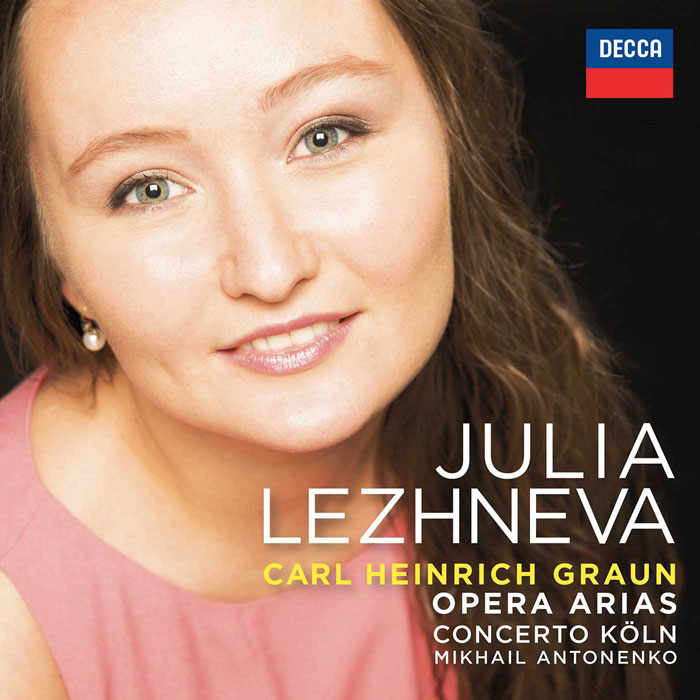
Julia Lezhneva / Concerto Köln / Mikhail Antonenko CARL HEINRICH GRAUN Opera Arias

Julia Lezhneva is one of the leading artists of her generation. The young Russian soprano with the voice of ”angelic beauty” (The New York Times), “pure tone” (Opernwelt) & “flawless technique” (Guardian) brings “unforgettable spiritual expression” & “perfect artistry” (Guardian) performing worldwide. Her international career skyrocketed when she created a sensation at the Classical Brit Awards at London’s Royal Albert Hall in 2010, singing Rossini’s Fra il padre at the invitation of Dame Kiri Te Kanawa. 
Born December 5 1989 in a family of geophysicists on Sakhalin Island, she began playing piano and singing at the age of five. She graduated from the Gretchaninov Music School and continued her vocal and piano studies at the Moscow Conservatory Academic Music College.. At 17 she came to int attention winning the 6th Elena Obraztsova Opera Singers Competition 2007, and next year shared the concert stage with Juan Diego Flórez at the opening of the Rossini Opera Festival in Pesaro. 

World-premiere Decca album is OUT!
Julia Lezhneva discovers arias written by forgotten genius for the greatest singers of the time – Giovanna Astrua, GIovanna Gasparini and castrato Antonio Uberti detto ‘Porporino’.
She is partnered by Concerto Köln and conductor Mikhail Antonenko.

jueves, 12 de noviembre de 2015

Julia Lezhneva / Il Giardino Armonico / Giovanni Antonini HANDEL

The young Russian soprano Julia Lezhneva has been described as possessing an “angelic voice” (The New York Times) with “pure tone” (Opernwelt) and “flawless technique” (The Guardian). They are big claims, and she has been living up to them ever since she created a sensation at the Classical Brit awards at London’s Royal Albert Hall in 2010, singing Rossini’s Fra il padre at the invitation of Dame Kiri Te Kanawa. 
Born into a family of geophysicists on Sakhalin Island in 1989, she began playing the piano and singing at the age of five. She graduated from the Gretchaninov Music School and continued her vocal and piano studies at the Moscow Conservatory. At 17 she came to international attention winning the Elena Obraztsova International Competition, and at 18 shared the concert stage with Juan Diego Flórez at the opening of the Rossini Opera Festival in Pesaro. In 2008 she began studying with tenor Dennis O’Neill in Cardiff, completing her training under Yvonne Kenny at London’s Guildhall School. She has also attended masterclasses with Elena Obraztsova in St. Petersburg, Alberto Zedda in Pesaro and Thomas Quasthoff in Verbier. In 2009 she won first prize at the Mirjam Helin International Singing Competition in Helsinki and the following year she took first prize at the Paris International Opera Competition, the youngest entrant in each competition’s history. 
The emphasis for this album is very much on youth and prodigious talent: at 25, Julia Lezhneva is ideally suited to the soprano arias of the young Handel, who arrived in Italy from Germany as a 21 year old at the beginning of the 18th century.
She has the perfect partners in Il Giardino Armonico and Giovanni Antonini whose recordings of music from the Italian baroque are celebrated for their “fizzing virtuosity” and “exquisite cushion of sound” (The Independent). For some tracks the orchestra is led by Dmitry Sinkovsky, the extraordinary Russian violinist and one of today’s most versatile Baroque musicians.
The music encompasses the best of Handel’s operatic and religious works from his years in Florence and Rome: the operas Rodrigo and Agrippina and the oratorios Il Trionfo and La Resurrezione as well as the complete Salve Regina and soprano solo from Dixit Dominus. Best known is the radiant “Lascia la spina” from Il Trionfo and its later incarnation as “Lascia ch'io pianga” from the opera Rinaldo.
The recording was made in the famously musical and historic Italian city of Cremona in the beautiful auditorium of the Museo del Violino.