Mostrando entradas con la etiqueta Lambert Orkis. Mostrar todas las entradas

viernes, 10 de agosto de 2018

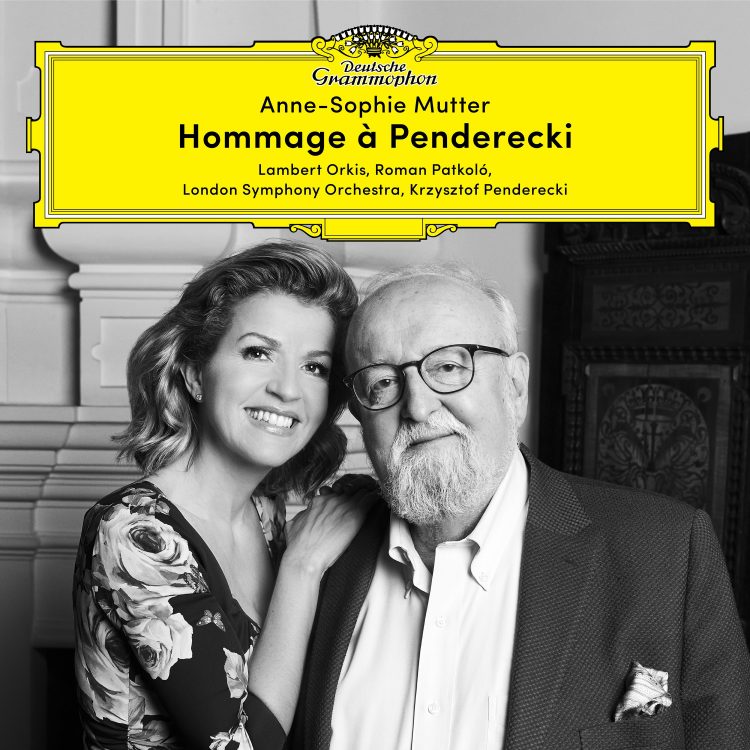
Anne-Sophie Mutter HOMMAGE À PENDERECKI

The violinist Anne-Sophie Mutter and the composer and conductor Krzysztof Penderecki are among the leading musical figures of our age. For more than thirty years these two outstanding musicians have been close friends, and during that time their friendship has proved a fruitful one, repeatedly inspiring and challenging both parties. To mark the composer’s eighty-fifth birthday Deutsche Grammophon is now releasing a very special double album featuring Anne-Sophie Mutter both as a soloist and in partnership with a number of colleagues. All the works that are included here reflect Penderecki’s unique musical language in fascinatingly intense and multifaceted ways. The result is a sensitive and moving homage on the part of the violinist to a musical friend whose Second Violin Sonata she has recorded for the first time.
Penderecki’s works have an existential depth to them that goes far beyond the sheer sensuousness of the musical world that they inhabit. Anne-Sophie Mutter compares their complex, multifaceted nature to the canvases of Pablo Picasso, so varied, extreme and contrastive are they. For the composer himself these works are the end result of a creative process that is both tireless and extremely demanding. As he himself puts it: “I like travelling uncharted pathways. I have to do this whenever I compose, otherwise nothing comes out. I start somewhere in the middle of a work, before moving to the right or left and time and again having to get back on course, which often means retracing my steps. I continue to compose until it becomes clear to me that I could really do it much better. I then start at the beginning.” Penderecki has retained this self-critical attitude right up to the present day. It is an attitude that places enormous demands on him. The works that have come into existence in this way afford impressive proof of his uncompromising dedication to music and provide thrilling evidence of his ability to explore the emotional extremes of human existence.
This double album brings together various pieces that Penderecki has written for the violin and that are performed by Anne-Sophie Mutter in ways that bring out their wealth of tone colours and captivating expressivity, while also striking a personal note. In addition to La Follia, a virtuoso set of variations for unaccompanied violin, and the dialogue-like concert duet for violin and double bass that Anne-Sophie Mutter has recorded with the bass player Roman Patkoló, it is two large-scale, complex works that are at the heart of the present release. Both reflect Penderecki’s multilayered and hugely expressive art of composition. Laid out along symphonic lines, the Second Violin Concerto – subtitled Metamorphosen – was premiered by Anne-Sophie Mutter in 1995: “For me this task is physically and psychologically challenging, but it is a challenge that I am grateful to accept,” says the violinist about the extremely demanding and contrastive work, in which Penderecki provides a virtuoso amalgam of the most varied styles. Like the Second Violin Concerto, the Second Violin Sonata is dedicated to Anne-Sophie Mutter, who has recorded it for the present album with the pianist Lambert Orkis. The piece is in five movements and resembles a dramatic disquisition on life that ultimately leaves the listener emotionally moved.
Penderecki and Mutter have been friends for many years. It is a friendship that has proved inspirational. They first got to know each other in the early 1980s, although it was not until 1988 that they began to work together closely. This was the year in which the then twenty-five-year-old violinist played Prokofiev’s First Violin Concerto under Penderecki’s direction. From the outset the conductor was fascinated by her musical maturity. Their musical association has lasted until the present day. For Anne-Sophie Mutter, it is “far more than mere admiration that has bound me to Krzysztof Penderecki’s works for several decades. I am shaken to the very roots of my being by the depth of emotion that issues from them – almost more than I am by his genius as a composer.” With this double album, Hommage à Penderecki, the violinist pays touching tribute to a truly exceptional composer and to their mutual friendship.

viernes, 25 de septiembre de 2015

Anne-Sophie Mutter / Lambert Orkis THE SILVER ALBUM

Chemistry is one of the most mysterious aspects of the performing arts, especially when it comes to music. In athletics, the chemistry among teammates is almost always right before us. When Larry Bird made eyes-closed, over-the-head, backwards passes to Kevin McHale or Robert Parish, we had the benefit of watching slow-motion replays. And even before television, when the early 20th Century Chicago Cubs turned a double play, going from "Tinkers to Evers to Chance" (as a famous poem says), the North Side crowd in the stands could see that unspoken understanding among the three players at work before their eyes.
Musical chemistry, when right, is almost impossible to discern. Two musicians with an innate, natural understanding of interpretation and expression meld together seamlessly when that chemistry is at its best.
Such is the case with violinist Anne-Sophie Mutter and pianist Lambert Orkis. To be clear, either one of these two raises the level of any collaboration to new heights. But when combined, their vision is as one, reaching a transcendence few other duos can match.
They first worked together in 1988, and to mark the occasion of a quarter-century of shared musical experiences, they've released The Silver Album.
Over the course of two discs, the duo treats us to sonatas by Beethoven, Brahms, Mozart, and Fauré. A few of the lovely encores by Fritz Kreisler make for a sweet palette cleanser, including Schön Rosmarin, Caprice viennois, and Liebeslied. And a dose of spice kicks in with a few Hungarian Dances by Brahms.
Two recent works, both dedicated to Anne-Sophie Mutter, give the collection a variety only music of our time can provide. La Follia was written by Krzysztof Penderecki last year as the composer celebrated his 80th birthday (which included a visit to the Boston Symphony Orchestra). And André Previn's Sonata for Violin and Piano No. 2, completed in 2011, received its first performance only six months ago.
According to Gavin Plumley at Sinfini Music, The double-disc survey opens with a punchy rendition of Beethoven’s Seventh Violin Sonata, in which the pair offers fiery counterpoint and lustre in more lyrical passages. It’s an approach that pays equally impressive dividends in Brahms’s Second Sonata and Hungarian Dances, as well as Penderecki and Previn’s new works for the duo. The solo La Follia, by the Polish composer, is full of Baroque flash and finesse, while Previn’s Second Violin Sonata bridges past and present with considerable panache. (WGBH)

miércoles, 2 de septiembre de 2015

Anne-Sophie Mutter THE CLUB ALBUM Live from Yellow Lounge

In May 2015 Anne-Sophie Mutter put her noble, impressively named “Lord Dunn-Raven” Stradivarius through more than its usual paces. For a change, rather than standing on stage in one of the world’s renowned grand concert halls, she spent two evenings playing in a tiny graffiti-scrawled nightclub in the Friedrichshain district of Berlin. The name of the club was Neue Hei- mat, or “new home”, and on two evenings in early summer it was jam-packed with hip young people. The atmosphere heated up in the usual way for such clubs, but not in the usual way for Anne- Sophie Mutter’s concerts. As she later put it: “It wasn’t good for the Strad’s wood. I’m the sort of person who usually sweats discreetly beneath my clothes. But it was extremely hot in the club, and in the long run it put a big strain on the varnish. So to prevent the original varnish from becoming damaged we applied a thin protective coat to the Strad where it touches my bare skin. But any instrument over 300 years old is bound to show signs of wear and tear.” 
But what’s a Strad doing in a Berlin nightclub? And how did a world-famous violinist wind up in such a place? What looks at first glance like a mistake is, in fact, nothing more than a logical next step for a musician who has always wanted to move forward and who knows that her genre, so called “classical music”, must explore new venues and fresh strategies lest it be mothballed as yesterday’s art. Where is classical music, whose very name spells tradition, headed in the age of Facebook, Twitter and Instagram? To a posh concert hall or sometines even to a stylish nightclub? “It felt like I was in the lion’s den. But I definitely wanted to put the audience in touch with the music I love and believe in, music that packs such a huge emotional punch. An audience which, sad to say, I’ll never find in the Philharmonie. So I thought to myself: OK, if there’s a bunch of people who’ll never go to the Philharmonie, I’ll have to go to them. I’ll ‘stalk’ them, so to speak, and go to their club.” 
The first challenge was to find a repertoire suitable for a club gig. How demanding should it be? How “easy” should it not be? Difficult questions, to be sure, and no wonder that the choice of repertoire was at the top of Ms Mutter’s agenda: “I looked at a lot of repertoire, and I really mean a lot. The result was a kaleidoscopic view of the variety of music history, and the variety of music for the violin.” Anne-Sophie Mutter was accompanied on both club appearances by pianist Lambert Orkis and her own Virtuosi, young scholarship holders from her foundation for up- and-coming talent: “I definitely wanted to put my Virtuosi on stage. They’re an integral part of my life. They come from Austria, Poland, the United States, South Korea, the Netherlands, France, Germany, Russia and Spain, and they have ideas as to what music can accomplish in society. In the final analysis, the point is to come together with music and to build bridges, not between generations, but between the cultural differences we’ve erected, between the religious and sometimes dogmatic walls that stand between us. As Heine so nicely put it, ‘Beneath our clothes we’re all naked’.” 
And so the Yellow Lounge programme came about, ranging from the Baroque to the present day. Obviously Vivaldi, the master of tone-painting, had to be there with his Four Seasons. Then came the Bach-Gounod Ave Maria, the Jamaican Rumba, Gershwin’s Preludes, Aaron Copland’s country fiddling and the title theme from Schindler’s List. An expertly prepared journey from past to present.
Even so, the world star had butterflies in her stomach when it was about to begin. “I was very tense, and I’m otherwise never nervous. It was perhaps the first time in my life that I had to struggle with expectations.” But as soon as she stepped onto the stage, surrounded by her musicians and an attentive audience, and tucked her trusty Strad under her chin, she seemed completely present and yet remote, engrossed in her playing. The music she otherwise plays behind a sort of cordon sanitaire in the world’s great concert halls acquired an incredible intensity, if only from her proximity to the listeners. She guided her musicians through the programme with passion and sangfroid, chatted and joked with listeners in a manner barely imaginable in the places where classical music is normally at home. All this did the music a good turn, emphasizing its vitality and, yes, it’s modernity. The audience, to Ms Mutter’s great joy, was equally euphoric in its response: “The applause was moving. But the other side of emotionality in a concert is the sharing of silence, listening with subtlety, tension, perhaps even amazement. And that’s something I sensed particularly strongly in the club. It’s precisely what music builds on, what it waits for: to grow from the intimacy of silence, from completely personal and sometimes whispered meaning into a giant flower, a grand message. I will always cherish the enthusiasm of the audience in these two intimate club appearances – that we managed to become truly one in the silence and the sharing of this very intimate moment.” 
And the Strad? It had to be sent for maintenance work to what its owner calls “The Spa”, where everything about the noble instrument would be tidied up to meet the challenges of new centuries and exciting new venues. (Christoph Dallach)

jueves, 19 de marzo de 2015

Anne-Sophie Mutter / Lambert Orkis PROKOFIEV - CRUMB - WEBERN - RESPIGHI Recital 2000 (CD 23 / ASM35)

This is a live recording, made at a pair of concerts in May, and ‘live’ is undoubtedly the word for it. All the performances have an improvisatory quality, interpretative decisions seemingly made before your very ears. At the beginning of the Prokofiev it is as though Mutter and Orkis, realising that the audience in the Beethovensaal are already uncommonly silent and attentive, had decided after a quick glance at each other to begin the Sonata almost confidingly, with quiet tenderness and muted colour. Once or twice they take risks: the third and most epigrammatic of the Webern pieces is played with a mere thread of tone; in the hall it must have approached the limits of audibility. But this approach powerfully distils the intimate but intense emotions of these pieces; there is something close to pain in the second of them.
Once in a while the risks show. Not long after the opening of the Prokofiev there is an abrupt, stabbed accent that you suspect Mutter would have had second thoughts about in a studio recording, and an equally sudden expressive scoop in the slow movement – hauntingly poignant as she phrases and colours it – robs her intonation of its purity for a moment. There are similar but less hazardous extremes in the big gestures and expansive palette of the Respighi; fewer in George Crumb’s evocative, post-Bartokian Nocturnes, with their striking use of plucked, brushed or drummed piano strings. Throughout the recital Mutter’s playing is nervously intense, emotionally searching, and you are bound to refer this to the fact that she dedicates the disc to the memory of her husband, who died five years ago. It is vulnerable music-making, not always comfortable, but deeply expressive and often moving. The recording is spacious, the audience hushed.' (Gramophone)

miércoles, 23 de octubre de 2013

Anne-Sophie Mutter / Lambert Orkis BRAHMS The Violin Sonatas (CD 38 / ASM35)

Anne-Sophie Mutter: The first time I came across the Brahms sonatas was very much at the beginning of my musical life, I’d just started to play the violin. I was five and a half years old, and David Oistrakh visited Basle. He was playing the three Brahms sonatas with Frieda Bauer, I was totally immersed in the music. And it was not only David Oistrakh’s personality, the warmth of sound and the lushness of expression, and of course the love for the violin, which was deepened by this concert, but it was Brahms’s music which was engraved from that moment on as something perfectly suited for the violin, understanding the singing quality of this instrument. When I was fifteen or sixteen, I started to play the Brahms sonatas. There have always been cycles in my life where I’ve dedicated time to one particular composer, like the Mozart cycle we did a few years ago, or the Beethoven cycle in ’98. So there was this period in my early teenage years where I was very dedicated to Brahms - the Violin Concerto, the Double Concerto, because I recorded them with Herbert von Karajan, and the Brahms violin sonatas.
Lambert Orkis: As far as my first experiences with the violin sonatas go, it was not so much of a listening but a playing experience. It was at Curtis. I was a young man, maybe fourteen or fifteen, and a fellow student needed a pianist to read through the “Rain” Sonata for his lesson. I went in there basically thinking I was going to sight-read this piece. And it was: Oh, my! This is more than I bargained for. Brahms’s pianism is very rich. I didn’t know then but realize now that it was very much influenced by his choral writing. The voice-leading is fantastic in Brahms. And don’t you find that these sonatas are quite different from the Beethoven and Mozart sonatas for the same combination? It’s not that there’s a lack of dialogue, but there tends to be more of a realization of what each instrument is really best at doing. And he certainly knows how to create moods using the various abilities of the instruments. You can whisper so much. The piano can whisper, too, but I also have the pedal to create this almost Impressionistic gloss. And those moments of quiet, when that whispering comes in with this kind of mist that the piano’s capable of creating, that’s Brahmsian.
Anne-Sophie Mutter: Beethoven was a rotten composer for the fiddle in terms of comfort. But Brahms really knew how to embrace the violin, and he learned quite a bit from knowing Joseph Joachim from the age of twenty.
Lambert Orkis: However, Brahms was a pianist, not a violinist. It’s a kind of truism that Brahms’s piano writing is not necessarily pianistic. In fact, in many ways it’s considered clumsy. There are just fistfuls of notes, and they don’t serve any kind of self-glorification. Rather, it’s serving musical functions. And Brahms would send these sonatas to Clara Schumann. He really trusted her instincts. With the D minor Sonata he goes so far as to say that, if you don’t like it, I won’t play it. Of the three sonatas, that is probably the most complex for the piano, especially the first movement and the last movement.
Anne-Sophie Mutter: I can’t say which of the three sonatas is the most difficult one for me as a violinist because each has its very specific characteristics, which you have to meet.
Lambert Orkis: Sometimes I hear that you’re more concerned about the G major, just from an instrument’s health point of view, whether or not you’re going to have whistles because of the humidity, dryness . . .
Anne-Sophie Mutter: That’s true, because I have to play it so delicately that the horse hair of the bow is very much under the influence of humidity.
Lambert Orkis: That influences my playing of the G major as well, the last movement with those very delicate raindrops: if the humidity rises or falls, it can really affect how the repetition on the piano works. People ask why we rehearse so much: because of these changes.
Anne-Sophie Mutter: To me, the G major holds a very special place because it’s such a private piece; it uses Clara Schumann’s favourite Regenlied punctuated theme for all three movements. Clara had just lost another child, and her son Felix had tuberculosis. So she was in a very bad state of mind, and Brahms wanted to give her this sonata to comfort her.
Lambert Orkis: He sent it to her, and apparently she was so taken with it that she was in tears.
Anne-Sophie Mutter: The A major Sonata, which was written eight years later, is much sunnier. Brahms had his eye on a soprano and was once again on vacation on Lake Thun. He was tremendously fond of composing while on holiday. All three sonatas were written in this way. The A major Sonata is very open, very joyous, the exact opposite of the G major piece, with two very difficult Vivaces and a wonderfully cantabile final movement that sounds almost like a welcome greeting to Frau Spies, whose arrival he was expecting. The D minor Sonata was begun at the same time and can be described as a concerto for violin and piano, with very dark features, almost demonic, a wonderful Adagio, an eerie Scherzo and a Presto just like a tornado, which Lambert and I regularly throw ourselves into at the end of a long evening.
Lambert Orkis: There’s more complexity in a certain way in the D minor, and maybe he’s getting more clever with the use of his materials. Brahms has always been somewhat clumsy for the piano. In the D minor Sonata he achieves his musical demands with the usual great leaps on the keys and lots of big chords. But it’s written in a much more masterly fashion. It’s as though he has finally discovered a better way of achieving his musical goals.
Anne-Sophie Mutter: For the violin I can’t say such a thing, it’s just as equally perfectly shaped, maybe because it wasn’t his instrument and Joachim was such a tremendous influence. We have played these sonatas for twenty years. Of course, my view of Brahms, my view on anything I play today has changed. I have a deeper understanding of music and, if you want it or not, life does leave its marks not only in your brain but in your heart and in your soul, the understanding of things deepens. And in the case of the sonatas I do see in the interaction between us much more awareness for details, for sound colours, for interwoven dialogues.
Lambert Orkis: We’ve learned them, we’ve lived with them, and we’ve played them on various continents together, and we go through life experience, and now we’d bring it all to this music. Brahms is a composer who’s not showing off: he’s showing life, beauty, art. It’s wonderful.
(The conversation was recorded on 4 December 2009)