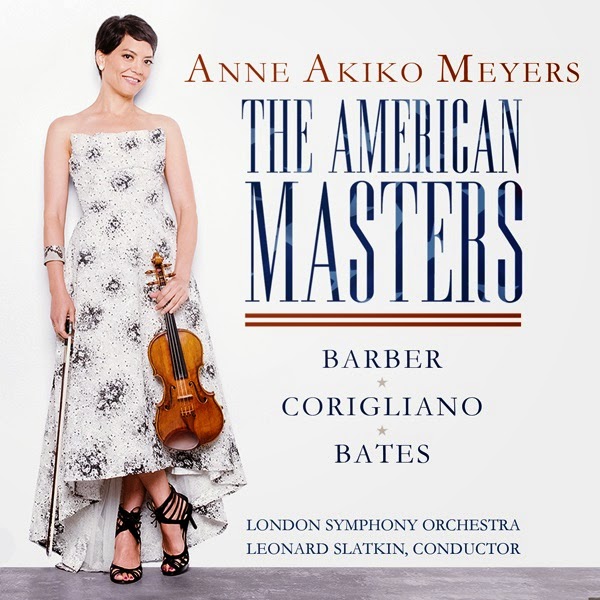
While I have written many program notes for my own CDs, this is the first time that I have done so for other composers.
There is a reason I agreed so readily to do it this time: Both composers have shared the intimate quality of mentorship with me – Samuel Barber was my mentor, and I was Mason Bates’s mentor. That sense of connection extends to the artists heard here: Anne commissioned both the concerto and lullaby from Mason and me, and Leonard Slatkin, a close friend of mine, has championed all three composers on this disc. Three generations of friendship and shared ideas are captured in this recording.
I met Samuel Barber in the 1960s after sending him my setting for chorus and orchestra of Dylan Thomas’s Fern Hill. He sent it on to his publisher, G. Schirmer, with a recommendation to publish it, and they agreed. I asked Hans W. Heinsheimer, at the time the famous head of publications at Schirmer, if I could meet Barber, and he arranged for me to see him. At the meeting, Barber gave me some important criticisms of my work, in addition to a lot of encouragement, and this occasion began a mentorship that lasted through the rest of his lifetime. I would show him my work, and he always had something important to say about it. As I developed and grew older, our relationship also grew into a deep friendship that lasted until his death in 1981.
I met Mason Bates, then a Juilliard student, when he brashly interrupted a dinner party I was giving. While my guests stayed in the dining room, he explained that although he knew my studio was full, he had to study with me. I made an exception and took him on as an extra student, both because I had heard his music and felt he had enormous potential, and because of his conviction that working with me would help him. We worked together for several years, and after graduating, he went off into the world and has established a considerable reputation. Mason and I have become colleagues and friends, and even now, he often speaks to me about works he is immersed in. So the mentorship (and friendship) continues… (John Corigliano)
There is a reason I agreed so readily to do it this time: Both composers have shared the intimate quality of mentorship with me – Samuel Barber was my mentor, and I was Mason Bates’s mentor. That sense of connection extends to the artists heard here: Anne commissioned both the concerto and lullaby from Mason and me, and Leonard Slatkin, a close friend of mine, has championed all three composers on this disc. Three generations of friendship and shared ideas are captured in this recording.
I met Samuel Barber in the 1960s after sending him my setting for chorus and orchestra of Dylan Thomas’s Fern Hill. He sent it on to his publisher, G. Schirmer, with a recommendation to publish it, and they agreed. I asked Hans W. Heinsheimer, at the time the famous head of publications at Schirmer, if I could meet Barber, and he arranged for me to see him. At the meeting, Barber gave me some important criticisms of my work, in addition to a lot of encouragement, and this occasion began a mentorship that lasted through the rest of his lifetime. I would show him my work, and he always had something important to say about it. As I developed and grew older, our relationship also grew into a deep friendship that lasted until his death in 1981.
I met Mason Bates, then a Juilliard student, when he brashly interrupted a dinner party I was giving. While my guests stayed in the dining room, he explained that although he knew my studio was full, he had to study with me. I made an exception and took him on as an extra student, both because I had heard his music and felt he had enormous potential, and because of his conviction that working with me would help him. We worked together for several years, and after graduating, he went off into the world and has established a considerable reputation. Mason and I have become colleagues and friends, and even now, he often speaks to me about works he is immersed in. So the mentorship (and friendship) continues… (John Corigliano)


