Mostrando entradas con la etiqueta Nonesuch. Mostrar todas las entradas

martes, 26 de marzo de 2019

Kronos Quartet MUSIC OF VLADIMIR MARTYNOV

Nonesuch Records releases Kronos Quartet’s Music of Vladimir Martynov on January 10, 2012. The album includes three works written or rescored for Kronos by the contemporary Russian composer Vladimir Martynov: The Beatitudes (1998, rescored for Kronos, 2006), Schubert–Quintet (Unfinished) (2009), and Der Abschied (2006). Kronos’ artistic director and founder David Harrington says Martynov’s music “straddles various points of musical history and time; the music seems to me to reflect and absorb humanity in such a beautiful way.”
Born in Moscow in 1946, Martynov was the son of a well-known musicologist and writer. He studied music from a young age and attended the Conservatory before expanding his musical pursuits beyond the traditional classical canon and into folk songs, early music, avant-garde, rock, and electronic music. In 1979, he entered the Spiritual Academy at the Trinity Lavra of St. Sergius, where he worked on preserving and restoring traditional Russian Orthodox chant. He returned to composition in the 1990s with a new style that combined the traditions of American minimalism with the repetitive chant of Russian Orthodoxy.

martes, 12 de febrero de 2019

Jeremy Denk J.S. BACH Goldberg Variations

A feature of Jeremy Denk's work as a pianist – a blisteringly original, thoughtful one at that – is his parallel skill at writing about music. In this unrushed, transparent, unmannered account of the Goldbergs, he provides an invaluable DVD of "video" programme notes, a bonus for anyone still trying to comprehend these variations, which I suspect is all of us. With unvarnished honesty Denk has said: "The best reason to hate the Goldberg Variations – aside from the obvious reason that everyone asks you all the time which of the two [Glenn Gould] recordings you prefer – is that everybody loves them… I worried for years that I would be seduced into playing them, and would become like all the others – besotted, cultish – and that is exactly what happened." This CD is another to cherish in the huge catalogue of Goldberg recordings. (FionaMaddocks / The Guardian)

lunes, 11 de febrero de 2019

Jeremy Denk c.1300 - c. 2000

Pianist Jeremy Denk's new album, c.1300–c.2000, is out now on Nonesuch Records. The double album captures a program of works spanning seven centuries that Denk created and performed at venues including Lincoln Center, Wigmore Hall, and Piano aux Jacobins. "The history of so-called classical music felt closer to me now than it did when I first learned about it in college, not just more relevant, but more alive. Wouldn't it be amazing, I wondered, to experience this sweep and arc in one sitting?" For that program, Denk performed twenty-four pieces by composers ranging from Machaut to Ligeti—with Binchois, Gesualdo, Stockhausen, Philip Glass, and many others in the middle.
"A piano recital covering 700 years of music: by most accepted definitions, that ought to be not just an oxymoron but an impossibility," says the Telegraph. "But the usual barriers fall whenever Jeremy Denk is at the keyboard ... Quite exhilarating."
"Full of contrast and surprise, this is a richly personal gallery of sound," says the Observer.
"Life, of course, runs in cycles," says NPR, "and Denk's c.1300–c.2000 lets us know that music—with its special powers of creation, expiration and restoration—does, too."
Denk says in the liner note, "You might call this album a version of time-lapse photography, which brings us from the 1300s to the present day in a series of sonic snapshots. I was aiming for a healthy mixture of light and dark, of optimism and pessimism." He continues, "To find a foothold, I started in the medieval era with two threads: the secular, and the religious. Worldly love, and love of God. At the same time, I felt it was essential to deal with a more purely musical love: the art of counterpoint, a foundation of the long story to come. If you don't care about counterpoint, you should. It is music's superpower, something it can do that no other art form quite can."

sábado, 29 de diciembre de 2018

STEVE REICH Pulse / Quartet

One of the great minimalists alongside Philip Glass and Terry Riley, Steve Reich remains heroically unafraid of the blank page. The 81-year-old may no longer rewrite the rules of modern composition as he did with revolutionary works such as Piano Phase, Drumming and Music for 18 Musicians, but happily continues to be inspired by younger artists. His Radio Rewrite (2012) evolved from a meeting with Radiohead guitarist Jonny Greenwood, while Pulse uses electric bass to nod to Giorgio Moroder via Daft Punk. The International Contemporary Ensemble make the wistful Pulse (premiered 2015) sing, with its spiralling, inquisitive strings, completely free of the tense nervousness of some of Reich’s more repetitive work. It’s a less complex listen than Quartet (2013), a lightly jazzy essay in key-confounding hypnosis on piano and vibraphone, written for and performed by Reich’s favourite percussionists, Colin Currie Group. (

sábado, 30 de junio de 2018

Gidon Kremer / Kremerata Baltica SILENCIO

Kremer's orchestra returns with a program of music centered (for the most part) on silence. With the exception of the first movement of Arvo Pärt's Tabula Rasa, the works on this recording explore themes of quiet and introspection. Not that these pieces are background music; these are all complex pieces. Glass' Company, in fact, has a cascade of liquid passages full of arpeggiations and complex rhythms. The overall effect, however, is one of peacefulness. Interesting, too, the titles of the pieces lend themselves to images of intimacy -- titles Company, Come In!, and Darf Ich (German for "May I"). Come In! features soft and delicate music interspersed with a knocking sound. Opening movement "Ludus" from Tabula Rasa is the exception to the disc, with fiery intensity and almost unbearable tension. The Kremerata Baltica performs exquisitely and seem to do so effortlessly. This disc features two premiere recordings (Come In! and Darf ich) and one first recorded arrangement for string orchestra (Company). (

sábado, 28 de abril de 2018

Leila Josefowicz / St. Louis Symphony / David Robertson JOHN ADAMS Violin Concerto

Nonesuch releases a new recording of John Adams's Grawemeyer Award–winning Violin Concerto (1993) with his frequent collaborators violinist Leila Josefowicz, conductor David Robertson, and the St. Louis Symphony Orchestra on April 27, 2018. The album was recorded at Powell Symphony Hall in St. Louis in 2016.
Adams's Violin Concerto was co-commissioned by the Minnesota Orchestra, the London Symphony Orchestra, and the New York City Ballet. It was described by the Boston Globe as having "the qualities of intelligence, craftsmanship, and quirkiness that have always marked the composer and his work; this time Adams also mingles virtuoso show with soul, popular appeal with the staying power that comes from intellectual interest." The premiere recording of the work, featuring violinist Gidon Kremer and the London Symphony Orchestra led by Kent Nagano, was released by Nonesuch in 1996.
Josefowicz said of the concerto in an interview with the St. Louis Post-Dispatch, "It was the piece where [Adams] first got to know me as a person and a player, when I was twenty-one. I'm now thirty-eight. When I started playing this piece, it was the confirmation of the new path that I was on, to really go down this new road with new music and with composers, because this experience was so inspiring for me." She further said, "It has a really dancelike feeling, so the violin line is often incredibly syncopated with everything else going on in the orchestra … Basically, it's supposed to make you groove."

sábado, 19 de agosto de 2017

Kronos Quartet / Wu Man TAN DUN Ghost Opera

A half-hour spent with Tan Dun’s Ghost Opera brings us face-to-face with the past, the present and ‘forever’ by employing, respectively, Bach and Shakespeare, a string quartet plus pipa (a pear-shaped, fretted lute) and an ensemble of water, stones, metal and paper. Wu Man plays pipa and doubles with vocals, bowed gong, tam-tam, Tibetan bells and paper. Kronos double their usual role with vocalizing, bowing a gong (watch those fillings!) and working a filled water bowl. Water is in fact the first thing we hear. Thereafter, three members of Kronos play a tender transcription of part of the Fourth Prelude from the First Book of Bach’s Well-Tempered Clavier – a leitmotiv that assumes especial poignancy in the third movement, or Third Act (there are five acts in all), where it converges with a Chinese folk-song to beautiful effect. The Fourth Act, “Metal and Stone”, a vivid study in aural perspectives and a hive of invention (some of it syncopated), transforms into the last act via a prominent gong stroke. Dun’s ethereal finale introduces a little girl’s lament for her lost parents and witnesses the gradual break-up of the Bach Prelude.
Ghost Opera was composed in 1994 and grew from an ancient tradition, where being rewarded after death is taken as read and everyone enters into dialogue with time. The libretto merges Shakespeare (“We are such stuff as dreams are made on...”), folk-song and the singing of monks, but Dun’s real mastery lies in the way he juxtaposes his ideas, delicately, dramatically, and alternating tactile sounds with the glow of Bach or the simplicity of folk-song. Some of the string writing echoes Chinese popular music (both in its compositional style and the way it is realized by Kronos), but it would be difficult to separate any one component of what is in effect a compact montage-cum-music-drama. It certainly says much for Kronos that they enter the spirit so convincingly (their vocal exclamations sound decidedly local), and the excellent recording does their efforts full justice.
Not one for every day of the week, perhaps, but an elevated form of ‘fusion’ that reaffirms the creative good sense of merging East with West.' (Gramophone)

viernes, 7 de julio de 2017

LOUIS ANDRIESSEN Writing to Vermeer

One of the last operas produced in the twentieth century was Louis Andriessen's Writing to Vermeer, premiered at the Netherlands Opera on December 1, 1999. It is a handsome production indeed, with libretto and gigantic film projection components by Peter Greenaway and bursts of electronic music contributed by Michel van der Aa. However, all things opera move slowly in the twenty first century, and it has taken a little over six years for Nonesuch to deliver the first recording of the work, Louis Andriessen: Writing to Vermeer. To be fair, this specific recording was not taken from the premiere performance, but from a revival given at Amsterdam in 2004; the U.S. premiere of Writing to Vermeer was presented at Lincoln Center in 2000.
Divided into six scenes, this opera depicts three women close to seventeenth century Dutch Master Johannes Vermeer writing letters to him from his household in Delft, as he is away in The Hague on business. Women writing letters, in addition to doing household chores, practicing music, and other mundane tasks constitute the imagery we most readily associate with Vermeer the painter, and it was this aspect of Vermeer's visual style that Greenaway and Andriessen sought to evoke in Writing to Vermeer. Another hallmark of Vermeer's painting is a subtle lack of drama, and in Writing to Vermeer "drama" is supplied by way of the interruption of external events -- political assassinations, the invasion of Holland by French forces, and finally, the flooding of Delft as a measure to stall the French invasion, which literally washes all of the characters and action away. For Andriessen and Greenaway the parts dealing with domestic life, children and the daily activities of the good Dutch hausfrau are the key elements of this work. To the composer and librettist's chagrin, the external layer of events has dominated the discussion of Writing to Vermeer among critics and most audiences, with its unstated implication that if Vermeer had been there, he might have found a way to stave off these disasters, at least in his own household. This conflict of interpretation may not be resolved anytime soon.
No matter what the controversy, Writing to Vermeer was one of the most completely controlled multimedia environments presented on the opera stage until now, and a mere recording of the music hardly does it justice -- one can argue that even a good DVD couldn't truly capture the experience of seeing it live. The style and sound of Andriessen's music falls somewhere between de Materie and de Staat -- it is not as dense as the former nor as rhythmically intense as the latter, and some of the instrumental texture even approaches a kind of lyric romanticism, albeit stated within the locus of Andriessen's usual modal/bitonal hybrid. The electronic segments by Michel van der Aa are excellent -- he has a masterful control of the technique of moving sound collages through space. One wonders why Andriessen, who long ago made some expert forays into electronic music himself, decided to outsource these segments, but it is undoubtedly for the better. The set comes with a 58-page-book containing the libretto, which one will want, as even though Writing to Vermeer is sung in English, that does not guarantee that all of its text is clearly comprehensible, even though the quality of the recording is outstanding. Writing to Vermeer is such a rich and complex work, chances are the listener will not "get it" on the first hearing, and it gets off to a slow start. Repeated listening, and time taken to concentrate fully on Writing to Vermeer, will reveal its many virtues.

jueves, 8 de junio de 2017

Kronos Quartet FOLK SONGS

For more than 40 years, San Francisco's Kronos Quartet—David Harrington and John Sherba (violins), Hank Dutt (viola), and Sunny Yang (cello)—has combined a spirit of fearless exploration with a commitment to continually re-imagine the string quartet experience. In the process, Kronos has become one of the world's most celebrated and influential ensembles, performing thousands of concerts, releasing more than sixty recordings, collaborating with many of the world's most eclectic composers and performers, and commissioning more than 900 works and arrangements for string quartet. Kronos is the recipient of more than 40 awards, including the Polar Music Prize and the Avery Fisher Prize. Last season, a five-year initiative, Fifty for the Future: The Kronos Learning Repertoire, began commissioning new works designed to train students and emerging professionals; the pieces are distributed online for free. Kronos has had a close relationship with Nonesuch since 1985, when the group recorded Philip Glass' soundtrack to Mishima. Nonesuch has since released forty-seven albums by Kronos, including Pieces of Africa (1992), a showcase of African-born composers; Nuevo (2002), a celebration of Mexican culture; and the 2004 Grammy winner, Alban Berg's Lyric Suite, featuring Dawn Upshaw—as well as motion picture soundtracks such as Requiem for a Dream and albums dedicated to composers including Glass, Terry Riley, Steve Reich, Franghiz Ali-Zadeh, Henryk Gorecki, and Astor Piazzolla, among others. 
When Nonesuch Records celebrated its 50th anniversary in 2014, with festivals at London's Barbican Centre and New York's Brooklyn Academy of Music (BAM), Kronos Quartet joined forces with four labelmates—Sam Amidon, Olivia Chaney, Rhiannon Giddens, and Natalie Merchant—to perform a concert entitled Folk Songs. The group later recorded the songs, most of which are traditional with contemporary arrangements, with Doug Petty as the album's producer. (Nonesuch)

miércoles, 19 de abril de 2017

Yo-Yo Ma / Chris Thile / Edgar Meyer BACH Trios

Yo-Yo Ma, Chris Thile, and Edgar Meyer have for years been musical fellow travelers and friends—brilliant, like-minded performers who have converged in the studio and on stage for several extraordinary projects. The work of Johann Sebastian Bach has often been at the heart of their ongoing artistic discourse. In March of 2016, the trio returned to the James Taylor's Berkshires studio, the site where violinist Stuart Duncan joined them to record the Grammy Award–winning The Goat Rodeo Sessions, to record the new album Bach Trios.
"The love of Bach is so central to the three of us that it is surprisingly difficult to explain," says double bassist Meyer. "It can be a shared experience, with so many pieces that we all know and have played. It can be a common dialect, from which we reference all other music. It certainly is a standard of beauty and logic that inspires for a lifetime."
Cellist Yo-Yo Ma echoes that latter sentiment: "Bach's music has the capacity to be infinitely empathetic to the human condition while at the same time being completely objective. It is because of this dichotomy that I have played the same music both for weddings and for memorials."
In 2013, mandolinist Thile released Bach: Sonatas and Partitas, Vol. 1, a solo disc for Nonesuch recorded at Taylor's barn studio and produced by Meyer. The New Yorker's Alec Wilkinson said of that album, "You have the feeling of someone trying as hard as he can to live inside the music and to breathe with it. His elaborate and often stunning playing is laced with sadness but also with a wild, delirious pleasure, a piercing happiness, even a joy."
Returning to the barn to record Bach Trios, Thile explains, "There is a religious aspect to working on Bach. It's sacred. Spending time with Bach gives any serious musician a sense of being in the presence of something higher. He's kind of a god-like figure in the music community. All arguments about who's the greatest musician start after Bach."
In his liner notes essay for Bach Trios, the composer and pianist Timo Andres admits "mandolin, cello, and double bass are, at face value, an unlikely instrumental combination, but this is an obviously harmonious set of personalities and musical predilections. There is a huge range of possibility in Bach interpretation, from the revisionist, almost authorial approach to the scholarly and historically informed. There's much to be gained from both schools, and, wisely, the Thile/Ma/Meyer trio finds its voice somewhere in the middle of the spectrum. Here, drawn in by the directness of the music itself, it's entirely possible to lose oneself for long stretches, just listening." (Nonesuch)

martes, 7 de febrero de 2017

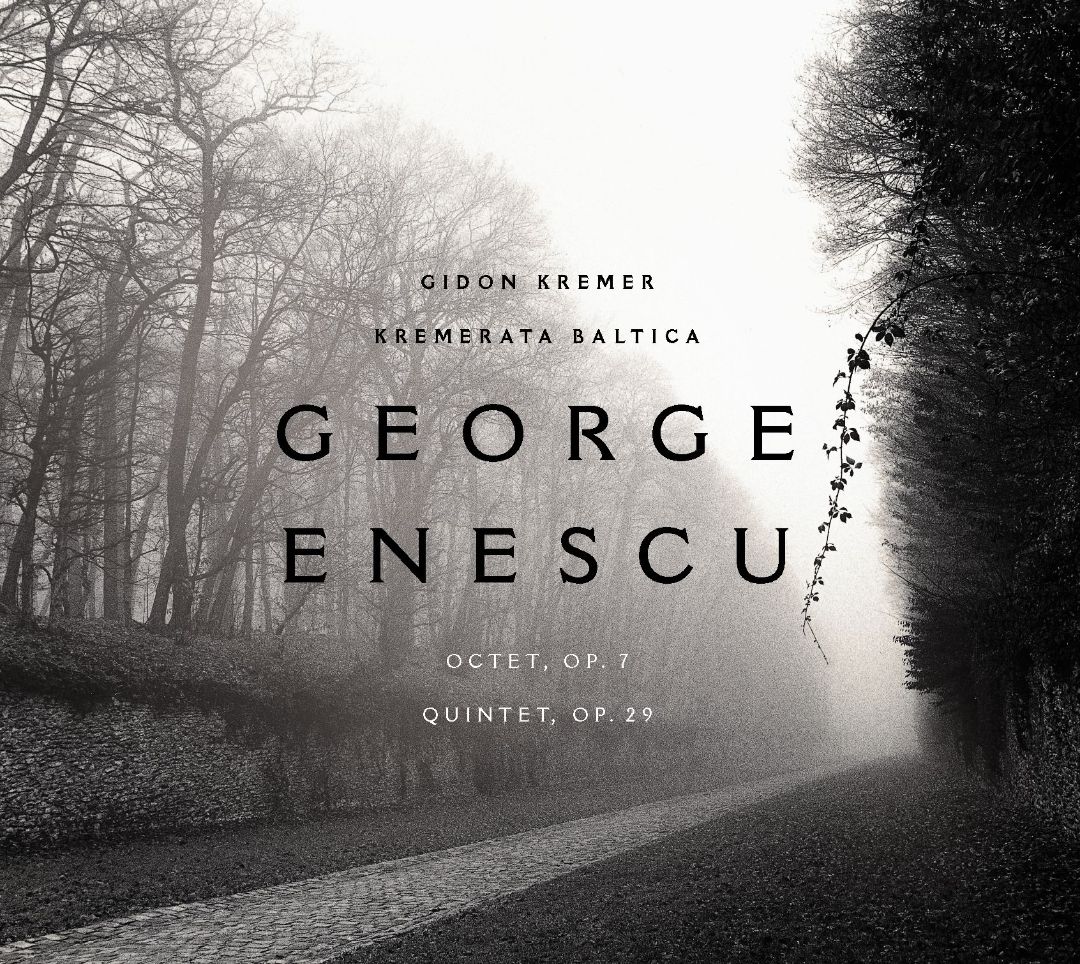
Gidon Kremer / Kremerata Baltica GEORGE ENESCU Octet, Op. 7 - Quintet, Op. 29

Featuring the first recording of two works by George Enescu -- the String Octet, Op. 7, and the Piano Quintet, Op. 29 -- this album introduces the listener to the fascinating, multifaceted, and intriguing world of the Romanian master's chamber music. Enescu's music is expertly performed by members of the extraordinary KREMERata BALTICA under the direction of Gidon Kremer, who plays first violin in both pieces. Kremer wisely chose the music, for the two works in many ways exemplify the salient features of the Enescu's musical language and reflect his development from an eclectic, post-Romantic style to a richer, more complex and personal idiom. Composed in 1900, the lush, colorful, and dynamic octet is played with remarkable subtlety, balance, and sense of nuance. The string players find the exact tonal color to perfectly conjure up Enescu's polychromous musical imagery, also impeccably expressing a wide range of moods from lyrically intimate to ardently symphonic. In the piano quintet, which Enescu composed in 1940, the players rise to the challenge of interpreting a work presenting many technical and artistic problems, many stemming from the composer's austerely sophisticated idiom. Indeed, the KREMERata, completely mastering the many complexities of Enescu's style, rewards listeners with the shared experience of highly significant, albeit lesser-known, works of twentieth century chamber music. (Zoran Minderovic)

miércoles, 5 de octubre de 2016

Leila Josefowicz / David Robertson / St. Louis Symphony JOHN ADAMS Scheherazade.2

Violence against women is no modern tragedy. Composer John Adams found that out when he saw an exhibition about the tales of the Arabian Nights — ancient stories in which Scheherazade tells her murderous husband a new tantalizing tale each night for 1001 nights, thus sparing her life a day at a time. The composer, writing in Scheherazade.2's booklet notes, says he was surprised by how many of the stories included women suffering brutality.
That got Adams thinking about "the many images of women oppressed or abused or violated that we see today in the news on a daily basis." Now, Adams has updated Scheherazade's disturbing story in a 50-minute piece for violin and orchestra.
Borrowing a formula from Hector Berlioz (with a nod to Scherherazade, Rimsky-Korsakov's popular symphonic suite), Adams created a "dramatic symphony," casting the violin as a modern-day Scheherazade — the smart woman who remains fearless in the face of cruelty. Over the course of four movements, no precise narrative is spelled out, yet Adams' descriptive titles and his cinematic music go a long way in unfolding a potent drama, masterfully illuminated by conductor David Robertson and the St. Louis Symphony Orchestra.
It begins with a strum of harp strings, the whoosh of winds and the clatter of a cimbalom (hammered dulcimer), as if a brightly colored curtain is swept back, inviting listeners inside. Here, we meet Scheherazade in the form of violinist Leila Josefowicz, a longtime Adams collaborator and courageous champion of new music, who gives a searing performance. She arrives with handsome, sinuous lines but later speaks in spikier gestures. In its lyrical moments, backed by Adams' lush orchestration, the music recalls Samuel Barber's beloved Violin Concerto.
The vibrant pulsations that open the second movement, "A Long Desire (Love Scene)," give way to a dreamy oasis of floating strings and flickering winds. Scheherazade enters sweet and high as the music grows more impassioned. Her winding, sensual song, one of the work's highlights, is backed by a delicate scrim of strings.
"Scheherazade And The Men With Beards," the disruptive third movement, finds our heroine trading arguments with a council of agitated strings, chattering winds and percussion. Her entreaties are mellifluous and articulate, but the opposition overpowers her with snarling brass and thunderous drums.
In "Escape, Flight, Sanctuary," Scheherazade makes her getaway amid an outburst of brass. Then she's off and running in frenzied bowing, with wind figures rushing to catch up. The fierceness and vulnerability Josefowicz expresses contributes to an award-caliber performance. Finally, palatial walls of Sibelius-like string textures enfold Scheherazade. She's found refuge, but who knows how safe she really is? (Tom Huizenga)

lunes, 25 de enero de 2016

Andrey Boreyko / London Philharmonic Orchestra HENRYK GÓRECKI Symphony No. 4

The recording was made during the 2014 world premiere performance at Royal Festival Hall with co-commissioner London Philharmonic Orchestra conducted by Andrey Boreyko. The piece, which pays homage to Górecki’s fellow Polish composer Alexsander Tansman, was incomplete at the time of Górecki’s 2010 death and thus missed its previously scheduled premiere. However the score had precise indications for orchestration, which Górecki’s son Mikolaj, also a composer, used to complete it. The Daily Telegraph said the piece "caps Górecki's reputation as an orchestral composer, but it also contains some surprises. The music … features some brutal juxtapositions of massively powerful music with slow, intimate passages for solo instruments, including prominent parts for piano and organ."
Symphony No. 4 will be released individually and as part of Henryk Górecki: A Nonesuch Retrospective, a seven-disc box set containing all Nonesuch recordings of Górecki works—Lerchenmusik; Symphony No. 3; String Quartets Nos. 1, 2, and 3; Miserere; Kleines Requiem für eine Polka; Harpsichord Concerto; and Good Night.
Born in 1933, Henryk Górecki spent most of his life in southern Poland. He was a leading composer of the Polish avant-garde in the 1950s and later reached a worldwide audience in the 1990s thanks to the success of his Symphony No. 3. The work was composed in 1976, and was at that time shocking in its tonality and simplicity, but it was with the release of the 1992 Nonesuch recording of the piece, featuring Dawn Upshaw and the London Sinfonietta, that it attracted international attention, selling more than a million copies and climbing to the top of the classical music charts in both the US and the UK. On the unexpected popularity of the piece, the composer remarked, "Perhaps people find something they need in this piece of music ... somehow I hit the right note, something they were missing. Something somewhere had been lost to them. I feel that I instinctively knew what they needed."
The London Philharmonic Orchestra was founded in 1932 by Sir Thomas Beecham. Since then, its principal conductors have included Sir Adrian Boult, Sir Georg Solti, Klaus Tennstedt, and Kurt Masur. In 2007, Vladimir Jurowski became the Orchestra’s principal conductor. The London Philharmonic Orchestra has been performing at Southbank Centre’s Royal Festival Hall since it opened in 1951, becoming resident orchestra in 1992. It also has residencies in Brighton and Eastbourne, and performs regularly around the UK. The Orchestra frequently tours abroad: highlights of the 2014–15 season included appearances across Europe, including Iceland, and tours to the USA (West and East Coasts), Canada, and China. The Orchestra broadcasts regularly on television and radio, and has recorded soundtracks for numerous films including The Lord of the Rings. In 2005 it began releasing live, studio, and archive recordings on its own CD label.
Symphony No. 4 received its US premiere in January of this year, by co-commissioner Los Angeles Philharmonic, and was performed in February by the Netherlands Radio Philharmonic Orchestra at the Concertgebouw (which is home to the piece’s third co-commissioner, the ZaterdagMatinee concert series). This recording was supported by the Adam Mickiewicz Institute as part of the Polska Music program. (Nonesuch)


lunes, 28 de diciembre de 2015

Los Angeles Master Chorale / Grant Gershon / Maya Beiser STEVE REICH You Are ( Variations)

Urban activity: buses moving; keypads clicking; bikers cutting off cabs; window washers scaling up a half completed skyscraper; the distant wail of an ambulance siren, and its sudden pitch modulation as it zooms past, carrying a rush of wind and a trail of receipts, wrappers, or the rare leaf; the clang of the subway; cash registers opening, closing, opening; everyone is counting something: time, money, appointments, each other; the whistle of a traffic cop and hundreds of half-heard conversations in the street. The flurry of the city isn't something best described as "beautiful" so much as alive, unstoppable, cruel, and complex.
American composer (and native New Yorker) Steve Reich has been writing the definitive city soundtrack for 40 years. From his early tape pieces "Come Out" and "It's Gonna Rain", to his now classic minimalist works-- though Reich would certainly scoff at the term-- Drumming and Music For 18 Musicians, to more recent works bother greater in scope and somehow conventionally attractive (Tehillim, Different Trains, The Desert Music), he's invented a sound that nails both the intricate detail and speed-ridden blur of some abstract "downtown." Where Philip Glass's music from the 1960s and 70s is vaguely futuristic and precise, Reich's is warm. Where Terry Riley, who never felt a particularly strong allegiance to the minimal aesthetic in the first place, is boundless and organic, Reich is brainy, propulsive, and hardened to the interiors of a metallic landscape. I read someone call him the "greatest living American composer," and though any all-encompassing title is debatable, you'd be hard pressed to find a more fitting example of individualism and stubborn will so often identified with this place.
You Are (Variations). is Reich's first CD of new material since the not altogether warmly received Three Tales (2002). If the composer has suffered complaints from critics of lacking ambition in recent years, he hasn't let that affect his writing: You Are is prime Reich, using choral and orchestral elements similarly to older pieces like Tehillim and The Desert Music, but seeming as rhythmically driven as anything he's done in years. Harmonically, he sticks to majors and relative minors (that is, a minor key that utilizes the same notes as a major one, but starts from a different point in the scale)-- a common Reich device-- thereby blurring the line between different tonalities. He uses a choir to impart text translated from Hasidic mystical verse: "You are wherever your thoughts are", "Explanations come to an end somewhere," and the idea of saying "little and do much". Words are repeated and spread out over great lengths, so the end effect is not one of narrative but of words as purely musical ingredients.
The "variations" in You Are take up most of the CD, but the closing track is Reich's Cello Counterpoint, featuring cellist Maya Beiser (Bang On a Can) overdubbed eight times to create a surprisingly dense string ensemble. As Reich points out in the CD insert, the cello is great because its capable of resonating clearly in a very wide range-- this piece was actually written for a full string octet, but its marked accents and interweaving melodies sound great all performed by one person. There is a slight similarity to Different Trains for string quartet, though Cello Counterpoint is nowhere near as "industrial," sounding more conventional, perhaps less confrontational, yet still unmistakably Reich. As with the You Are tracks, the constant rumble of motion fills up whatever mental space I have to drift away from the music. (Dominique Leone)