Mostrando entradas con la etiqueta Steven Isserlis. Mostrar todas las entradas

viernes, 30 de noviembre de 2018

Steven Isserlis / Dénes Várjon CHOPIN Cello Sonata SCHUBERT Arpeggione Sonata

Not given to routine planning, Steven Isserlis comes up here with a generous, characterful programme of early-Romantic masterworks—formerly B-road stuff, these days anything but—offset by two suspendingly beautiful song arrangements inimitably natural in their tessitura, utterly painful in their introspective longing. There's a forgotten little 6/8 Larghetto, too, by the dedicatee of Chopin’s Cello Sonata, Auguste Franchomme (1808-84), published in Leipzig in 1838, during the E-flat middle section of which Schubert, dead ten years, quietly dances the ether.
Isserlis approaches both main works expansively, getting his 1726 'Marquis de Corberon' Stradivarius to sing, project and fade with beauty, form and expression foremost. More than once one is struck by how paragraphs and episodes breathe, surge and cadence, rests and silences given potent tension; this is finely articulate cultured playing—ruminant poetry and reflective musicality, aristocratically suspended climaxes, carrying the argument free of ego or 'produced' theatre. Chopin's complex first movement, a ballade-like narrative difficult to hold together, particularly impresses, amounting in Isserlis's hands to perhaps the closest the composer ever got to sustaining a prolonged symphonic dynamic. It compels at every turn of its leisured fifteen-minute journey. Similarly one would not want to be without the gloriously poised aria of the Largo. The early Polonaise brillante goes with a Slavonic swagger, its imperial rhythms ideally placed, neither rushed nor laboured. Good polonaise playing, like good mazurka feeling, is an art not all have the key to.
In programme order, out of Chopin's later (1845 and same key) ‘Nie ma czego trzeba’ comes Schubert's 1824 Arpeggione Sonata (for a now-defunct instrument), unpublished until 1871, a bouquet of traceries and grace, its more strenuous passages benefitting from the openness of the keyboard writing. Repeatedly, Isserlis regales us, Schubert the Sonata man was one like no other—fashioning canvasses as dependent on sighing Lied contrasts and expanding caesuras as the pursuit of purely Beethovenian dialectics. In these pages strasse tunes and sparing motifs go hand-in-hand, uncontrived companions of the Biedermeier hour, lilting and tilting their way through time. Isserlis's 'song without words' Schubert is magical. And infinitely sad.
His booklet essay is wisely expressive reading. Likewise his note on the editions used. Most telling, in the Chopin Sonata, is his adoption of two autograph tempo markings otherwise ignored: Maestoso rather than Allegro moderato for the first movement, and Più lento for the Trio section of the Scherzo – both bringing needed air and space to the music. Apparently small changes, yet, as he says, 'these things make a difference…'.
Dénes Várjon is a gracious partner, maybe not always at home in Chopin's trickier figurations but otherwise agreeably in accord with Isserlis's wider vision. He plays an 1851 Érard (Birmingham University Music Department), tuned to A430. More opaque and less 'big' than expected (compared with examples we've heard in Paris or Warsaw), the lyric mezzo domain is where it speaks best, generating a warmly pedalled halo of overtones and breathtaking die-aways (the end of the Arpeggione for one, both song transcriptions for another). In denser, louder textures, though, it loses clarity and attack, the engineered balance with cello—picking up on an ambient acoustic prone to cloudiness— producing occasionally muddied artefacts. (Classical Source)

lunes, 21 de agosto de 2017

Steven Isserlis / Frankfurt Radio Symphony Orchestra / Paavo Järvi PROKOFIEV - SHOSTAKOVICH Cello Concertos

Prokofiev’s demanding, conceptually lopsided Cello Concerto, failed at the box office and has been little heard. Indeed, the only significant on-disc competition for Steven Isserlis’s blazing live account comes from the 2000 recording made by the late Alexander Ivashkin. With a Russian cellist and orchestra, the music sounds deceptively ‘Soviet’ so that we experience it counterfactually as a variant of the entity it would become years later when refashioned for Mstislav Rostropovich as the Symphony-Concerto, Op 125. Isserlis’s reading may yet mark a step change in the reception history of the 1930s original. No matter that Paavo Järvi’s accompaniment feels super-efficient rather than comparably spontaneous. Applause is excised.
While you might not consider the hard-edged companion concerto a natural Isserlis piece, the cellist has played it a good deal. Distinctly brisk, except in the initial Allegretto, the new studio interpretation is flexible rather than lightweight or disconnected in feeling, with no lack of soulful emoting. In the first movement Isserlis conjures some surprising, visceral sounds from his instrument, ratcheting up the tension with a febrile, nervy vibrato up high. Being less comatose than usual, the second movement can afford to proceed in longer breaths, the not-quite-immaculate solo line spurning vibrato one moment, sliding romantically the next.
Yes, Rostropovich was grand and implacable, more lyrical too in a sense, but you’ll have one or other of his Shostakovich recordings already and he was understandably committed to the revamped version of the Prokofiev. The present disc has its own built-in encore, as arranged by Gregor Piatigorsky, the émigré virtuoso for whom Prokofiev began his concerto and with whom Isserlis himself intended to study. The soloist contributes his own lively and individualistic booklet-notes, enhancing the value of a fascinating, I’d say unmissable project. Sympathetic miking ensures that his relatively modest sound is never swamped even if the suggestion of insectile buzzing is not wholly avoided. (Gramophone)

Steven Isserlis / Stephen Hough RACHMANINOV - FRANCK Cello Sonatas

Playing together for the first time for Hyperion, Hough and Isserlis are stunningly matched in this large-scale passionate romantic programme. The sonatas stand at the centre of the meaty repertoire established by Brahms—whose two cello sonatas Steven Isserlis has recorded for us in an award-winning disc accompanied by Peter Evans (CDA66159)—and characterised by grand sweeping gestures, lush melody, and heartfelt emotions that sear from pathos to frenzy. The Franck is, of course, an alternative version the composer wished for his violin sonata, a transition that many feel to be the work's happiest incarnation. These performances are distinguished by the inspired combination of the renowned energy and panache of Isserlis with the fastidious translucency of Hough's playing, in music often despatched with more gush than gusto. Isserlis also provides a programme note very much in his own style; he examines the inspiration behind both works, coming as they do from deeply religious composers who were also the voices of greatly sensual radiance, while including reminiscences of his grandfather playing the piano part for the dedicatee of the Rachmaninov and of his grandmother learning the piano part in her 80s, to accompany her grandson! The disc is completed by what in the context may seem miniatures but which amply show how these great composers had a language of intimacy as much as expansiveness. (Hyperion Records)

'Steven Isserlis gives a deeply felt and warmly affectionate reading, abetted by Stephen Hough’s sensitive pianism' (Classics Today)

'Steven Isserlis and Stephen Hough give a serene and eloquent performance' (Gramophone)

jueves, 3 de agosto de 2017

Sam Haywood / Steven Isserlis JULIUS ISSERLIS Piano Music

Knowledge of the fascinating story behind this music is integral to a thorough appreciation of it. Julius Isserlis (1888-1968) was horn in the Russian province of Moldova, and his prodigious talent as a pianist took him to the Moscow Conservatoire, where after studying with Taneyev he won the gold medal at 16. Scriabin was instrumental in getting him booked at Carnegie Hall, but homesickness took him back to Moscow and a job as the only Jewish teacher in College of the Imperial Philharmonic Society. Post-Revolutionary anti-semitism drove him to Vienna, of whose musical world he became a key figure. The Anschluss was declared while he was touring the UK, and as a result he settled in London.
After being awarded the Royal Philharmonic Society’s Julius Isserlis scholarship, pianist Sam Haywood became friends with Julius’s grandson, the cellist Steven, and chanced to discover manuscripts of some of Julius’s piano compositions. Hence, with the additional ballast of Julius’s sweetly resonant Ballade in a A minor for cello and piano, this CD. It makes for a delightful hour.
If the echoes of Chopin, Rachmaninov, and—in one striking instance—Stravinsky’s Petrushka are loud and clear in these short and often simple character-pieces, that merely reminds us of how those composers were at the centre of Julius’s musical world. His is salon music in the best sense of the word, reminiscent of Tchaikovsky’s pieces d'occasion (if not with their magic). Haywood’s rubato is delicate and his touch pliantly expressive; when virtuosity is required, he delivers it comfortably, but for the most part he just lets the music's artless charm speak for itself. (BBC Music Magazine)

martes, 22 de noviembre de 2016

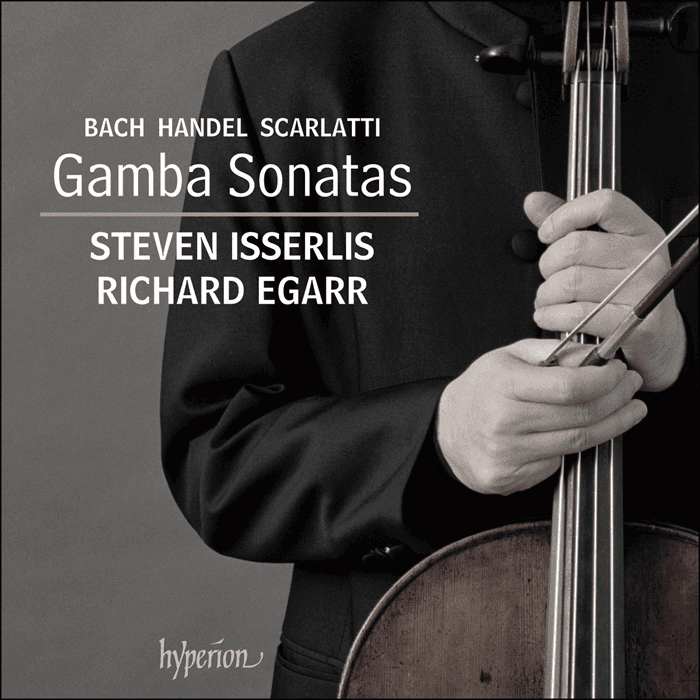
Steven Isserlis / Richard Egarr BACH – HANDEL – SCARLATTI Gamba Sonatas

None of these pieces was written for cello and harpsichord, and at no stage does that matter one bit. Bach’s sonatas for viola da gamba and harpsichord may not have been conceived for that combination but they are such sublime creations that the identity of the instruments is perhaps the last thing that should worry us. Rather, it is the performers’ musicianship that counts, and in this case that is of high quality indeed. 
Steven Isserlis makes no attempt to make his cello imitate the wispy resonance of the gamba, instead claiming the music for his instrument with vigorously articulated lines, robust technical athleticism and ravishing cantabile. Indeed, it is this wondrous singing quality—which never loses its bearing and employs vibrato only as one of its discreet expressive elements—that stands out in these performances, its presence felt above all in the slow movements, of course, but also constantly governing the sense of line in busier ones. Also telling is the profound awareness of architecture and the inter-relationship of movements, for instance in the gathering joy with which the finale of BWV1027 picks us off the floor following the sudden shaft of desolation that has ended the preceding Andante (astutely likened by Isserlis to ‘Es ist vollbracht’ from the St John Passion). In short, these are full-blooded but sensitive readings which, far from being contrary to Bach’s spirit, seem rather to magnify it. 
Isserlis is excellently partnered at every turn by Richard Egarr’s bustling harpsichord-playing, though I would have liked a greater presence for it in the balance to give more definition to the unsupported bass-line. In the two non-Bach items—sonatas probably originally conceived for violin and continuo by Handel and Scarlatti (the latter working up a fiery head)—the balance works better, with Egarr typically inventive and Robin Michael’s lightly drawn doubling of the bass adding just enough weight without drawing attention to itself. Otherwise, they show the same quality in performance as the Bach—namely first-class. (Gramophone)

miércoles, 5 de octubre de 2016

Joshua Bell / Academy of St. Martin in the Fields FOR THE LOVE OF BRAHMS

With a career spanning more than 30 years as a soloist, chamber musician, recording artist and conductor, Joshua Bell is one of the most celebrated violinists of his era. An exclusive Sony Classical artist, Bell has recorded more than 40 CDs garnering Grammy, Mercury, Gramophone and Echo Klassik awards and is recipient of the Avery Fisher Prize. Named the Music Director of the Academy of St. Martin in the Fields in 2011, he is the only person to hold this post since Sir Neville Marriner formed the orchestra in 1958. In September 2016, Sony Classical releases Bell’s newest album, For the Love of Brahms, with the Academy of St. Martin in the Fields, cellist Steven Isserlis and pianist Jeremy Denk.

A tribute to the love and friendship shared by Brahms and Schumann, the album is Joshua’s latest with the Academy of St Martin in the Fields (where he has served as Music Director since 2011) and highlights his longstanding relationship with the orchestra as well as two guest artists: cellist Steven Isserlis and pianist Jeremy Denk.
The album is the the first recording of an unusual coupling: Brahms’s well-known Double Concerto, with Joshua and Steven paired with the slow movement of Schumann’s rarely heard Violin Concerto arranged with a codetta by Benjamin Britten. Joshua, Steven, and Jeremy then unite for Brahms’s first published chamber work, the Piano Trio in B Major, heard here in its rarely performed 1854 version.

martes, 5 de julio de 2016

Steven Isserlis / Dénes Várjon SCHUMANN

‘There is no composer to whom I feel closer than to Schumann. He has been a beloved friend since I was a child; I remain as fascinated today as I was then by his unique blend of poetry, ecstatic strength and confessional intimacy.’
Steven Isserlis’s own words give the background to this fascinating disc.
Schumann’s affection for the cello ran deep. It was an instrument he had played in his youth, and considered taking up again when, at the age of twenty-two, an accident to his hand forced him to relinquish his dream of being a virtuoso pianist. ‘I want to take up the violoncello again (one needs only the left hand for this) and it will be very useful to me in composing symphonies’, he wrote to his mother. The sound of the cello played without the right hand would have been somewhat minimalist; but his love for the instrument is clearly demonstrated by the cello parts in all four of his symphonies, as well as in the concertos for piano and violin, and of course throughout his chamber music. As the great musicologist Donald Francis Tovey put it: ‘The qualities of the violoncello are exactly those of the beloved dreamer whom we know as Schumann.’