Mostrando entradas con la etiqueta Zig Zag Territoires. Mostrar todas las entradas
jueves, 9 de enero de 2020
Gli Incogniti / Amandine Beyer CORELLI The Complete Concerti Grossi
Amandine Beyer
Gli Incogniti
ARCANGELO CORELLI (1653-1713)
Concerto da chiesa Op.VI no.7 in D major
Concerto da camera Op.VI no.9 in F major
Sinfonia, WoO 1, to the oratorio Santa Beatrice d’Este in D minor
Concerto da chiesa Op.VI no.4 in D major
Concerto da camera Op.VI no.11 in B-flat major
Concerto da chiesa Op.VI no.2 in F major
Concerto da chiesa Op.VI no.8 in G minor, « Fatto per la notte di Natale »
Concerto da chiesa Op.VI no.6 in F major
Sonata a quattro in G minor, WoO 2
Concerto da camera Op.VI no.10 in C major
Concerto da chiesa Op.VI no.5 in B-flat major
Concerto da camera Op.VI no.12 in F major
Concerto da chiesa Op.VI no.3 in C minor
Concerto da chiesa Op.VI no.1 in D major
jueves, 5 de julio de 2018
Alexei Lubimov FRANZ SCHUBERT Impromptus
Alexei Lubimov, one of
the last pupils of the great Heinrich Neuhaus, has had a most
interesting career. He was an early champion of avant-garde music,
playing the Moscow premieres of works by John Cage and Terry Riley in
1968. For this he was “punished” by the Russian regime and prohibited
from foreign travel. For a while he toured Russia with the Moscow
Baroque Quartet. Then in the early 1990s he made a famous Erato
recording of the complete Mozart piano sonatas played on a fortepiano
built by Christopher Clarke. Currently he is a professor at the Moscow
Conservatory and performs around the world, pursuing his twin interests
of modern and period music. For op. 90, Lubimov plays a fortepiano built in 1810 by Matthias Müller, which was discovered in an attic and rebuilt in the Netherlands by Edwin Beunk. The instrument has three pedals and is capable of a surprisingly full sound (as in the fortissimos in the first two pieces) as well as a pure and silvery tone (shown to advantage especially in the last two). For op. 142, he uses a larger and warmer instrument made in 1830 by Joseph Schantz. It permits more colorism than the Müller piano and is ideally suited to the bigger scope of the op. 142 pieces, especially the variations of No. 3 and the flashy writing in No. 4. Throughout, Lubimov lets the music and the instruments speak for themselves, with tempos that are straightforward but characterful and rubato that is vocally inspired and never artificially applied. These are mainstream performances that rank with the very fine fortepiano recording by Jan Vermeulen (on Et’Cetera) and the stunning modern piano one by Krystian Zimerman (for Deutsche Grammophon). Lubimov’s next recording, of Beethoven’s last three sonatas played on a fortepiano by Alois Graf, was made during the same recording sessions as this one. It is eagerly anticipated. (FANFARE /Charles Timbrell)
martes, 24 de abril de 2018
Anima Eterna Brugge / Jos van Immerseel, BERLIOZ Symphonie Fantastique - Le Carnaval Romain
Without any prior information, the first thing listeners will notice about Jos van Immerseel's 2008 recording of Hector Berlioz's
Symphonie fantastique is the umistakable period instrumentation, with
the sheen of the strings and the distinctive sound of early 19th century
woodwinds and brass, obvious at the outset. The second thing
discriminating listeners will notice is the great care Immerseel
takes with connecting notes, not only in the straightforward handling
of melodic phrases, but also in linking secondary figures in the
accompaniment, so that this chord progression or that isolated pitch
makes sense within the larger scheme of things. This is where the
performance either rises or falls, depending on what one wants to get
out of this work. To the extent that Berlioz
created Symphonie fantastique to show off his innovative orchestration,
this recording goes as far as any historically informed and scholarly
version to make sure that everything is heard clearly, not merely as
separate sounds, but as integral parts of the greater, kaleidoscopic
whole. Where this rendition might be regarded as a failure is in its
lack of visceral excitement, which seems to be the unintended result of
producing an immaculate-sounding performance. Immerseel
gets astonishing sonorities from the ensemble Anima Eterna Brugge, and
the engineers of Zig Zag Territoires capture them to perfection, but no
one remembered to make the music cook. If Symphonie fantastique is
deprived of its passion, delirium, fury, violence, and horror, it is
merely an exercise in futility. The point of this work and its bizarre
program is to portray the extreme emotional life of its drug-addled
protagonist. Yet because it is played here at somewhat slower tempos
that feel plodding, and with a meticulous precision that seems overly
fussy, it doesn't rush madly, it doesn't whirl feverishly, and it
doesn't fly off its handle, but seems too self-conscious to really let
things rip. The sole exception is the Dream of a Witches' Sabbath,
which is almost as fiendish and hair-raising as one might wish, but
comes much too late to save the performance. Conversely, Le Carnaval
romain is the best selection on the album because it has a wonderful
period sound and is played with the verve and energy missing in the
Symphonie. At points, Immerseel
seems to pull back slightly in his pacing, but these are minor
adjustments for the sake of clarity that don't impede the vitality of
the whole overture, least of all in the final stretch. So if clear
performances of these classics are required, this CD will fill that
need, but for wild and thrilling Romantic music, this recording of
Symphonie fantastique is not a contender. (Blair Sanderson)lunes, 23 de abril de 2018
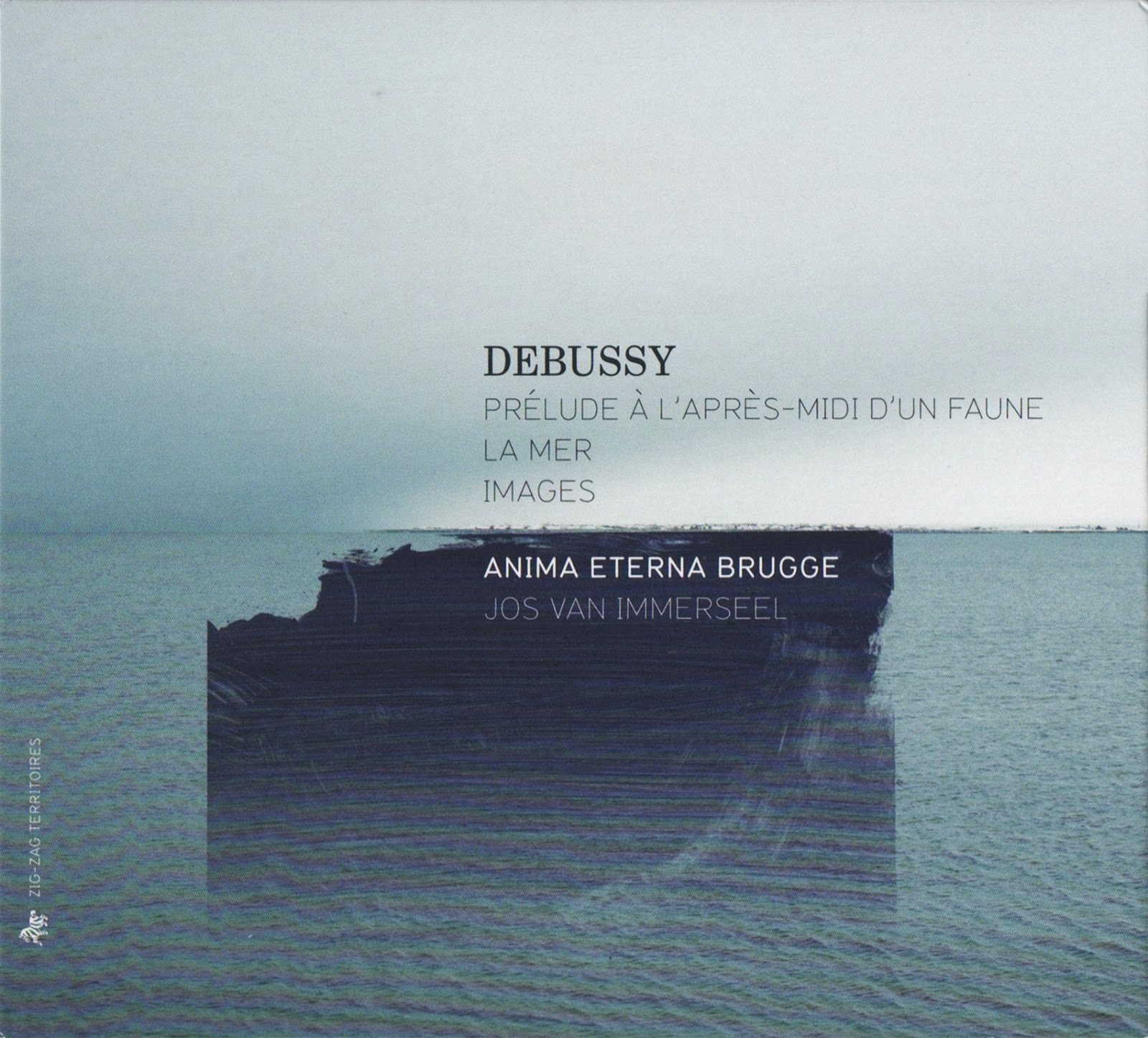
Anima Eterna Brugge / Jos van Immerseel DEBUSSY Prélude à l'Après-Midi d'un Faune - La Mer - Images
Debussy suddenly seems to be on the front line of the
period-instrument movement's steady advance through music history. This
disc from Jos van Immerseel and his Belgian orchestra arrives just a few
months after Simon
Rattle's London performances of La Mer and Prélude à l'Après-Midi d'un
Faune with the Orchestra of the Age of Enlightenment, and John Eliot Gardiner's Proms account of Pelléas et Mélisande with the Orchestre Révolutionnaire et Romantique. For this recording, Anima Eterna Brugge's
woodwind, brass, percussion and harps were French-made instruments of
Debussy's time; they're generally more abrasive and pungent than their
modern counterparts, and they combine with the gut strings to produce a
more open sound than we are used to today.
Van Immerseel's approach can seem a bit too deliberate; there's
something ponderous about Prélude à l'Après-Midi, while in La Mer he
seems determined to emphasise the work's symphonic credentials. In fact,
it's the orchestral Images that gains most from the brighter, rawer
colours of this performance, with the myriad subtleties of Debussy's
scoring more beguiling than ever. Where most conductors make the
three-part Ibéria their centrepiece, with Gigues before it and Rondes de
Printemps as the finale, Van Immerseel begins with Rondes and places
Ibéria last, following the order adopted by Debussy's friend and
assistant André Caplet for performances he conducted after the
composer's death. There's logic to that ordering, for Ibéria is
significantly longer than the other two movements put together, and
makes a substantial finale to the whole sequence; Van Immerseel resists
the temptation to turn it into a real orchestral showpiece, but there's
enough flair and imagination to make his performance compelling. (Andrew Clements / The Guardian)
miércoles, 4 de abril de 2018
Edna Stern / Arie van Beek / Orchestre d'Auvergne W.A. MOZART Concerto No. 9 - Concertos No. 12, 14
Though these two discs have arrived at the same time and offer two of
the same works, the differences between them run deeper than the fact
that one is on period instruments and one on modern. Edna Stern’s performances are
all about intimacy: intimacy of sound, manifested in a close, dry (and
sometimes rather unlovely) recording offering sharp textural clarity and
emphasising the tightness of the Orchestre d’Auvergne’s
ensemble-playing; and intimacy of thought, for this is an artist with a
delicate touch who likes to shape every detail of phrasing and
articulation as if polishing a tiny gem. Whether that suits this
particular music at every turn is open to question and her approach may
strike some as too reined in for the extrovert Mozart on show in these
concertos. Pearlescent passagework and exquisite voicing is an important
part of the Mozartian armoury, of course, but a more assertive swagger
is surely required for the first movements of K271 and K449 (why the coy
diminuendos in the former’s first piano entry?), along with a
more boisterous sense of play in the finales. Surprisingly, Stern also
misses the anguish in K271’s extraordinary slow movement, hopping
through it somewhat perfunctorily, and although the prettier, more
chamber-like K414 suits her style much better and she finds greater
depth and nobility in its slow movement, she seems like one of those
undeniably talented players destined to divide opinion. Ronald
Brautigam’s disc – the first in an intended cycle on period instruments –
is projected on a more public scale. The Kölner Akademie is the same
size as Stern’s orchestra but sounds bigger in its more resonant
acoustic, while the smaller tone of the fortepiano has the effect of
allowing Brautigam to play out without inhibition. The piano and
orchestra are less integrated here, giving a greater feel of a contest,
and this brings generally happier results in an uncomplicated K271 which
comes over as it should do – bold, brilliant and strong-fingered but
with a dark vein of tragedy in the slow movement (a minute longer in
Brautigam’s performance!). K414 has more grandeur, too, with Michael
Alexander Willens drawing expansive lines and the occasional massive crescendo
from his players. The smooth subtleties of Stern’s playing were perhaps
never likely to surface on this recording – but then, natural energy
and straightforward assurance are Brautigam’s strengths, and they are
fittingly applied here. (Lindsay Kemp / Gramophone)
martes, 3 de abril de 2018
Edna Stern BACH Nun Komm' der Heiden Heiland
Young Israeli pianist Edna Stern has already recorded one album of what might be called extreme Bach arrangements, called Chaconne. This group of preludes and fugues, together with chorale-based pieces by Bach and (in a mysteriously single case) Brahms, is in its way even more extreme than the earlier release, in that Stern is mostly playing Bach's own notes. The three Bach chorales appear in arrangements by Ferruccio Busoni, and it is Busoni that provides the model for Stern's playing even where he is not present. It's not just that Stern
plays a modern piano. The preludes and fugues of The Well-Tempered
Clavier, for her, each have their own particular moods, calling forth an
entirely different pianistic approach. Tempo is flexible; articulation
is varied and often luxuriously legato; the pedal is more or less
constantly in action. Bach hasn't been played like this since the days of Russian pianist Samuil Feinberg, who perhaps was part of or close to Stern's pianistic family tree. One thing Stern adds to the style is an emphasis on bass lines, giving the music an organ-like texture. Is it Bach?
Only partially; the rest of it is the Romantic adoration of the Baroque. Is it compellingly musical? Depends on your perspective. Plunge
in anywhere to sample and determine whether you're on this remarkable
young artist's wavelength. The Zig Zag Territoires label's studio sound
captures every smear of Stern's pedals. (James Manheim)martes, 13 de marzo de 2018
Ensemble Discantus / Brigitte Lesne UNIVERSI POPULI
This is rare and rarified music of great beauty and regional historical significance.
It represents the beginning of a collaboration between the label,
Zig-Zag Territoires, and the early music group, Discantus with its
director, Brigitte Lesne. It reflects the work of a substantial new
research project lead by musicologist Marie-Noël Colette under the
auspices of the Institut Français de Prague and the Sablé Festival. The
project has unearthed new antiphoners, processionals and tropers from St
George's Basilica in Prague that date from the thirteenth to the
fifteenth centuries. It is these which are performed with great style,
enthusiasm and sophistication on this excellent (though somewhat hard to
track down) CD:
persevering in obtaining a copy is worth it; it's lovely music and expertly sung.
After these new chants (nova cantica) emerged – along with early motets –
in Aquitaine in the twelfth century, Bohemia, interestingly enough, was
among the first lands to adopt their usage. This is explained by the
stay Machaut made in Prague in the fourteenth century. Indeed what we
hear on Universi Populi is testament to a fairly widespread, though
perhaps unrecognized, 'cultural exchange' across Europe in the late
middle ages: contact between sovereigns; the Crusades; the reforms of
Gregory VII; and substantial migration of farmers and merchants explain
this. Perhaps as a result, this music is more florid, more luxuriant and
in some ways richer to the modern ear than that of Machaut. More like
the world of Hildegard. Indeed, more cosmopolitan, extrovert. It is
remarkable that the earliest liturgical manuscript from St Vitus' (he of
the dance) cathedral in Prague contains twelfth century chants of the
Ordinary (Sanctus) which were written in the Limousin and known to have
been circulating outside Prague only in France and Catalonia.
This CD uses representative music to trace the developments in the
Bohemian liturgy from the twelfth to the fifteenth centuries; most
significant was the continuity which obtained once the initial impact of
the new chants had been felt: works in honor of Virgin Mary and two
patron saints, Ludmilla and Wenceslas, who were responsible for
important innovations in Bohemian worship.
There is, though, no sense of the performances on this CD being cultish.
Nor are they dry. Discantus (between five and ten women depending on
what's right for each piece) presents the music as fresh, but not novel;
exciting, but not histrionic; and devotional but not excluding. There
is the same kind of ecstasy (in Castus mente corpore/Preclaris, for
example) as one expects from Hildegard. But the singing is a trifle more
subdued, and appropriately so. If you enjoy early a cappella singing
(though minimum tuned percussion is used in places) performed to a high
standard, a very high standard, and of considerable historical
significance, then you should certainly look into this CD. Its booklet
is clear and informative, written mainly by Colette; and you get the
full texts. The recording itself is excellent, having been made in the
beautiful twelfth century Cistercian Abbaye de Sylvanès between
Montpellier and Toulouse. It's not a collection obviously devised to
convey holiness or accentuate the innovation (or conservatism) of any
one composer; nor really to act as exemplum for the local musical
changes described. Yes, it's of its own kind. But the delivery by
Discantus was clearly designed – and equally clearly emerges – as a
delightful, flowing recital. Recommended. (Mark Sealey / Classical Net)
martes, 27 de febrero de 2018
Edna Stern / Amandine Beyer CHACONNE
The chaconne, like the
passacaglia, is an old dance of Spanish origin, often slow and solemn,
which is built on a rhythmic scheme in triple time. The term chaconne
came to designate a variation form founded on a theme of four or eight
bars stated in the bass, and ending with a clearly marked perfect
cadence. Cadential regularity, a slow and solemn tempo, triple time, and
the ostinato principle are the essential characteristics of this
imposing form whose majestic gait and demonstrative, ostentatious
character make it a Baroque phenomenon par excellence. This major genre
inseparable from the Baroque style, was to prove ideal terrain for the
creators of the seventeenth and eighteenth centuries. Its unrivaled
period of expansion, notable for
distinguished contributions from such men as Frescobaldi, Couperin, and
Buxtehude, culminated in the works of Johann Sebastian Bach, with such
noted examples as the towering Passacaglia in C minor for organ, BWV582. (Arkiv Music)
jueves, 28 de septiembre de 2017
Alexei Lubimov HAYDN The Seven Last Words of Christ
Although it is played on a period instrument, no one is arguing that this recording of Haydn's The Seven Last Words of Christ is historically authentic. The work, exceptionally in Haydn's
output, exists in multiple versions, for orchestra, string quartet,
chorus, and keyboard (either fortepiano or harpsichord). But surely Haydn
did not have the instrument heard here, the rare tangent piano, in his
head. This was, speaking roughly, a piano-harpsichord hybrid that never
really found its footing in the late 18th century. As long as listeners
are down with the idea of a fairly speculative recording, the effect of
the tangent piano in this particular work is electrifying. Lubimov gets the best of both worlds: the intimacy of the keyboard version and
the dynamic contrasts and timbral shadings of the orchestral original.
The keyboard transcription is not by Haydn himself but was made in his own time, and he approved it. Lubimov
works from this, tweaking it and adding contrasts that break up the
seven consecutive slow movements and give them an extraordinarily
expressive quality. Even when listeners know it's coming, the final
Terremoto movement, depicting the earthquake following Christ's
crucifixion, comes as a shock. Listeners will never hear the work quite
the same way again after experiencing this recording, and even if Haydn didn't intend it this way, most may well end up wishing he had. (James Manheim)
miércoles, 26 de abril de 2017
Orchestre Philharmonique du Luxembourg / Emmanuel Krivine / Karine Deshayes RAVEL Boléro - La Valse - Shéhérazade...
There is a lot to be
said for French music performed by the French! An obvious point, but one
belied in the history of recording by the traditionally iffy condition
of French orchestras and the expatriate nature of
great French conductors. In recent years, though, with cultural
cross-fertilization a mere Internet click away, Francophone orchestras
have begun to stand tall for the sheer excellence of their playing and
set convincingly before listeners the special blend of sensuality and
Cartesian lucidity that in so many ways makes France French. Gallic
orchestras, one might say, are recapturing their musical patrimony
through excellence. Indeed, the sort of virtuosity and precision to be
found on Radio France these days would make George Szell and his
Clevelanders proud. And now there is the French-speaking Orchestre
Philharmonique du Luxembourg, under Emmanuel Krivine: beautifully
disciplined and all of a piece.
The special authenticity of orchestras performing music from their
own culture is to be found in the little inner details of accent and
articulation. Krivine and his musicians appear fascinated with each
wriggle in Ravel’s world. Coloristic figurations other orchestras would
play on automatic pilot suddenly mean something here. Every woodwind
appears to have its own special accent and personality. Even in the
snare drum, flurries of atmospheric notes acquire more than a background
purpose. and flickers of light illuminate more than just rotating
shards in the kaleidoscope. Krivine’s approach emphasizes a sort of
Toscaninian precision, or at least I think so. Despite pleasant words
written about the Luxembourg Philharmonie, the auditorium as recorded
here sounds nearly as crackly as NBC’s notorious Studio 8H—beautifully
balanced—but dry as a radiator. The sound itself is good, with an
amazingly solid bass line, but the acoustic picture is so flat as to
destroy any real sensuality being sought. But taken on its own terms,
this analytical close-up is quite fascinating.
La Valse
and especially
Une Barque sur l’océan
have a lot more going on within than is normally audible, and
Krivine’s precision pays real dividends. I thought more of both pieces
after hearing this performance.
Shéhérazade
suffers a bit, though, from the sheer lack of voluptuous appeal.
Karine Deshayes sings beautifully, but I’d judge her to be one of the
less-voluptuous mezzos around. Her performance does nothing to dislodge
Janet Baker, who not only managed the French accent in her classic
recording, but also contributed that special timbre of voice that
identified her immediately, no matter which note was being sung. And
someone looking for a real wallow should turn to Renée Fleming, still in
fresh and lush timbre, whose sensuality, flirtatiousness, and feeling
for her own charisma play beautifully into Ravel’s hands. (Steven Kruger)
Suscribirse a:
Entradas (Atom)
-
Music Is The Key will be closing soon. Over the last year maintaining this site and keeping it up to date has become an expensive and tim...