
Mostrando entradas con la etiqueta Cuarteto Casals. Mostrar todas las entradas
Mostrando entradas con la etiqueta Cuarteto Casals. Mostrar todas las entradas
martes, 19 de mayo de 2020

lunes, 18 de mayo de 2020

lunes, 18 de marzo de 2019
Cuarteto Casals REVELATIONS

After 'Inventions', 'Revelations' is the second volume in a complete set
of the Beethoven quartets that breaks new ground: it aims to regroup
the works according to their position within the three broad creative
divisions of the composer's life - the formative years, the 'heroic'
period and the late period. This programme assembles the 'median
quartets', in other words the works that prolonged and consolidated the
stylistic innovations outlined at the beginning of each of these
creative periods. 'It'll be fascinating to hear the next instalment' (Gramophone).
martes, 19 de junio de 2018
Cuarteto Casals INVENTIONS
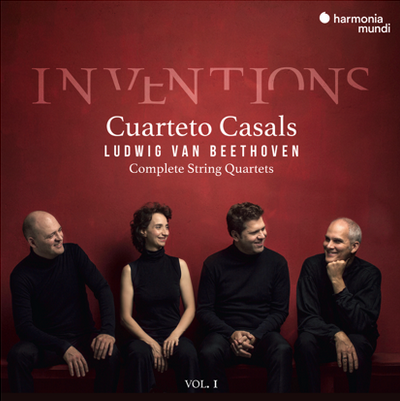
Launching its complete cycle of Beethoven's string quartets, the
Cuarteto Casals presents this first installment featuring initial
examples of the genre from each of the three key periods in the
composer's career: his formative years, the socalled 'heroic' middle
period, and that of his artisticmaturity. The ingenious juxstaposition
shows how much his superhuman quest for perfection enriched a
compositional language of breathtaking originality in tandem with a
depth of expression without precedent in this genre, of which Beethoven
is the uncontested master.
jueves, 5 de mayo de 2016
Cuarteto Casals METAMORPHOSIS Bartók - Kurtág - Ligeti
 It is sometimes said that the essence of ‘classical' music lies in the
principle of variation; but when the idea of incessant transformation of
the musical material irrigates scores like these quartets by three
eminent Hungarian composers of the 20th century, the resulting sonic
impressions are very different. The governing principle here is
metamorphosis, an idea as dear to Bartók as it was to the compatriots
who succeeded him.
It is sometimes said that the essence of ‘classical' music lies in the
principle of variation; but when the idea of incessant transformation of
the musical material irrigates scores like these quartets by three
eminent Hungarian composers of the 20th century, the resulting sonic
impressions are very different. The governing principle here is
metamorphosis, an idea as dear to Bartók as it was to the compatriots
who succeeded him.
“The Bartok Fourth Quartet receives a
relatively 'classical', even cool account - not as relentlessly
hard-driven as some other recent accounts of the piece but in itself
perfectly valid (and certainly not as exhausting). On the technical
elevel, it is practically perfect.” International Record Review, October 2010
“Bartók's piece has perhaps the most unsettling opening of any string quartet – a discomfiting premonition of the technical challenges ahead, from the furtive prestissimo to the biting pizzicatos of the allegretto, all navigated with sensitivity to the changing moodscape by the Quarteto Casals” The Independent, 30th July 2010
“Cuarteto Casals hold their big-boned, heart-on-sleeve sound in reserve for much of this disc, unleashing it only in the brutal blur of the second movement of Métamorphoses nocturnes.” The Independent on Sunday, 3rd October 2010
viernes, 5 de septiembre de 2014
Cuarteto Casals WOLFGANG AMADEUS MOZART String Quartets dedicated to Joseph Haydn

No one could accuse the Cuarteto Casals of being reticent in these three of the six quartets that Mozart dedicated to Haydn, the works in G: K387, E flat K428 and C K465. They launch into every movement with tremendous relish, on such a tide of rich, deep string tone that they could be playing Brahms or Dvořák, and it comes with equally full-blooded, expressive inflections. It is very involving to begin with, as such musical generosity draws you into the performance – welcomes you almost. But after a while it all seems a bit too obvious and generalised. The habit of shaping every phrase the same way, so that each of them is turned into a crescendo, which can be heard right from the outset in the opening movement of K387, starts to be fussy, while the scoops and touches of portamento seem to belong to a different style of performance altogether. The musicality and warmth of the playing are never in doubt; it's just that the Casals' approach perhaps doesn't suit Mozart as well as it might later composers.(Andrew Clements)
lunes, 19 de mayo de 2014
Cuarteto Casals JOSEPH HAYDN Die sieben letzten Worte

Haydn wrote his 'Seven Last Words' in 1786/87 for
Good Friday devotions in Cádiz. Although the custom in Cádiz was to
perform an oratorio, Haydn's brief was in fact to write seven movements
for orchestra alone, each creating a mood inspired by one of the sayings
attributed to the dying Christ. He chose to frame them with a further
slow movement called ‘Introduzione’ and a concluding Presto entitled ‘Il
Terremoto’, intended to depict the earthquake that occurred after
Christ’s death (Matthew 27:51).
This purely instrumental
‘oratorio’ consisting of seven contemplative slow movements was by no
means an easy task; but the outcome was a work of sublime nobility,
which in Haydn’s own transcription for string quartet has enjoyed
unfailing popularity ever since.
It is entirely appropriate that
this recording of Haydn’s 'Seven Last Words of Christ' should be
performed by the Cuarteto Casals, for the work represents one of the few
surviving traces of the composer’s flourishing relationship with Spain,
where his music seems quickly to have become as popular as it was in
France and Britain.
Suscribirse a:
Entradas (Atom)


