
Mostrando entradas con la etiqueta Orchestre de Chambre de Paris. Mostrar todas las entradas
Mostrando entradas con la etiqueta Orchestre de Chambre de Paris. Mostrar todas las entradas
lunes, 16 de noviembre de 2020

miércoles, 11 de septiembre de 2019
Shani Diluka / Orchestre de Chambre de Paris / Ben Glassberg TEMPÉRAMENTS

Shani Diluka has given us some unusual programmes on the Mirare label in the past, including Schubert’s final great sonata with an assortment of other short pieces by the master, and Road 66
with American composers. So what are we to make of this assortment of
C.P.E. Bach solo works, plus one concerto, a couple of pieces by Mozart
and a change of instrument in the last 10 minutes?
Quite a lot as it happens. Diluka’s way with C.P.E. Bach is deeply poetic and involving in the opening Andante con tenerezza, with the sharpest of contrasts in the spectacular Solfeggietto that follows. The weight here is somewhat in favour of Bach over Mozart, and we are kept in anticipation as to “the filial, even spiritual relationship” between these two composers. The Variations sur le thème de la Folia has just about everything, from tender reminiscence to extrovert showmanship that at times looks as much towards Beethoven as anything else. Diluka’s touch is pearlescent in the quieter music, with plenty of colour and steely edge when the mood changes.
Quite a lot as it happens. Diluka’s way with C.P.E. Bach is deeply poetic and involving in the opening Andante con tenerezza, with the sharpest of contrasts in the spectacular Solfeggietto that follows. The weight here is somewhat in favour of Bach over Mozart, and we are kept in anticipation as to “the filial, even spiritual relationship” between these two composers. The Variations sur le thème de la Folia has just about everything, from tender reminiscence to extrovert showmanship that at times looks as much towards Beethoven as anything else. Diluka’s touch is pearlescent in the quieter music, with plenty of colour and steely edge when the mood changes.
The Concerto in D minor might seem like a centrepiece, but in
many ways feels more like a continuation of the wide expressive palette
to which we’ve been treated until now. The Orchestre de chambre de Paris
is given an early music finish with harpsichord continuo adding spice
to the refined string sound and the modern piano is a hefty machine
against this backdrop, but the music and musicianship are both superb,
with Bach’s declamatory drama presented with emphasis in the opening Allegro. The central Poco andante is more Mozartean, with simple textures and expressive lines exchanging between soloist and orchestra, the final Allegro assai
drawing on dramatic techniques that connect us with Vivaldi as well as
propelling us into the explosive extremes of C.P.E. Bach’s personal
idiom. The link with Mozart is given some added brushstrokes in
well-placed cadenzas by Shani Diluka that refer to Mozart’s Concerto D. 466, one that shares its D minor tonality with this work.
Bach’s Abschied von meinem Silbermanischen Klaviere in einem Rondo is another special choice in the context of this programme, given that we’re comparing period with modern instruments as well as composers. Full of contemplative reflection and “nourished by the imagination of lost sounds” this is both a reminiscence and an exploration, with some striking moments which demand repeated hearing. Having become attuned to C.P.E. Bach, Mozart’s Sonata in A minor K.310 does indeed take on a new aspect. Diluka doesn’t change her touch particularly between composers, so there is an almost seamless transition and we hear Mozart’s contrasts in the light of what has gone before. It is only as the form develops and Mozart’s individual shaping of his musical paragraphs roll out that we sense a different imagination at work. Mozart’s dramas are less fleeting in this work, though the contrasts are in many ways no less extreme. Diluka doesn’t force the point in the opening Allegro maestoso, but she doesn’t really have to. Mozart’s operatic side comes more to the fore in the central Andante cantabile con espressione, the notes gathering into vocal ensembles as much as they can be aria-like. C.P.E. Bach is more cabaret than opera with these kinds of mood, surprising us with quick changes and variety, where Mozart reaches out with longer arcs, the diversions from which are given time to take on more concrete identities. I really like Diluka’s touch in this piece; not overdoing things, but delivering each emotive high point with the right kind of weight.
There is an inevitable disturbing drop in pitch between the modern piano and the 1790 Walter fortepiano, reportedly Mozart’s favourite type of piano, in a faithful copy by Chris Maene. Mozart’s Fantaisie in D minor K.397, one of his most C.P.E. Bach-like pieces, sounds superb on this instrument. Silky softness contrasts with metallic edges to maximise the sort of effect Mozart must have been after, Diluka proving her skill in keeping things together on an instrument with a fragility to its sound that only adds to the intensity of the experience.
The programme ends with a reprise of the Andante con tenerezza on this fortepiano, which makes for an interesting comparison between instruments. The lack of sustain makes for a less lyrical performance, but by no means a less interesting one. Diluka gets to the heart of this music and takes us with her very effectively. This programme might seem a little eccentric at first glance, but all is justified by the time you reach the end and have the feeling you’d want to hear it all over again straight away. With excellent recorded sound and wonderful playing, this is a path strewn with gems you just want to pick up and take home to keep. (Dominy Clements)
Bach’s Abschied von meinem Silbermanischen Klaviere in einem Rondo is another special choice in the context of this programme, given that we’re comparing period with modern instruments as well as composers. Full of contemplative reflection and “nourished by the imagination of lost sounds” this is both a reminiscence and an exploration, with some striking moments which demand repeated hearing. Having become attuned to C.P.E. Bach, Mozart’s Sonata in A minor K.310 does indeed take on a new aspect. Diluka doesn’t change her touch particularly between composers, so there is an almost seamless transition and we hear Mozart’s contrasts in the light of what has gone before. It is only as the form develops and Mozart’s individual shaping of his musical paragraphs roll out that we sense a different imagination at work. Mozart’s dramas are less fleeting in this work, though the contrasts are in many ways no less extreme. Diluka doesn’t force the point in the opening Allegro maestoso, but she doesn’t really have to. Mozart’s operatic side comes more to the fore in the central Andante cantabile con espressione, the notes gathering into vocal ensembles as much as they can be aria-like. C.P.E. Bach is more cabaret than opera with these kinds of mood, surprising us with quick changes and variety, where Mozart reaches out with longer arcs, the diversions from which are given time to take on more concrete identities. I really like Diluka’s touch in this piece; not overdoing things, but delivering each emotive high point with the right kind of weight.
There is an inevitable disturbing drop in pitch between the modern piano and the 1790 Walter fortepiano, reportedly Mozart’s favourite type of piano, in a faithful copy by Chris Maene. Mozart’s Fantaisie in D minor K.397, one of his most C.P.E. Bach-like pieces, sounds superb on this instrument. Silky softness contrasts with metallic edges to maximise the sort of effect Mozart must have been after, Diluka proving her skill in keeping things together on an instrument with a fragility to its sound that only adds to the intensity of the experience.
The programme ends with a reprise of the Andante con tenerezza on this fortepiano, which makes for an interesting comparison between instruments. The lack of sustain makes for a less lyrical performance, but by no means a less interesting one. Diluka gets to the heart of this music and takes us with her very effectively. This programme might seem a little eccentric at first glance, but all is justified by the time you reach the end and have the feeling you’d want to hear it all over again straight away. With excellent recorded sound and wonderful playing, this is a path strewn with gems you just want to pick up and take home to keep. (Dominy Clements)
sábado, 3 de febrero de 2018
Gautier Capuçon INTUITION
 Gautier Capuçon releases his latest album Intuition on Warner/Erato. Released on 2 February 2018, it is an album featuring a collection of short pieces for cello with orchestra and cello with piano.
The orchestral works, which include pieces such as Massenet’s Méditation de Thais, Rachmaninov’s Vocalise, and Saint-Saëns’ ‘The Swan’ from Carnival of the Animals, were recorded with the Orchestre de Chambre de Paris under the direction of Douglas Boyd. The other half of the album features recital pieces from Joplin, Dvořák, Paganini, Piazzolla and Ducros, and were recorded with long-term duo-partner Jérôme Ducros.
“Since childhood, intuition has guided me on my journey through the cello landscape. Before horsehair vibrates across strings, before technique and training kick in; music begins with intuition.” Gautier Capuçon
Throughout the 2017/18 season, Capuçon will perform works from the Intuition album worldwide. With the Orchestre de Chambre de Paris he will appear in Aix, Paris, Berlin, Hannover, Düsseldorf, Frankfurt, and Hamburg; and with Ducros he will perform in Moscow, London, Toronto, and Santa Monica.
lunes, 11 de septiembre de 2017
Accentus / Orchestre de Chambre de Paris / Ottavio Dantone ROSSINI Petite Messe solennelle
 Starring Julia Lezhneva, Ottavio Dantone and accentus, this live
recording brings a new and fresh light on Rossini's most famous choral
work. The concert took place in Paris - Basilique de Saint-Denis, to
celebrate the 150th anniversary of the work, first performed in March
1864, in Paris. The amazing quality of the solo voices (Julia Lezhneva,
Delphine Galou, Michael Spyres, Alexander Vinogradov) meets the dynamic
direction of Ottavio Dantone and is supported by the vocal dexterity of
accentus chamber choir.
Starring Julia Lezhneva, Ottavio Dantone and accentus, this live
recording brings a new and fresh light on Rossini's most famous choral
work. The concert took place in Paris - Basilique de Saint-Denis, to
celebrate the 150th anniversary of the work, first performed in March
1864, in Paris. The amazing quality of the solo voices (Julia Lezhneva,
Delphine Galou, Michael Spyres, Alexander Vinogradov) meets the dynamic
direction of Ottavio Dantone and is supported by the vocal dexterity of
accentus chamber choir.
“Because of its uncommon instrumental
forces, the ‘chamber’ version of the 'Petite Messe', for two pianos and
harmonium, was long regarded as the definitive version; the
orchestration Rossini made in 1867-68 was viewed as merely an
arrangement. In his recent critical edition, Davide Daolmi presents a
different interpretation, which makes the orchestrated version the
culmination of a long genetic process, begun in 1862, in which the
‘chamber’ version is merely an intermediate stage. The posthumous
premiere of the definitive version of the 'Petite Messe', which was also
the work’s first public performance, took place at the Théâtre-Italien
on 28 February 1869, the anniversary of the composer’s birth, with
Gabrielle Kraus (soprano), Marietta Alboni (contralto), Ernest Nicolas
(tenor), and Luigi Agnesi. It was at once a triumph and a highly
emotional occasion. A few years later, on 30 May 1876, Verdi was to
conduct his 'Messa da requiem' in the same theatre, thus continuing the
homage to the great Italian composer.” (from the booklet notes)
sábado, 6 de mayo de 2017
Thomas Zehetmair / Orchestre de Chambre de Paris ROBERT SCHUMANN
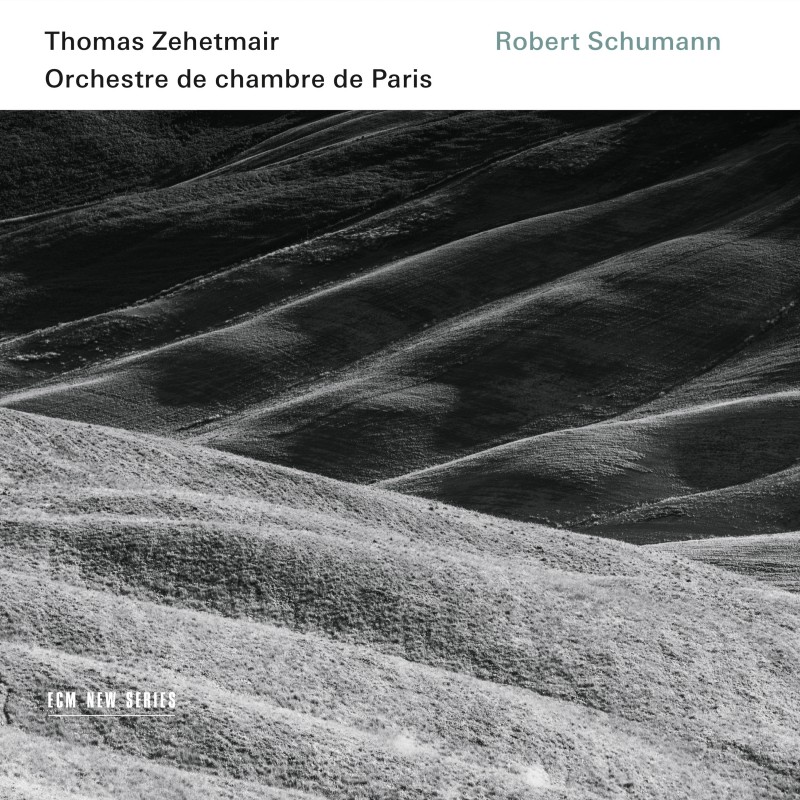
As with the chamber music, so with the symphonic works. On this
recording, made at Théâtre des Champs-Elysées in February 2014,
Zehetmair does double duty as both soloist and conductor, leading the
Orchestre de chambre de Paris in compelling performances of Schumann’s
Violin Concerto and the Phantasy for Violin and Orchestra, as well as
the First Symphony. Zehetmair has spoken of the “simultaneous
spontaneity, power and delicacy” which inform Schumann’s symphonic
compositions and these are qualities which he draws forth from the Paris
orchestra in these beautifully-realized performances.
In the liner notes for the present disc, Giselher Schubert describes the
genesis of the compositions and of Schumann’s very different frame of
mind during the writing of the First Symphony in 1941 and the Violin
Concerto a dozen years later. The Violin Concerto and the Phantasy were
written for Hungarian violinist Joseph Joachim in 1853, but only the
Phantasy, the solo part of which was designed by Schumann as a “written
out improvisation” to match the flair of Joachim’s performance style,
was premiered in the composer’s lifetime. Joachim and Clara Schumann
shared reservations about the playability of the Violin Concerto and,
after Schumann’s death, resolved not to publish it. The piece then had
to wait more than 80 years for its first performance, in Berlin in 1937.
Thomas Zehetmair: “The concerto has gripped me since I first encountered
it. But back in the early 1980s there was only the Schünemann edition
of the score available. As worthy as it was, it was nevertheless full of
errors. So I meticulously studied the original manuscript in 1988 in
the Berlin State Library, and recently contributed to the new Breitkopf
‘Urtext’ edition. Where the concerto was once considered a poor relative
in Schumann’s oeuvre, today no one doubts that the work belongs to the
greatest that has been written for violin and orchestra.”
Zehetmair made a well-received studio recording of the concerto for
Teldec in 1988, but notes that “experience naturally plays a major role
in performing such a profound piece, which I have now lived through in
numerous performances. This has left many traces.”
Deep engagement with the structure and proportions of the music runs
like a thread through Thomas Zehetmair’s distinguished and unusually
varied musical career as soloist, quartet leader, and conductor. (ECM Records)
lunes, 31 de octubre de 2016
Thibault Cauvin / Orchestre de Chambre de Paris / Julien Masmondet THE VIVALDI ALBUM
 Thibault Cauvin is certainly one of the most talented, charismatic and sought-after guitarists at the moment. He started touring more than ten years ago and never stopped since. Cauvin perfomed as a soloist in 120 countries on the most prestigious stages: Carnegie Hall in New York, Shanghai Concert Hall, Tchaikovsky Hall in Moscow, Queen Elizabeth Hall in London, GAM in Santiago de Chile, the Théâtre des Champs Elysées in Paris, Gasteig in Munich, and many others.
He releases is eighth album, which follows his two very popular and critically acclaimed previous albums, « Le Voyage d’Albéniz », recorded at the Château Lafite-Rothschild in 2014 and « Danse avec Scarlatti » in 2013. These albums are available in many countries and can be found on several compilations bringing together the music that has marked the past few years.
Born into a family of musicians, Thibault Cauvin started learning to play guitar at five years old with his father. After brilliant studies at the Bordeaux Conservatory and the National Superior Conservatory of Paris, he began entering international competitions. At age 20, he was and remains the only guitarist in the world to have won 13 international first prizes. This accomplishment at such a young age was the trigger of his « endless tour » which now counts over 1000 concerts. Cauvin’s one-of-a-kind career inspires the young generation of French classical guitarists who shines in many competitions around the world making France one of the most respected music school in the world.
Thibault Cauvin was appointed « Ambassador of Bordeaux Métropole » in 2013. He is patron of the « Paris Guitar Foundation » and is a Sony Music artist. The 30 year old musician takes the classical guitar further and further. His inspired, expressive and natural playing brings together people, generations and breaks down boundaries. This popular and eclectic guitar, new into the world of classical music, becomes the queen of the XXIst century. (Sony Classical)
martes, 25 de octubre de 2016
Philippe Bernold / Emmanuel Ceysson MOZART Flute & Harp Concerto
 Philippe Bernold began his musical
studies in Colmar, France, studying the flute and later composition and
conducting under René Matter, himself a student of Charles and Fritz
Münch.
Philippe Bernold began his musical
studies in Colmar, France, studying the flute and later composition and
conducting under René Matter, himself a student of Charles and Fritz
Münch.
He
then attended the Paris Conservatory, where he earned the First prize
in flute and the next year, at the age of 23, was appointed first flute
of the National Opera Orchestra of Lyon. In 1987 he won First Prize in the Jean-Pierre Rampal International Competition in Paris
This
award allowed him to start a career as a soloist, performing with world
famous artists and orchestras such as: M. Rostropovitch, J. P. Rampal,
M. Nordmann, with Paris Orchestra, F. Liszt Orchestra of Budapest,
Manchester Hallé Orchestra, Tapiola Sinfonietta, National Orchestra of
Lyon, Tokyo and Kyoto Symphony Orchestra…, he has been directed by S.
Bychkov, J. E. Gardiner, L. Maazel, K. Nagano, Sir Y. Menuhin, M. Inoué,
T. Koopman, in concert halls such as the Royal Festival Hall in London,
Pleyel Hall and Chatelet Theater in Paris, Cologne Philharmonie, Warsaw
Philharmonic, , Bunka Kaikan in Tokyo, Seoul Art Center, Tchaïkovsky
Conservatory in Moscow, as well as at the Festivals of Aix-en-Provence,
Cannes, Evian, Strasbourg, Radio France…
Philippe Bernold returned to conducting in 1994, founding "Les Virtuoses de l’Opéra de Lyon"
with the encouragement of conductors John Eliot Gardiner and Kent
Nagano. The ensemble quickly gained a reputation for its high level of
artistry.
Bernold was then appointed
assistant conductor of “Orchestre de Bretagne”. Since then, he has been
invited to conduct concerts with such ensembles as Sinfonia Varsovia
touring in Lisbon, Bilbao, Valence, Nantes and Warsaw, the National
Opera Orchestra of Lyon, Baden Baden Philharmonie, “Ensemble Orchestral
de Paris”, Philharmonic Orchestra of Marseille, Orchestra of the Opera
house of Toulon, Kanazawa Ensemble (Japan), “Bucheon Philharmonic”
(Seoul), San Remo Symphonic Orchestra, Geneva Chamber Orchestra, Janacek
Philharmonic Orchestra, Cappella Istropolitana, with whom he is first
gest conductor. In Caracas, (Venezuela) Philippe conducts the famous
“Simon Bolivar orchestra” (Musical director: Gustavo Dudamel).
martes, 1 de diciembre de 2015
Sarah & Deborah Nemtanu BACH / SCHNITTKE

French sisters Sarah and Deborah Nemtanu are leaders of the Orchestre
National de France and the Orchestre de Chambre de Paris, respectively.
And they are also characterful soloists who play Bach’s three violin
concertos with what sounds like intuitive freedom – just sample the
flicked-in embellishments.
These recordings also combine period- instruments style spareness of
vibrato with moments of almost old-style fullness of orchestral sound.
The couplings are fascinating, two of Bach’s Two-Part Inventions played
on violin and gutteral viola, and Schnittke’s Third Concerto Grosso of
1985, a work that moves from faux Bach into pure Schnittke as if by way
of musical hallucination.
Suscribirse a:
Entradas (Atom)

-
Music Is The Key will be closing soon. Over the last year maintaining this site and keeping it up to date has become an expensive and tim...

