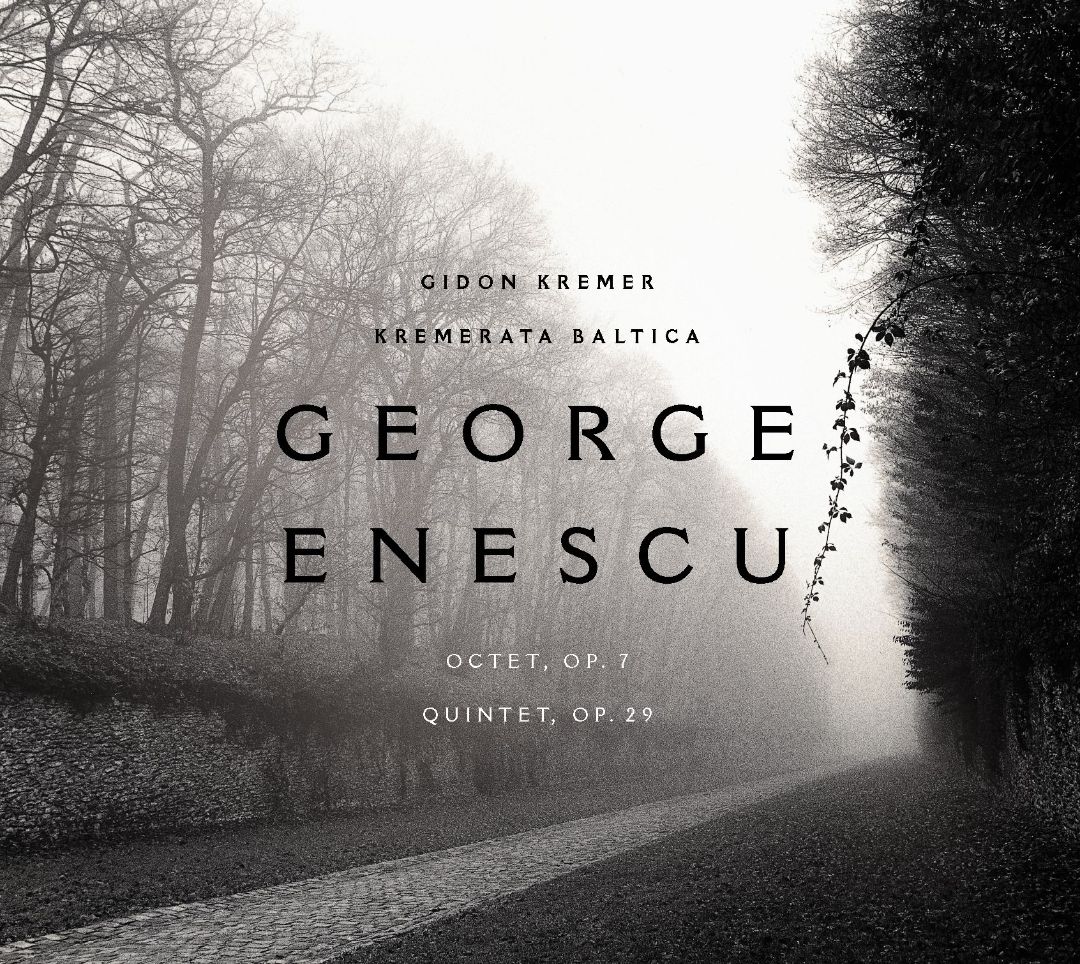
 Featuring the first recording of two works by George Enescu
-- the String Octet, Op. 7, and the Piano Quintet, Op. 29 -- this album
introduces the listener to the fascinating, multifaceted, and
intriguing world of the Romanian master's chamber music. Enescu's music is expertly performed by members of the extraordinary KREMERata BALTICA under the direction of Gidon Kremer, who plays first violin in both pieces. Kremer wisely chose the music, for the two works in many ways exemplify the salient features of the Enescu's
musical language and reflect his development from an eclectic,
post-Romantic style to a richer, more complex and personal idiom.
Composed in 1900, the lush, colorful, and dynamic octet is played with
remarkable subtlety, balance, and sense of nuance. The string players
find the exact tonal color to perfectly conjure up Enescu's
polychromous musical imagery, also impeccably expressing a wide range
of moods from lyrically intimate to ardently symphonic. In the piano quintet, which Enescu composed in 1940, the players rise to the challenge of interpreting a
work presenting many technical and artistic problems, many stemming from
the composer's austerely sophisticated idiom. Indeed, the KREMERata, completely mastering the many complexities of Enescu's
style, rewards listeners with the shared experience of highly
significant, albeit lesser-known, works of twentieth century chamber
music. (Zoran Minderovic)
Featuring the first recording of two works by George Enescu
-- the String Octet, Op. 7, and the Piano Quintet, Op. 29 -- this album
introduces the listener to the fascinating, multifaceted, and
intriguing world of the Romanian master's chamber music. Enescu's music is expertly performed by members of the extraordinary KREMERata BALTICA under the direction of Gidon Kremer, who plays first violin in both pieces. Kremer wisely chose the music, for the two works in many ways exemplify the salient features of the Enescu's
musical language and reflect his development from an eclectic,
post-Romantic style to a richer, more complex and personal idiom.
Composed in 1900, the lush, colorful, and dynamic octet is played with
remarkable subtlety, balance, and sense of nuance. The string players
find the exact tonal color to perfectly conjure up Enescu's
polychromous musical imagery, also impeccably expressing a wide range
of moods from lyrically intimate to ardently symphonic. In the piano quintet, which Enescu composed in 1940, the players rise to the challenge of interpreting a
work presenting many technical and artistic problems, many stemming from
the composer's austerely sophisticated idiom. Indeed, the KREMERata, completely mastering the many complexities of Enescu's
style, rewards listeners with the shared experience of highly
significant, albeit lesser-known, works of twentieth century chamber
music. (Zoran Minderovic)
Mostrando entradas con la etiqueta Marta Sudraba. Mostrar todas las entradas
Mostrando entradas con la etiqueta Marta Sudraba. Mostrar todas las entradas
martes, 7 de febrero de 2017
Gidon Kremer / Kremerata Baltica GEORGE ENESCU Octet, Op. 7 - Quintet, Op. 29
Featuring the first recording of two works by George Enescu
-- the String Octet, Op. 7, and the Piano Quintet, Op. 29 -- this album
introduces the listener to the fascinating, multifaceted, and
intriguing world of the Romanian master's chamber music. Enescu's music is expertly performed by members of the extraordinary KREMERata BALTICA under the direction of Gidon Kremer, who plays first violin in both pieces. Kremer wisely chose the music, for the two works in many ways exemplify the salient features of the Enescu's
musical language and reflect his development from an eclectic,
post-Romantic style to a richer, more complex and personal idiom.
Composed in 1900, the lush, colorful, and dynamic octet is played with
remarkable subtlety, balance, and sense of nuance. The string players
find the exact tonal color to perfectly conjure up Enescu's
polychromous musical imagery, also impeccably expressing a wide range
of moods from lyrically intimate to ardently symphonic. In the piano quintet, which Enescu composed in 1940, the players rise to the challenge of interpreting a
work presenting many technical and artistic problems, many stemming from
the composer's austerely sophisticated idiom. Indeed, the KREMERata, completely mastering the many complexities of Enescu's
style, rewards listeners with the shared experience of highly
significant, albeit lesser-known, works of twentieth century chamber
music. (Zoran Minderovic) 
lunes, 24 de febrero de 2014
Gidon Kremer / Kremerata Baltica SOFIA GUBAIDULINA Canticle of the Sun

Sofia Gubaidulina’s 80th birthday in October 2011 generated much
press coverage around the world, appropriately stressing the uniqueness
and the variety of her compositional approaches. Both are in evidence on
these recordings from Lockenhaus. Gidon Kremer is the soloist and
Kremerata Baltica the ensemble on the premiere recording of “The Lyre of
Orpheus”, dedicated to the memory of Gubaidulina’s daughter. Kremer has
long been a committed advocate of Gubaidulina’s work, and the composer
has praised the way the violinist seems to unleash music from the soul.
In this work of austere beauty and raw lyricism, violin, string
orchestra and percussion intermingle in new ways. At a subterranean
level, the piece is also an exploration into acoustic phenomena and the
physics of sound, with pulsating difference tones part of its underlying
structures. “The Lyre of Orpheus” was recorded in 2006, a month after
Kremer gave the first performance.
“Canticle of the Sun”, recorded in 2010, revisits the celebrated
piece that Gubaiduilina wrote in tribute to Mstislav Rostropovich on the
occasion of his 70th birthday in 1997. Rostropovich’s famously sunny
disposition was an inspiration, by association prompting Gubaidulina to
set St Francis of Assisi’s “Canticle of the Sun” for choir. In this
recording, Nicolas Altstaedt, one of the most accomplished cellists of
his generation, takes on the highly expressive lead role. A further,
timely, Lockenhaus connection here: as of this year, Altsteadt takes
over from Kremer as the new director of the Lockenhaus Chamber Music
Festival.
Suscribirse a:
Entradas (Atom)

-
Music Is The Key will be closing soon. Over the last year maintaining this site and keeping it up to date has become an expensive and tim...

