Mostrando entradas con la etiqueta cantaloupe music. Mostrar todas las entradas
Mostrando entradas con la etiqueta cantaloupe music. Mostrar todas las entradas
martes, 6 de octubre de 2020

domingo, 16 de junio de 2019
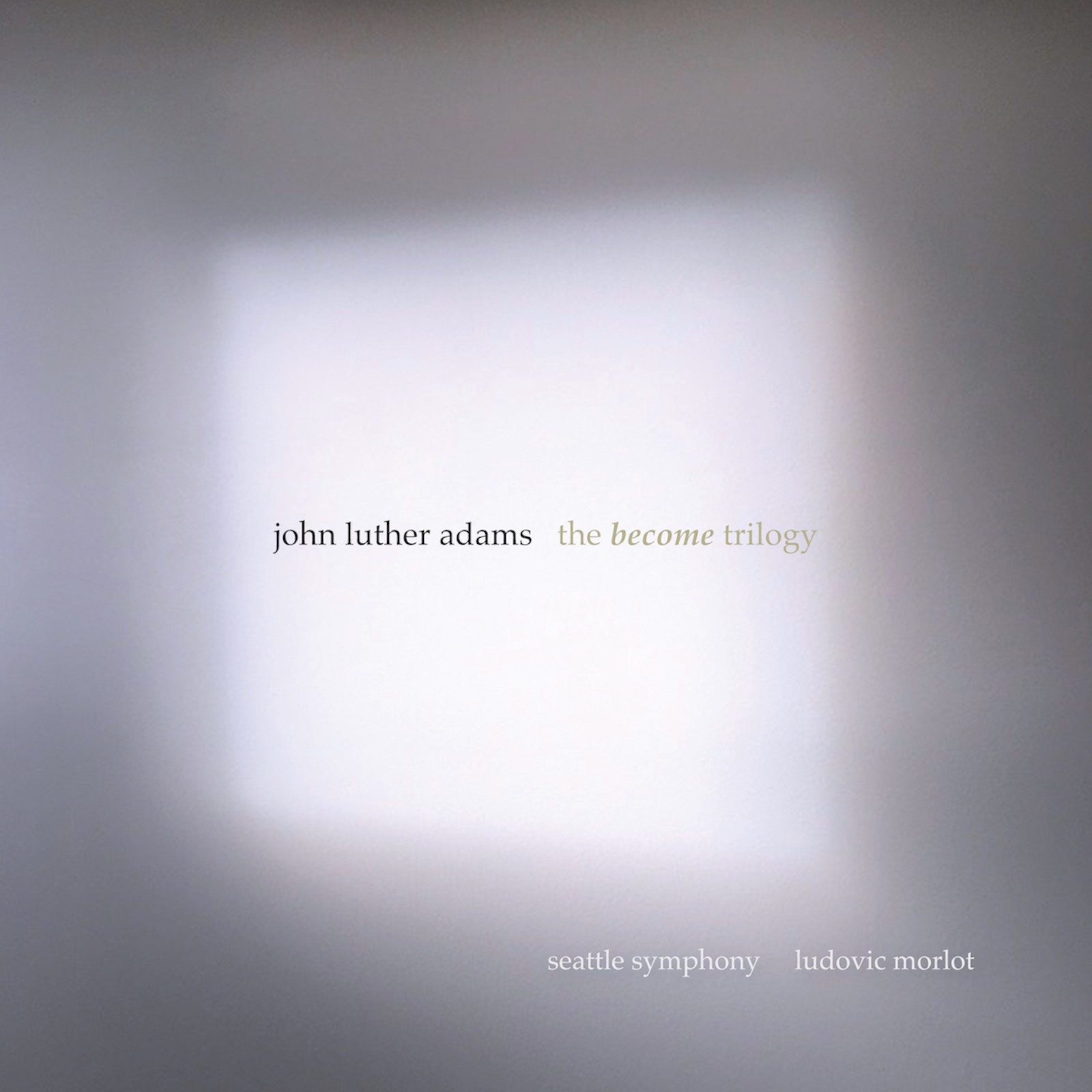
Seattle Symphony Orchestra / Ludovic Morlot JOHN LUTHER ADAMS Become Desert
 Become Desert is the much-anticipated sequel to Adams’ Pulitzer-winning Become Ocean, and a major milestone in the creative partnership between the composer and the Seattle Symphony with Ludovic Morlot.
For Adams, who has been called “one of the most original musical thinkers of the new century” by The New Yorker’s
Alex Ross, the 40-minute work completes a trilogy he hadn’t intended to
write, and yet it emerges as one of his most expansive and
consciousness-raising musical statements to date.
In 2010, Adams created musical streams both aurally and visually with Become River. He followed with Become Ocean, which divides the orchestra into three parts to create a vast
sense of undulating space and rhythm. The 2014 recording by Morlot and
the Seattle Symphony debuted atop the Billboard Traditional Classical
Chart, and won a Grammy Award for Best Contemporary Classical Composition.
With Become Desert, space is once again a
fundamental compositional element, but on a larger scale, with five
different ensembles moving at five different tempos. The work features a
large orchestra and choir that are deployed as five ensembles that
surround the audience.
Seattle Symphony Orchestra / Ludovic Morlot JOHN LUTHER ADAMS Become Ocean
 Awarded the 2014 Pulitzer Prize for Music, Become Ocean is set
to finally extricate John Luther Adams from the shadow of his
near-namesake. In fact the two lie at polar ends of the post-minimal
spectrum. JLA composes slowly evolving, monumental sound creations that
seem somehow to emerge from the essence of the earth. His lifelong
engagement with elemental forces and the power of nature stems from
years living in the Alaskan wilderness, where he has evolved a ‘music of
place’ grounded in its physical, cultural and spiritual attributes.
Awarded the 2014 Pulitzer Prize for Music, Become Ocean is set
to finally extricate John Luther Adams from the shadow of his
near-namesake. In fact the two lie at polar ends of the post-minimal
spectrum. JLA composes slowly evolving, monumental sound creations that
seem somehow to emerge from the essence of the earth. His lifelong
engagement with elemental forces and the power of nature stems from
years living in the Alaskan wilderness, where he has evolved a ‘music of
place’ grounded in its physical, cultural and spiritual attributes.
Surprising, therefore, that Adams’s recent composition is inspired by the sea rather than the earth. Become Ocean
takes the sense of scale and space that captured the composer’s
imagination when he first visited Alaska in the 1970s and applies it to
the deep, dark and hidden depths of the oceans surrounding the Pacific
Northwest.
This is not ersatz programmatic music, however. Adams’s ‘sonic
geography’ is a by-product of what can only be described as a keenly
felt musical osmosis. If ever an orchestra sounded like an immense sonic
object, slowly floating across a vast area, then this must be it. Become Ocean
is divided into six seven-minute segments, with each one forming a kind
of slow-motion wave. Some of these waves swell up into enormous,
thunderous crashes, as heard around the 21' and 35' marks, causing
changes in the music’s environment – like shifting glaciers in a frozen
sea. As if to demonstrate the connection, there’s also a DVD consisting
of six oceanic images looped in sequence to the music.
Of course, a strong cautionary message lies behind Become Ocean.
To quote the composer himself: ‘As the polar ice melts and sea level
rises, we humans find ourselves facing the prospect that once again we
may quite literally become ocean.’ (Gramophone)
martes, 15 de mayo de 2018
Kronos Quartet MICHAEL GORDON Clouded Yellow
 Over the course of a decade, Bang on a Can founding composer Michael
Gordon has collaborated with the world-renowned Kronos Quartet on a
series of provocative works that have sought to stretch, bend and
otherwise reshape the boundaries of modern classical music. Clouded Yellow assembles these works for the first time, perfectly encapsulating
the breadth and complexity of this long-standing creative partnership.
For the past thirty years, Michael Gordon has produced a strikingly
diverse body of work, ranging from large-scale pieces for high-energy
ensembles to major orchestral commissions to works conceived
specifically for the recording studio. Transcending categorization, the
music represents the collision of mysterious introspection and brutal
directness. Gordon’s music merges subtle rhythmic invention with
incredible power embodying, in the words of The New Yorker’s Alex Ross,
“the fury of punk rock, the nervous brilliance of free jazz and the
intransigence of classical modernism.”
Over the course of a decade, Bang on a Can founding composer Michael
Gordon has collaborated with the world-renowned Kronos Quartet on a
series of provocative works that have sought to stretch, bend and
otherwise reshape the boundaries of modern classical music. Clouded Yellow assembles these works for the first time, perfectly encapsulating
the breadth and complexity of this long-standing creative partnership.
For the past thirty years, Michael Gordon has produced a strikingly
diverse body of work, ranging from large-scale pieces for high-energy
ensembles to major orchestral commissions to works conceived
specifically for the recording studio. Transcending categorization, the
music represents the collision of mysterious introspection and brutal
directness. Gordon’s music merges subtle rhythmic invention with
incredible power embodying, in the words of The New Yorker’s Alex Ross,
“the fury of punk rock, the nervous brilliance of free jazz and the
intransigence of classical modernism.”
domingo, 5 de noviembre de 2017
Ars Nova Copenhagen / Paul Hillier FIRST DROP

“Almost all the works on this CD are first recordings,” Hillier explains, referring to one source of inspiration behind the title. “Ideally we wanted the idea of First Drop to remain ambiguous, but the diligent listener will sooner or later notice that it originates with Ralph Waldo Emerson.”
Recorded over a stretch of nearly ten years, in different locations and with different configurations of singers, the performances documented here still come across as parts of a seamless whole. From the haunting strains of Michael Gordon’s “He Saw A Skull” (composed specifically for the 12 voices of Ars Nova) to Hillier’s vocal arrangement of Steve Reich’s classic “Clapping Music,” First Drop channels a vernal energy that’s unparalleled in new vocal music.
martes, 11 de julio de 2017
DAVID LANG Child

Sentieri Selvaggi plays GAVIN BRYARS & PHILIP GLASS
 Sentieri Selvaggi,
made up of some of the brightest young Italian musicians to emerge
around the turn of the millennium, has devoted itself to a wide range of
contemporary music, ranging stylistically from Glass to Stockhausen.
The two eight-minute pieces recorded here are taken from the
full-length 1999 album Musica Coelestis, which included 12 pieces. The
outstanding sound is clean and the instruments are vividly
differentiated. The performance of the Glass is a reminder of the variety of interpretations that can be brought to minimalist repertoire. Glass
and his ensemble perform Façades with rhythmic strictness, but with
linear expressiveness; in fact, it comes across as one of the composer's
more overtly emotional pieces. Sentieri Selvaggi
performs it with absolute strictness with both rhythmic and dynamic
contours. This makes for a square-ish performance, but it works on its
own terms. It also tends to be somewhat bass-heavy, which has the
advantage of making Glass' subtle changes in the lower string parts clearly audible. Bryars'
Sub Rosa, for an unusually quirky ensemble of timbrally disparate
instruments, is something of a remix for live performers of
"Throughout," a song from Bill Frisell's 1984 album, In Line. Sentieri Selvaggi's recording is superior to Bryars'
own murky version largely because of the splendidly clear sound quality
that allows the strangeness of the ensemble to be savored and wondered
at. It's a short CD, but one that should interest fans of Bryars and Glass. (Stephen Eddins)
Sentieri Selvaggi,
made up of some of the brightest young Italian musicians to emerge
around the turn of the millennium, has devoted itself to a wide range of
contemporary music, ranging stylistically from Glass to Stockhausen.
The two eight-minute pieces recorded here are taken from the
full-length 1999 album Musica Coelestis, which included 12 pieces. The
outstanding sound is clean and the instruments are vividly
differentiated. The performance of the Glass is a reminder of the variety of interpretations that can be brought to minimalist repertoire. Glass
and his ensemble perform Façades with rhythmic strictness, but with
linear expressiveness; in fact, it comes across as one of the composer's
more overtly emotional pieces. Sentieri Selvaggi
performs it with absolute strictness with both rhythmic and dynamic
contours. This makes for a square-ish performance, but it works on its
own terms. It also tends to be somewhat bass-heavy, which has the
advantage of making Glass' subtle changes in the lower string parts clearly audible. Bryars'
Sub Rosa, for an unusually quirky ensemble of timbrally disparate
instruments, is something of a remix for live performers of
"Throughout," a song from Bill Frisell's 1984 album, In Line. Sentieri Selvaggi's recording is superior to Bryars'
own murky version largely because of the splendidly clear sound quality
that allows the strangeness of the ensemble to be savored and wondered
at. It's a short CD, but one that should interest fans of Bryars and Glass. (Stephen Eddins)domingo, 8 de junio de 2014
Andrew Zolinsky DAVID LANG this was written by hand

On his new album from Cantaloupe Music, this was written by hand,
David Lang treats the piano alternately as a eulogizer and as a medium
to commune with the departed. Pianist Andrew Zolinsky’s technique is
well suited to tastefully render these finely wrought improvisatory
pieces, to sound out the meditative character of Lang’s postminimalism.
The range of piano articulation presented here stretches from use of the
instrument as pitched percussion all the way to liquid, dulcet burbles.
Piano music in the contemporary classical world often embraces jazz
tropes, or world music idioms, or past stylistic genres. Lang’s piano
voice sometimes recalls the phase music of Reich but is for the most
part quite original in its complete metrical flexibility (or complete
lack of meter in some cases, it seems), and in the way it exhaustively
explores all the possibilities of a spare musical form. The tracks here
are all character pieces in my opinion. There are no grand statements;
on the contrary, the prevailing voice is one of personal introspection,
without a hint of sentimentality.
“this was written by hand” opens with a rising white-note motif,
bubbling up and echoed upon itself to create a lush texture. Simple
modal recitatives sound in the piano’s upper register. Eventually a
voice in the tenor range takes tentative steps toward more chromatic
territory, fleshing out austere impressions of tone. The piece was the
composer’s attempt to revisit the act of writing without the convenience
of a computer. It certainly flaunts its agogic freedom. The succession
of notes seems to fold back upon itself before having a chance to
establish any kind of conventional melody, so bashful are the various
voices. The overall impression is of a blinded creature, resigned to
slowly feeling about in the dark to find its way. The composition, whose
subject is the artistic process itself, has a cunning metatextuality in
spite of its chaste tonal garb. The piano is an old soul; it predates
automobiles, let alone computers. It is thus fitting that the piano
should eulogize that lost time, before the banality of comfort and
connectivity in the digital age. (Rob Wendt)
jueves, 5 de junio de 2014
Anonymous 4 DAVID LANG Love Fail

Composed by David Lang, love fail is a meditation on the timelessness of love that weaves together details from the story of Tristan and Isolde with more modern sources. The recording also spotlights the singular and magical sound of the vocal quartet Anonymous 4,
whose longstanding commitment to medieval music and historical
scholarship has been acclaimed worldwide. The music and libretto pull
together narratives of love from such sources as Lydia Davis, Marie de
France, Gottfried von Strassburg, Béroul, Thomas of Britain and Richard
Wagner. love fail was commissioned by The Brooklyn Academy of
Music’s 2012 Next Wave Festival, The International Festival of Arts
& Ideas, The John F. Kennedy Center Abe Fortas Memorial Fund, The
Center for the Art of Performance at UCLA, The Wake Forest
University/Secrest Artists Series, and Hancher Performances at the
University of Iowa.
Reviewing the BAM performance for the New York Times, Anthony
Tommasini wrote: “It was Mr. Lang’s music, and the ethereal, pure-toned
singing of Anonymous 4, that claimed me in the first section of the
piece, which begins with the line ‘he was a blessed man.’”
In his liner notes, David Lang poses the question: “It’s ‘the greatest love story ever!’ But why? Of course, there is excitement,
drama, love, lust, shame, death, dragons. I think the real reason is
because the love of Tristan and Isolde begins by accident—they
drink a love potion. They didn’t mean to drink it, and they didn’t mean
to fall in love. They drink and—BAM!—it starts. It’s almost a laboratory
experiment into what love might be like without any of the
complications of how real love begins or works—without the excitement,
embarrassment, frustration, guilt or competition present in the
courtships of ordinary people.”
The recording of love fail was supported by New Music USA, the Aaron Copland Fund for Music, and the Doris Duke Performing Artists Awards, and was made possible by annual program support and / or endowment gifts from Mary Flagler Cary Charitable Trust.
lunes, 2 de junio de 2014
Nico Muhly / Owen Pallett / Bryce Dessner / Shara Worden DAVID LANG Death Speaks

Death is present in so many of Schubert's lieder, and those appearances provide the starting point for the five songs that make up David Lang's Death Speaks. Lang went through the 600-plus texts that Schubert set, extracting all the lines that are either attributed explicitly to death, or to characters representing him, translating them "roughly" into English and creating lovesong-like lyrics. The settings are wonderfully spare and insistent, with accompaniments from guitar, piano and violin. Shara Worden, lead singer of My Brightest Diamond, is the vocalist, recorded in a close perspective, while the other work on the disc, Depart, offers a very different kind meditation on death. It was commissioned to be played in a French morgue, a peaceful setting in which the bereaved could see their loved ones for the last time. A sequence of slowly changing drones for wordless women's voices and cello, makes the perfect foil for Lang's naggingly memorable songs. (Andrew Clements / The Guardian)
viernes, 30 de mayo de 2014
Maya Beiser / Michael Harrison TIME LOOPS

The mysterious power of music has intrigued thinkers across the
centuries. Plato described a universe in which Sirens situated atop the
rings of the cosmic whorl each sing a single note from a great scale,
together producing concords that can transport mortals to the heavenly
regions. In our own time we tend to use other metaphors to explain the
phenomenon -- with terms like "brain scan" and "beta-endorphins" -- but
when listening to an exquisite piece of music, who could deny the
emotional truth of Plato's vision?
Perhaps we respond so forcefully because, as Clement of Alexandria put it, the human body is itself a musical instrument. That was the view not only of the ancient Greeks but also of the Indian masters who strongly influenced Michael Harrison's musical development. Both proposed deep connections between the arrangements of tones and the human condition, and pointed to the most fundamental musical relationships -- those defined by Pythagoras in "whole number" proportions, as when strings vibrate in the ratio of 2:1, or 3:2, or 4:3 -- as being endowed with special qualities.
These comprise the tuning known as "just intonation," and generate the musical alchemy found throughout this intoxicatingly beautiful recording. In Just Ancient Loops, says cellist Maya Beiser, these unique musical relationships allow the sound of the cello to shimmer and bounce. "It's as if you are turning all the artificial lights off and just letting the rays of sunlight into your space," she says. In her recording and concert collaborations, Ms. Beiser has sought to redefine the traditional boundaries of the cello, opening new sonic possibilities for human expression. In this collaboration, Beiser and Harrison's musical and spiritual worlds converge.
"Michael's music is perfect for our times," Beiser observes. "It's architectural and precise, yet exhilarating and beautiful. It draws on music from ancient Greece and the Renaissance, Indian ragas and minimalism." This project is just the latest example of Michael Harrison's remarkable path, which has wound its way through compositional possibilities outside the modern Western canon and the denatured sounds of its modern tuning system. In his landmark piano work Revelation, he used "very small but perfectly tuned microtonal intervals to create a sound world of sustaining, pulsing" and kaleidoscopic effects. "With Time Loops, I'm demonstrating the simpler and more harmonious aspects of just intonation," he says. "As a result the tunings on the CD don't push the boundaries, but rather they sound clearer and more direct than the normal equal tempered scale that is used in most Western music."
Perhaps we respond so forcefully because, as Clement of Alexandria put it, the human body is itself a musical instrument. That was the view not only of the ancient Greeks but also of the Indian masters who strongly influenced Michael Harrison's musical development. Both proposed deep connections between the arrangements of tones and the human condition, and pointed to the most fundamental musical relationships -- those defined by Pythagoras in "whole number" proportions, as when strings vibrate in the ratio of 2:1, or 3:2, or 4:3 -- as being endowed with special qualities.
These comprise the tuning known as "just intonation," and generate the musical alchemy found throughout this intoxicatingly beautiful recording. In Just Ancient Loops, says cellist Maya Beiser, these unique musical relationships allow the sound of the cello to shimmer and bounce. "It's as if you are turning all the artificial lights off and just letting the rays of sunlight into your space," she says. In her recording and concert collaborations, Ms. Beiser has sought to redefine the traditional boundaries of the cello, opening new sonic possibilities for human expression. In this collaboration, Beiser and Harrison's musical and spiritual worlds converge.
"Michael's music is perfect for our times," Beiser observes. "It's architectural and precise, yet exhilarating and beautiful. It draws on music from ancient Greece and the Renaissance, Indian ragas and minimalism." This project is just the latest example of Michael Harrison's remarkable path, which has wound its way through compositional possibilities outside the modern Western canon and the denatured sounds of its modern tuning system. In his landmark piano work Revelation, he used "very small but perfectly tuned microtonal intervals to create a sound world of sustaining, pulsing" and kaleidoscopic effects. "With Time Loops, I'm demonstrating the simpler and more harmonious aspects of just intonation," he says. "As a result the tunings on the CD don't push the boundaries, but rather they sound clearer and more direct than the normal equal tempered scale that is used in most Western music."
Suscribirse a:
Entradas (Atom)

-
Music Is The Key will be closing soon. Over the last year maintaining this site and keeping it up to date has become an expensive and tim...

