
Mostrando entradas con la etiqueta John Cage. Mostrar todas las entradas
Mostrando entradas con la etiqueta John Cage. Mostrar todas las entradas
sábado, 26 de septiembre de 2020

martes, 12 de mayo de 2020

lunes, 11 de febrero de 2019
Shani Diluka ROAD 66
 Diluka brings appreciable nuance and delicacy to Adams’s China Gates and Beach’s Young Birches, and infuses the churning minimalist patterns of Glass’s Etude No 9 with more dynamic and colouristic range than one often hears from so-called contemporary music specialists. In most lyrical pieces, however, softer dynamics often recede and wilt to the point of fading away, especially when Diluka makes diminuendos. You hear this in the two Bernstein Anniversaries, Ginastera’s ‘Danza de la moza donosa’ and Grainger’s gorgeous transcription of Gershwin’s ‘Love walked in’. Her spineless performance of Copland’s Piano Blues No 1 lacks the sinew and projection heard from Leo Smit, the work’s dedicatee, although such a style befits Hyung-ki Joo’s noodly, shapeless Chandeliers.
However, Diluka’s faster-than-usual tempo for Cage’s In a Landscape rescues this music from its usual frozen dream state. Her enervated, flaccid approach to Keith Jarrett and Bill Evans is alien to these jazz icons in both spirit and letter; in fact she misreads Waltz for Debby’s fourth-to-last chord. But Diluka plays the piano part to Raphaël Merlin’s brilliant, harmonically imaginative arrangement of Cole Porter’s ‘What is this thing called love’ gorgeously, abetted by special guest Natalie Dessay’s sultry singing. Had the two paired up for an entire CD’s worth of Merlin-arranged standards, I would have stayed up all night behind the wheel to listen, rather than squirming in the back seat to the tune of ‘Are we there yet? Are we there yet?’ (Jed Distler / Gramophone)
martes, 9 de octubre de 2018
Manuel Zurria REPEAT!
 The restless experimentation and creativity of Manuel Zurria (of Alter
Ego fame) has resulted in a brilliant series of collaborative works with
legendary composers such as Luc Ferrari, Alvin Lucier, Arvo Pärt, John
Cage, Morton Feldman, László Sáry, Louis Andriessen, Aldo Clementi,
Zoltan Jeney, Stefano Scodanibbio, Salvatore Sciarrino, Jonathan Harvey
and Kevin Volans. A truly stunning mixture of electronic and longform
electro-acoustic pieces, repetitive ethnic rhythms, drones and delay,
field recordings, flute and the human voice.
The restless experimentation and creativity of Manuel Zurria (of Alter
Ego fame) has resulted in a brilliant series of collaborative works with
legendary composers such as Luc Ferrari, Alvin Lucier, Arvo Pärt, John
Cage, Morton Feldman, László Sáry, Louis Andriessen, Aldo Clementi,
Zoltan Jeney, Stefano Scodanibbio, Salvatore Sciarrino, Jonathan Harvey
and Kevin Volans. A truly stunning mixture of electronic and longform
electro-acoustic pieces, repetitive ethnic rhythms, drones and delay,
field recordings, flute and the human voice. Repeat is the diary of an obsession that has been accompanying me for four long years. Alighiero Boetti, one of the fathers of Italian conceptual art, had fit out along a wall of his house in Rome his most introspective work: The Wall. On this wall he showed, continuously modifying their choice and position, objects and works belonging to his own production or to the one of other artists friends, together with objects he found by chance on the street, family pictures and drawings of his children. In other words, his own world. During the realisation of this project I have been reading “Difference and Repetition” by Gilles Deleuze, which gave me the occasion to ponder on the involvements that bring back to the principle of repetition in music of our time. In a certain sense, Deleuze’s writing allowed me to focus on the importance of repetition as a perceptive fact, and as an experience of listening in accumulation. In the same time, I thought of repetition as difference, as a minimal fact, as trance. This element has been determinant in my activity and allowed me to collaborate during the years with musicians who look at repetition as an exciting experience, both physical and mystic. (Manuel Zurria)
viernes, 22 de junio de 2018
Ezio Bosso / StradivariFestival Chamber Orchestra BOSSO, MARCELLO, BACH, TCHAIKOVSKY, CAGE
 Resident Conductor and Art Director of the StradivariFestival Chamber Orchestra, Sony Classical International Artist from 2016, and in February 2018 he was designated as a Steinway Artist.
Moreover, Ezio Bosso is the Testimonial and International Ambassador of the Associazione Mozart14, official legacy of the social and educational principles established by the late Maestro Claudio Abbado, pursued with unique dedication by his daughter Alessandra. This confirms Maestro Bosso’s didactic and social commitment underlined by his intense dissemination activity, constantly emphasised through his concerts, his decision to open, where possible, all the orchestra or chamber music rehearsals to the public. He is the first conductor to do so: his lessons are open to everyone, but also his ventures with the Opera Pia Barolo and Medicina a Misura di Donna in Turin.
Ezio Bosso is the official testimonial of the 2018 European Music Day.
A conductor, a composer, a pianist when necessary as he loves to describe himself, Ezio Bosso intensified his concert activity in 2015 with a career constantly increasing that, after having attracted an audience of over 100,000 people to the most significant theatres with his solo piano recital in 2016, considered as the most important classical music tour in Italian history, sees him today having just completed a long series of triumphant concerts at the head of some of the best Italian and international orchestras in his regained roleof conductor, after a few years’ hiatus.
martes, 29 de mayo de 2018
Jürg Frey BEUGER - CAGE
 Clarinetist Jürg Frey performs two works, one composed by Antoine Beuger and one by John Cage, both related to time, or of becoming and of unceasing becoming, pieces using silence in powerful sound structures, contrasting empty moments with the complexity of individual sound.
"The movement which occurs throughout the program played here by Jürg
Frey, is one of becoming, of unceasing becoming; that means: of time.
Becoming has no starting point and no desire to reach a close. lt cannot
be localized. lt is unseizable, even in the smallest interval between
two points in time. lt occurs imperceptibly, in the simultaneity of "not
yet" and "already gone". Becoming is never presence. That is why
becoming occurs in silence. lt appears as though nothing takes place -
then, as it turns out, something irreversible has happened.
In
"dialogues (silence)" by Antoine Beuger; this concept is made
perceptible. Each sound structure is preceded and followed by silence.
Between the silence after a sound structure and the silence before the
next one, one hears the sound of a page being turned: the sound of
silence between the silences.
When music abandons itself to
complexity, tapping into the infinity of possible differences in sound,
becoming also occurs, as it were, while one's back is turned. lt is
never equal to what is going on, but merely passes through.
"Music
for One" by John Cage is characterized by the presence of both
directions: infinite extension of the moment in silence; infinite
diminution of the time-space in complexity. lt is however not the
diversity which distinguishes this music, but its equanimity." (Editions
Wandelweiser)
domingo, 20 de mayo de 2018
Sheila Arnold ÉCOUTEZ!

Tōru Takemitsu had to distance himself from his own culture in order
to listen to Japanese music with the ears of a Western-trained musician –
adopting, for instance, the approach of John Cage. He came to realize
that Japan’s venerable musical tradition had long been highlighting
individual notes as complex sonorities in their own right, instead of
treating them as part of a series of several notes.
From the human need for sound as well as silence, John Cage drew the
most extreme conclusions. The concept of a “beautiful” sound was never
static in music history: it has changed over the centuries, and it
differs from one culture to another. Western musical aesthetics tend to
differentiate between “noises” and “notes”: the latter feature
well-ordered harmonics. The concept of “dissonance” has also changed
throughout different musical periods. What is more, musicians and their
audiences have always felt the need to “savor” a dissonance – to listen
to it consciously, to experience it – before it is resolved.
On the other hand, time plays a truly fundamental
role in how a work is conceived and structured, and each individual
listener experiences musical time in a different way. Ideally, the
performer and the listener share the same time system: they enjoy
passages in a similar way, they hear a piece with the same depth of
focus. Music resonates inside the instrument, in our bodies, in the
space that surrounds us. Each note is in motion. When several notes
vibrate simultaneously, they make up an ocean of concomitant vibrations.
If we add the sounds and noises from our surroundings, then we are
dealing with an incredible concentration of sonic events within a very
short period of time.
What happens then?
We become more aware of the way we perceive things. If we are lucky,
this kind of conscious musical listening starts to affect how we pay
attention to other people, whether they are speaking or not. And lending
an ear to one another has become more necessary than ever. Wouldn’t you
agree? (Sheila Arnold)
lunes, 30 de abril de 2018
JOHN CAGE Four4
 “Another Timbre celebrate the sixtieth anniversary of the publication of John Cage's
influential work "Silence" by releasing "Four 4", a work written in 1991, the year
before Cage died. It was written for four percussionists, but the composer in his
typical way, chose to let the musicians decide which instruments to use! By selecting
the general instrumentation, while still allowing players to choose the specifics
freely, Cage showed that he does not really lack interest in how the music should
sound, he gives up only on the detail of the choices. So his ego drew back, but
- paradoxically - that doesn’t mean that he allowed that it should sound like just
anything. Cage was not a pronounced friend of improvisation, or rather, he saw it
only as one of many methods.
“Another Timbre celebrate the sixtieth anniversary of the publication of John Cage's
influential work "Silence" by releasing "Four 4", a work written in 1991, the year
before Cage died. It was written for four percussionists, but the composer in his
typical way, chose to let the musicians decide which instruments to use! By selecting
the general instrumentation, while still allowing players to choose the specifics
freely, Cage showed that he does not really lack interest in how the music should
sound, he gives up only on the detail of the choices. So his ego drew back, but
- paradoxically - that doesn’t mean that he allowed that it should sound like just
anything. Cage was not a pronounced friend of improvisation, or rather, he saw it
only as one of many methods.
These days the elements of silence, style and repetition are often used within improvisation.
Without thinking about it, improvised musicians work with sounds and materials that
are often reminiscent of Cage’s music. In this piece he withdrew having created a
meagre economy of musical means for the players to explore. He used so-called "time
brackets" in the score, determining only how long the piece should be. In "Four 4" he lets the first player start his "time bracket" choice somewhere between 0'00
and 1'00, but it must end somewhere between 0'40 and 1'40. When such different "time
brackets" are used for multiple players, the result will vary substantially in each
realisation, and that leaves the performers with an enormous amount of artistic nuance
and sensitivity with regard to each other's playing. This method creates a narrow
limitation on one plane, but leaves things wide open on another dimension.
This performance opens with 30 seconds and ends with another 90 seconds of silence,
or rather of inactivity by the musicians. This extreme openness of structure inevitably
creates a relationship with so-called free improvised music. The soundworld that
is heard is significantly interwoven with the kind of low-dynamic gestures that we
are used to in improvised music. As soon as the performance begins we sense both
a slowness of pace and an energetic rhythmic repetition that moves between the instruments
(and especially the very special timbres produced by Chris Burn’s piano).
The piece sounds as transparent as improvised music often tends to be. It's also
good to hear how a piece with written instructions can sound playful at times so
that the pauses seem to vibrate with sounds. Paradoxically, this recording of Cage
which is a tribute 60 years after "Silence" provides the clearest evidence of how
alive Cage is within today's music. The musicians, seasoned within improvisation,
have brought with them a sense of nuance and group interaction so that Cage’s work
is taken into a completely different rhythmic and tonal space than usual. So let
Cage think what he wants about improvisation, but these improvisers have developed
his sound gently and firmly in their own way.” (Thomas
Millroth / Sound of Music)
sábado, 10 de febrero de 2018
JOHN CAGE The Seasons
 The first appearance of the work of John Cage on ECM is cause for
celebration. This recording goes beyond the artistic-nihilistic gestures
and the anarchic-Zen gags to get at the essence of Cage's musical
thought. Cage's playfulness can't be - and shouldn't be - muzzled, of
course, but here one also experiences the beauty and the sensuality of
the compositions, thanks to the input of two musicians who worked
closely with the composer: conductor Dennis Russell Davies and pianist
Margaret Leng Tan. The album includes a premiere recording of
'Seventy-Four' which Cage wrote especially for the American Composers
Orchestra. (ECM Records)
The first appearance of the work of John Cage on ECM is cause for
celebration. This recording goes beyond the artistic-nihilistic gestures
and the anarchic-Zen gags to get at the essence of Cage's musical
thought. Cage's playfulness can't be - and shouldn't be - muzzled, of
course, but here one also experiences the beauty and the sensuality of
the compositions, thanks to the input of two musicians who worked
closely with the composer: conductor Dennis Russell Davies and pianist
Margaret Leng Tan. The album includes a premiere recording of
'Seventy-Four' which Cage wrote especially for the American Composers
Orchestra. (ECM Records)
Who would ever dream of
arranging John Cage's tinkly little Suite for Toy Piano from 1948 for
full symphony orchestra? Probably no one but Lou Harrison, whose
virtuosic arrangement provides the most surprises on this already
surprising album. Harrison not only perfectly renders the toy piano's
unique timbre through combinations of plucked strings and mallet
instruments, but he veers far from the toy sound while retaining the
suite's spirit: he opens the second movement, for instance, with a
majestic fanfare of brass and gongs. His orchestration is so adept that
you forget the extremely limited pitch range of this inventive suite.
Pianist Margaret Leng Tan provides a poetic rendition of the original.
We hear a dizzying range of Cage here, from the Stravinskian palette of The Seasons to 1992's Seventy-Four (in two versions) which sounds like it could be a Mahler slow movement slowed down to the extreme. Dennis Russell Davies matches Tan's pointillistic precision in Cage's Concerto for Prepared Piano and Chamber Orchestra, and invests each performance with kaleidoscopic brilliance and full-blooded conviction. (Sarah Cahill /Classics Today)
We hear a dizzying range of Cage here, from the Stravinskian palette of The Seasons to 1992's Seventy-Four (in two versions) which sounds like it could be a Mahler slow movement slowed down to the extreme. Dennis Russell Davies matches Tan's pointillistic precision in Cage's Concerto for Prepared Piano and Chamber Orchestra, and invests each performance with kaleidoscopic brilliance and full-blooded conviction. (Sarah Cahill /Classics Today)
sábado, 24 de junio de 2017
JOHN CAGE Two4 - TOSHIO HOSOKAWA In die Tiefe der Zeit
 The Japanese composer Toshio Hosokawa describes his music as calligraphy
with notes in space and time, notes that come from the world of silence
and also return to it. He understands his composition "In die Tiefe der Zeit" [Into the Depths of Time] as a mythic soundscape. To the
traditional Japanese "paths" of discovering the self, Toshio Hosokawa
adds another one: the "path of music".
The Japanese composer Toshio Hosokawa describes his music as calligraphy
with notes in space and time, notes that come from the world of silence
and also return to it. He understands his composition "In die Tiefe der Zeit" [Into the Depths of Time] as a mythic soundscape. To the
traditional Japanese "paths" of discovering the self, Toshio Hosokawa
adds another one: the "path of music".
John Cage, too, decided early
on to take the "path of music", and he thoroughly explored non-Western
systems of thought and ways of life.
martes, 20 de junio de 2017
Herbert Henck JOHN CAGE Sonatas and Interludes HERBERT HENCK Festeburger Fantasien
 “As
well as being a superb technician,” wrote The Guardian last year,
“Herbert Henck always puts together his discs with great
thoughtfulness.” Viewed collectively, Herbert Henck’s recordings for ECM
have added up to portrait gallery of some of the most fiercely
independent spirits of 20th century music: the Spanish Mompou, whose
“voice of silence” was inspired by St John of the Cross; the Russian
Mosolov who found poetry in the hammerings of the iron foundry; the
French composer Barraqué, whose massively complex Piano Sonata has
defied all but the most gifted contemporary interpreters; the German
composer Hans Otte, whose “Das Buch der Klänge” proposed “a new
consciousness of sounds”; and, on “Piano Music” a double-portrait of two
American mavericks, Conlon Nancarrow and George Antheil, whose music
drew influence from early jazz and ragtime and the soundscape of the
machine age.
“As
well as being a superb technician,” wrote The Guardian last year,
“Herbert Henck always puts together his discs with great
thoughtfulness.” Viewed collectively, Herbert Henck’s recordings for ECM
have added up to portrait gallery of some of the most fiercely
independent spirits of 20th century music: the Spanish Mompou, whose
“voice of silence” was inspired by St John of the Cross; the Russian
Mosolov who found poetry in the hammerings of the iron foundry; the
French composer Barraqué, whose massively complex Piano Sonata has
defied all but the most gifted contemporary interpreters; the German
composer Hans Otte, whose “Das Buch der Klänge” proposed “a new
consciousness of sounds”; and, on “Piano Music” a double-portrait of two
American mavericks, Conlon Nancarrow and George Antheil, whose music
drew influence from early jazz and ragtime and the soundscape of the
machine age.
“Locations”, however, gives the most complete indication of Henck’s
musical range thus far. Although he is heard once again as a nonpareil
interpreter of modern music – turning his attention to that “inventor of
genius” (to quote Schoenberg), John Cage – he also appears as a most
convincing improviser. And more than this, he shows his listeners how
these aspects of his artistry are integrated, and how one impacts upon
the other.
Disc One of this 2-CD set is devoted to an impeccable and creative
account of John Cage’s seminally important “Sonatas and Interludes for
Prepared Piano”. Written in 1946-48,the “Sonatas and Interludes”
revolutionized piano music, in several ways. First of all, there was the
transformation of the sound. As “prepared” by Cage, with screws and
bolts and erasers, the piano offered a vast range of new timbres, taking
on the sonorities of a percussion orchestra – its shimmering gong-like
sounds suggested the Gamelan ensembles of Indonesia. The new colours
reflected an interest in oriental philosophy and also in what Cage
called “considered improvisation”.
“Sonatas and Interludes” remains one of the most attractive of Cage’s
early works, its character profoundly meditative. At the time, Cage
subscribed to the Indian definition of the purpose of music, “to quiet
the mind and render it susceptible to divine influence.” He went
further: this music was “an attempt to express the ‘permanent’ emotions
of Indian tradition: the heroic, the erotic, the wondrous, the mirthful,
sorrow, fear, anger, the odious and their common tendency toward
tranquillity.” His work for prepared piano anticipates the music of the
music of the Minimalists of two decades later. It is pattern music,
gentle pulse music, and it opens doors to music beyond Western art
music. At the same time, as Cage scholar Richard Kostelanetz once noted,
in its insinuating prettiness it also has qualities in common with the
music of Erik Satie, one of Cage’s formative enthusiasms.
On Disc Two, Henck offers two “freestyle extensions” of his work with
composed music. His two sets of “Fantasies” are improvisations taped
immediately after his recordings of Cage and of Mompou. Henck: “Though
there were some good practical reasons for this, it also released me
from the somewhat contradictory undertaking of having to be spontaneous
and inventive on command, in other words at fixed times on predetermined
days. The improvisatory ‘addenda’ relieved the tension and, in my
opinion, benefited the preceding interpretations, with what might be
termed the ‘school figures’ being followed by a ‘freestyle’ section
offering greater and different freedom.”
Both cycles were recorded in the Evangelische Festeburgkirche in Preungesheim, a district of Frankfurt am Main.
“The piano preparations were based on the requirements of Cage’s ‘Sonatas and Interludes’, which I had played shortly before. But unlike Cage, who did not use all the keys and also left certain notes unprepared, I wanted to modify the timbre of all the strings. For the higher registers I used screws and bolts of various sizes, for the copper-wound bass strings, mainly small rubber wedges. The metal preparations, which tended to produce sounds ranging from (cow)bell- and xylophone-like chiming to the occasional slight jangling, frequently obscured the original pitches. On the other hand, the rubber preparations inserted close to the end of the strings left the original pitches largely intact, changing only the timbre and duration of the notes. As in Cage, the prepared pitches were microtonally out of tune, producing unexpectedly shimmering, vibrating, sometimes even distinctly pulsating timbres. Even if the tone colours themselves were predetermined, they were not deployed according to a fixed plan; like so much else, they arose in the course of play, out of a sudden idea and spontaneous decision.”
“The piano preparations were based on the requirements of Cage’s ‘Sonatas and Interludes’, which I had played shortly before. But unlike Cage, who did not use all the keys and also left certain notes unprepared, I wanted to modify the timbre of all the strings. For the higher registers I used screws and bolts of various sizes, for the copper-wound bass strings, mainly small rubber wedges. The metal preparations, which tended to produce sounds ranging from (cow)bell- and xylophone-like chiming to the occasional slight jangling, frequently obscured the original pitches. On the other hand, the rubber preparations inserted close to the end of the strings left the original pitches largely intact, changing only the timbre and duration of the notes. As in Cage, the prepared pitches were microtonally out of tune, producing unexpectedly shimmering, vibrating, sometimes even distinctly pulsating timbres. Even if the tone colours themselves were predetermined, they were not deployed according to a fixed plan; like so much else, they arose in the course of play, out of a sudden idea and spontaneous decision.”
A feature shared by the two series of improvisations is their use of
glissando at extremely high speed. This is particularly prominent in the
second duo of the first series, which also belongs to a set of
glissando studies begun in 1990.
Herbert Henck has been playing improvised music for almost four decades.
“Locations” is the first of his ECM recordings to include his
improvisations. “I gained access to the field on my own, “ he says in
his liner notes, “through the sheer joy of music and my delight in the
opportunity to invent piano sonorities and deploy them according to my
judgement, not to mention my need to communicate an emotional message in
my own artistic medium.” (ECM Records)
lunes, 19 de junio de 2017
Herbert Henck JOHN CAGE Early Piano Music
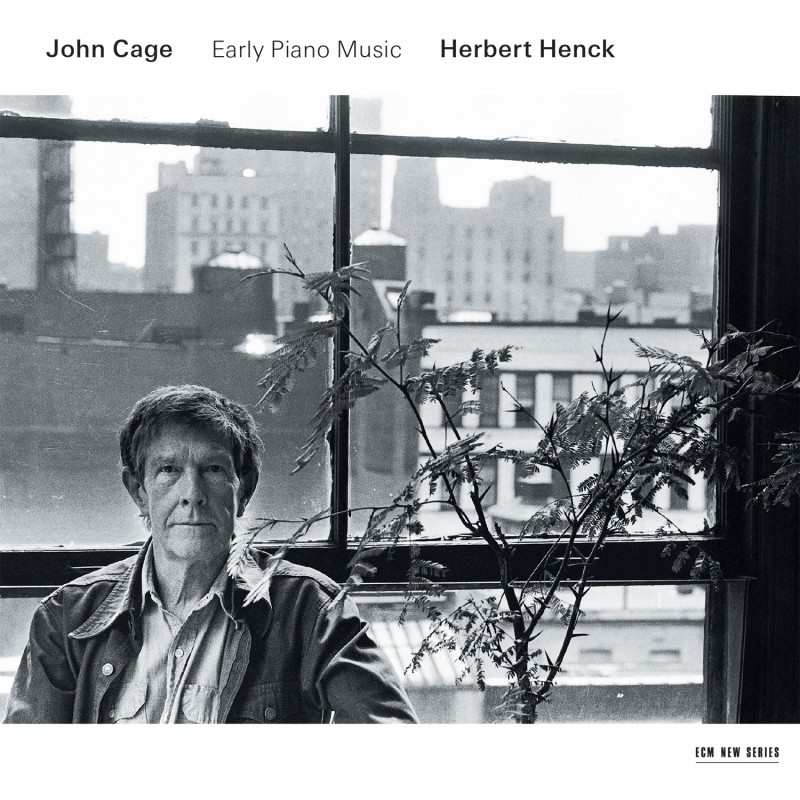
Few composers can have adopted the mantle of musical pioneer more
enthusiastically than Cage. Whenever the “danger” of his music being
accepted arose, he at once attempted to take it to the place “where it
would not be accepted”, always insisting that his favourite music was
the music not yet heard. The main thing was to keep moving. An enfant terrible and finally a père terrible of
successive avant-gardes, Cage successively challenged all the
parameters of music-making, leaving an often bewildering variety of
compositions behind him.
In the last decades of his life – Cage died in 1992 – most critics, and
many fellow musicians, had abandoned the attempt to keep pace with John
Cage, finding it more convenient to consider him a musical philosopher
than to wrestle with the implications of the ever-changing work. It
became popular to read Cage in such still-illuminating books as
“Silence”, “A Year From Monday”, “M” or “For The Birds”, sooner than
listen to him. But re-evaluations are taking place today as time
inevitably mutes the revolutionary impact of the work.
Two years ago, ECM New Series issued Herbert Henck’s account of Cage’s
“Sonatas and Interludes for Prepared Piano” (1946-8), widely considered
to be a benchmark recording of this important work. Now Henck
re-examines some of the other inventions of the young Cage, piano pieces
written by the American composer between 1935 and 1948.
The oldest of these pieces here is “Quest”, apparently the second half
of a two movement work. Along with the early “Two Pieces for Piano” and “Metamorphosis”, this gives us the clearest idea of Cage as a composer
still in thrall to the work and ideas of Arnold Schönberg. (The extent
of Cage’s studies with Schönberg has never been verified to the
satisfaction of music historians, but it seems fairly certain that Cage
at least attended Schönberg’s courses at the University of Los Angeles
in the summer of 1935, if not the two years of tuition he subsequently
claimed.) These are pieces still based on tone-rows.
“Ophelia” (1946) is dedicated to dancer and choreographer Jean Erdman
with whom Cage often worked. Henck writes: “Ophelia” is one of Cage’s
most sensually appealing piano pieces in every way. Inclining towards
the dance style of Jean Erdman, it is often lively with marked rhythms.”
“The Seasons” (1947) gets its second airing on ECM in the Henck piano
rendition. The American Composers Orchestra, under the direction of
Dennis Russell Davies, previously recorded it – using the orchestral
arrangement Cage prepared together with Lou Harrison and Virgil Thomson –
on ECM New Series 1696. It’s an important piece, marking the beginning
of Cage’s interest in Eastern thought. At the time of its composition,
Cage, then 35, was immersing himself in the religious philosophy of both
West and East – studying Meister Eckhardt as well as Sri Ramakrishna
and Ananada Coomaraswamy and considering the points of contact between
the diverse traditions of Christian mysticism, Buddhism and Hinduism
(but he was still four years away from his important studies in Zen with
D.T. Suzuki). He was also studying Indian music and becoming
increasingly convinced that the function of music was – as many Indian
philosophers had insisted – “to quiet the mind and render it susceptible
to divine influence.”
“In A Landscape” (1948) also makes a second appearance on ECM, having
previously been incorporated into Alexei Lubimov’s recital disc “Der
Bote”. Since it follows a group of pieces called “Imaginary Landscape”
it is highly likely the title is a Cagean pun on “Inner Landscape”. It
was premiered at Black Mountain College in North Carolina where Cage
scandalized the faculty by proposing to the students that Satie was a
superior composer to Beethoven. The poetic simplicity of Erik Satie was
very much on Cage’s mind at the time (the French composer was to be a
lifelong influence). Gently undulating, quietly unpredictable, the case
can be made that Cage’s “In A Landscape” is a cousin to Satie’s
“Gymnopédies”. It is a highly attractive composition as are all these
instances of John Cage’s early piano music. (ECM Records)
sábado, 10 de junio de 2017
Murcof / Vanessa Wagner STATEA
 Statea is essentially about augmentation: Murcof's electronics enhancing Vanessa Wagner's piano. But the idea goes further. Statea
is the result of an impromptu live performance that took place in 2010
at La Carrière De Normandoux, an old quarry in France that was turned
into a contemporary arts centre. One artist's concert was taking place
after the other's, so Wagner bridged the gap by playing pieces by Erik
Satie. Murcof joined her, and their improvisation has since grown.
Statea is essentially about augmentation: Murcof's electronics enhancing Vanessa Wagner's piano. But the idea goes further. Statea
is the result of an impromptu live performance that took place in 2010
at La Carrière De Normandoux, an old quarry in France that was turned
into a contemporary arts centre. One artist's concert was taking place
after the other's, so Wagner bridged the gap by playing pieces by Erik
Satie. Murcof joined her, and their improvisation has since grown.
Statea revolves around minimalist piano compositions, including Aphex Twin's lyrical "Avril 14th." On the surface, that may seem like a wildcard inclusion, nestled next to Arvo Pärt and György Ligeti, but it's part of a wider narrative: augmenting the minimal music tradition itself. Some selections even pre-date minimalism's 1960s New York origins, ascribed to forefathers La Monte Young, Terry Riley, Steve Reich and Philip Glass. Only Glass appears here, his Kafka-inspired "Metamorphosis 2" concluding Statea with one of the record's purest recordings.
Statea is less of a music history lesson than a dialogue
between its collaborators. When they perform together, Murcof and Wagner
take turns leading the charge, and it's the same here. Their version of
John Cage's "In A Landscape" starts out with naturalistic playing from
Wagner, before Murcof begins smearing the keys like watercolours. His
electro-acoustic touches are subtle at first, but become intense enough
that Wagner is all but phased out by the end. "In A Landscape" is
morphed into something else entirely. "Musica Ricercata No. 2" is more
of a melodramatic call and response between the two players. Wagner's
playing is dynamic and emotive, but Murcof's rebuttals are more
stinging. It goes to show the gulf between traditional musicians,
limited to an instrument's physicality, and those with technology's
endless possibilities.
For all of its alluring electronics, Statea would be nothing without the clarity of Wagner's piano. It's such contrasts—classical and ambient, the past and the present, the accentuated and the ambiguous—that make the record more than the sum of its parts, sounding richer and more nuanced with every listen. As a snapshot of a performance-based collaboration, Statea is strong, but the project's full scope can only be experienced in the concert halls that birthed it. (Holly Dicker)
For all of its alluring electronics, Statea would be nothing without the clarity of Wagner's piano. It's such contrasts—classical and ambient, the past and the present, the accentuated and the ambiguous—that make the record more than the sum of its parts, sounding richer and more nuanced with every listen. As a snapshot of a performance-based collaboration, Statea is strong, but the project's full scope can only be experienced in the concert halls that birthed it. (Holly Dicker)
sábado, 11 de marzo de 2017
Ensemble Intercontemporain / Matthias Pintscher NEW YORK

The Ensemble intercontemporain is a contemporary music ensemble of 31 soloists dedicated to the performance and promotion of music from the 20th and 21st centuries.
For over 30 years, this permanent ensemble of highly professional musicians has been performing a demanding repertoire of orchestral music in all its diverse forms. Under the artistic direction of Matthias Pintscher they are united by a shared passion for new music. They accompany composers in the exploration of new musical realms, nourished by inventions (new performance and extended techniques, computer music, etc.) and encounters with other forms of artistic expression such as dance, theatre, video and visual arts.
In residence at the Philharmonie de Paris, The Ensemble intercontemporain performs in France and abroad as a regular guest at major international festivals. The Ensemble also organizes a range of outreach activities ( educational concerts, school music workshops, master classes, etc.) serving a diversified public (conservatory students, professional and amateur musicians, general audience, etc.)
For over 30 years, this permanent ensemble of highly professional musicians has been performing a demanding repertoire of orchestral music in all its diverse forms. Under the artistic direction of Matthias Pintscher they are united by a shared passion for new music. They accompany composers in the exploration of new musical realms, nourished by inventions (new performance and extended techniques, computer music, etc.) and encounters with other forms of artistic expression such as dance, theatre, video and visual arts.
In residence at the Philharmonie de Paris, The Ensemble intercontemporain performs in France and abroad as a regular guest at major international festivals. The Ensemble also organizes a range of outreach activities ( educational concerts, school music workshops, master classes, etc.) serving a diversified public (conservatory students, professional and amateur musicians, general audience, etc.)
sábado, 26 de noviembre de 2016
Katia & Marielle Labèque MINIMALIST DREAM HOUSE
 To be musically avant-garde in the 1950s meant to be difficult. Not by
the end of the 1960s. That decade saw a group of American beatniks
overthrow the musical givens of postwar Europe. In a series of
disobediently straightforward compositions La Monte Young, Terry
Jennings, Terry Riley, Steve Reich and Philip Glass declared that music
could be clear, honest, pretty and experimental. Turning their backs on
the conventional centres of musical power, the earliest minimalist works
got their first public audience in La Monte Young's 1960-61 Chamber
Street Series in Yoko Ono's New York loft. Through the 1960s in art
galleries and alternative spaces, the minimalists slowly demystified,
democratised and Americanised European modernism. They rejected the
angst (what Philip Glass would call "crazy creepy music"). They rejected
the invisible games. They rejected the theatricality. "I don't know any
secrets of structure that you can't hear," wrote Steve Reich in his
1968 minimalist manifesto, Music as a Gradual Process. Minimalism
claimed that there was enough interest in the sounding process itself
and enough new territory to be explored in rhythmic patterning to
sustain a work. If one removed the Baroque complications - the harmonic story-telling and thematic cleverness - that were obscuring the natural
beauties of rhythm and sound, what would be revealed and discovered
could provide classical music with a new lease of life. They were right.
Minimalism was the last great musical revolution of the 20th century.
And it became the most influential and successful ism of them all. In
the spirit of the loft concerts we also present new works by David
Chalmin, Raphael Seguinier.
To be musically avant-garde in the 1950s meant to be difficult. Not by
the end of the 1960s. That decade saw a group of American beatniks
overthrow the musical givens of postwar Europe. In a series of
disobediently straightforward compositions La Monte Young, Terry
Jennings, Terry Riley, Steve Reich and Philip Glass declared that music
could be clear, honest, pretty and experimental. Turning their backs on
the conventional centres of musical power, the earliest minimalist works
got their first public audience in La Monte Young's 1960-61 Chamber
Street Series in Yoko Ono's New York loft. Through the 1960s in art
galleries and alternative spaces, the minimalists slowly demystified,
democratised and Americanised European modernism. They rejected the
angst (what Philip Glass would call "crazy creepy music"). They rejected
the invisible games. They rejected the theatricality. "I don't know any
secrets of structure that you can't hear," wrote Steve Reich in his
1968 minimalist manifesto, Music as a Gradual Process. Minimalism
claimed that there was enough interest in the sounding process itself
and enough new territory to be explored in rhythmic patterning to
sustain a work. If one removed the Baroque complications - the harmonic story-telling and thematic cleverness - that were obscuring the natural
beauties of rhythm and sound, what would be revealed and discovered
could provide classical music with a new lease of life. They were right.
Minimalism was the last great musical revolution of the 20th century.
And it became the most influential and successful ism of them all. In
the spirit of the loft concerts we also present new works by David
Chalmin, Raphael Seguinier.martes, 27 de octubre de 2015
Kim Kashkashian / Sarah Rothenberg / Steven Schick MORTON FELDMAN - ERIK SATIE - JOHN CAGE Rothko Chapel
 The album ‘Rothko Chapel’ addresses a network of musical
relationships and inspirations, taking as its main focus Morton
Feldman’s work named for the Houston, Texas multi-faith chapel built to
house Mark Rothko’s site-specific paintings.
The album ‘Rothko Chapel’ addresses a network of musical
relationships and inspirations, taking as its main focus Morton
Feldman’s work named for the Houston, Texas multi-faith chapel built to
house Mark Rothko’s site-specific paintings.
Feldman considered
that his ‘Rothko Chapel’ lay “between categories, between time and
space, between painting and music”, and described the score as his
“canvas”. Amongst his most important influences were abstract painters,
his friend Mark Rothko prominent amongst them. (Rothko, for his part,
yearned to “raise painting to the level of music and poetry”.) Feldman
was also liberated by the freewheeling example of John Cage’s work. “The
main influence from Cage was a green light,'' Feldman said. ''It was
permission, the freedom to do what I wanted.'' Cage, the most relentless
of 20th century experimentalists, didn’t acknowledge what he called an
“ABC model of ‘influence’” but always had a special fondness for Satie, a
musical inventor of good-humoured originality with whom he could
identify.
Feldman’s piece was first played in the chapel in 1972.
On the 40th anniversary of the opening of the Rothko Chapel in 2011, a
concert was held there bringing together works of Feldman, Cage and
Satie. This programme was reprised for the present CD with recordings
made at other Houston locations - Rice University (Cage, Satie) and the
Brown Foundation Performing Arts Theater (Feldman).
Leading viola
player Kim Kashkashian negotiates the subtle, glowing textures of
Feldman’s planes of sound, joined by Sarah Rothenberg on celeste, and
supported by percussion and choir. Rothenberg, on piano, plays Satie’s
Gnossiennes and Cage’s Inner Landscape, and the Houston Chamber Choir
sings Cage’s Four, Five and more, illuminating this rarely heard choral
music. (Presto Classical)
viernes, 15 de noviembre de 2013
JOHN CAGE Four minutes thirty-three seconds
4′ 33″, the silent piece, is easily John Cage’s most famous creation. I would say that anyone who recognizes Cage’s name knows that he wrote a piece of music that consists entirely of silence. It is a piece that has become a sort of icon in post-war culture, like Warhol’s soup cans: a punch line for jokes and cartoons; the springboard for a thousand analyses and arguments; evidence of the extremity of a destructive avant-garde that appeared in the 1950s and 60s.
 It is not surprising that this piece would attract the kind of attention that it has. To begin with, it is a compelling dramatic gesture. At its first performance, virtuoso pianist David Tudor sat at the piano, opened the keyboard lid, and sat silently for thirty seconds. He then closed the lid. He reopened it, and then sat silently again for a full two minutes and twenty-three seconds. He then closed and reopened the lid one more time, sitting silently this time for one minute and forty seconds. He then closed the lid and walked off stage. That was all. With the right kind of performer, such an event can be riveting, and Tudor was absolutely the right kind of performer, possessing an understated mastery of the instrument and a seriousness of purpose that was palpable to everyone in attendance.
Part of what makes the drama so compelling is the utter simplicity of the concept. The composer creates nothing at all. The performer goes on stage and does nothing. The audience witnesses this very basic act, the act of sitting still and being quiet. All this takes place in a Western concert hall setting, lending a historical and artistic gravity to the proceedings that begs us to put this act into some kind of weighty context, fraught with importance.
The piece can be difficult for audiences (just as the empty room in the exhibition might have been). Sitting quietly for any length of time is not something to which people are accustomed in Western culture in general, much less in a concert hall setting. That tensions will arise, with controversy and notoriety following, is only natural. Confronted with the silence, in a setting we cannot control, and where we do not expect this kind of event, we might have any of a number of responses: we might desire for it to be over, or desire for more interesting sounds to listen to, or we might feel frightened, insulted, pensive, cultured, baffled, doubtful, bored, agitated, tickled, sleepy, attentive, philosophical, or, because we “get it”, a bit smug. But do we really think of 4′ 33″ as a piece of music? What did Cage mean when he made this piece? How are we supposed to take this music? I believe that the story of4′ 33″, of the circumstances in Cage’s life from which it arose, can help us to answer these questions... (Copyright 2009 by James Pritchett. All rights reserved.)
Suscribirse a:
Entradas (Atom)


