Mostrando entradas con la etiqueta Louis Lortie. Mostrar todas las entradas

domingo, 18 de noviembre de 2018

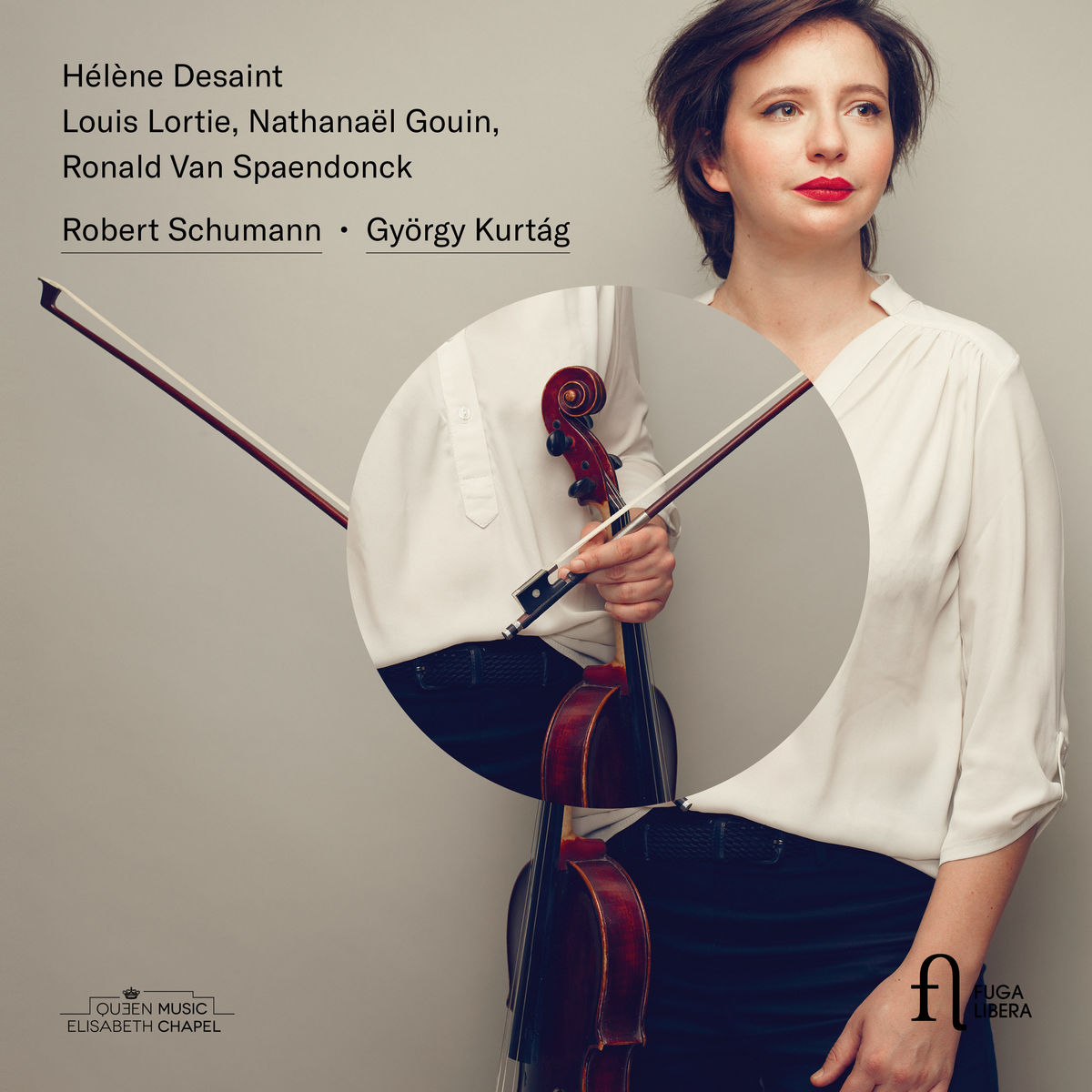
Hélène Desaint / Louis Lortie / Nathanaël Gouin / Ronald van Spaendonck ROBERT SCHUMANN - GYÖRGY KURTÁG

Hélène Desaint, Laureate of the Queen Elisabeth Music Chapel, presents a recital with two facets that are an admirable illustration of her personality: ‘This disc was born of my fascination with Schumann. Everything about him captivates me: the tormented human being, the great reader fascinated by the fantastical and the supernatural, the brilliant and introverted composer, the poet who goes where words cannot go, the music, powerfully evocative at once of human characters or tableaux and of complex states of mind. In 1990, György Kurtág composed a trio in homage to Schumann – a way of straddling the centuries and opening up a dialogue between two styles, of reviving the imaginary figures and short contrasting forms with which we are familiar in Schumann. So it seemed an obvious idea to build a programme around these two composers. The comparison seems all the more interesting to me because I find in their music the same interiority, the same concentration (in Kurtág’s work, this density goes so far as to permeate every note), the same concision.’ (Hélène Dessaint)

sábado, 8 de septiembre de 2018

BBC Symphony Orchestra / Sir Andrew Davis FINZI Cello Concerto - Eclogue - New Year Music - Grand Fantasia and Toccata

A broad and meticulous selection of orchestral works and concertos by Gerald Finzi is here matched by a first-class cast of soloists, supported by the BBC Symphony Orchestra under the direction of Sir Andrew Davis, expert in British repertoire and conducting this year’s Last Night of the Proms.
Paul Watkins displays exhilarating virtuosity in the Cello Concerto, a central work on this album, composed in the wake of the devastating news that Finzi was terminally ill, but yet filled with ‘vigorous, almost turbulent thematic material’, as he wrote in the programme note for the work’s premiere at the Cheltenham Music Festival in 1955.
Louis Lortie, for his part, tackles the high-spirited and majestic Grand Fantasia and Toccata, the Fantasia originally conceived as part of a concerto for piano and strings and first performed on two pianos. This contrasts with the more restrained Eclogue for Piano and Strings, timeless, and blessed with a mood of benediction.
This album also features the orchestral Nocturne (subtitled ‘New Year Music’), dark, misty, and at times ironic.

“… it [Cello Concerto] ranks as one of the finest British works for cello and orchestra. When he [Finzi] started writing it in 1951, he already knew he did not have long to live, and the wistful land of lost content that never seems too far away in any of his music pervades this work. Watkins’ performance captures that mood perfectly. Nothing is exaggerated or over-assertive … Louis Lortie is the soloist in the ruminatively beautiful Eclogue for piano and strings, and is spiritedly athletic, with full orchestra, in the neo-baroque Grand Fantasia and Toccata. Andrew Davis and the BBC Symphony Orchestra make a fine job of the one near rarity in this collection, the strikingly atmospheric Nocturne …” (Andrew Clements / The Guardian)

Louis Lortie / BBC Philharmonic / Edward Gardner SAINT-SAËNS Piano Concertos Nos. 1, 2 and 4

Having already mastered such French concertos as Poulenc’s on record, the French-Canadian pianist Louis Lortie and Edward Gardner now explore with the BBC Philharmonic the vigorous and progressive world of Camille Saint-Saëns, offering the first of two volumes to contain his complete piano concertos.
The brilliance, virtuosity, and technical perfection of Louis Lortie’s playing encapsulate these unusual, yet exhilarating works. While the spirited, unconventional Concerto No. 1 centres round a slow movement consisting of a dialogue between the sober orchestra and virtuosic piano, the technical requirements of No. 2 are so high that Saint-Saëns himself after its premiere admitted that his fluent technique was not quite up to the challenge. Finally, the unusual form and mixed musical ideas of No. 4 make for a uniquely dramatic, passionate, and dream-like experience.