
Mostrando entradas con la etiqueta Kim Kashkashian. Mostrar todas las entradas
Mostrando entradas con la etiqueta Kim Kashkashian. Mostrar todas las entradas
viernes, 22 de octubre de 2021

viernes, 6 de noviembre de 2020

lunes, 8 de abril de 2019
Kim Kashkashian / Sivan Magen / Marina Piccinini TRE VOCI Takemitsu - Debussy - Gubaidulina

Kim Kashkashian, who won a Grammy last year with her solo viola Kurtág/Ligeti disc, returns with a new trio. Tre Voci includes Italian-American flutist Marina Piccinini and Israeli harpist Sivan Magen. All three musicians have been acknowledged for bringing a new voice to their instruments. Kashkashian, Piccinini and Magen first played together at the 2010 Marlboro Music Festival, and agreed that the potential of this combination was too great to limit it to a single season. Since then they have been developing their repertoire. On this compelling first release it revolves around Debussy’s 1915 “Sonata for flute, viola and harp” and its influence, most directly felt in Takemitsu’s shimmering “And then I knew ’twas Wind”.
Debussy himself had been profoundly moved by his encounter with music of the East and in his last works was emphasizing tone-colour, texture and timbre and a different kind of temporal flow.
In this music, the elasticity of Debussy’s feeling for time (as Heinz Holliger observed) pointed far into the future and to the works of Boulez. And indeed to the music of Sofia Gubaidulina, whose “Garten von Freuden und Traurigkeiten” (“Garden of Joys and Sorrows”) makes its own reckoning with orient and occident. Gubaidulina has said that she considers herself "a daughter of two worlds, whose soul lives in the music of the East and the West".
As Jürg Stenzl points out in the liner notes, hardly any composer of his generation was more greatly affected by the discovery of Debussy's music than Tōru Takemitsu: “This largely self-taught composer had already studied a broad range of recent 'western' musics before he turned to the 'classical' traditions of his native Japan. The late work ‘And then I knew 'twas Wind’ scored for the same instruments as Debussy's second sonata, is especially characteristic of his understanding of music” ...
… and emphasizes what Takemitsu called “the vibrant complexity of sound as it exists in the instrument”. His composition resembles Debussy's in its free and rhapsodic form, but unlike Debussy's 'musique pure', Takemitsu's title relates to a poem by Emily Dickinson:
“Like Rain it sounded till it curved / And then I knew ‘twas Wind – / It walked as wet as any Wave / But swept as dry as sand – / When it had pushed itself away / To some remotest Plain …”
Sofia Gubaidulina’s “Garten von Freuden und Traurigkeiten” (“Garden of Joys and Sorrows”) also draws upon lyric poetry for inspiration. The work concludes with a recitation of a poem by Austrian-born writer Francisco Tanzer, but its title comes from a text by the Moscow poet Iv Oganov.
The vivid imagery of Oganov’s poem makes itself forcefully felt in Gubaidulina’s work: “The lotus was set aflame by music / The white garden began to ring again with diamond borders.”
The composer, in her words, was compelled to a concrete aural perception of this garden, explored at length in the music. As with Takemitsu the flow of the work retains an improvisational freshness, and the combined sound-colours of viola, harp and flute are as beguiling as in the Debussy sonata.
Tre Voci’s album was recorded in April, 2013 at the Auditorio Radiotelevisione svizzera, Lugano, and produced by Manfred Eicher. It is released in time for a European tour with a programme including music of Debussy, Takemitsu and Gubaidulina.
viernes, 12 de octubre de 2018
Kim Kashkashian J.S. BACH Six Suites for Viola Solo BWV 1007 - 1012
 Here are Bach’s six cello suites, played on the viola by one of the instrument’s greatest exponents, Kim Kashkashian.
Bach composed the suites around 1720 when he was in the employ of Prince
Leopold of Anhalt-Köthen. The autograph manuscript is no longer
extant, and the earliest known copies date from 1726 and 1730, the
latter made by Anna Magdalena Bach.
Hearing the Suites on the viola, with its range an octave above the
cello, Paul Griffiths remarks in the liner notes, the music takes on “a
different kind of sombreness, a different kind of dazzlement, a
different kind of self-examination.” His essay details the
characteristics of the suites and the dance forms – the allemandes,
courantes, sarabandes, minuets, bourrés, gavottes and gigues - and
emphasises Kashkashian’s sense of pulse, which “comes from the music,
not from the clock. Bach’s dances are not for jaunting feet but made
rather of shapes and images moving in the mind.”
Kim Kashkashian approaches the suites as a player whose sensibilities
have been shaped by engagement with new music as well as classical
tradition. For these performances she uses contemporary instruments,
including a 5-string viola (as called for in the Anna Magdalena Bach
manuscript) for the challenging D major suite, and brings to the whole
set a feeling of freedom, grace and power. The cello suites have long
been part of her performance repertoire, approached from multiple
perspectives. (In concert, for instance, inspired by György Kurtág’s
insertion of Bach arrangements amid his Játékok pieces, she has sometimes threaded sections of Kurtág’s Signs, Games and Messages in between movements). In her hands, the music is very much alive, and speaks to the present. (ECM Records)
viernes, 30 de junio de 2017
Kim Kashkashian / Jan Garbarek / Vangelis Christopoulos ELENI KARAINDROU Concert in Athens
 “Each of my compositions seems to be part of a mosaic which takes on its
ultimate form very slowly through the years”, Eleni Karaindrou once
said, and the larger picture becomes both clearer and more
finely-detailed with each new album. Concert in Athens is her
tenth release on ECM. It is an exceptional documentation of a
performance from 2010, marking a triumphant return to the Athens Concert
Hall, the setting for the “Elegy of the Uprooting” shows five years
earlier.
“Each of my compositions seems to be part of a mosaic which takes on its
ultimate form very slowly through the years”, Eleni Karaindrou once
said, and the larger picture becomes both clearer and more
finely-detailed with each new album. Concert in Athens is her
tenth release on ECM. It is an exceptional documentation of a
performance from 2010, marking a triumphant return to the Athens Concert
Hall, the setting for the “Elegy of the Uprooting” shows five years
earlier.
A new programme offers new insights, particularly when participating
friends include guest soloists Jan Garbarek and Kim Kashkashian, both of
whom have made major contributions to the realization of Karaindrou’s
work in the past – Garbarek with his evocative playing of the themes for
The Beekeeper (reprised on the album Music for Films) and Karaindrou as the key musical protagonist of Ulysses’ Gaze. Over the years both artists have periodically returned to join Eleni for special events. Ulysses’ Gaze and Beekeeper themes are reprised here, along with music from other films of the late Theo Angelopoulos - Dust of Time, Eternity and a day, Landscape in the Mist and Journey to Cythera, all
of them revealing new facets as Kashkashian and Garbarek are featured
alongside Eleni’s team of soloists (with oboist Vangelis Christopoulos
especially striking). There is also much here that is new or heard on
CD for the first time including compositions originally written for
theatre productions directed by Antonis Antypas including Who’s afraid of Virginia Woolf? by Edward Albee, The Glass Menagerie by Tennessee Williams as well as Jules Dassin’s production of Arthur Miller’s Death of a Salesman.
The differing demands of the theatre music open up a new emotional
range for the soloists to explore. Eleni: “I sought to share with them
memories from past and more recent voyages in the worlds of theatre and
poetry. With Jan I plunged deep into the fascination and torment of
Arthur Miller, of Edward Albee and Tennessee Williams...” The album
opens and closes with Garbarek’s intensely brooding saxophone,
accompanied by Karaindrou’s piano and the string orchestra, playing the
“Requiem for Willie Loman” from Death of a Salesman. Meanwhile, “Kim’s sturdy and sensitive bow swept us on a journey to Laurä’s fragile world in The Glass Menagerie, having first traversed the Closed Roads
[one of several newly-arranged pieces of Karaindrou concert music] with
all the passion and unmatched internal nobility which distinguish her
work.” The scope of the music is further expanded with three charming
miniatures inspired by M. Karagatsis’s novel “Number Ten , and written
for the Greek television series of the same name. (ECM Records)
jueves, 29 de junio de 2017
Kim Kashkashian / Stuttgarter Kammerorchester / Dennis Russell Davies LACHRYMAE
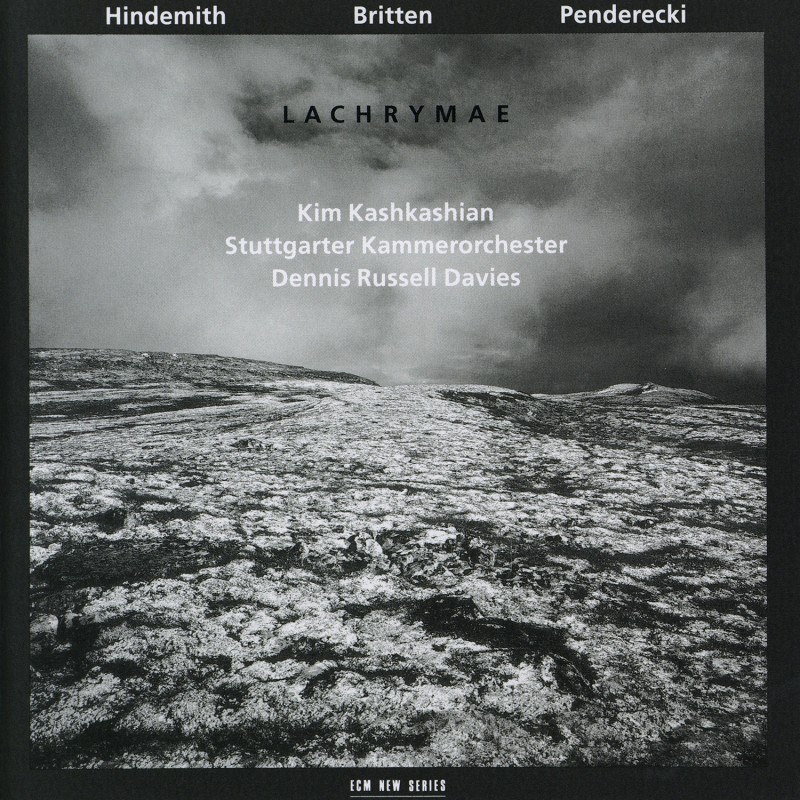 Lachrymae was my second exposure to the brilliance of violist Kim Kashkashian, after her ECM recording
of Paul Hindemith’s viola sonatas. It has long been one of my favorites
of hers, as its emotional and tonal complexities are high points of the
New Series catalog. The program here is modest—consisting of only three
pieces—but heavy. The opening strains of Hindemith’s Trauermusik
paint a grave and darkening picture. Composed in a six-hour stretch of
creative fervor in the afternoon following the death of King George V in
1936, the piece mourns the fall of the monarchical figurehead by
describing a musical effigy in his place. Hindemith gave the premier
performance that very evening in a special BBC live broadcast. And
indeed, the music has that very quality: a lost message somehow regained
and spread across the airwaves in a time of great sorrow.
Lachrymae was my second exposure to the brilliance of violist Kim Kashkashian, after her ECM recording
of Paul Hindemith’s viola sonatas. It has long been one of my favorites
of hers, as its emotional and tonal complexities are high points of the
New Series catalog. The program here is modest—consisting of only three
pieces—but heavy. The opening strains of Hindemith’s Trauermusik
paint a grave and darkening picture. Composed in a six-hour stretch of
creative fervor in the afternoon following the death of King George V in
1936, the piece mourns the fall of the monarchical figurehead by
describing a musical effigy in his place. Hindemith gave the premier
performance that very evening in a special BBC live broadcast. And
indeed, the music has that very quality: a lost message somehow regained
and spread across the airwaves in a time of great sorrow.
The album’s title work comes from Benjamin Britten and is performed
here in its glorious 1975 orchestrated version (for the earlier
viola/piano version, check out Kashkashian’s Elegies,
also on ECM). Britten has subtitled the work “Reflections on a Song of
John Dowland,” thereby lending it a rather bold intertextual potency.
And while it goes without saying that Kashkashian’s soloing is first
rate here, the Stuttgart Chamber Orchestra casts an even more enchanting
spell as it binds each motivic cell with fluid grace.
Which brings us to Krzysztof Penderecki’s Konzert für Viola und Kammerorchester.
The result of a 1983 commission from the Venezuelan government in honor
of freedom fighter Simón Bolívar, the concerto marks a distinct shift
in the composer’s aesthetic of virtuosity. Much in contrast to the
density of his earlier concertos, here Penderecki cultivates a more
intimate sound palette. Yet none of the color his work is known for is
lost. We still get a meticulously constructed object adorned with all
manner of timbres and percussive details.
In my opinion, Lachrymae showcases some of the most powerful
music written for the viola. And who better than Kashkashian to wring
out every last tear from this trio of captivating scores? This music is
wrought in sadness and refined through a nurturing touch from its
composers and musicians alike. It is not the spirit made manifest, but
the manifest made spirit. (ECM Reviews)
martes, 27 de junio de 2017
Kim Kashkashian / The Hilliard Ensemble / Dennis Russell Davies / Stuttgarter Kammerorchester GIYA KANCHELI Abii Ne Viderem
 My first exposure to the music of Giya Kancheli, with which the
composer once said, “I feel more as if I were filling a space that has
been deserted,” was through Exil,
which remains in my opinion the finest ECM New Series release to date.
Much in contrast to the tearful beauty of that most significant chamber
album, the orchestral arrangements on Abii ne viderem—drawn as
they are from the same thematic sources—lend extroverted articulation to
essentially “monastic” material. This music may speak the same
language, but in a far more distant dialect. The Life without Christmas
cycle, from which two pieces bookend the present recording, is central
to the Kancheli oeuvre. Not only is it his wellspring, but it also
comprises, it would seem, the overarching worldview under which he
musically operates. It is the gloom of a life of displacement, the full
embodiment of what Hans-Klaus Jungheinrich calls “measured gravity,”
which may perhaps be likened to the heavy emptiness of Tarkovsky’s Stalker.
As in said film, every gesture makes a footprint, a remnant of human
presence left to sink into the submerged wasteland of a silent future.
My first exposure to the music of Giya Kancheli, with which the
composer once said, “I feel more as if I were filling a space that has
been deserted,” was through Exil,
which remains in my opinion the finest ECM New Series release to date.
Much in contrast to the tearful beauty of that most significant chamber
album, the orchestral arrangements on Abii ne viderem—drawn as
they are from the same thematic sources—lend extroverted articulation to
essentially “monastic” material. This music may speak the same
language, but in a far more distant dialect. The Life without Christmas
cycle, from which two pieces bookend the present recording, is central
to the Kancheli oeuvre. Not only is it his wellspring, but it also
comprises, it would seem, the overarching worldview under which he
musically operates. It is the gloom of a life of displacement, the full
embodiment of what Hans-Klaus Jungheinrich calls “measured gravity,”
which may perhaps be likened to the heavy emptiness of Tarkovsky’s Stalker.
As in said film, every gesture makes a footprint, a remnant of human
presence left to sink into the submerged wasteland of a silent future.
Morning Prayers (1990) is immediately distinguished by an
angelic boy soprano, whose taped voice is never fully grounded but which
hovers throughout. The piano adds another haunting element, seeming to
pull at the barbed ends of nostalgia even as it pushes the orchestra
down a flight of descendent chords. Occasional violent moments startle
us into self-awareness and only serve to underscore the power of the
prayers that surround them. The most profoundly effective moment occurs
when the piano echoes in a dance-like theme, the orchestral
accompaniment slightly off center—a distant memory ravaged by time and
circumstance.
The title of the album’s central piece, Abii ne viderem
(1992/94), translates to “I turned away so as not to see.” The more one
listens to it, the question becomes not what is being turned away from
but what is being observed upon turning. Its paced staccato bursts are
linked by a profound silence, escalating with every reiteration. This
silence eventually opens into a full orchestral statement, italicized
again by the piano’s audible pulse. We find ourselves caught in the
middle of a larger web of sentiments, until we can no longer see
ourselves for who we are but only for who we have been. Personally, I
find this piece to be a touch overbearing, if only because the import of
its ideas is easily crushed by the heft of its dynamic spread.
The presence of the Hilliard Ensemble rescues Evening Prayers
(1991) from the didacticism of its predecessor. It is a more fully
unified narrative, linked by a lingering alto flute. A gorgeous
“ascension” passage marks a rare contrapuntal moment for Kancheli, while
David James’s voice creates magic, ever so subtly offset by a
skittering violin. Occasional bursts, some punctuated by snare drum,
break the mood and ensure that our attention is held. Inevitably, the
piece ends like a ship sailing into a foggy ocean, leaving behind only a
blank map to show for our travels.
Don’t let any comparisons to Arvo Pärt lure you astray. Kancheli’s
music, while transcendent, cannot be divorced from its rootedness in
upheaval. And while this album may be filled with beautiful moments, I
cannot help but feel that something gets elided in these grander
arrangements. I say this with the gentlest of criticisms, and perhaps
only because my first foray into this world was on such a small scale.
The sound of Exil stays with me, and sometimes I just cannot
hear it in any other context, and for those wishing to hear this
composer for the first time I would recommend starting there. That being
said, the scale of these pieces makes them no less evocative for all
their historical understatements and sensitivity. And perhaps that is
Kancheli’s underlying observation: that, in our current climate of
convalescent ideologies, all we have to hold on to are those rare
flashes of fire in which our communion with something greater has
transcended the rising waters of sociopolitical corruption. (ECM Reviews)
Kim Kashkashian / Robert Levin / Eduard Brunner GYÖRGY KURTÁG Hommage à R.Sch. - ROBERT SCHUMANN
 Bartók serves as the link between Schumann and Kurtág: when Kurtág says
'My mother tongue is Bartók, and Bartók's mother tongue was Beethoven'
he is referring to the historically linked musical traditions of Germany
and Austria, which are his special concern. In addition to this general
connection, the works of Kurtág and Schumann reveal astonishing and
fascinating affinities in terms of both literary and musical
references..... --From the CD booklet notes by Hartmut Lück
Bartók serves as the link between Schumann and Kurtág: when Kurtág says
'My mother tongue is Bartók, and Bartók's mother tongue was Beethoven'
he is referring to the historically linked musical traditions of Germany
and Austria, which are his special concern. In addition to this general
connection, the works of Kurtág and Schumann reveal astonishing and
fascinating affinities in terms of both literary and musical
references..... --From the CD booklet notes by Hartmut Lückon Kashkashian: '... the best violist in the world.' --New York Daily News
'Her playing is notable for its songfulness, a weightless soaring that conveys a wealth of emotion.' --Philadelphia Inquirer
Kim Kashkashian / Netherlands Radio Chamber Orchestra / Peter Eötvös BÉLA BARTÓK - PETER EÖTVÖS - GYÖRGY KURTÁG

Typically impassioned, committed performances distinguish Kim
Kashkashian’s New Series recording of music for viola by three great
Hungarian composers. Kashkashian’s intense focus, superb craftsmanship
and explosive virtuosity are brought to bear on Béla Bartók’s final
work, on one of György Kurtág’s early pieces, and on an important new
work written especially for her by Peter Eötvös.
Interconnections between the composers and the interpreter are many.
Something akin to a line of transmission runs from Bartók to Eötvös via
Kurtág. Kurtág has famously said that his “mother tongue is Bartók”, and
his Movement for Viola and Orchestra was directly influenced by
Bartók’s Violin Concerto and Concerto for Orchestra. Peter Eötvös was
born, like Bartók, in Transylvania, befriended Kurtág in Budapest, and
his musical development was decisively influenced by the work of both
composers. “György Kurtág’s music”, Eötvös has noted, “is deeply rooted
in European tradition. The certainty and glowing intensity of his works
remind me of Van Gogh and Dostoyevsky. The increasing success of his
music comes on the one hand from the fact that his powerful, subjective
ability to express himself cannot be pigeonholed in any of the familiar
stylistic movements, and on the other hand, from the fact that his music
has an unusually vital relationship to the living and the dead.” A
similar claim might well be made for the musics of Eötvös himself and
Bartók, in which innovation and respect for the weight of tradition are
keenly balanced.
Kashkashian, who has worked closely with Kurtág, was instrumental in
bringing his music to the New Series and made the premiere recording of
his revised six-part cycle “Jelek” (ECM New Series 1508). She has also
worked under the baton of Eötvös and has, furthermore, been playing the
Bartók Viola Concerto for three decades now. In preparation for the
current project she went back to some of Bartók’s own sources,
“listening to a lot of the Hungarian folk music he collected to study
the articulation of melody, rhythm, phrasing.” (ECM Records)
jueves, 5 de enero de 2017
ELENI KARAINDROU David

The stage cantata David features Eleni Karaindrou’s music for a
unique piece of Aegean drama, a verse play with words by an unknown
18th century poet from the island of Chios. Its text (first published
only in 1979), invites a musical response and Greek composer Karaindrou
rises splendidly to the challenge, imaginatively moving between past and
present in her settings for mezzo-soprano and baritone singers,
instrumental soloists, choir and orchestra. Kim Kashkashian’s evocative
viola against strings may trigger associations with Karaindrou’s
acclaimed writing for Ulysses’ Gaze. The music also draws
inspiration from the world of baroque opera as singers Irini Karagianni
and Tassis Christoyannopoulos are brought to the foreground.
Karaindrou’s David is a work of changing music colours .
Recorded live at the Athens Megaron, it was edited and mixed by Manfred
Eicher and Nikos Espialdis for CD release. (ECM Records)
lunes, 17 de octubre de 2016
Kim Kashkashian / Lera Auerbach DMITRI SHOSTAKOVICH - LERA AUERBACH Arcanum
 Kim Kashkashian introduces a duo with Russian composer-pianist Lera
Auerbach. Their first collaborative recording features Auerbach’s viola
and piano version of Dmitri Shostakovich’s 24 Preludes op. 34, and Auerbach’s own, darker, sonata for viola and piano, Arcanum.
The musicians first met at Switzerland’s Verbier Festival in 2010,
although Auerbach had long been aware of Kashkashian’s recordings, and
the “quality of life-or-death-intensity to her performing, which is rare
and wonderful.” Arcanum, accordingly, was written for
Kashkashian. Its title, the composer explained in a recent interview,
“means ‘mysterious knowledge’: I was fascinated by the inner voice
within each of us, some may call it perhaps intuition, some maybe guided
meditation, but there is some knowledge that we have, which we may not
necessarily verbalize or rationalize. This knowledge allows us to see
the truth, to be guided, to seek answers.”
Kim Kashkashian introduces a duo with Russian composer-pianist Lera
Auerbach. Their first collaborative recording features Auerbach’s viola
and piano version of Dmitri Shostakovich’s 24 Preludes op. 34, and Auerbach’s own, darker, sonata for viola and piano, Arcanum.
The musicians first met at Switzerland’s Verbier Festival in 2010,
although Auerbach had long been aware of Kashkashian’s recordings, and
the “quality of life-or-death-intensity to her performing, which is rare
and wonderful.” Arcanum, accordingly, was written for
Kashkashian. Its title, the composer explained in a recent interview,
“means ‘mysterious knowledge’: I was fascinated by the inner voice
within each of us, some may call it perhaps intuition, some maybe guided
meditation, but there is some knowledge that we have, which we may not
necessarily verbalize or rationalize. This knowledge allows us to see
the truth, to be guided, to seek answers.”
Of Auerbach’s roles as composer and performer in this programme, Kim
Kashkashian notes that “Lera performs any piece of music as if she had
composed it: she has a way of understanding the perspective of a piece
of music, its structure, its character and the colors that go with it.”
Dmitri Shostakovich’s 24 Preludes for piano (1933) gained
renewed popularity through Dmitri Tsyganov’s transcriptions of some of
them for violin and piano. Lera Auerbach first turned her attention to
violin/piano transcriptions of the preludes Tsyganov had not reworked.
In 2008, she set the full cycle for cello and piano, two years later
creating a version for viola and piano intended, she said, as a
contrasting partner piece to the Sonata for Viola and Piano op 147,
Shostakovich’s sombre last work. “This way, violists could enjoy both
sides of Shostakovich. The journey through the 24 Preludes
gives so much opportunity for colours, for experimentation of different
characters, for humour – there is a lot of humour in these Preludes.” (ECM Records)
domingo, 11 de septiembre de 2016
Kim Kashkashian / Dennis Russell Davies GIYA KANCHELI Vom Winde beweint ALFRED SCHNITTKE Konzert für Viola und Orchester
 This powerful record brings together two of the most seminal works
for viola and orchestra of the twentieth century. Although these pieces
are as different as they are similar, together they form a distinct
balance of sentiment and execution.
This powerful record brings together two of the most seminal works
for viola and orchestra of the twentieth century. Although these pieces
are as different as they are similar, together they form a distinct
balance of sentiment and execution.
Giya Kancheli: Vom Winde beweint (Mourned by the Wind)
Kancheli’s self-styled “liturgy” is an exercise in patience and surrender. Its opening slam of piano chords is a big bang in and of itself, and sets the stage for the soloist’s epic journey. Wilfred Mellers, in his liner notes, posits the viola’s emergence from such chaos as the “birth of consciousness.” And indeed, one can extrapolate from its startling abruptness the inklings of a life yet lived, fresh and devoid of self-awareness in the greater void of silence. The orchestra skirts the periphery, gradually uniting with the soloist. This contrast mimics the arbitrary stability of human values—at once sacred and mutable—so that moments of resolution always tread a downward slope. Luminous winds, a cosmic harpsichord, and trails of harmonics characterize the first movement. Brief horn blasts introduce the second, throughout which the viola wanders without fortitude into a minefield of piano and timpani, singing without carrying a tune. The harpsichord again works its galactic magic, feeding stardust into the viola’s arterial core. A passage of intense and sustained volume leads into an epic swan song. The third movement is brought forth on the strings of the harpsichord, the viola a mere flit of wings in the surrounding air. An oboe threads the hesitation like the beginning of an incomplete statement. The fourth movement is a violent implosion and balances out the first with its selfish gaze. As with seemingly every Kancheli composition, it ends as quietly as an evening breeze. One hears the rustling of leaves in the distance, only to find that it was a trick of the ears all along. Vom Winde beweint is rich with sharp dynamic peaks that are short-lived and sporadic, the hallmarks of an ode to process over progress.
Kancheli’s self-styled “liturgy” is an exercise in patience and surrender. Its opening slam of piano chords is a big bang in and of itself, and sets the stage for the soloist’s epic journey. Wilfred Mellers, in his liner notes, posits the viola’s emergence from such chaos as the “birth of consciousness.” And indeed, one can extrapolate from its startling abruptness the inklings of a life yet lived, fresh and devoid of self-awareness in the greater void of silence. The orchestra skirts the periphery, gradually uniting with the soloist. This contrast mimics the arbitrary stability of human values—at once sacred and mutable—so that moments of resolution always tread a downward slope. Luminous winds, a cosmic harpsichord, and trails of harmonics characterize the first movement. Brief horn blasts introduce the second, throughout which the viola wanders without fortitude into a minefield of piano and timpani, singing without carrying a tune. The harpsichord again works its galactic magic, feeding stardust into the viola’s arterial core. A passage of intense and sustained volume leads into an epic swan song. The third movement is brought forth on the strings of the harpsichord, the viola a mere flit of wings in the surrounding air. An oboe threads the hesitation like the beginning of an incomplete statement. The fourth movement is a violent implosion and balances out the first with its selfish gaze. As with seemingly every Kancheli composition, it ends as quietly as an evening breeze. One hears the rustling of leaves in the distance, only to find that it was a trick of the ears all along. Vom Winde beweint is rich with sharp dynamic peaks that are short-lived and sporadic, the hallmarks of an ode to process over progress.
Alfred Schnittke: Konzert für Viola und Orchester
For this monumental work, Schnittke has chosen to invert the standard concerto form, sandwiching an Allegro Molto between two Largos. The piece opens with a viola solo held aloft by shimmering orchestral waves. Every melodic line is like the root of an ever-growing tree of voices. In the second movement, the viola skips across a landscape of consonances and dissonances at the behest of a passively insistent harpsichord. Schnittke maintains the fascinating sense of rhythm and energy that distinguishes his faster turns, scratching at the surface of a larger unfathomable world. Harpsichord, flute, and viola congregate in a Mozartean danse macabre at the movement’s center. The strangely wooden pizzicato toward the end haunts as the piano jumps impatiently on its lower notes. The last movement gives the viola a demanding solo, which is eventually overtaken by horns and winds. A deep pause marks a change in intent. The harpsichord once again comes to the fore, the final cameo of a strong orchestral cast, before bowing to a beautifully dissonant double stop from the viola.
For this monumental work, Schnittke has chosen to invert the standard concerto form, sandwiching an Allegro Molto between two Largos. The piece opens with a viola solo held aloft by shimmering orchestral waves. Every melodic line is like the root of an ever-growing tree of voices. In the second movement, the viola skips across a landscape of consonances and dissonances at the behest of a passively insistent harpsichord. Schnittke maintains the fascinating sense of rhythm and energy that distinguishes his faster turns, scratching at the surface of a larger unfathomable world. Harpsichord, flute, and viola congregate in a Mozartean danse macabre at the movement’s center. The strangely wooden pizzicato toward the end haunts as the piano jumps impatiently on its lower notes. The last movement gives the viola a demanding solo, which is eventually overtaken by horns and winds. A deep pause marks a change in intent. The harpsichord once again comes to the fore, the final cameo of a strong orchestral cast, before bowing to a beautifully dissonant double stop from the viola.
Schnittke would suffer a stroke just ten days after completing the
score for his concerto.* Said the composer: “Like a premonition of what
was to come, the music took on the character of a restless chase through
life (in the second movement) and that of a slow and sad overview of
life on the threshold of death (in the third movement).” Such narrative
approaches to one’s own work speak of a pragmatic mind that seeks order
in the flow of a creative life. Yet rather than a premonition, I
experience the concerto as an affirmation of what one already knows. If
Kancheli’s is an unanswered question, Schnittke’s is an unquestioned
answer.
This is a profoundly emotional album, by turns confrontational and
mournfully resplendent. Kashkashian brings her usual heartrending
strength to even the subtlest gestures and is never afraid to betray the
fragility of her pitch. The orchestras, under the direction of Dennis
Russell Davies, are forces to be reckoned with that scintillate in a
slightly distanced mix. A benchmark recording in all respects. (Tyran Grillo)
sábado, 9 de julio de 2016
Kim Kashkashian / Robert Levin ELEGIES
 Kim Kashkashian is easily one of the finest violists to ever place her
bow on the instrument. She shines just as effervescently in the company
of an orchestra as she does solo or here alongside Robert Levin, a
trusty accompanist with whom she shares a palpable musical bond, and
puts the range of her talents on full display in this fine chamber
program of mostly rarities.
Kim Kashkashian is easily one of the finest violists to ever place her
bow on the instrument. She shines just as effervescently in the company
of an orchestra as she does solo or here alongside Robert Levin, a
trusty accompanist with whom she shares a palpable musical bond, and
puts the range of her talents on full display in this fine chamber
program of mostly rarities.
On the whole, this album is very warmly recorded. Levin pulls from the
piano an almost gamelan-like quality, while Kashkashian luxuriates in
the plurivocity afforded to her. She interacts with her instrument as
would fingers upon a spine and her tonal depth often breaches cello
territory. For anyone who is curious to discover what her playing is all
about but who is wary of her penchant for the contemporary, this is an
ideal place to start. (ECM Reviews)
jueves, 7 de julio de 2016
Kim Kashkashian / Robert Levin PAUL HINDEMITH Sonatas for Viola/Piano and Viola Alone
 “The viola is commonly (with rare
exceptions indeed) played by infirm violinists, or by decrepit players
of wind instruments who happen to have been acquainted with a stringed
instrument once upon a time.”
“The viola is commonly (with rare
exceptions indeed) played by infirm violinists, or by decrepit players
of wind instruments who happen to have been acquainted with a stringed
instrument once upon a time.”–Richard Wager
If ever a recording could put Wagner’s infamous statement to rest,
this would be it. Simply overflowing with musical brilliance, it remains
one of the finest examples of what the viola is capable of. Kim
Kashkashian’s technique and passion are almost palpable and one can only
marvel at the humble respect she brings to both. The viola doesn’t
simply exist somewhere between violin and cello, forever doomed to be
second rate to both. It is, rather, an utterly dynamic and rich musical
object, and the ways in which Hindemith unravels its subtler intonations
in these sonatas is nothing short of monumental. Every chapter tells us
something new, until the linguistic possibilities of the music
represented in this eclectic set are exhausted.
Of the many solo sonatas for various instruments composed since the
time of Bach, it is Hindemith’s that most concretely capture a
likeminded spirit. While Paganini’s caprices, for example, model Bach on
the surface, they are essentially showstoppers meant to test the
technical limits of whoever dares perform them. The solo violin works of
Ysaÿe
are also closely allied with Bach. Ysaÿe draws more specifically and
overtly, and in doing so pushes away from Bach in the process. By
contrast, Hindemith chose colors from his own palette. In the same way
that Bach revitalized the violin and the cello, Hindemith forged a space
for the viola. I hear no evidence in these sonatas to suggest that
Hindemith was in any way attempting an imitation. He was, rather,
exploring his own territory with unbridled honesty. Thankfully, Kashkashian has given us this landmark performance to enjoy to our
hearts’ content. Her playing is by turns robust and delicate, her tone
impeccable, her technique assured and minimally adorned.
It has been said that, as a performer, one develops a certain
appreciation for a given piece of music that the listener can never
access, for the performer learns a piece from the inside out. What
separates Kashkashian from the rest is her willingness to let the
listener in on the performer’s appreciation, and on the different levels
of which such an engagement is comprised. We feel every detail as we
would feel our own. (ECM Reviews)
viernes, 1 de julio de 2016
Gidon Kremer EDITION LOCKENHAUS
 Five-CD limited-edition box set, issued in time for the 30th anniversary
of the Austrian chamber-music festival. “Edition Lockenhaus” returns
long out-of-print titles to the catalogue, with some of the finest
musicians of the New Series, including Gidon Kremer, Kim Kashkashian,
Heinz Holliger, Thomas Zehetmair, Thomas Demenga, Robert Levin, Eduard
Brunner and many more. Gidon Kremer: “The artistic atmosphere in
Lockenhaus soon has everybody speaking on the same wavelength.” The set
opens with previously unreleased recordings – from 2001 and 2008 – with
Sir Simon Rattle and Roman Kofman conducting Kremerata Baltica in
revelatory performances of Richard Strauss’s “Metamorphosen” and Olivier
Messiaen’s “Trois petites Liturgies de la Présence Divine”: the
committed interpretations convey the spirit of Lockenhaus. Discs two
through five focus on music of César Franck, André Caplet, Francis
Poulenc, Leos Janácek, Igor Stravinsky, Dmitri Shostakovich and Erwin
Schulhoff. Original liner notes, an interview with Kremer, and new texts
complete a very special edition. (ECM Records)
Five-CD limited-edition box set, issued in time for the 30th anniversary
of the Austrian chamber-music festival. “Edition Lockenhaus” returns
long out-of-print titles to the catalogue, with some of the finest
musicians of the New Series, including Gidon Kremer, Kim Kashkashian,
Heinz Holliger, Thomas Zehetmair, Thomas Demenga, Robert Levin, Eduard
Brunner and many more. Gidon Kremer: “The artistic atmosphere in
Lockenhaus soon has everybody speaking on the same wavelength.” The set
opens with previously unreleased recordings – from 2001 and 2008 – with
Sir Simon Rattle and Roman Kofman conducting Kremerata Baltica in
revelatory performances of Richard Strauss’s “Metamorphosen” and Olivier
Messiaen’s “Trois petites Liturgies de la Présence Divine”: the
committed interpretations convey the spirit of Lockenhaus. Discs two
through five focus on music of César Franck, André Caplet, Francis
Poulenc, Leos Janácek, Igor Stravinsky, Dmitri Shostakovich and Erwin
Schulhoff. Original liner notes, an interview with Kremer, and new texts
complete a very special edition. (ECM Records)jueves, 5 de mayo de 2016
GIYA KANCHELI Caris Mere
 I waxed lyrical, or tried to, about Kancheli’s Morning Prayers and Evening Prayers
in April 1995. But I can’t compete with Hans-Klaus Jungheinrich’s
booklet-essay for ECM’s companion disc containing the other two Prayers
in the cycle. He claims a post-avant-garde historical significance for
Kancheli which some may find hyperbolic, and which surely reads more
into the music than the composer himself intended. Yet the high-flown
imagery is not inappropriate: “In such trackless terrain, history seems
to be arrested and sedimented in remembered traces of lost beauty,
bygone battles, shattered happiness, and spent suffering... Like the
Eskimos whose life experience has led to some three dozen linguistic
descriptions of the all-pervasive white of their environment, Kancheli’s
mournful expressivity gleans untold variations and nuances from the
‘white’ of his tonal environment.” That’s all well said, and though I
can’t share the author’s apparent conviction that Kancheli’s recent work
has the expressive power and innovative boldness of his remarkable
symphonies from the 1970s, the new disc will certainly appeal to those
who have already caught the Kancheli ‘bug’.
I waxed lyrical, or tried to, about Kancheli’s Morning Prayers and Evening Prayers
in April 1995. But I can’t compete with Hans-Klaus Jungheinrich’s
booklet-essay for ECM’s companion disc containing the other two Prayers
in the cycle. He claims a post-avant-garde historical significance for
Kancheli which some may find hyperbolic, and which surely reads more
into the music than the composer himself intended. Yet the high-flown
imagery is not inappropriate: “In such trackless terrain, history seems
to be arrested and sedimented in remembered traces of lost beauty,
bygone battles, shattered happiness, and spent suffering... Like the
Eskimos whose life experience has led to some three dozen linguistic
descriptions of the all-pervasive white of their environment, Kancheli’s
mournful expressivity gleans untold variations and nuances from the
‘white’ of his tonal environment.” That’s all well said, and though I
can’t share the author’s apparent conviction that Kancheli’s recent work
has the expressive power and innovative boldness of his remarkable
symphonies from the 1970s, the new disc will certainly appeal to those
who have already caught the Kancheli ‘bug’.Midday Prayers and Night Prayers complete the cycle somewhat cryptically entitled A Life without Christmas. They are meditations on snatches of biblical text, as is the solo viola piece Caris Mere (Georgian for “After the Wind”). Night Prayers was originally composed for string quartet (are the Kronos Quartet, to whom it was dedicated, getting round to a recording?), and to my ears the revised arrangement, superimposing soprano saxophone, doesn’t sound entirely convincing. This may come as a disappointment to those expecting Jan Garbarek to emulate his wonderful collaboration with the Hilliard Ensemble on “Officium” (ECM, 10/94).
In Midday Prayers Kancheli’s familiar polarized extremes of near-hibernation and manic activity are faithfully captured by performers and engineers. So too, unfortunately, is a certain amount of traffic noise, which rather breaks the spell in passages of extreme hush. Kim Kashkashian plays her short solo piece to the manner born.
Not a top priority issue, then, but one which makes a valuable addition to the discography of a distinctive voice in contemporary music.' (Gramophone)
martes, 27 de octubre de 2015
Kim Kashkashian / Sarah Rothenberg / Steven Schick MORTON FELDMAN - ERIK SATIE - JOHN CAGE Rothko Chapel
 The album ‘Rothko Chapel’ addresses a network of musical
relationships and inspirations, taking as its main focus Morton
Feldman’s work named for the Houston, Texas multi-faith chapel built to
house Mark Rothko’s site-specific paintings.
The album ‘Rothko Chapel’ addresses a network of musical
relationships and inspirations, taking as its main focus Morton
Feldman’s work named for the Houston, Texas multi-faith chapel built to
house Mark Rothko’s site-specific paintings.
Feldman considered
that his ‘Rothko Chapel’ lay “between categories, between time and
space, between painting and music”, and described the score as his
“canvas”. Amongst his most important influences were abstract painters,
his friend Mark Rothko prominent amongst them. (Rothko, for his part,
yearned to “raise painting to the level of music and poetry”.) Feldman
was also liberated by the freewheeling example of John Cage’s work. “The
main influence from Cage was a green light,'' Feldman said. ''It was
permission, the freedom to do what I wanted.'' Cage, the most relentless
of 20th century experimentalists, didn’t acknowledge what he called an
“ABC model of ‘influence’” but always had a special fondness for Satie, a
musical inventor of good-humoured originality with whom he could
identify.
Feldman’s piece was first played in the chapel in 1972.
On the 40th anniversary of the opening of the Rothko Chapel in 2011, a
concert was held there bringing together works of Feldman, Cage and
Satie. This programme was reprised for the present CD with recordings
made at other Houston locations - Rice University (Cage, Satie) and the
Brown Foundation Performing Arts Theater (Feldman).
Leading viola
player Kim Kashkashian negotiates the subtle, glowing textures of
Feldman’s planes of sound, joined by Sarah Rothenberg on celeste, and
supported by percussion and choir. Rothenberg, on piano, plays Satie’s
Gnossiennes and Cage’s Inner Landscape, and the Houston Chamber Choir
sings Cage’s Four, Five and more, illuminating this rarely heard choral
music. (Presto Classical)
lunes, 24 de noviembre de 2014
Kim Kashkashian / Robert Levin / Robyn Schulkowsky DMITRI SHOSTAKOVICH - PAUL CHIHARA - LINDA BOUCHARD

Kim Kashkashian’s third disc for ECM is a curiously mixed bag.
Although the liner notes give some delightful anecdotes and insider’s
information, I am torn over how much said information enriches my
experience of the whole. For example, Kashkashian points to the
percussiveness of Shotakovich’s piano writing in his Sonata for Viola and Piano op. 147
as justification for the two companion pieces scored for “actual”
percussion and viola. To be sure, this is a fascinating connection,
though one that perhaps only the performers can intuit with such
immediacy. Either way, the knowledge does guide my listening in new
directions and pushes me to burrow into the music wholeheartedly.
We begin with Pourtinade by Linda Bouchard, consisting of
nine sections that may be rearranged at will and which are otherwise
meticulously notated. Each chapter breeds freshness in this
indeterminate order and points to a hidden vitality behind the
deceptively ineffectual surface. This is a piece that finds precision in
its looseness. Deftly realized, Schulkowsky’s percussion work is porous
and minutely detailed like a spiked pincushion through which
Kashkashian threads her song.
Next we have Paul Seiko Chihara’s Redwood. Chihara, a film composer who has collaborated with such greats as Louis Malle, was inspired by Japanese ukiyo-e
woodblock prints for this piece largely built around melodic phrases
volleying between viola and tuned drums. I doubt that one would ever
guess its source from the music alone, and I can’t say for sure whether
this really informs the way I listen to it. Nonetheless, the
programmatic music has its heart set on something beautiful.
Last but not least is Dmitri Shostakovich’s Sonata for Viola and Piano op. 147.
This being his final work, it unfolds like the imminence of death and
the timid promise of afterlife. The central Allegretto is filled with
concentrated ardor, held back every time it threatens to transcend its
cage, and the final 15-minute Adagio is as visceral a swan song as one
could expect from such a towering figure in modern music. While this
sonata does sound haggard, conserving its energy for selective
crescendos, there is a glint of affirmation for every cloud of
resignation, so that by the end there is only neutral space.
Even after repeated listenings, I am still not sure how successful
this program is as a whole. While the Bouchard and Chihara pieces have
their own merits, knowing that Shostakovich is waiting around the corner
throws a much different shadow on already obfuscated atmospheres. It’s
not that the conceptual approach of the percussion pieces is out of
place with the op. 147, but simply that they feel like different
languages in want of an intermediary (and, to Kashkashian’s credit, she
tries her best to fulfill that role). They rather put me in mind of the
stark stop-motion artistry of the Brothers Quay, and would perhaps be
better suited to such imagery, crying as they are for visual
accompaniment. Nevertheless, all three musicians’ rich talents
scintillate at every moment, breathing vibrancy into still notes on a
page with oracular fervor.
Knowing the context of a piece biases our interpretation of it. This
can be a hindrance, or it can lead to an enlightened understanding. In
this case, I find it to be both—hence my complicated reactions to this
release. Sometimes the most memorable musical experiences are also the
most unexpected. Albums such as this remind us that music is its own
reward.
domingo, 23 de noviembre de 2014
Kim Kashkashian HAYREN Music of Komitas and Tigran Mansurian

Tigran Mansurian’s composition “Nostalgia” was recently hailed as a highlight of Alexei Lubimov’s recital disc Der Bote.
Now an important new recording from Kim Kashkashian brings Armenia’s
leading contemporary composer to ECM New Series in a programme that also
explores the roots of Armenian music. Compositions by Mansurian for
viola and percussion, played by Kashkashian and Robyn Schulkowsky,
receive their premiere recordings here, and frame a selection of
Mansurian’s arrangements of the music of Komitas.
Komitas (1869-1935) is revered by Armenians as his nation’s most brilliant songwriter. He was also more than this. Composer, priest, philosopher, poet, ethnomusicologist, collector of folk songs, writer of sacred and secular music that bridged the old and the new …. The fine line that connects the melodic character of the most ancient Armenian music with the works of contemporary Armenian composers runs through Komitas.
In his settings of the Komitas pieces, Mansurian shows us the rich soil from which his own music springs. Analogies can be drawn also with Kashkashian’s last disc, the widely acclaimed “Voci”, on which Berio’s music was set alongside the folksongs that inspired it. In exploring Komitas, American-Armenian violist Kashkashian is also contacting her own roots. Kashkashian and Mansurian understand each other perfectly here. When they first met, the music of Komitas proved a common bond. “The necessity to live with our traditional melodies was already apparent to both of us,” says Mansurian, “and I understood that these pieces belong as much to Kim as they do to Komitas.”
The Mansurian/Kashkashian association was further strengthened by an “Armenian Night” realized with the help of Manfred Eicher, at the 1999 Bergen International Music Festival, in which Kashkashian, Robyn Schulkowsky, and Jan Garbarek participated, along with the Yerevan Chamber Choir and leading Armenian soloists. During the concert some of Mansurian’s works were played for the first time, including the Duet for Viola and Percussion, and “Havik”. Mansurian: “The poetical text and the melody of this song were written by the great 10th century Armenian mystic Grigor Narekatsi.” An early 20th century recording of Komitas singing this song exists, and it inspired Mansurian’s composition, in which he “tried to retain all the nuances of Komitasian performance.”
The album’s title, Hayren alludes to the “poetical style most beloved by Armenians, which has a tradition of centuries.” Mansurian continues, ‘Hayren’ is dense with the phonetics and intonation of our language, and the Armenian landscape and aspects of Armenian worldview and sentiment are also present."
Komitas (1869-1935) is revered by Armenians as his nation’s most brilliant songwriter. He was also more than this. Composer, priest, philosopher, poet, ethnomusicologist, collector of folk songs, writer of sacred and secular music that bridged the old and the new …. The fine line that connects the melodic character of the most ancient Armenian music with the works of contemporary Armenian composers runs through Komitas.
In his settings of the Komitas pieces, Mansurian shows us the rich soil from which his own music springs. Analogies can be drawn also with Kashkashian’s last disc, the widely acclaimed “Voci”, on which Berio’s music was set alongside the folksongs that inspired it. In exploring Komitas, American-Armenian violist Kashkashian is also contacting her own roots. Kashkashian and Mansurian understand each other perfectly here. When they first met, the music of Komitas proved a common bond. “The necessity to live with our traditional melodies was already apparent to both of us,” says Mansurian, “and I understood that these pieces belong as much to Kim as they do to Komitas.”
The Mansurian/Kashkashian association was further strengthened by an “Armenian Night” realized with the help of Manfred Eicher, at the 1999 Bergen International Music Festival, in which Kashkashian, Robyn Schulkowsky, and Jan Garbarek participated, along with the Yerevan Chamber Choir and leading Armenian soloists. During the concert some of Mansurian’s works were played for the first time, including the Duet for Viola and Percussion, and “Havik”. Mansurian: “The poetical text and the melody of this song were written by the great 10th century Armenian mystic Grigor Narekatsi.” An early 20th century recording of Komitas singing this song exists, and it inspired Mansurian’s composition, in which he “tried to retain all the nuances of Komitasian performance.”
The album’s title, Hayren alludes to the “poetical style most beloved by Armenians, which has a tradition of centuries.” Mansurian continues, ‘Hayren’ is dense with the phonetics and intonation of our language, and the Armenian landscape and aspects of Armenian worldview and sentiment are also present."
miércoles, 29 de octubre de 2014
Kim Kashkashian / Till Felner / Quatuor Diotima THOMAS LARCHER Madhares

The creative output of Austrian composer (and pianist) Thomas Larcher
(born 1963) whom the London Times recently called “a musical talent of
unbounded sensitivity and distinction bound for 21st- century glory” has
been championed on ECM New Series since 2001. Last fall Larcher’s piano
piece “What becomes” attracted wide-spread attention when premiered on
Leif Ove Andsnes’ international tour with the project “Pictures,
Reframed” in which musical performances were juxtaposed with video
images by concept artist Robin Rhode. In the Daily Telegraph Ivan Hewett
spoke of “a real 21st- century picture of childhood, rudely energetic
and unsentimental”. “Madhares”, the third release dedicated exclusively
to Larcher’s works, assembles some of the finest ECM musicians such as
Kim Kashkashian, Till Fellner and the Munich Chamber Orchestra conducted
by Dennis Russell Davies to present a gripping cross-section of
Larcher’s recent orchestral output, enhanced by the third string quartet
“Madhares” which is played by the youthful French Quatuor Diotima.
Larcher’s recent pieces are marked by intense sonic imagination, great
rhythmic energy and a virtuoso impact that makes for an immediately
rewarding listening. In the upcoming months his music will be performed
in musical centers such as Amsterdam, London, Heimbach chamber music
festival (composer in residence) and many more.
Suscribirse a:
Entradas (Atom)


