. . . [from the first chords of the "Figaro" overture, Nézet-Séguin]
establishes a bold, fully crystallized concept of Mozartean sonority and
the psychological implications behind it . . . [Christiane Karg as the
wily servant Susanna and Sonya Yoncheva as the Countess] are just
wonderful . . . [Luca Pisaroni's Figaro] makes dramatic points not with
his usual word articulation but with more microphone-friendly use of
tone Color . . . Even small roles are cast with stars: Anne Sofie von
Otter as Marcellina and Rolando Villazón as Basilio help sustain Act 4 .
. . [the 50-plus "Figaro" recordings on CD and DVD] show how the opera
showcases each generation of Mozart performers . . . Nézet-Séguin's
recording takes its place among these touchstones. A great musical
mediator . . .
Mostrando entradas con la etiqueta Anne Sofie von Otter. Mostrar todas las entradas
martes, 22 de septiembre de 2020
sábado, 13 de junio de 2020
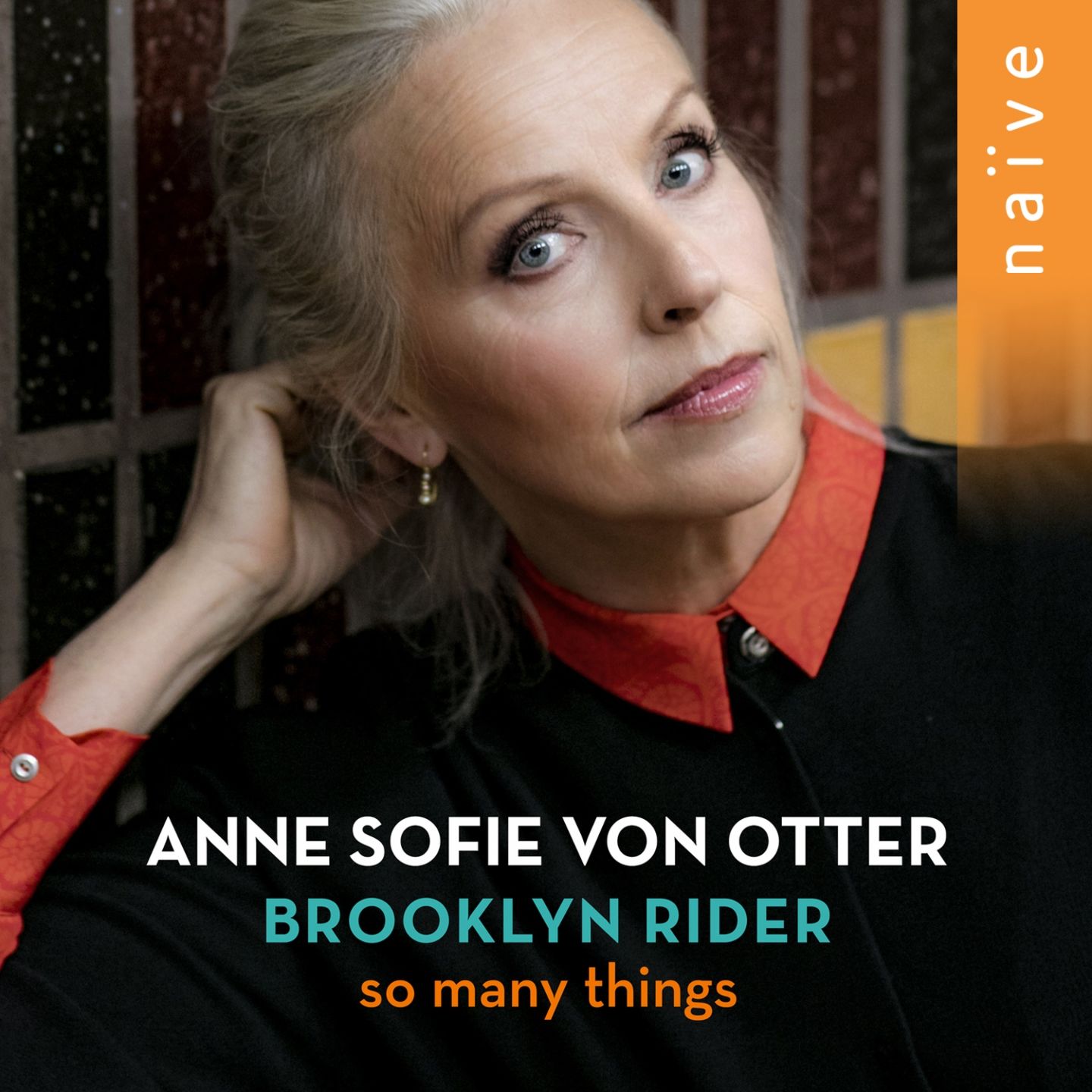
Anne Sofie von Otter / Brooklyn Rider SO MANY THINGS
miércoles, 12 de diciembre de 2018
Anne Sofie von Otter / Bengt Forsberg A SIMPLE SONG
A brief glance at the list of contents is enough to reveal who the
singer is – only Anne Sofie von Otter could have come up with a
programme as varied and wide-ranging. And only von Otter could hold it
together seamlessly by finding the resonances between these very
different pieces, and bringing them out with a rare ability of embracing
different singing styles and expressive registers: to paraphrase Bernstein in his A Simple Song, Anne Sofie von Otter never fails to ‘sing like she likes to sing’.
From Liszt to Pärt and from Mahler’s Resurrection Symphony to Richard Rodgers’ Sound of Music, von Otter is supported by her long-time accompanist Bengt Forsberg, here at the organ instead of his usual piano. At various points in the programme they are joined by a number of musical friends, in the organ loft of St James’s Church in central Stockholm – the very church where the young von Otter began her singing career as a chorister and, together with Forsberg, gave one of her very first public concerts.
jueves, 12 de abril de 2018
Le Concert d'Astrée / Emmanuelle Haïm UNE FÊTE BAROQUE!
This "fête Baroque" occurred in December 2011 at the Théâtre des Champs
Elysées in Paris, marking the tenth anniversary of the ensemble Le Concert d'Astrée under founder and conductor Emmanuelle Haïm. The concert was a benefit for a French cancer research facility, and it attracted a galaxy of guest stars. Le Concert d'Astrée is one of the very best Baroque vocal ensembles, and this release never descends to a low common denominator. Haïm's
trademark expressive phrasing is everywhere in evidence, but the
biggest attraction is the selection of singers, with several figures
from the mainstream showing up alongside established Baroque
specialists. You might not think that tenor Rolando Villazón has quite the right voice for an aria from Handel's
Tamerlano, HWV 18, but he's clearly wrestling with the problem, and he
gets an appreciative roar from the Parisian crowd (who are given full
voice on the recording). Right after that comes a delicious duet from
mainstreamer Anne Sofie von Otter and countertenor Philippe Jaroussky in the Cornelia-Sesto duet from the second act of Handel's Giulio Cesare in Egitto, HWV 17, a pure feast of sensuous singing. Established Baroque vocalists like Natalie Dessay and Sara Mingardo
are on hand, as well as a few up-and-comers who seized the chance to
put their names and voices in front of a well-heeled crowd. Rather than
try to cover the entire range of Baroque opera, Haïm wisely chooses to focus on three composers: Rameau, Lully, and Handel,
whose vocal riches occupy the entire second CD. The sound picks up
unadulterated audience noise, but nothing interferes with the
spontaneity the musicians bring to the event. (James Manheim)domingo, 15 de octubre de 2017
Anne Sofie von Otter / Finnish Radio Symphony Orchestra / Hannu Lintu SIBELIUS Tapiola - En Saga - 8 Songs
This new release by the Finnish Radio Symphony Orchestra conducted by
Hannu Lintu is an all-Sibelius programme featuring internationally
acclaimed mezzo-soprano Anne Sofie von Otter. The album includes two
major tone poems by Jean Sibelius (1865–1957), Tapiola and En Saga,
combined with a set of songs orchestrated by Aulis Sallinen (b. 1935) in
2015. • Sibelius’ tone poem Tapiola, written shortly after the 7th
Symphony, may be regarded as the culmination of a period that began with
the Fifth Symphony, a period where Sibelius created music that grew
organically out of tiny germs into huge processes. It was completed in
1926 and remained Sibelius’s last great orchestral work. In Tapiola,
Sibelius appears to equate the primacy of nature with the value of art
for its own sake, the unattainable truths of which remain uneroded by
time or by the shifting ideals of mankind. Sibelius stated to his
private secretary: “My inspiration for Tapiola came wholly from nature,
or even more accurately from something inexpressible in words.”
The genesis of En Saga, originally premiered in 1892, is also
shrouded in mystery, and even later in life Sibelius was reluctant to go
into any detail regarding its content. It is among Sibelius’ earliest
orchestral works, and its original title in Swedish, En saga, refers to
ancient Nordic tales of heroes and gods. Although En saga is among the
most popular works by Sibelius today, the premiere of the work was not a
success and Sibelius revised the score in 1902.
On the occasion of the 150th anniversary of Sibelius’s birth in 2015
composer Aulis Sallinen (b. 1935) orchestrated a cycle of songs for
mezzosoprano Anne Sophie von Otter. This cycle of eight songs contains
several less known songs in a cavalcade juxtaposing human emotions and
innermost thoughts with the natural environment and experiences in
nature. (Ondine)
martes, 18 de abril de 2017
Anne Sofie von Otter / Cord Garben / Berliner Philharmoniker / James Levine BERLIOZ Les Nuits d'été - Mélodies
Berlioz composed his song-cycle Les nuits
d’été for mezzo-soprano; so it is curious that Anne Sofie von Otter
should transpose four songs down, retaining the keys intended for
contralto. She is at her best in ‘Le spectre de la rose’, although her
marvellous capacity to spin lines while fully articulating the words and
their meaning is apparent everywhere. Was the semitone transposition of
‘L’île inconnue’ really necessary? ‘Villanelle’, ‘Absence’, and ‘Au
cimetière’ lie a third lower (as with Janet Baker), marring Berlioz’s
expertly conceived orchestrations and making the Berlin Philharmonic
plusher than ever. Levine is a sensitive Berliozian, but the sound is
more dense than intense, the voice embedded in the texture: some might
prefer it in higher relief.
Five mélodies with piano are repeated from the recent multi-voiced DG
Berlioz collection which I have already reviewed (see July 1994).
Further hearing reminds me to praise Cord Garben’s idiomatic playing,
particularly the birds in ‘Le matin’ and the storm in ‘La belle
Isabeau’. The other songs are ‘La mort d’Ophélie’, ‘La captive’ and ‘La belle voyageuse’; a pity not to use Berlioz’s orchestrations of the
latter pair. A small orchestra and chorus reappear for ‘Strophes’ from
Roméo et Juliette, exquisitely placed.
An odd collection, therefore, but infinitely worth it for the singing.
(Julian Rushton / BBC Music Magazine))jueves, 21 de julio de 2016
Yannick Nézet-Séguin / Chamber Orchestra of Europe MOZART Le Nozze di Figaro
. . . [from the first chords of the "Figaro" overture, Nézet-Séguin]
establishes a bold, fully crystallized concept of Mozartean sonority and
the psychological implications behind it . . . [Christiane Karg as the
wily servant Susanna and Sonya Yoncheva as the Countess] are just
wonderful . . . [Luca Pisaroni's Figaro] makes dramatic points not with
his usual word articulation but with more microphone-friendly use of
tone Color . . . Even small roles are cast with stars: Anne Sofie von
Otter as Marcellina and Rolando Villazón as Basilio help sustain Act 4 .
. . [the 50-plus "Figaro" recordings on CD and DVD] show how the opera
showcases each generation of Mozart performers . . . Nézet-Séguin's
recording takes its place among these touchstones. A great musical
mediator . . .
Record Review /
David Patrick Stearns,
Philadelphia Inquirer / 10. July 2016
Luxuriously presented and cast . . . [Nézet-Séguin's Mozart recording]
oozes confidence . . . You are in his safe hands the moment Mozart's
upstairs-downstairs comedy kicks off, the Chamber Orchestra of Europe
buoyant, textures balanced, colours vibrant . . . the romp of a fandango
that concludes Act III is a marvellous little scene-stealer . . . Sonya
Yoncheva's magnificently melancholic Countess is a peach of a
performance, lusciously, dreamily sung. Luca Pisaroni is an experienced
Figaro and his velvety baritone is smoothly delivered . . .
Record Review /
Neil Fisher,
The Times (London) / 01. July 2016
domingo, 24 de abril de 2016
Anne Sofie von Otter / Sandrine Piau / Cappella Mediterranea / Leonardo García Alarcón SOGNO BAROCCO
Mezzo-soprano Anne Sofie von Otter
is an artist who continues to amaze with the undiminished luster and
beauty of her voice, the depth and daring of her interpretation, and her
commitment to exploring unfamiliar repertoire. Sogno Barocco is a recital of Italian songs, scenas, and operatic solos and duets
drawn from the early to middle Baroque era. It's a mix of familiar
pieces like Monteverdi's
solo madrigal Si dolce è'l tormento, and "Pur ti miro" from
L'incoronazione di Poppea and some real rarities (not to say oddities)
such as Luigi Rossi's eccentric, starkly dramatic Lamento della regina di suezia, and Francesco Provenzale's even stranger, highly entertaining parody of it, Squarciato appena havea. Von Otter
brings a lifetime of experience and probing intelligence to this
intensely expressive repertoire, yet her voice is youthfully fresh and
radiant, making for performances of unusual depth and vocal loveliness.
Her dramatic sensibility in these pieces, many of which are laments, is
focused and subtle (except in the over-the-top comedy of the Provenzale, in which she cuts loose with abandon). Soprano Sandrine Piau
joins her in three duets and their voices blend beautifully, especially
in sensuality of "Pur ti miro" and the intimate urgency of "Signor,
hoggi rinasco," also from Poppea.
Leonardo García Alarcón
demonstrates exceptional insight into the music of the early and middle
Baroque and further cements his reputation as one of the brightest
stars in this repertoire to emerge in the second decade of the 21st
century. He and Cappella Mediterranea
opt for a spare, lean approach to the realization of the accompaniment,
and while it is not the only possible interpretation, it works
wonderfully well. It is understated but always inventive, and the
ensemble is varied and colorful. Naïve's sound is characteristically
immaculate, detailed, and realistic, with plenty of warmth. Highly
recommended for fans of vocal music of the Baroque. (Stephen Eddins)
viernes, 1 de agosto de 2014
Anne Sofie von Otter BACH
It was with Bach that Anne Sofie von Otter made her very first solo appearances when she performed the alto arias in the St. John Passion
in Stockholm. But by then, as she has explained, the experience gained
as a chorister in the Stockholm Bach Choir had already had a fundamental
and enduring influence on her approach to the composer. “The conductor
of the Bach Choir at that time was very dynamic: he was on fire for this
music, and I became on fire for it as well. Then Nikolaus Harnoncourt
came up to conduct the Bach motets, and that was also a marvellous
experience. Harnoncourt was revolutionizing the performance of Baroque
and Viennese Classical works - spring-cleaning tempos and phrasing and
using original instruments to shed the old woolly sounds of a Romantic
orchestra and make the music vibrant again. It was an exciting time for
young people like me who gathered around the gramophone and listened
eagerly to his new recordings of Monteverdi, Bach and Mozart.
Harnoncourt really was my main influence in Bach."
“In the first ten years of my career I sang a lot of Bach," the singer adds, “but after that I purposely put his music and oratorio aside, because there was so much else to explore, especially opera. So this disc is like coming back full circle." Her concept for the recording and the repertoire she has chosen for it date back to the autumn of 2007. “I borrowed discs of every single Bach cantata, listened to them all, and made notes. It was wonderful to discover new arias, but rather than have a solo vocal recital I decided to break it up with purely instrumental movements. I'd known Lars Ulrik Mortensen for a long time, though we hadn't seen a lot of each other recently, and suddenly this name 'Concerto Copenhagen' appeared on the horizon; I heard them on the radio, and I thought: 'What a wonderful ensemble!' Sure enough, Lars Ulrik was the leader of this great ensemble, so when the idea of the Bach recording came up I thought: 'Why don't I ask Concerto Copenhagen?' I cut down the original list, Lars Ulrik added new ideas, and we had a fantastic time making this recording." As for instrumentation: “Bach often puts the alto voice together with the oboe, so that choice was given, and the sound of the Baroque oboe is one I love."
There is a strong showing in the programme of works from the latter part of the young Bach's years in Weimar, from 1714, when he composed Widerstehe doch der Sünde BWV 54, for alto, strings and continuo, and the more elaborately scored Weinen, Klagen, Sorgen, Zagen BWV 12, with its plangent Sinfonia. After his subsequent spell at the court of the music-loving prince of Anhalt-Cöthen, where most of his secular orchestral works were written, Bach returned to composing cantatas when he was appointed Kantor at the Thomaskirche in Leipzig in 1723. At the end of May he began the production of what would, in a relatively short time, turn out to be a staggering quantity of work for the Lutheran liturgical year - some 300 sacred cantatas for Leipzig in five annual cycles, not to mention the great Passions and oratorios. For Christmas that year he wrote the first version of his Magnificat, originally in E flat major and with four insertions specific to Christmas Day; the pastoral siciliano of the lilting alto and tenor duet “Et misericordia", with its two flutes, is heard here in the more familiar D major version, made toward the end of the decade.
The two sacred works that tower over that period, however, are the St Matthew Passion and the B minor Mass, both represented here. From the St Matthew Passion, first performed on Good Friday 1729, Anne Sofie von Otter sings the profoundly moving aria “Erbarme dich", which occurs at the point in the Easter narrative when Peter has fulfilled Christ's prediction that he will deny him three times before the cock crows, and follows the words “And he went out, and wept bitterly." The B minor Mass was initiated in 1733 with the Kyrie and Gloria and expanded with music composed both previously and later before reaching its final form at the end of the 1740s. The great alto aria “Agnus Dei" was written in 1735.
Historical considerations aside, for von Otter the music remains the starting point, and then the way it relates to the text. Bach poses specific problems for any singer: “Bach is tricky as far as breathing is concerned. There are these wonderful lines, and you want not to breathe so as not to break them up. But more and more the text has increased in meaning for me. Bach really does something with the words, and I enjoy using the text, getting it across. It's not by chance that Bach will really squeeze everything he can out of certain vowels or consonants - this symbolism is something I learned about in the Bach Choir. One has to paint the picture in Bach's mind with one's voice. 'Erbarme dich', for instance, has great sadness, in the pleading of the minor sixths, while in 'Widerstehe doch der Sünde' we decided on a particular approach to convey the image of the poison in the text."
“I dived into this project with great excitement. Lars Ulrik really has what I always like in a conductor, particularly in a Baroque conductor: very clear ideas and a lot of energy. He leads from the organ, so he's part of the music-making himself in a very active way. It was a creative collaboration, and the time was spent with great love." (Kenneth Chalmers)
“In the first ten years of my career I sang a lot of Bach," the singer adds, “but after that I purposely put his music and oratorio aside, because there was so much else to explore, especially opera. So this disc is like coming back full circle." Her concept for the recording and the repertoire she has chosen for it date back to the autumn of 2007. “I borrowed discs of every single Bach cantata, listened to them all, and made notes. It was wonderful to discover new arias, but rather than have a solo vocal recital I decided to break it up with purely instrumental movements. I'd known Lars Ulrik Mortensen for a long time, though we hadn't seen a lot of each other recently, and suddenly this name 'Concerto Copenhagen' appeared on the horizon; I heard them on the radio, and I thought: 'What a wonderful ensemble!' Sure enough, Lars Ulrik was the leader of this great ensemble, so when the idea of the Bach recording came up I thought: 'Why don't I ask Concerto Copenhagen?' I cut down the original list, Lars Ulrik added new ideas, and we had a fantastic time making this recording." As for instrumentation: “Bach often puts the alto voice together with the oboe, so that choice was given, and the sound of the Baroque oboe is one I love."
There is a strong showing in the programme of works from the latter part of the young Bach's years in Weimar, from 1714, when he composed Widerstehe doch der Sünde BWV 54, for alto, strings and continuo, and the more elaborately scored Weinen, Klagen, Sorgen, Zagen BWV 12, with its plangent Sinfonia. After his subsequent spell at the court of the music-loving prince of Anhalt-Cöthen, where most of his secular orchestral works were written, Bach returned to composing cantatas when he was appointed Kantor at the Thomaskirche in Leipzig in 1723. At the end of May he began the production of what would, in a relatively short time, turn out to be a staggering quantity of work for the Lutheran liturgical year - some 300 sacred cantatas for Leipzig in five annual cycles, not to mention the great Passions and oratorios. For Christmas that year he wrote the first version of his Magnificat, originally in E flat major and with four insertions specific to Christmas Day; the pastoral siciliano of the lilting alto and tenor duet “Et misericordia", with its two flutes, is heard here in the more familiar D major version, made toward the end of the decade.
The two sacred works that tower over that period, however, are the St Matthew Passion and the B minor Mass, both represented here. From the St Matthew Passion, first performed on Good Friday 1729, Anne Sofie von Otter sings the profoundly moving aria “Erbarme dich", which occurs at the point in the Easter narrative when Peter has fulfilled Christ's prediction that he will deny him three times before the cock crows, and follows the words “And he went out, and wept bitterly." The B minor Mass was initiated in 1733 with the Kyrie and Gloria and expanded with music composed both previously and later before reaching its final form at the end of the 1740s. The great alto aria “Agnus Dei" was written in 1735.
Historical considerations aside, for von Otter the music remains the starting point, and then the way it relates to the text. Bach poses specific problems for any singer: “Bach is tricky as far as breathing is concerned. There are these wonderful lines, and you want not to breathe so as not to break them up. But more and more the text has increased in meaning for me. Bach really does something with the words, and I enjoy using the text, getting it across. It's not by chance that Bach will really squeeze everything he can out of certain vowels or consonants - this symbolism is something I learned about in the Bach Choir. One has to paint the picture in Bach's mind with one's voice. 'Erbarme dich', for instance, has great sadness, in the pleading of the minor sixths, while in 'Widerstehe doch der Sünde' we decided on a particular approach to convey the image of the poison in the text."
“I dived into this project with great excitement. Lars Ulrik really has what I always like in a conductor, particularly in a Baroque conductor: very clear ideas and a lot of energy. He leads from the organ, so he's part of the music-making himself in a very active way. It was a creative collaboration, and the time was spent with great love." (Kenneth Chalmers)
lunes, 16 de diciembre de 2013
Anne Sofie von Otter / Drottningholm Baroque Ensemble HANDEL - MONTEVERDI - TELEMANN - ROMAN
I'm very proud of the first solo disc that I did which was recorded for Proprius, a Swedish label, with songs and arias by Telemann, Monteverdi, Roman and Handel. It was in 1983, and I was comparatively young - 27, I think - and I was so inexperienced. But I was sort of in charge. It was all done rather instinctively. I'd never sung a whole Handel opera but one of the coaches at the Guildhall said I should look at the aria "Where shall I fly" from Hercules, and then I heard on the radio Piangerò from Giulio Cesare and I thought that was divine. We had no conductor, no rehearsals: we just got on with it. I stood in front of the ensemble and made signs with my pencil where they should play faster or slower or stop. Miraculously, it all worked very well and this disc is still on sale. It was used by my agent as a sort of business card. That's how Georg Solti, for instance, heard of me and why he booked me. (Anne Sofie von Otter / BBC Music)
jueves, 12 de diciembre de 2013
Anne Sofie von Otter / Bengt Forsberg JOHANNES BRAHMS Lieder
There have been recordings where I've had terrible colds and gone ahead anyway - you have to. But I still wouldn't want to redo them because once it's done I don't want to look back. And being me, I quickly look forward to getting my teeth into the next project! After so much time spent on preparation, rehearsal, getting my creative mind round the specific repertoire, I truly don't feel the desire to go back. When I did my Brahms Lieder recording in the early 1990s, I had a nasty cold and you can hear a sort of nasal twang. I was also coughing the whole time which is extremely bad for the voice. It was hard and we had to do many retakes because of it. But again, once it's done it's done. I don't quite understand why one would want to re-record an already familiar work when there is so much wonderful music left to sing. There have been rare occasions where the mood has been tense which is not good for recording, but you just have to get through it unfortunately. "I let the music speak" would be my inner mantra on such an occasion. (Anne Sofie von Otter / BBC music)domingo, 10 de noviembre de 2013
THE UNKNOWN SIBELIUS Rarities and First Recordings
This nicely varied selection of little-known Sibelius contains four orchestral works, 7 songs and choruses, two chamber pieces, and four piano works. Some of it, such as the late Four Fragments for orchestra and most of the vocal pieces, is ephemeral indeed, but there are some fairly substantial works here as well. The two chamber pieces, a charming Serenade for string trio, and the incidental music to the symbolist play The Lizard (Ödlan), are interesting and important. Finland Awakes, an interim version of Finlandia, features the big hymn tune played complete at the end (first sound clip). Had the very last bars been less perfunctory, this could well be the preferred way to hear the work.The original version of TheRead more Oceanides is also fascinating. Sibelius completely revised and extended it between initial composition and first performance. In its original form it had more of a rondo shape, justifying its original title: Rondo of the Waves. The revised version, on the other hand, follows Sibelius’ characteristic tone-poem shape of sonata form without development (that is, ABA’B'). That fabulous, huge climax toward the end is completely missing from the first version, as is the poetic coda. Although some thematic ideas are shared, the two works might as well be independent pieces.
The two outstanding piano pieces are the very ample Impromptu in B minor and a heartfelt Adagio dedicated to the composer’s wife, Aino. As previously mentioned, the Four Fragments, idiomatically orchestrated from Sibelius’ sketches by Timo Virtanen (second clip), are musically tantalizing but too short to tell us anything beyond the fact that they sound like Sibelius. The program ends with the impressive orchestral Processional arranged by Sibelius from his Musique religieuse (originally for tenor and harmonium). The performances, drawn from BIS’s generally wonderful complete Sibelius edition, are uniformly terrific, and so are the sonics. Essential for serious Sibelians. ( David Hurwitz, ClassicsToday.com)
Suscribirse a:
Entradas (Atom)


