
Mostrando entradas con la etiqueta Ernest Chausson. Mostrar todas las entradas
Mostrando entradas con la etiqueta Ernest Chausson. Mostrar todas las entradas
domingo, 7 de marzo de 2021

martes, 6 de octubre de 2020

viernes, 29 de mayo de 2020

domingo, 12 de abril de 2020

miércoles, 26 de febrero de 2020

lunes, 10 de febrero de 2020


martes, 17 de septiembre de 2019
Marie-Nicole Lemieux / Orchestre National Bordeaux Aquitaine / Paul Daniel MER(S)

MER(S) brings together three sumptuous late-19th century works for
female voice and orchestra: Chausson’s Poème de l’amour et de la mer,
Elgar’s Sea Pictures and, in a world premiere recording, an
‘ode-symphonie’ by Victorin Joncières entitled La mer. Following her
triumphant performance as Cassandre in Berlioz’s Les Troyens,
Marie-Nicole Lemieux embarks on this musical sea voyage in the company
of the Orchestre et choeurs nationaux Bordeaux Aquitaine under their
music director Paul Daniel.
Magdalena Kožená & Friends SOIRÉE

Soirée captures the atmosphere of informal, domestic music making. Czech
star mezzo-soprano Magdalena Kožená offers an intimate and highly
personal collection of international songs together with an outstanding
group of musical friends, including Sir Simon Rattle, who makes his
recording debut as a pianist. The German lied is represented by Brahms
(Two Songs, Op. 91 and Five Ophelia Songs, WoO 22) and Strauss
(Morgen!), the French chanson by Chausson (Chanson perpétuelle) and
Ravel (Chansons madécasses), and 20th-century avant-gardism with
Stravinsky’s Three Songs from William Shakespeare. In between these
explorations, Kožená revisits her musical roots with a selection of
Dvořák songs, arranged by Duncan Ward, as well as Janáček’s Nursery
Rhymes.
Soirée is the second release of Magdalena Kožená’s exclusive collaboration with PENTATONE, after having presented the baroque cantatas recital album Il giardino dei sospiri in 2019.
Soirée is the second release of Magdalena Kožená’s exclusive collaboration with PENTATONE, after having presented the baroque cantatas recital album Il giardino dei sospiri in 2019.
jueves, 18 de julio de 2019
Ginette Neveu THE COMPLETE RECORDINGS

The French violinist Ginette Neveu was just 30 when her plane crashed
in the Azores in October 1949. She had studied with George Enescu and
Carl Flesch, and as The Observer wrote in 1945, “Her playing was
superbly vigorous and passionate, and made the impression that its great
qualities, such as eloquent phrasing and an apparently limitless range
and variety of tone, came from the only true source – an identity with
the music and with her instrument.”
Her complete recordings, specially
remastered from the best sources available, are gathered on these four
CDs, with her incandescent Sibelius Concerto taking pride of place.
2019 marks the centenary of Ginette Neveu’s birth.
“Her playing was superbly vigorous and passionate, and made the
impression that its great qualities, such as eloquent phrasing and an
apparently limitless range and variety of tone, came from the only true
source – an identity with the music and with her instrument.” The
Observer, 1945
The present box gathers the complete studio recordings done by Ginette Neveu and contains the first CD reissue in the West of Ion
Scărlătescu’s Bagatelle
martes, 23 de abril de 2019
Rosanne Philippens / Julien Quentin DEDICATIONS

It began with a piece which I fell in love with: Eugène
Ysaÿe’s Poème élégiaque. You have to tune the bottom violin string a
tone lower. That explains the dark character, which you hear
particularly in the middle, which is a funeral march. Ysaÿe dedicated it
to Gabriël Fauré. And so the idea for this CD was born: violin music by
composers who honoured and inspired one another. I found out, for
example, that Fauré often visited the famous singer Pauline Viardot’s
salon. It was there that he premiered the Romance. At first it sounds
like a rather sweet Fauré, but passions rise high in the middle. Fauré
was briefly engaged to a daughter of Viardot. The Russian writer Ivan
Toergenjev, Viardot’s lover, used the affaire in his short story Le
chant de l’amour triomphant, on which, in turn, Ernest Chausson based his Poème, with its dreamy music and a tragic ring. Chausson dedicated
it to Ysaÿe and drew inspiration from his Poème élégiaque, as one hears
in the high violin trills at the end of both pieces.
sábado, 6 de abril de 2019
Carolyn Sampson / Joseph Middleton REASON IN MADNESS
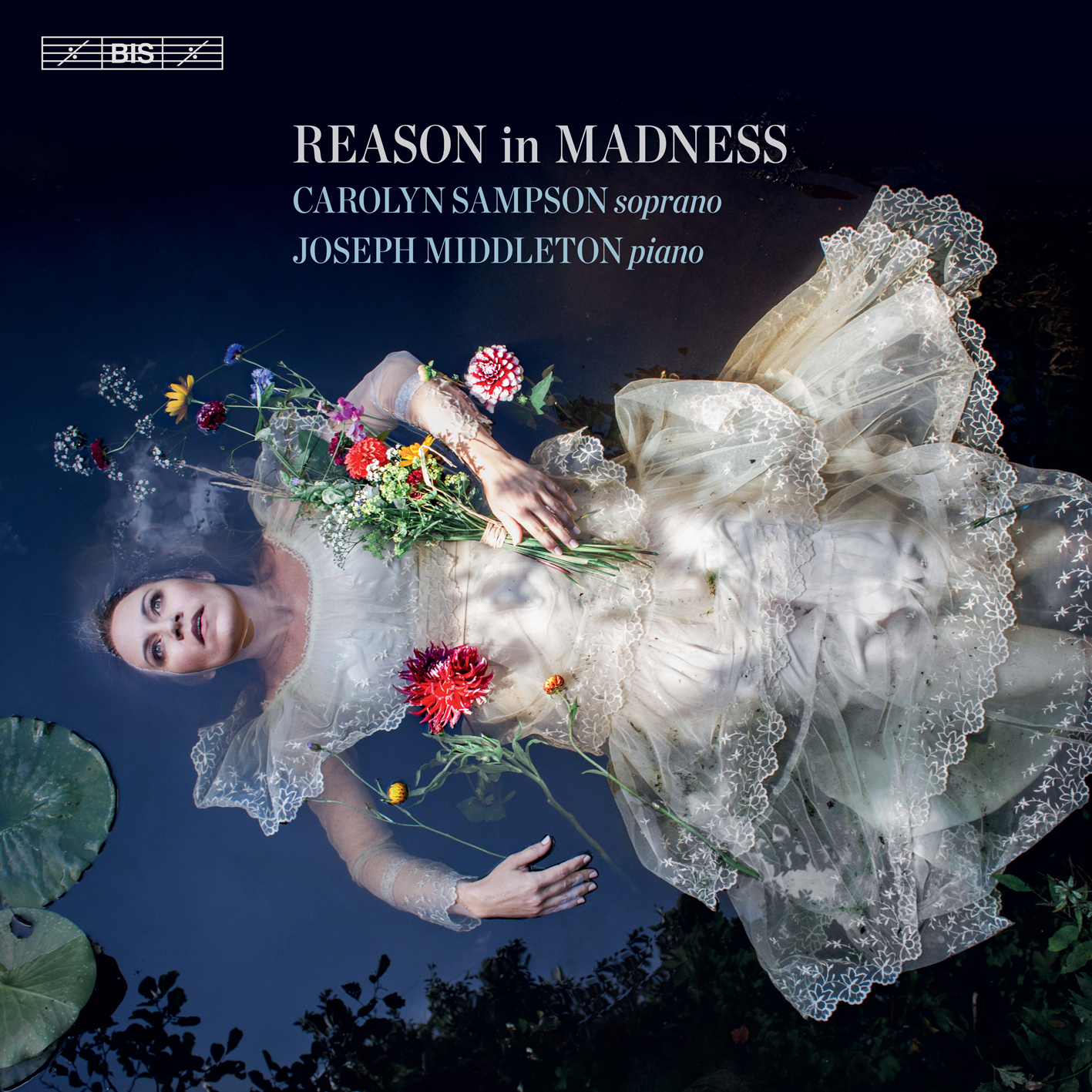 Throughout history men have feared madwomen, burning them as witches,
confining them in asylums and subjecting them to psychoanalysis – yet,
they have also been fascinated, unable to resist fantasizing about them.
For their new disc, Carolyn Sampson and Joseph Middleton have created a
programme that explores
the responses of a variety of composers to women whose stories have left
them vulnerable and exposed. As a motto they have chosen an aphorism by
Nietzsche: ‘There is always some madness in love, but there is also
always some reason in madness.’
Throughout history men have feared madwomen, burning them as witches,
confining them in asylums and subjecting them to psychoanalysis – yet,
they have also been fascinated, unable to resist fantasizing about them.
For their new disc, Carolyn Sampson and Joseph Middleton have created a
programme that explores
the responses of a variety of composers to women whose stories have left
them vulnerable and exposed. As a motto they have chosen an aphorism by
Nietzsche: ‘There is always some madness in love, but there is also
always some reason in madness.’ Brahms’ Ophelia Songs, composed for a stage production of Hamlet, appear next to those by Richard Strauss and Chausson, while Ophelia's death is described by both Schumann (in Herzeleid) and Saint-Saëns. Goethe’s mysterious and traumatized Mignon appears in settings by Hugo Wolf as well as Duparc, while his ill-used Gretchen grieves by her spinning-wheel in Schubert's matchless setting. Sadness and madness tip into witchery and unbridled eroticism with Pierre Louÿs's poems about Bilitis, set by Kœchlin and Debussy. Sampson and Middleton end their recital as it began, with a suicide by drowning: in Poulenc’s monologue La Dame de Monte-Carlo, the elderly female protagonist has been unlucky at the gambling tables and decides to throw herself into the sea.
viernes, 28 de diciembre de 2018
Fidelio Trio FAURÉ, CHAUSSON & SATIE Piano Trios

Following on from their acclaimed Resonus debut the Fidelio Trio
continues its exploration of the French piano trio with this impressive
new recording of works by Gabriel Fauré, Ernest Chausson, and Erik
Satie.
Chausson’s opulent and lyrical Op. 3 piano trio from 1881, is joined by
Fauré’s only work in this chamber music genre – the heartfelt Piano
Trio in D minor, Op. 120 – composed during the latter part of his life.
The album is completed with arrangements by John White of works by Erik
Satie – selections from his only liturgical work, the Messe des Pauvres,
and the incidental music to his own play, Le Piège de Méduse.
viernes, 16 de noviembre de 2018
Sophie Karthäuser / Eugene Asti LE BAL DES ANIMAUX

A mirror for the human animal The inhabitants of the animal kingdom have
long been a subject of fascination for visual artists, and a source of
inspiration for composers as well. Whether voicing their affection and
awe, or mocking the human animal, composers have paid tribute to our
furry and feathered friends by producing masterpieces of invention,
musical mimicry, and wit. Peacocks, ducks, dromedaries, pigs,
butterflies, carp, cicadas, and owls are just some of the creatures in
the menagerie assembled for this recording, featuring the mischievous
voice of Sophie Karthäuser, deftly accompanied by Eugene Asti.
jueves, 27 de septiembre de 2018
Isabelle Faust / Alexander Melnikov / Salagon Quartet CÉSAR FRANCK Sonate pour Piano et Violon ERNEST CHAUSSON Concert

Faust and the quartet use vibrato rather sparingly, which clarifies
the often intricate texture and creates a luminosity that, while lacking
in bite and body, conjures and maintains a spellbinding, moonlit
atmosphere. Note, for example, the pearlescent opacity of the passage at
6'26" in the first movement, and the almost spectral quality at the
beginning of the finale – worlds away from the playful (yet equally
magical) reading by Francescatti, Casadesus et al. Yet there’s no lack
of drama. Indeed, Faust, Melnikov and the Salagon frequently bring
Chausson’s fascination with Wagner to the fore and even anticipate the
languorous sensuality of Scriabin (listen from 4'35" in the first
movement), thanks in large part to Melnikov’s judicious phrasing.
Franck’s Violin Sonata is equally impressive. Here, again, Faust uses vibrato prudently, and in general finds intense expressivity in
restraint and emotional directness. Pianissimo passages beckon in
secretive, confessional whispers, and the sometimes blunt rhetoric of
Franck’s style is allowed to speak for itself without overemphasis or
apology. The electricity of the third-movement Recitativo-Fantasia, for
instance, is conveyed not with bold gestures but through quiet,
sustained tension, so that even the most sparsely textured passage keeps
one on the seat’s edge. Melnikov’s tone can harden in loud passages,
but this may be partly the fault of the engineering, which is pleasingly
resonant yet also strangely muffled. In any case, the interpretations
are so committed and forthright that any occasional sonic blemish is
only momentarily distracting. The Decca recording with Amoyal and Rogé
offers the same coupling in better sound but seems overwrought in
comparison. Those looking for greater passion and tonal warmth in this
repertoire are urged to hear a recent Aparté release with Rachel Kolly
d’Alba, Christian Chamorel and the Chicago-based Spektral Quartet. (Andrew Farach-Colton/ Gramophone)
lunes, 17 de septiembre de 2018
Anne Queffélec ENTREZ DANS LA DANSE...
 The same qualities as on her delightful cornucopia ‘Satie &
Compagnie’ (4/13) are on display again in Anne Queffélec’s programme of
dances from the belle époque and inter-war periods in France. All the
composers were either disciples or pupils of one another or personal
friends. Stylistically, it is easy to hear the cross-references: ‘Their
works engaged in dialogue, nourished and interpenetrated each other’, as
the excellent booklet has it. You can hear Faure’s Le pas espagnol,
for instance, either as an affectionate tribute to or tongue-in-cheek
pastiche of Chabrier. It was Fauré who provided early inspiration for
the Catalan Federico Mompou, the sole outsider in nationality on this
album (though not in terms of musical style) and whose Canción y Danza No 4 opens proceedings.
The same qualities as on her delightful cornucopia ‘Satie &
Compagnie’ (4/13) are on display again in Anne Queffélec’s programme of
dances from the belle époque and inter-war periods in France. All the
composers were either disciples or pupils of one another or personal
friends. Stylistically, it is easy to hear the cross-references: ‘Their
works engaged in dialogue, nourished and interpenetrated each other’, as
the excellent booklet has it. You can hear Faure’s Le pas espagnol,
for instance, either as an affectionate tribute to or tongue-in-cheek
pastiche of Chabrier. It was Fauré who provided early inspiration for
the Catalan Federico Mompou, the sole outsider in nationality on this
album (though not in terms of musical style) and whose Canción y Danza No 4 opens proceedings.
Again, Queffélec mixes the familiar with the less well known,
with enough of the latter to entice any pianophile to invest and pianist
to track down the sheet music (as an example, your reviewer has now
finally got round to having a serious look at Poulenc’s Suite française).
Her approach to the music is one of enchanting simplicity. No show, no
grandstanding; she beckons the listener to leave what they are doing, if
they wish, and to come over and join her. Minimum pedal, lovely finger
legato, each note of these economically scored pieces intimately
projected and made to tell.
Le pas espagnol, mentioned above, is one of five (out of the
24) tracks in which Queffélec is joined by Gaspard Dehaene.
Notwithstanding the exuberant nature of this and a few others
(Massenet’s Valse folle first among them), the general tenor of
the 82-minute programme is one of reflection and introspection, a
welcome balm, and warmly recommended. (Jeremy Nicholas / Gramophone)
viernes, 27 de abril de 2018
Carolyn Sampson / Joseph Middleton A VERLAINE SONGBOOK

Carolyn Sampson and Joseph Middleton have turned to Verlaine settings
for their new album for BIS, drawing inevitable comparisons with
‘Green’ (Erato, 4/15), Philippe Jaroussky and Jérôme Ducros’s two-disc
Verlaine survey. Wisely, perhaps, they take a very different approach.
Where Jaroussky and Ducros focus on multiple settings of individual
texts, Sampson and Middleton concentrate on song-cycles, bookending
their recital with Fêtes galantes and Ariettes oubliées, and placing La bonne chanson
at its centre. Notable among the remaining songs are those by Régine
Wieniawski (‘Poldowski’ was the pseudonym she adopted), and d’Indy’s
pupil Déodat de Séverac, whose plainchant-inflected ‘Paysages tristes’,
one of many discoveries here, forms the disc’s unforgettable epilogue.
Sampson and Middleton are very much at home in this repertory,
frequently functioning as an indivisible unit with sound and sense
beautifully fused. Occasionally – in the opening ‘En sourdine’ from Fêtes galantes,
for instance – Sampson lets consonants slip in a quest for dynamic
shading, though elsewhere texts are scrupulously delivered. She’s in
excellent voice, too, her tone clear and silvery, her upper registers
exquisite: Chausson’s ‘Apaisement’ sends shivers down your spine with
its floated high pianissimos and suggestive portamentos.
The subtlety of Verlaine’s poetry – in which inner emotion and
external reality are in continuous if fragile accord – encouraged song
composers to expand the range of their piano-writing, and Middleton’s
playing is marvellously fresh throughout, the thin dividing line between
wit and melancholy superbly negotiated. When it comes to La bonne chanson,
I prefer the more forthright approach of Gérard Souzay, say, or the
underrated Camille Maurane, to Sampson and Middleton’s reined-in
interpretation, fascinating though it is. Ariettes oubliées, on
the other hand, gets one its finest performances on disc, the slide from
eroticism to bitterness immaculately judged. Very fine. (Tim Ashley / Gramophone)
miércoles, 18 de octubre de 2017
Rachel Kolly d'Alba FRENCH IMPRESSIONS
 Warner Classics' album French Impressions, with Swiss violinist Rachel
Kolly d'Alba, is not, as you might initially expect, a survey of French
violin works from the so-called Impressionists. Rather, it is an
intriguing look at the many different directions French art music was
taking in the early part of the 20th century. From the Third Violin
Concerto of Saint-Saëns -- a longtime holdout of the Romantic style,
although he accepted and encouraged the advancements of his compatriots
-- to the exotic, virtuosic, and flashy Tzigane of Ravel, this program
has more to offer listeners than just a grouping of Impressionist works.
Likewise, d'Alba offers her listeners a breadth of colors and moods
that match nicely with the changing characteristics of the scores. The Saint-Saëns concerto is played with invigorating force and drive,
yielding a spontaneous, off-the-cuff feeling. Both the Ysaÿe works as
well as the Chausson Poème are played with beautifully shaped, long,
flowing lines and sensitive, careful application of dynamics. And
finally Tzigane, in which d'Alba gets to show off her ample technique,
punctuated articulation, and nimble bow arm. D'Alba produces a
voluminous sound on her Vuilaume violin, so much so that her sound is
almost too big and too present for the somewhat low recorded level of
the accompanying orchestra.
Warner Classics' album French Impressions, with Swiss violinist Rachel
Kolly d'Alba, is not, as you might initially expect, a survey of French
violin works from the so-called Impressionists. Rather, it is an
intriguing look at the many different directions French art music was
taking in the early part of the 20th century. From the Third Violin
Concerto of Saint-Saëns -- a longtime holdout of the Romantic style,
although he accepted and encouraged the advancements of his compatriots
-- to the exotic, virtuosic, and flashy Tzigane of Ravel, this program
has more to offer listeners than just a grouping of Impressionist works.
Likewise, d'Alba offers her listeners a breadth of colors and moods
that match nicely with the changing characteristics of the scores. The Saint-Saëns concerto is played with invigorating force and drive,
yielding a spontaneous, off-the-cuff feeling. Both the Ysaÿe works as
well as the Chausson Poème are played with beautifully shaped, long,
flowing lines and sensitive, careful application of dynamics. And
finally Tzigane, in which d'Alba gets to show off her ample technique,
punctuated articulation, and nimble bow arm. D'Alba produces a
voluminous sound on her Vuilaume violin, so much so that her sound is
almost too big and too present for the somewhat low recorded level of
the accompanying orchestra.viernes, 21 de julio de 2017
Jennifer Pike / Tom Poster / Doric String Quartet CHAUSSON Concert for Violin, Piano and String Quartet - String Quartet

Chausson’s premature death in 1899 in a cycling accident left his
String Quartet unfinished. Two movements were complete, with a third
needing the helping hand of Vincent d’Indy. It was clearly intended as a
four-movement work and is conceived on a grand scale. The Doric make
the best possible case for the piece, even where it’s less than
polished. This is very much a product of its time, sitting on the cusp
of the 19th and 20th centuries, with all the unease that that suggests;
it has its hints of Wagner but also echoes of Debussy. The third
movement is the weakest, without a particularly pronounced character,
which is ironically not helped by d’Indy’s very definite ending, which
rounds it off as if it were a true finale rather than the penultimate
movement.
The Concert is another matter, however. Chausson’s musical
inventiveness amply fills its statuesque dimensions and it never
outstays its welcome. There are plenty of opportunities for Jennifer
Pike to display her sinuous, tender tone, while Tom Poster reminds us
yet again why he’s so highly regarded as a chamber musician: sample from
around 4'10" in the finale, where he makes light and highly nuanced
work of the filigree that forms a shadowy backdrop to the strings. In
some performances it can feel as if the quartet is too small a force to convey the grandeur of Chausson’s vision, but not here, with the Doric
revelling in the luxuriant textures. Though I retain a soft spot for the
note of disquiet that Graffin brings to the Grave in his
recording with the Chilingirian, their reading as a whole doesn’t have
the same cumulative impact as the Doric et al. And there’s no contest in
the finale, which in the new version has a thrilling one-in-a-bar
propulsion. A real front-runner for the Concert, and the most convincing of advocates for the more problematic String Quartet. (Harriet Smith / Gramophone)
lunes, 10 de julio de 2017
Sandrine Piau / Susan Manoff ÉVOCATION

Soprano Sandrine Piau has an ideal voice for this music--true and lovely across her range, with no points of harshness, no weakness of technique. And especially in the French repertoire, her ability to phrase and impart feeling is consistent with her statement in the notes that this is her "most personal and intimate" album. Although she does a nice job with the Strauss songs, they don't seem to flow as naturally as, for instance, those by Chausson (of which Le Colibri--"the hummingbird"--for me was the highlight of the disc). Piau is fortunate to have such a musical soul-mate in pianist Susan Manoff, a superb partner who also knows about nuances of color, from the softest shades to tones more bold and emphatic.
There's much to savor here--it would be difficult to name an inferior song among the program's 30 selections--but the rarely-heard Strauss Mädchenblumen, Schoenberg's beautiful and affecting Vier Lieder Op. 2 (from 1899), and Koechlin's Sept Chansons pour Gladys (to his own very strange texts) are of particular interest. And you've never heard a more gently endearing song than Zemlinsky's Frühlingslied or a more perfectly evocative musical creation than Debussy's Fleur des blés, depicting a breeze rippling through a cornfield, a whispering bird, cascading hair, sunshine, and flowers. The sound is nicely balanced and complementary to both voice and piano, with a comfortably positioned listener perspective (not always the case with voice/piano recitals!). Highly recommended. (David Vernier / ClassicsToday.com)
jueves, 6 de julio de 2017
Sandrine Piau / Susan manoff APRÈS UN RÊVE
 Sandrine
Piau was recently forced to withdraw from both Glyndebourne and this
year's Proms after sustaining a knee injury, so if you admire her work,
then you're going to have to make do, I'm afraid, with her latest album.
It thoughtfully examines images of night, sleep, dreams and waking in
post-Romantic and modern song. Piau treats the subject metaphorically as
well as literally, which allows her to include Poulenc's settings of
surrealist poetry, Strauss's Morgen, and Britten's The Salley Gardens,
which deals with waking up to reality after disappointment in love. She
also gives us Vincent Bouchot's Galgenlieder – an eerie new song cycle
that pitches settings of Christian Morgenstern somewhere between
nightmare and nursery rhyme – together with some rarely heard
Mendelssohn and familiar numbers by Chausson and Fauré. At 58 minutes,
the disc is a bit short, and a preponderance of reflective material
results in an occasional sameness of mood. But there's exquisite playing from Susan Manoff, and no mistaking the beauty of Piau's voice, or her
hypnotic way with words. This is singing that sends shivers down
your spine. (Tim Ashley / The Guardian)
Sandrine
Piau was recently forced to withdraw from both Glyndebourne and this
year's Proms after sustaining a knee injury, so if you admire her work,
then you're going to have to make do, I'm afraid, with her latest album.
It thoughtfully examines images of night, sleep, dreams and waking in
post-Romantic and modern song. Piau treats the subject metaphorically as
well as literally, which allows her to include Poulenc's settings of
surrealist poetry, Strauss's Morgen, and Britten's The Salley Gardens,
which deals with waking up to reality after disappointment in love. She
also gives us Vincent Bouchot's Galgenlieder – an eerie new song cycle
that pitches settings of Christian Morgenstern somewhere between
nightmare and nursery rhyme – together with some rarely heard
Mendelssohn and familiar numbers by Chausson and Fauré. At 58 minutes,
the disc is a bit short, and a preponderance of reflective material
results in an occasional sameness of mood. But there's exquisite playing from Susan Manoff, and no mistaking the beauty of Piau's voice, or her
hypnotic way with words. This is singing that sends shivers down
your spine. (Tim Ashley / The Guardian)
Suscribirse a:
Entradas (Atom)


