
Mostrando entradas con la etiqueta Domenico Scarlatti. Mostrar todas las entradas
Mostrando entradas con la etiqueta Domenico Scarlatti. Mostrar todas las entradas
miércoles, 27 de enero de 2021

miércoles, 8 de julio de 2020

jueves, 18 de junio de 2020

viernes, 15 de mayo de 2020
miércoles, 6 de mayo de 2020

lunes, 10 de junio de 2019
Trio SR9 ALORS, ON DANSE?

For their second album on Naïve, the three percussionists (marimba
players) of Trio SR9 have chosen to shine the light on the theme of
dance, in all its rich variety throughout the history of Western
classical music: from Rameau and Bach, to Debussy, Satie and Borodin.
So, shall we dance?
The first part of the album is a set of Baroque dances (Gavotte,
Sarabande, Minuet, Gigue...) drawn from the legacy of various European
composers. These pieces are presented in the form of a large suite, as
was the tradition at the time.
Then we move on to explore Europe of the nineteenth century. A taste
for exoticism and folk dance rhythms are here made even more sublime by
Claude Debussy with his Tarentelle Styrienne, Béla Bartok with the
Romanian Dances and Alexander Borodin with his Polovtsian Dances.
The last part of the disc is dedicated to the mysticism of dance and
begins, perhaps unsurprisingly, with the Ritual Fire Dance by Manuel de
Falla. It is followed by Narnchygäer, a new work for three marimbas and
the first of its kind composed by François Tashdjian especially for the
SR9 Trio.
Lastly, it is around the three Danse de Travers by Erik Satie that
this programme is weaved. This common thread punctuates each part of the
album with sweetness and melancholy.
After a highly-regarded first album, Bach on the marimba, this new
programme allows us to go one step further in revealing the many riches
of the marimba, the sumptuously-crafted five-octave rosewood instrument.
It's via the sound of three marimbas that the Trio SR9 demonstrates its
ability to develop the reputation of percussion, all in one
choreographed gesture …
martes, 4 de junio de 2019
Luc Beauséjour MOMENTS BAROQUES AU PIANO

The repertoire on this recording was written for harpsichord during
the Baroque period, generally considered to span the years 1600 to 1750.
While many pianists have played Bach, Scarlatti, Handel, Rameau, and
even Couperin and Froberger, few harpsichordists have come to the
defence of the harpsichord repertoire on the modern piano.
The
idea was born during a meeting with Analekta president, François Mario
Labbé. I was submitting some recording proposals for harpsichord and
clavichord, and he asked me, “Why not make a CD of piano music?”
Somewhat taken aback, I asked for a few days to think about it.
Not
long after, I suggested a program that would not only include
harpsichord repertoire already covered by pianists–Bach, Scarlatti, and
Handel– but would also feature some lesser-known works. In compiling
this program, I played for several friends on various occasions to get
their opinions. After reading through quite a number of works, I
selected those that appealed to me most and that I felt worked best on
the piano.
Some pieces borrowed from the harpsichord repertoire
sound very good on the piano, but I quickly realized that not all
Baroque repertoire lends itself to the modern instrument with equal
satisfaction. (Luc Beauséjour)
miércoles, 8 de mayo de 2019
Daria van den Bercken DOMENICO SCARLATTI Sonatas

One of the enduring fascinations of Scarlatti is the way a
single sonata can respond to a wide variety of approaches. Van den
Bercken takes Kk119 at a relatively sedate pace – others, not least
Sudbin in his recent Scarlatti disc (BIS, 4/16), are more outlandish.
Kk27, on the other hand, is relatively swift here, but it has its own
allure, the ritardandos and accelerandos sounding entirely natural.
However, I did find Kk32 just too slow, leaving its beautiful melody
sounding a little stilted. Sudbin is also steady but maintains more of a
sense of line; he takes considerably more liberties than van den
Bercken but he makes them work, thanks to his sense of conviction. She
is also a little too smooth-edged in Kk230, which really comes to life
in Scott Ross’s classic recording on harpsichord (Erato, 6/88).
Occasionally I wanted a bit more oomph: the hunt-infused Kk159 is too
genteel – more of a sedate outing on a seaside donkey than a canter
through the fields. Queffélec (Apex, 3/95) is a real speed merchant here
but it’s thrilling, and Hewitt (Hyperion, 2/16), not quite so feckless,
gets more of a sense of the chase in her reading. But the much-recorded
Kk87 is another winner, its undulating lines warmly shaped and full of
enticing detail, such as the slightly detached left-hand counterpoint at
4'03". She ends as she began, in a mood of gentle good humour with
Kk544. (Harriet Smith / Gramophone)
martes, 19 de marzo de 2019
Alberto Urroz DOMENICO SCARLATTI Sonatas

The musical richness of Scarlatti’s sonatas has already produced
memorable performances at the harpsichord as well as at the piano, and
both options will remain open for sure in the future. Eva Badura-Skoda,
in her recent 2017 book The Eighteenth-Century Fortepiano Grand and Its
Patrons, underlines once more the option to consider both the
harpsichord and the piano, even the modern piano, as suitable
instruments to play Domenico Scarlatti’s sonatas. Just like Johann
Sebastian Bach’s works for keyboard, Scarlatti’s pieces, Badura-Skoda
says, can sound convincing in any instrument, provided that each
performer may have the training, the taste and the sensitivity to
recreate the proper language, sound and aesthetic for that music.
Alberto Urroz, one of the most brilliant pianists of his generation,
faces in this recording the challenge to explore his own selection and
version of some of Domenico Scarlatti’s sonatas, inviting us to enjoy a
repertoire that is always attractive and inspiring, from which every
great performer knows how to extract new nuances, subtleties and
perspectives. (Maria Gembero-Ustárroz)
viernes, 19 de octubre de 2018
Jean Rondeau SCARLATTI Sonatas

For his third Erato album of harpsichord music, Jean Rondeau turns to
Domenico Scarlatti and some 20 of the often-dazzling sonatas that the
Neapolitan composer wrote during his years at the royal court in Madrid.
Imbued with the spirit of the dance, they are works that Rondeau uses
“to tell a story for the people who will listen to an album from
beginning to end … An artist must consider how he tells his story, how
he can stimulate the public’s curiosity.”
Andreas Staier / Orquestra Barroca Casa da Música Porto À PORTUGUESA
 This colorful musical journey takes its title from one of William
Corbett's Bizzarie universali, a set of concertos which, in truth, owe
much more to the Italian tradition than to the Iberian Peninsula.
Performed by Andreas Staier and the Orquestra Barroca Casa da Música, À Portuguesa features a selection of concertos and sonatas in the
Portuguese style composed during the Age of Enlightenment. Ranging from
the inexhaustible delights of Domenico Scarlatti's solo Sonatas to
concertos by Corbett, Seixas and Avison, Staier's program concludes with
an orchestral arrangement of Boccherini's evergreen Musica notturna
delle strade di Madrid.
This colorful musical journey takes its title from one of William
Corbett's Bizzarie universali, a set of concertos which, in truth, owe
much more to the Italian tradition than to the Iberian Peninsula.
Performed by Andreas Staier and the Orquestra Barroca Casa da Música, À Portuguesa features a selection of concertos and sonatas in the
Portuguese style composed during the Age of Enlightenment. Ranging from
the inexhaustible delights of Domenico Scarlatti's solo Sonatas to
concertos by Corbett, Seixas and Avison, Staier's program concludes with
an orchestral arrangement of Boccherini's evergreen Musica notturna
delle strade di Madrid.
sábado, 15 de septiembre de 2018
Duo Sempre DRAMATIQUE
 Duo Sempre represents a
duo of two guitarists, winners of numerous guitar competitions Arsen
Asanov and Dariya Panasevych. Their performances are characterizing by a
high sensitivity, expressiveness and clearness of musical images.
Nowadays they are focused on the creation of a new repertoire by
transcribing baroque, classical and contemporary masterpieces like
clavier music of J.P.Rameau, D.Scarlatti, piano music by C. Debussy, A.
Ginastera etc. At the same time, they have a full program composed out
of highlights of original guitar duo repertoire, a heritage of such
great composers as N. Coste, M. Castelnuovo-Tedesco, L. Brouwer, S.
Assad etc. Almost every concert program includes own compositions and
it becomes a feature of the Duo.
Duo Sempre represents a
duo of two guitarists, winners of numerous guitar competitions Arsen
Asanov and Dariya Panasevych. Their performances are characterizing by a
high sensitivity, expressiveness and clearness of musical images.
Nowadays they are focused on the creation of a new repertoire by
transcribing baroque, classical and contemporary masterpieces like
clavier music of J.P.Rameau, D.Scarlatti, piano music by C. Debussy, A.
Ginastera etc. At the same time, they have a full program composed out
of highlights of original guitar duo repertoire, a heritage of such
great composers as N. Coste, M. Castelnuovo-Tedesco, L. Brouwer, S.
Assad etc. Almost every concert program includes own compositions and
it becomes a feature of the Duo.
The first CD "Seven Rings" was recorded at the "Ton- und Video-Studio" in Salzburg and was released in 2014. The new CD "Dramatique",
dedicated to Harpsichord music of the 18th century, was recorded at
"Hochschule für Musik und Theater" in Hamburg and released by Aliso
Records in 2018.
domingo, 5 de agosto de 2018
Roland Pöntinen INGMAR BERGMAN: MUSIC FROM THE FILMS

Ingmar Bergman (1918- 2007) made fifty films, directed more than 150
theatre productions and wrote several books, but the recurrent thread
running through his life was music. He often said that if he hadn't
become a director he would have wished to become a conductor, and went
so far as to claim that ‘film and music are almost the same thing. They
are means of expression and communication that go beyond human wisdom
and that touch a person’s emotional centre.’
Bergman’s interest in classical music became evident early on in his
career. Music in Darkness (1948) is about a pianist who loses his sight
in a shooting accident, To Joy (1950) features a violinist who dreams of
a solo career and Summer Interlude (1951) takes place at the Royal
Swedish Opera. He admired all who could perform music, reserving his
greatest love for pianists, and concert pianists are portrayed in Hour
of the Wolf, Face to Face and Autumn Sonata.
One of Bergman’s favourite Swedish pianists was Roland Pöntinen, who
here performs a number of pieces featured in Bergman’s films, by
composers including Mozart, Chopin and Schumann. Pöntinen is joined by
the Stenhammar Quartet in the second movement of Schumann’s piano
quintet, used by Bergman to great effect in the award-winning Fanny and
Alexander. Another of the director’s favourite performers, the cellist
Torleif Thedéen, also contributes to the project, with the sarabandes
from three of Bach’s suites for solo cello
viernes, 25 de mayo de 2018
Justin Taylor CONTINUUM

Following his First Prize at the Bruges Competition and his first
album, devoted to the Forqueray family (Choc of the Year in Classica,
Editor’s Choice in Gramophone, Grand Prix de l’Académie Charles Cros),
the Franco American harpsichordist Justin Taylor has recently been
awarded the Révélation Musicale Prize of the French Critics’ Circle. His
career has developed rapidly, both as soloist (harpsichordist and also
fortepianist) and as director of his ensemble, the Taylor Consort, with
which Alpha will soon be recording... For his second recital, Justin
Taylor juxtaposes Scarlatti and Ligeti, two composers whose periods and
universes seem so remote from each other, yet who show numerous
affinities: in their inventiveness, the virtuosity of their respective
languages and their common urge to push the keyboard to its very limits.
Continuum builds a bridgehead between these two hypersensitive composers by intertwining Ligeti’s three emblematic (and spectacular!)
pieces for solo harpsichord with sonatas by Scarlatti.
miércoles, 28 de marzo de 2018
EnAccord String Quartet CAPRICCIO

The string quartet repertoire is an unending voyage of discovery and
exploration. The great masterpieces of the repertoire conceal unknown
jewels in their shadow; these latter works, however, seldom find their
way onto a concert programme. This recording introduces our listeners to
our first and highly personal anthology of splendidly varied and short
pieces for string quartet. We hope you enjoy them - because there are
many more such works still to be discovered and enjoyed.
“Our CD is a collection of short stories: each piece has its own
structure and mood, its own individual world. Schulhoff’s five pieces,
each with its own individual character, are perfect examples of this.”
Rosalinde Kluck - alt violin
“The Lekeu piece was a real discovery. Splendid music with great depth. But what a tragedy! How many more masterpieces could Lekeu have composed, if he hadn’t died at such a young age?”
Maike Reisener - cello
“It was an immense pleasure to get to grips with these small masterpieces. Puccini’s Crisantemi is possibly the best of them for me personally. It’s like a scene from one of his operas, with so much emotion and so atmospheric. And of course I’m pleased that there’s also an important work by a Belgian composer on the CD as well…”
Helena Druwé - violin
“To make this CD was a really intriguing experience. I think it’s so amazing to have so many different styles on one CD, because you get to hear all of the different things that our quartet can do. For me, one of the best things in the CD is the Mendelssohn piece, with its warm and impassioned introduction.”
Ilka van der Plas - violin
Rosalinde Kluck - alt violin
“The Lekeu piece was a real discovery. Splendid music with great depth. But what a tragedy! How many more masterpieces could Lekeu have composed, if he hadn’t died at such a young age?”
Maike Reisener - cello
“It was an immense pleasure to get to grips with these small masterpieces. Puccini’s Crisantemi is possibly the best of them for me personally. It’s like a scene from one of his operas, with so much emotion and so atmospheric. And of course I’m pleased that there’s also an important work by a Belgian composer on the CD as well…”
Helena Druwé - violin
“To make this CD was a really intriguing experience. I think it’s so amazing to have so many different styles on one CD, because you get to hear all of the different things that our quartet can do. For me, one of the best things in the CD is the Mendelssohn piece, with its warm and impassioned introduction.”
Ilka van der Plas - violin
miércoles, 4 de octubre de 2017
Angela Hewitt DOMENICO SCARLATTI Sonatas

Angela Hewitt
has chosen 17 of Domenico Scarlatti’s super-abundant keyboard sonatas
(he wrote more than 550) to create a second engaging recital following
her 2015 volume. Again, she has cleverly organised her selection into
satisfying subgroups linked by key and mood. We begin in declamatory
mode with the theatrical sonata in D major Kk491 followed by the sultry
Iberian flavours of Kk492 and Kk146 and so on. In another group, we hear
sonatas Kk63 and Kk64, chosen to encourage amateur players to try this
sparkling and inventive repertoire and yet another reason to admire this
most accomplished of pianists. (Stephen Pritchard / The Guardian)
Recording a first album of Sonatas by Domenico Scarlatti in February
2015 was such a great experience that, inevitably, I couldn’t stop
there. Not with another 540 or so to choose from! It wasn’t easy to
select seventeen for this second recording, simply because there are so
many wonderful ones—but perhaps the pleasure was even greater than the
first time as many of them were new to my repertoire.
The more
I read about Domenico Scarlatti, the more I realize how little we know
about him. Often key events in a composer’s life give clues to the
interpretation of a work. That hardly applies in the case of Scarlatti.
What
I do find is that by playing not just a few but many of his sonatas,
and especially in public (because, at least for me, they gain an extra
dimension in performance), the more you start to comprehend what exactly
makes this music so appealing, so unique, so dazzling. (Angela Hewitt)
lunes, 24 de julio de 2017
Katia Braunschweiler TEN HUNDRED DEVILS

As a soloist and chamber musician, Katia Braunschweiler has performed in Switzerland, France, Germany, Holland, Belgium, Austria and Spain.
Katia was born in Geneva, daughter of a Swiss father and a French mother. She received her first piano lesson at the age of 6 and three years later was accepted into the music conservatory of Geneva where she pursued her music studies in piano and violin.
At the age of 15, Katia was accepted into a “Pre-Professional Section of Piano” in Geneva. After her graduation in 2003 where she was awarded a prize for best composition, she decided to relocate to Holland to study with American pianist Alan Weiss (laureate of the Queen Elizabeth Competition). In 2007 Katia decided to come back to Switzerland (Zurich) to study with the German pianist Eckart Heiligers, member of the Jean-Paul Trio.
Katia has participated in many piano master classes, held by such musicians as Gyorgy Sandor, Jeremy Menuhin, Maria Jao Pires, Alexis Golovine, Tomasz Herbut, Bruno Canino, Pierre Amoyal, Sylviane Deferne, Igor Blagodatov, Martha Argerich and Robert Greenhouse (cellist from “Beaux-Art trio”). She received a grant to study with Menahem Pressler, Anton Kuerti and André Laplante in Toronto, Canada. (2007) Katia has peformed in several prestigious venues, including the Zurich Tonhalle, the “Bösendorfer Hall” in Vienna and the Centre of Music in Utrecht. Katia performed on the Queen Mary II in January 2013.
One of the greatest keyboard legacies of all was left by Domenico Scarlatti who, like Bach and Handel, was born in 1685 – the fact that it is one of the most important, an oeuvre whose influence extended all the way to composers of the 20th century, can’t be repeated often enough. But the music itself is more eloquent than any words, particularly in a performance as masterful as the one offered by Swiss pianist Katia Braunschweiler in her GENUIN debut release. She serves up these miniature gems with great care, tonal beauty, and loving attention to detail – an ideal ambassador for the virtuoso and strikingly modern sonatas that tell of Scarlatti’s Italian homeland and his love for his adopted home of Spain. (GENUIN Records)
One of the greatest keyboard legacies of all was left by Domenico Scarlatti who, like Bach and Handel, was born in 1685 – the fact that it is one of the most important, an oeuvre whose influence extended all the way to composers of the 20th century, can’t be repeated often enough. But the music itself is more eloquent than any words, particularly in a performance as masterful as the one offered by Swiss pianist Katia Braunschweiler in her GENUIN debut release. She serves up these miniature gems with great care, tonal beauty, and loving attention to detail – an ideal ambassador for the virtuoso and strikingly modern sonatas that tell of Scarlatti’s Italian homeland and his love for his adopted home of Spain. (GENUIN Records)
martes, 4 de julio de 2017
Roberta Invernizzi / Sonia Prina / Ensemble Claudiana / Luca Pianca AMORE E MORTE DELL'AMORE

An album of Baroque love duets seems to tumble off the presses every
other month. Not that I’m complaining when the results are as good as
this. The programme is unclichéd, ranging from Monteverdi’s Seventh and
Eighth Books of Madrigals, via little-known pieces by Benedetto
Marcello, Lotti and Durante, to two chamber cantatas composed by the
young Handel immediately after his triumphant Italian sojourn. And in
Roberta Invernizzi and Sonia Prina, Naïve have netted the two most
exciting Italian Baroque specialists of their generation.
Native speakers have a head start, of course, in Monteverdi’s humanist-inspired declamatory recitative. With their pure, almost instrumental timbres, musical intelligence and acute yet unexaggerated feeling for verbal sound and sense, Invernizzi and Prina make well-nigh ideal partners. Their precision and blend are uncanny. In the languidly melancholic ‘Interrotte speranze’ they point the harmonic clashes and shape the cadences with exquisite taste, using vibrato discreetly and tellingly. ‘Mentre vaga angioletta’, a hymn to the spirit of music, provokes riots of giddy yet perfectly controlled coloratura. Their voices then entwine in hushed ecstasy in the final duet from L’incoronazione di Poppea, long known not to be by Monteverdi – though there’s no whisper of this in the inadequate booklet-note, the one serious blot on the whole production.
Moving forward a century, soprano and contralto are no less intense in the masochistic adoration of Lotti’s Giuramento amoroso and Durante’s darkly brooding Son io barbara donna. They spar gleefully with each other in the two Handel cantatas. Throughout the disc the continuo battery of Ensemble Claudiana provides colourful support, while violinist Riccardo Minasi relishes both the inwardness and percussive boldness of a rare sonata by Domenico Scarlatti. But the disc belongs to Invernizzi and Prina, who aptly cap a feast of glorious Baroque singing with volleys of delighted Handelian virtuosity. (Richard Wigmore / Gramophone)
Native speakers have a head start, of course, in Monteverdi’s humanist-inspired declamatory recitative. With their pure, almost instrumental timbres, musical intelligence and acute yet unexaggerated feeling for verbal sound and sense, Invernizzi and Prina make well-nigh ideal partners. Their precision and blend are uncanny. In the languidly melancholic ‘Interrotte speranze’ they point the harmonic clashes and shape the cadences with exquisite taste, using vibrato discreetly and tellingly. ‘Mentre vaga angioletta’, a hymn to the spirit of music, provokes riots of giddy yet perfectly controlled coloratura. Their voices then entwine in hushed ecstasy in the final duet from L’incoronazione di Poppea, long known not to be by Monteverdi – though there’s no whisper of this in the inadequate booklet-note, the one serious blot on the whole production.
Moving forward a century, soprano and contralto are no less intense in the masochistic adoration of Lotti’s Giuramento amoroso and Durante’s darkly brooding Son io barbara donna. They spar gleefully with each other in the two Handel cantatas. Throughout the disc the continuo battery of Ensemble Claudiana provides colourful support, while violinist Riccardo Minasi relishes both the inwardness and percussive boldness of a rare sonata by Domenico Scarlatti. But the disc belongs to Invernizzi and Prina, who aptly cap a feast of glorious Baroque singing with volleys of delighted Handelian virtuosity. (Richard Wigmore / Gramophone)
domingo, 16 de abril de 2017
Terezie Fialová SILHOUETTES
 Terezie Fialová is one of the most prominent Czech solo piano players.
Despite her age, she has been a partner to many Czech and international
soloists (J. Bárta, V. Hudeček, C. Chapelle, H. Milne, J. Mráček,
J. Špaček, R. Patočka etc).
Terezie Fialová is one of the most prominent Czech solo piano players.
Despite her age, she has been a partner to many Czech and international
soloists (J. Bárta, V. Hudeček, C. Chapelle, H. Milne, J. Mráček,
J. Špaček, R. Patočka etc).
Her debut performance with and orchestra
was at the age of twelve. Until the age of twenty, she pursued a career
of a violin player in an international merit parallel to her piano
career. Terezie is a Academy for performing Arts Prague (I. Klánský)
and Hochschule für Musik und Theater Hamburg (N. Schmidt) graduate.
She steadily performs on significant international festivals (Prague,
Munich, Basel, Hamburg, Sarajevo, Paris, Madrid, Ankara, Istanbul, New
York, Washington and many others) and is a member of Eben trio, with
which she has won the international competition in Lausanne. She
participated in Verbier Festival Academy 2013 in Switzerland as the only Czech piano player. Successful debut at international festival of
chamber music in American Newport (2014) was described as "stunning
performance and very bright future" by critics. She is The Yamaha Artist
of the Czech Republic.
martes, 22 de noviembre de 2016
Steven Isserlis / Richard Egarr BACH – HANDEL – SCARLATTI Gamba Sonatas
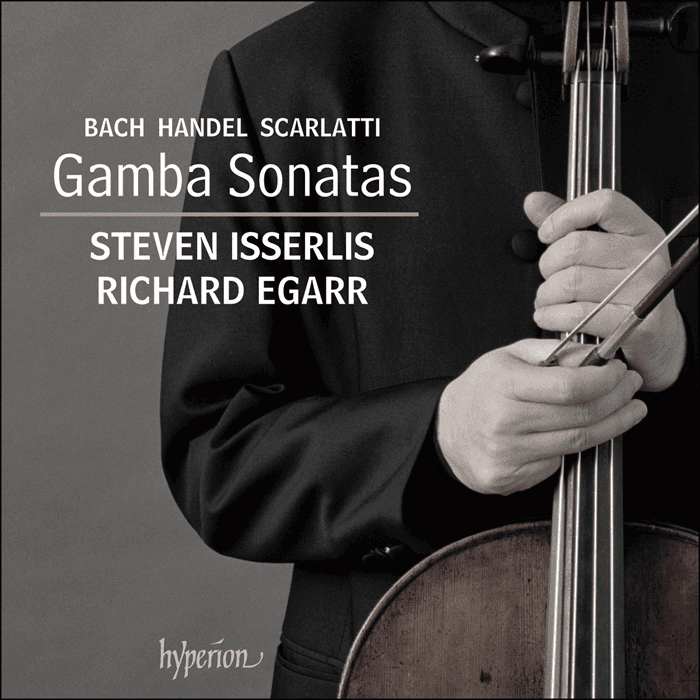
None of these pieces was written for cello and harpsichord, and at no stage does that matter one bit. Bach’s sonatas for viola da gamba and harpsichord may not have been conceived for that combination but they are such sublime creations that the identity of the instruments is perhaps the last thing that should worry us. Rather, it is the performers’ musicianship that counts, and in this case that is of high quality indeed.
Steven Isserlis makes no attempt to make his cello imitate the wispy resonance of the gamba, instead claiming the music for his instrument with vigorously articulated lines, robust technical athleticism and ravishing cantabile. Indeed, it is this wondrous singing quality—which never loses its bearing and employs vibrato only as one of its discreet expressive elements—that stands out in these performances, its presence felt above all in the slow movements, of course, but also constantly governing the sense of line in busier ones. Also telling is the profound awareness of architecture and the inter-relationship of movements, for instance in the gathering joy with which the finale of BWV1027 picks us off the floor following the sudden shaft of desolation that has ended the preceding Andante (astutely likened by Isserlis to ‘Es ist vollbracht’ from the St John Passion). In short, these are full-blooded but sensitive readings which, far from being contrary to Bach’s spirit, seem rather to magnify it.
Isserlis is excellently partnered at every turn by Richard Egarr’s bustling harpsichord-playing, though I would have liked a greater presence for it in the balance to give more definition to the unsupported bass-line. In the two non-Bach items—sonatas probably originally conceived for violin and continuo by Handel and Scarlatti (the latter working up a fiery head)—the balance works better, with Egarr typically inventive and Robin Michael’s lightly drawn doubling of the bass adding just enough weight without drawing attention to itself. Otherwise, they show the same quality in performance as the Bach—namely first-class. (Gramophone)
Suscribirse a:
Entradas (Atom)

-
Music Is The Key will be closing soon. Over the last year maintaining this site and keeping it up to date has become an expensive and tim...

