Mostrando entradas con la etiqueta Herbert Henck. Mostrar todas las entradas

lunes, 23 de septiembre de 2019

Herbert Henck JEAN BARRAQUÉ Sonate pour piano

"Whole slabs of sound crumble and vanish between the all-engulfing ocean of silence, until only the twelve notes of the row remain, and even those are plucked off, one by one." André Hodeir's poetic characterization of Barraqué's Sonate as a work in which music finally loses an heroic battle against encroaching silence is better-known, perhaps, than the piece itself. Barraqué's Sonata has remained one of the toughest pianistic challenges in modern composition, a much-discussed and seldom played piece. With its oblique trajectory and staggered dying fall, its asymmetric and sometimes apparently irrational rhythms, and its buried or "negative" tone-rows, it remains a veritable Matterhorn of abstraction. Only a handful of pianists have faced up to it, among them Yvonne Loriod, Claude Helffer and Roger Woodward – whose 1972 recording of the sonata was considered, for a very long time, to be as far as any interpreter could get with this intentionally recalcitrant, secretive material. Musicologist Richard Toop has drawn attention to Barraqué's sympathy for Debussy's standpoint on the question of musical accessibility: "Music should really have been a hermetic science, hedged around by texts whose interpretation would be so long and difficult as to surely discourage that troop of people who make use of music as nonchalantly as one uses a pocket handkerchief."
"The Sonata defies real analysis,”  Hodeir had insisted in 1961, "It is unclassifiable, incomparable and, to some degree, still incommunicable." And yet even then, a handful of players had a sense of its worth. Composer Bill Hopkins was smitten by the Sonata, and listened to it "repeatedly, intently, with an overwhelming apprehension of living greatness. If music meant anything today, only here was that meaning fully grasped..." Barraqué himself was prepared to wait for these sentiments to be expressed more universally, estimating, in Propos Impromptu, that "it will take fifty years to establish if I am the musician others – including myself – think I am." His early death in 1973, at the age of 45, left his most ambitious undertaking, the sprawling cycle La Mort de Virgile, uncompleted, and deprived him of the opportunity to witness the beginnings of a revival of interest in his work, when the Piano Sonata would repeatedly be compared with the Boulez sonatas and with Beethoven's "Hammerklavier"  sonata op. 106.

martes, 20 de junio de 2017

Herbert Henck CHARLES IVES Piano Sonata No. 2 "Concord, Mass., 1840-1860"

Charles Ives' "Concord" Sonata has come to be recognized as perhaps the greatest of American piano works. Largely composed over the years 1911-1915, it contains some of the most radical experiments in harmony and rhythm of its time. Pianist John Kirkpatrick, long associated with the music of Ives, gave the work its historic first performance at New York's Town Hall on January 20, 1939.
While working on the initial publication of the sonata in 1919, Ives wrote his Essays Before a Sonata, in which he discusses the genesis and content of the work. He described the sonata as his "impression of the spirit of transcendentalism that is associated in the minds of many with Concord, MA, of over a half century ago,...undertaken in impressionistic pictures of [Ralph Waldo] Emerson and [Henry David] Thoreau, a sketch of the Alcotts, and a Scherzo supposed to reflect a lighter quality which is often found in the fantastic side of [Nathaniel] Hawthorne." Ives' interest in American literature, pursued during his student days at Yale, was reawakened by his wife Harmony (whom he married in 1908) and became integral to the sonata.
The monumental, dissonant beginning of the "Emerson" movement creates the impression of a vast struggle. The famous four-note motto from the opening of Beethoven's Fifth Symphony emerges (as it does elsewhere in the work), representing, according to Ives, "the Soul of humanity knocking at the door of the Divine mysteries." Thick, almost orchestral sonorities dominate this longest of the sonata's four movements. Toward the end a viola makes a ghostly two-measure appearance. Ives never felt this movement to be entirely finished; numerous variants exist, and he later created a new work, Four Transcriptions from Emerson, which develops some of its ideas further.
The "Hawthorne" movement acts as a scherzo, with wild flurries of notes, a couple of brief lyrical episodes, and hints of hymn tunes and a country band. At one point, Ives directs the pianist to use a 14 3/4" piece of wood to sound an enormous tone cluster. All this is meant to evoke what the composer called Hawthorne's "wilder, fantastical adventures into the half-childlike, half-fairylike phantasmal realms."
The peaceful third movement, "The Alcotts," serves as a respite. Here Ives meditates on the calm of Concord's streets and the "trials and happiness of the family." Beethoven's Fifth reappears, this time transformed into a nostalgic tune, as Ives imagines one of the Alcotts playing on "the little old spinet-piano Sophia Thoreau gave to the Alcott children."
For the closing "Thoreau" movement, Ives creates a portrait of "an autumn day of Indian summer at Walden." The constant use of the piano's pedals creates an almost impressionistic atmosphere as the slow, enigmatic music unfolds, only raising its voice on a couple of occasions. An ostinato bass line pervades much of the second half of the movement. Thoreau's instrument, the flute, appears briefly with a lyrical melody symbolizing "a mist heard over Walden Pond." The movement ends quietly. (Chris Morrison)

Herbert Henck JOHN CAGE Sonatas and Interludes HERBERT HENCK Festeburger Fantasien

“As well as being a superb technician,” wrote The Guardian last year, “Herbert Henck always puts together his discs with great thoughtfulness.” Viewed collectively, Herbert Henck’s recordings for ECM have added up to portrait gallery of some of the most fiercely independent spirits of 20th century music: the Spanish Mompou, whose “voice of silence” was inspired by St John of the Cross; the Russian Mosolov who found poetry in the hammerings of the iron foundry; the French composer Barraqué, whose massively complex Piano Sonata has defied all but the most gifted contemporary interpreters; the German composer Hans Otte, whose “Das Buch der Klänge” proposed “a new consciousness of sounds”; and, on “Piano Music” a double-portrait of two American mavericks, Conlon Nancarrow and George Antheil, whose music drew influence from early jazz and ragtime and the soundscape of the machine age.
“Locations”, however, gives the most complete indication of Henck’s musical range thus far. Although he is heard once again as a nonpareil interpreter of modern music – turning his attention to that “inventor of genius” (to quote Schoenberg), John Cage – he also appears as a most convincing improviser. And more than this, he shows his listeners how these aspects of his artistry are integrated, and how one impacts upon the other.
Disc One of this 2-CD set is devoted to an impeccable and creative account of John Cage’s seminally important “Sonatas and Interludes for Prepared  Piano”. Written in 1946-48,the “Sonatas and Interludes” revolutionized piano music, in several ways. First of all, there was the transformation of the sound. As “prepared” by Cage, with screws and bolts and erasers, the piano offered a vast range of new timbres, taking on the sonorities of a percussion orchestra – its shimmering gong-like sounds suggested the Gamelan ensembles of Indonesia. The new colours reflected an interest in oriental philosophy and also in what Cage called “considered improvisation”.
“Sonatas and Interludes” remains one of the most attractive of Cage’s early works, its character profoundly meditative. At the time, Cage subscribed to the Indian definition of the purpose of music, “to quiet the mind and render it susceptible to divine influence.” He went further: this music was “an attempt to express the ‘permanent’ emotions of Indian tradition: the heroic, the erotic, the wondrous, the mirthful, sorrow, fear, anger, the odious and their common tendency toward tranquillity.” His work for prepared piano anticipates the music of the music of the Minimalists of two decades later. It is pattern music, gentle pulse music, and it opens doors to music beyond Western art music. At the same time, as Cage scholar Richard Kostelanetz once noted, in its insinuating  prettiness it also has qualities in common with the music of Erik Satie, one of Cage’s formative enthusiasms.
On Disc Two, Henck offers two “freestyle extensions” of his work with composed music. His two sets of “Fantasies” are improvisations taped immediately after his recordings of Cage and of Mompou. Henck: “Though there were some good practical reasons for this, it also released me from the somewhat contradictory undertaking of having to be spontaneous and inventive on command, in other words at fixed times on predetermined days. The improvisatory ‘addenda’ relieved the tension and, in my opinion, benefited the preceding interpretations, with what might be termed the ‘school figures’ being followed by a ‘freestyle’ section offering greater and different freedom.”
Both cycles were recorded in the Evangelische Festeburgkirche in Preungesheim, a district of Frankfurt am Main.
 “The piano preparations were based on the requirements of Cage’s ‘Sonatas and Interludes’, which I had played shortly before. But unlike Cage, who did not use all the keys and also left certain notes unprepared, I wanted to modify the timbre of all the strings. For the higher registers I used screws and bolts of various sizes, for the copper-wound bass strings, mainly small rubber wedges. The metal preparations, which tended to produce sounds ranging from (cow)bell- and xylophone-like chiming to the occasional slight jangling, frequently obscured the original pitches. On the other hand, the rubber preparations inserted close to the end of the strings left the original pitches largely intact, changing only the timbre and duration of the notes. As in Cage, the prepared pitches were microtonally out of tune, producing unexpectedly shimmering, vibrating, sometimes even distinctly pulsating timbres. Even if the tone colours themselves were predetermined, they were not deployed according to a fixed plan; like so much else, they arose in the course of play, out of a sudden idea and spontaneous decision.”
A feature shared by the two series of improvisations is their use of glissando at extremely high speed. This is particularly prominent in the second duo of the first series, which also belongs to a set of glissando studies begun in 1990.
Herbert Henck has been playing improvised music for almost four decades. “Locations” is the first of his ECM recordings to include his improvisations. “I gained access to the field on my own, “ he says in his liner notes, “through the sheer joy of music and my delight in the opportunity to invent piano sonorities and deploy them according to my judgement, not to mention my need to communicate an emotional message in my own artistic medium.” (ECM Records)

Herbert Henck CONLON NANCARROW - GEORGE ANTHEIL Piano Music

As well as being a superb technician, the pianist Herbert Henck always puts together his discs with great thoughtfulness. This brilliantly executed programme of the renegade American composers Conlon Nancarrow and George Antheil may seem an unlikely juxtaposition, but it makes musical sense. ... The sources of Nancarrow’s inspirations are clear – the rhythmic energy and the syncopation come from jazz, while the clarity and the contrapuntal ingenuity stem from neoclassicism in general and Stravinsky in particular. Jazz and Stravinsky had also been the main inspirations of Antheil’s music more than a decade earlier, when this self-styled “bad boy of music” left the US (in 1922) to live in Europe for 11 years, touring as a pianist and scandalising his audiences with his own provocative compositions. At a recital in Paris in 1923, he played his Airplane Sonata, Sonata Sauvage and Mechanisms (all three included here by Henck, alongside the Jazz Sonata, and the Sonatina, of the same vintage, and the Sonatina for radio written six years later). ... The music is still immensely attractive, full of vigour and harmonic daring – some untethered harmonies anticipate the more abandoned moments of Messiaen, other insouciant tunes sound like close cousins of the music of the Parisian Les Six, and yet other works are entirely rhythmic. ... As far as I know, the two composers never met, but had they done so, they would have found they had a lot in common, as Henck so lucidly demonstrates. (Andrew Clements, The Guardian)

lunes, 19 de junio de 2017

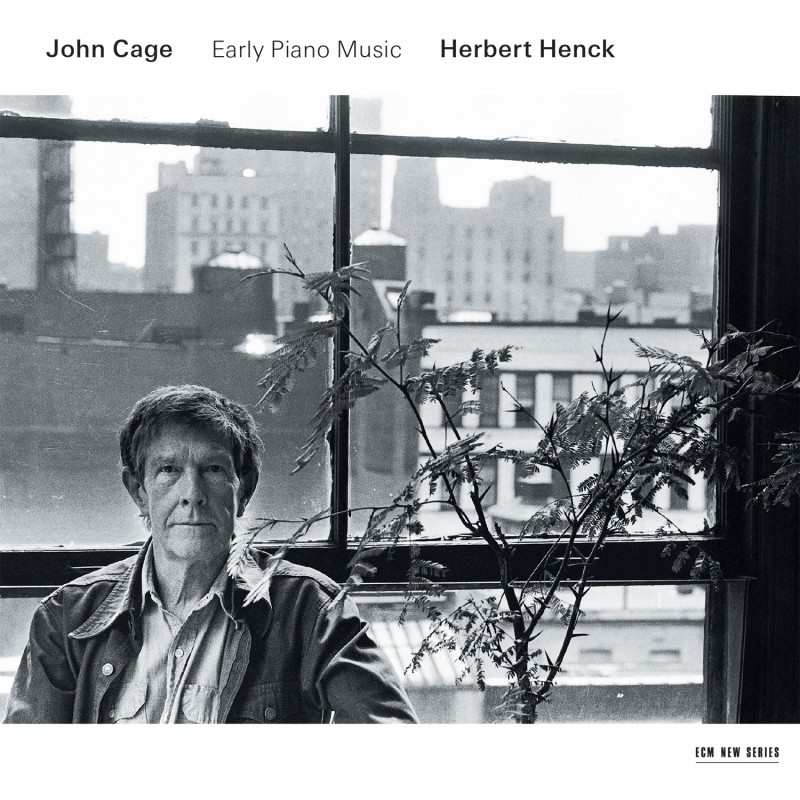
Herbert Henck JOHN CAGE Early Piano Music

A musicologist, announcing his intention to lecture on “John Cage’s style” received from the composer the wry response: “You have a problem. There are so many.”
Few composers can have adopted the mantle of musical pioneer more enthusiastically than Cage. Whenever the “danger” of his music being accepted arose, he at once attempted to take it to the place “where it would not be accepted”, always insisting that his favourite music was the music not yet heard. The main thing was to keep moving. An enfant terrible and finally a père terrible of successive avant-gardes, Cage successively challenged all the parameters of music-making, leaving an often bewildering variety of compositions behind him.
In the last decades of his life – Cage died in 1992 – most critics, and many fellow musicians, had abandoned the attempt to keep pace with John Cage, finding it more convenient to consider him a musical philosopher than to wrestle with the implications of the ever-changing work. It became popular to read Cage in such still-illuminating books as “Silence”, “A Year From Monday”, “M” or “For The Birds”, sooner than listen to him. But re-evaluations are taking place today as time inevitably mutes the revolutionary impact of the work.
Two years ago, ECM New Series issued Herbert Henck’s account of Cage’s “Sonatas and Interludes for Prepared Piano” (1946-8), widely considered to be a benchmark recording of this important work. Now Henck re-examines some of the other inventions of the young Cage, piano pieces written by the American composer between 1935 and 1948.
The oldest of these pieces here is “Quest”, apparently the second half of a two movement work. Along with the early “Two Pieces for Piano” and “Metamorphosis”, this gives us the clearest idea of Cage as a composer still in thrall to the work and ideas of Arnold Schönberg. (The extent of Cage’s studies with Schönberg has never been verified to the satisfaction of music historians, but it seems fairly certain that Cage at least attended Schönberg’s courses at the University of Los Angeles in the summer of 1935, if not the two years of tuition he subsequently claimed.) These are pieces still based on tone-rows.
“Ophelia” (1946) is dedicated to dancer and choreographer Jean Erdman with whom Cage often worked. Henck writes: “Ophelia” is one of Cage’s most sensually appealing piano pieces in every way. Inclining towards the dance style of Jean Erdman, it is often lively with marked rhythms.”
“The Seasons” (1947) gets its second airing on ECM in the Henck piano rendition. The American Composers Orchestra, under the direction of Dennis Russell Davies, previously recorded it – using the orchestral arrangement Cage prepared together with Lou Harrison and Virgil Thomson – on ECM New Series 1696. It’s an important piece, marking the beginning of Cage’s interest in Eastern thought. At the time of its composition, Cage, then 35, was immersing himself in the religious philosophy of both West and East – studying Meister Eckhardt as well as Sri Ramakrishna and Ananada Coomaraswamy and considering the points of contact between the diverse traditions of Christian mysticism, Buddhism and Hinduism (but he was still four years away from his important studies in Zen with D.T. Suzuki). He was also studying Indian music and becoming increasingly convinced that the function of music was – as many Indian philosophers had insisted – “to quiet the mind and render it susceptible to divine influence.”
“In A Landscape” (1948) also makes a second appearance on ECM, having previously been incorporated into Alexei Lubimov’s recital disc “Der Bote”. Since it follows a group of pieces called “Imaginary Landscape” it is highly likely the title is a Cagean pun on “Inner Landscape”.  It was premiered at Black Mountain College in North Carolina where Cage scandalized the faculty by proposing to the students that Satie was a superior composer to Beethoven. The poetic simplicity of Erik Satie was very much on Cage’s mind at the time (the French composer was to be a lifelong influence). Gently undulating, quietly unpredictable, the case can be made that Cage’s “In A Landscape” is a cousin to Satie’s  “Gymnopédies”. It is a highly attractive composition as are all these instances of John Cage’s early piano music. (ECM Records)

Herbert Henck ALEXANDR MOSOLOV

Alexandr Mosolov's reputation in the West rested, until quite recently on a handful of orchestral works, in particular the 1928 Zavod (in English, The Iron Foundry). The piece's hammering rhythms cast the composer as the 'machine music' man, the embodiment of Russian Constructivism. This characterization worked against Mosolov in his own, troubled, lifetime and has continued to obscure the breadth of his music. In fact, Mosolov's compositional output was prolific and diverse as evident in his early works produced during the 1920's which included orchestral works, a symphony, two operas, numerous pieces of chamber music and the Sonatas and Noctures for Piano on this recording. In different ways, these pieces were attempts to bring the industrial soundscape into the concert hall and were received with much controversy. (ECM Records)