Mostrando entradas con la etiqueta WERGO. Mostrar todas las entradas

sábado, 24 de junio de 2017

JOHN CAGE Two4 - TOSHIO HOSOKAWA In die Tiefe der Zeit

The Japanese composer Toshio Hosokawa describes his music as calligraphy with notes in space and time, notes that come from the world of silence and also return to it. He understands his composition "In die Tiefe der Zeit" [Into the Depths of Time] as a mythic soundscape. To the traditional Japanese "paths" of discovering the self, Toshio Hosokawa adds another one: the "path of music".
John Cage, too, decided early on to take the "path of music", and he thoroughly explored non-Western systems of thought and ways of life.

martes, 20 de junio de 2017

PETER RUZICKA Metastrofe - "...fragment..." - Stress - In processo di tempo - Bewegung

German composer of mostly orchestral, chamber, choral, and vocal works that have been performed throughout the world; he is also active as an administrator, conductor and writer. 
Prof. Ruzicka initially studied music theory and piano with Peter Hartmann and oboe with Egbert Gutsch at the Hochschule für Musik und Theater Hamburg from 1963–68. He later studied law and musicology in Munich, Hamburg and Berlin from 1968–76 and earned his doctorate under the supervision of Wilhelm Nordemann in 1977. 
Among his honours are the Kompositionspreis from the city of Stuttgart (1969, for Esta Noche [Trauermusik für die Opfer des Krieges in Vietnam]), a prize in the competition Bartók in Budapest (1970, for 2. Streichquartett, '...Fragment...' [withdrawn]), a mention in the UNESCO International Rostrum of Composers (1971, for Metastrofe [Versuch eines Ausbruchs]), First Prize in the competition of the Internationale Gaudeamus Muziekweek in Amsterdam (1972, for In processo di tempo...), the Bach-Preis der Freien und Hansestadt Hamburg (1972), and the Louis Spohr Musikpreis Braunschweig (2004, for his œuvre and his promotion of new music). He has been a member of the Akademie der Künste in Munich since 1985 and of the Freie Akademie der Künste in Hamburg since 1987. 
As an administrator, he served as artistic director of the Deutsches Symphonie-Orchester Berlin from 1979–87, as director of the Staatsoper Hamburg and the Hamburger Staatsphilharmoniker from 1988–97 and as artistic advisor of the Koninklijk Concertgebouworkest in Amsterdam from 1997–99. He served as artistic director of the Münchener Biennale from 1996–2014, has served as president of the Bayerische Akademie für Theater since 1999 and served as artistic director of the Salzburger Festspiele from 2001–06.

Herbert Henck CHARLES IVES Piano Sonata No. 2 "Concord, Mass., 1840-1860"

Charles Ives' "Concord" Sonata has come to be recognized as perhaps the greatest of American piano works. Largely composed over the years 1911-1915, it contains some of the most radical experiments in harmony and rhythm of its time. Pianist John Kirkpatrick, long associated with the music of Ives, gave the work its historic first performance at New York's Town Hall on January 20, 1939.
While working on the initial publication of the sonata in 1919, Ives wrote his Essays Before a Sonata, in which he discusses the genesis and content of the work. He described the sonata as his "impression of the spirit of transcendentalism that is associated in the minds of many with Concord, MA, of over a half century ago,...undertaken in impressionistic pictures of [Ralph Waldo] Emerson and [Henry David] Thoreau, a sketch of the Alcotts, and a Scherzo supposed to reflect a lighter quality which is often found in the fantastic side of [Nathaniel] Hawthorne." Ives' interest in American literature, pursued during his student days at Yale, was reawakened by his wife Harmony (whom he married in 1908) and became integral to the sonata.
The monumental, dissonant beginning of the "Emerson" movement creates the impression of a vast struggle. The famous four-note motto from the opening of Beethoven's Fifth Symphony emerges (as it does elsewhere in the work), representing, according to Ives, "the Soul of humanity knocking at the door of the Divine mysteries." Thick, almost orchestral sonorities dominate this longest of the sonata's four movements. Toward the end a viola makes a ghostly two-measure appearance. Ives never felt this movement to be entirely finished; numerous variants exist, and he later created a new work, Four Transcriptions from Emerson, which develops some of its ideas further.
The "Hawthorne" movement acts as a scherzo, with wild flurries of notes, a couple of brief lyrical episodes, and hints of hymn tunes and a country band. At one point, Ives directs the pianist to use a 14 3/4" piece of wood to sound an enormous tone cluster. All this is meant to evoke what the composer called Hawthorne's "wilder, fantastical adventures into the half-childlike, half-fairylike phantasmal realms."
The peaceful third movement, "The Alcotts," serves as a respite. Here Ives meditates on the calm of Concord's streets and the "trials and happiness of the family." Beethoven's Fifth reappears, this time transformed into a nostalgic tune, as Ives imagines one of the Alcotts playing on "the little old spinet-piano Sophia Thoreau gave to the Alcott children."
For the closing "Thoreau" movement, Ives creates a portrait of "an autumn day of Indian summer at Walden." The constant use of the piano's pedals creates an almost impressionistic atmosphere as the slow, enigmatic music unfolds, only raising its voice on a couple of occasions. An ostinato bass line pervades much of the second half of the movement. Thoreau's instrument, the flute, appears briefly with a lyrical melody symbolizing "a mist heard over Walden Pond." The movement ends quietly. (Chris Morrison)
miércoles, 19 de abril de 2017

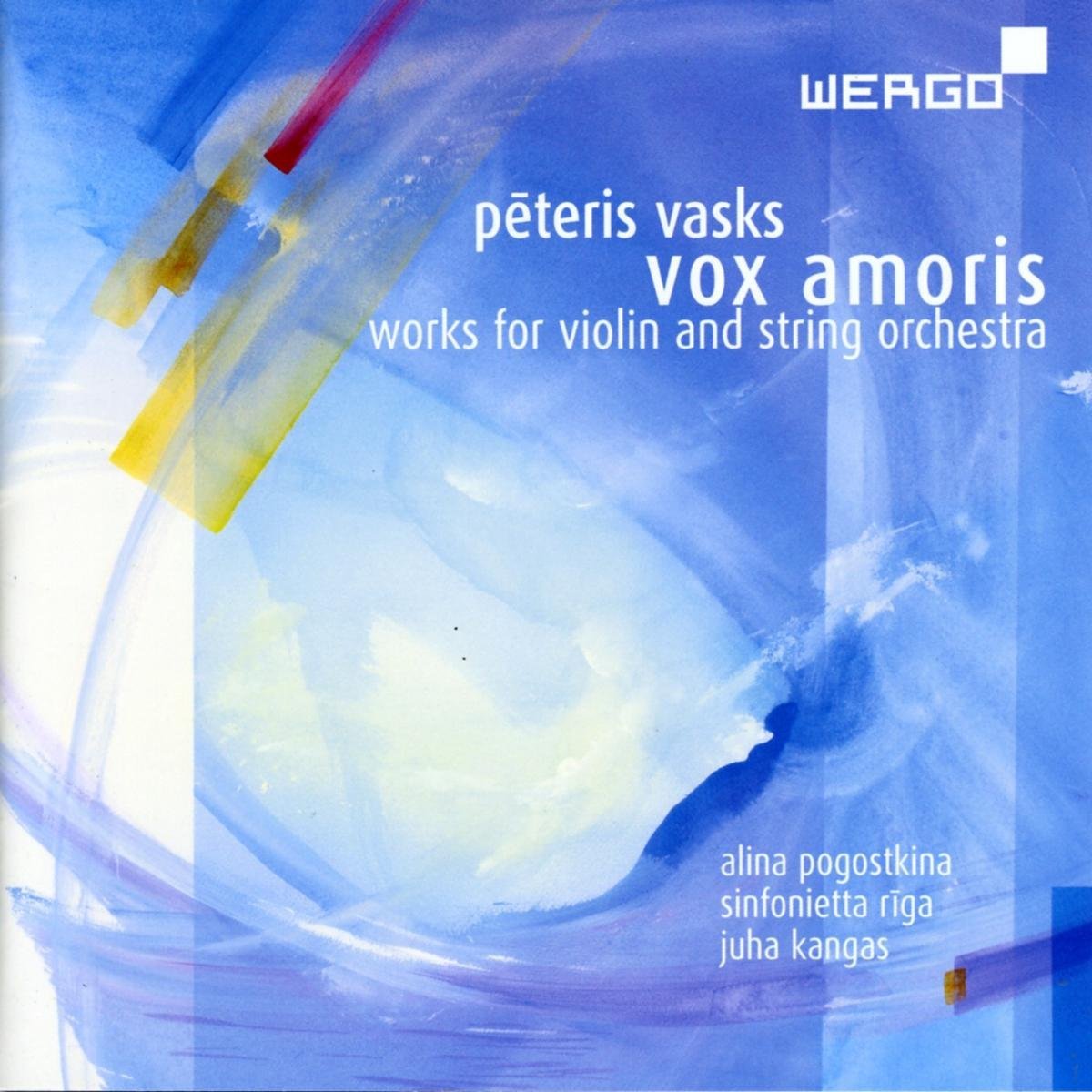
Alina Pogostkina / Sinfonietta Riga / Juha Kangas PETERIS VASKS Vox Amoris

Peteris Vasks' music should be viewed against the socially and politically turbulent history of his home country Latvia. All three pieces, here, according to Vasks, represent the polarity between optimistic hope for a better future and an anxious concern for the modern world.
Regarding the fantasia "Vox Amoris" Vasks said: "It has to do with the strongest force in the world - love. I hope that this piece touches the listener and makes the world a little more friendly and open for love." With the violin, the "voice of love", the listener experiences different sensations from a gentle blossoming to open passion.
1996/97 saw the composition of the concerto "Tala gaisma" (Distant Light", Vasks' first and so far most extensive work for violin and string orchestra. Its form consists of a sequence of strongly contrasting episodes that are partly influenced by Latvian folk music.
Almost ten years later he wrote "Vientulais engelis" (Lonely Angel). During its composition, Vasks had a special image in mind: "I saw an angel, flying over the world; the angel looks at the world's condition with grieving eyes, but an almost imperceptible, loving touch of the angel's wings brings comfort and healing. This piece is my music after the pain."
The pieces are performed by the exceptional violinist Alina Pogostkina, superbly accompanied by the Sinfonietta Riga under the direction of Juha Kangas. "You really have to rhapsodize about Alina Pogostkina: so young, so brilliant, so musical, perfect and at the same time natural." (Süddeutsche Zeitung)

lunes, 10 de agosto de 2015

JONATHAN HARVEY – BEAT FURRER – GEORGES APERGHIS – UNSUK CHIN Sprechgesänge

"Sprechgesänge" – "Speech Songs" run throughout the program of the first CD in the new “edition musikFabrik” on WERGO: Voices try out their instrumental possibilities, and instruments savor their vocal potential.
In his “meditation on the nature of language as sound,” Jonathan Harvey alludes directly to the “inventor” of the Sprechgesang, Arnold Schönberg. Beat Furrer provides the protagonist of Arthur Schnitzler’s "Fräulein Else" with several different “language spaces” – like an encephalogram, he records the oscillations of an interior monologue. Georges Aperghis teaches a clarinet to “babble,” and Unsuk Chin gives an answer to a question from Georges Perec: What might it sound like to throw rotten tomatoes at singers of the species "cantatrix sopranica"? In dreamlike fashion, Chin causes multiple musics of various styles and periods to swirl through one another in a furious piece.
The live recordings document highlights from the concert series "musikFabrik im WDR", with noted soloists such as David Cordier, Salome Kammer and Anu and Piia Komsi, and the conductors Stefan Asbury, Sian Edwards, Beat Furrer and Peter Rundel. Two members of Ensemble musikFabrik, Carl Rosman and Peter Veale, provide evidence of the ensemble’s soloistic qualities. (wergo.de)

miércoles, 22 de abril de 2015

Dominik Susteck ADRIANA HÖLSZKY Wie ein gläsernes meer, mit feuer gemischt...

Adriana Hölszky’s own comments concerning her music reveal her fascinating use of parameters such as “space” and “time”. She prefers to describe her works as individually structured “sound spaces”. There are “expanding and shrinking spaces”, and there are shifts from one sound area to another, which she compares to film editing with its sharp cuts or gentle fades. There are sudden “intrusions” of one sound area into another, and sometimes two or more sound areas are superimposed. Also, the concept of time does not exist for her as a single entity: Temporal processes appear in multiple strands in her music: cosmic time, terrestrial time, and an endless variety of experiential times that permeate one another and are superimposed.
The title of Hölszky’s “apocalyptic” work for organ “... und ich sah wie ein gläsernes Meer, mit Feuer gemischt” [And I saw what looked like a sea of glass mixed with fire] describes extremely contrasting realities: "sea of glass" and "fire". They interact in clear-cut succession; sounds and expressive characters alternate constantly: “From one instant to the next, vivid pictures of light and color alternate with calm and mysterious moments that seem like narrow openings into other dimensions”, explains the composer.
Her work “Efeu und Lichtfeld” [Ivy and Field of Light] also contains a stark contrast within itself. “The worlds of the violin and organ appear to exist independently of one another. The violin figures move like pin pricks in a disconnected and restless fashion, primarily in the extreme upper register of the instrument. The organ sounds are like pulsating sources of light. The multiple meanings of the contrasting sounds arise finally as a consequence of the interaction between gradual transformations of color and discontinuous changes in pulse.” (Hölszky)
In the large four-movement composition “... und wieder Dunkel I” [… And Again Darkness 1] each movement is associated with a fragment from Gottfried Benn’s poem “Ein Wort” [A Word]: The wording of the second verse has been subdivided by Hölszky, and the fragments have each been placed in front of part of her composition.

miércoles, 4 de marzo de 2015

Amy Williams / Helena Bugallo CONLON NANCARROW Studies and Solos

One aspect of the polymorphously polyrhythmic music of Conlon Nancarrow is its lack of practicality in live performance. Nancarrow didn't have, in his time, access to electronics, and as his interest in hearing multiple levels of rhythmic activity increased he turned to the only medium capable of delivering the goods -- the pneumatic technology of the player piano, driven by the "digital software" of a paper roll punched by hand. About the time his work began to gain attention, Nancarrow started to receive commissions for works from real, flesh-and-blood players. One of them, the late pianist Yvar Mikhashoff, created a number of arrangements of Nancarrow's studies for various live ensembles, including a four-hand version of Study No. 15. Duo pianists Helena Bugallo and Amy Williams have taken Mikhashoff's work as the point of departure, resulting in this disc, Conlon Nancarrow: Studies and Solos
Ten of Nancarrow's studies are heard combined with six other works written for human players. Three Two-Part Studies, Prelude, Blues, and Sonatina are early works from the 1930s and '40s, and the Three Canons for Ursula and Tango are late works. The obvious benefit that human intervention brings to the table in these pieces is a sense of touch and expression. Nancarrow's modified player pianos were capable of delivering discretion between soft and loud, but there was little they could achieve in terms of any gradations in between. The Bugallo-Williams Piano Duo demonstrates that there is a lot to experience in Nancarrow's music outside the realm of its pneumatic context. Wergo's recorded sound is excellent, and Bugallo and Williams make Nancarrow's horrendously difficult rhythmic textures seem both natural and non-mechanical. Particularly impressive is their handling of three movements from the "Boogie Woogie Suite," namely Studies No. 3B in C and D; although the original player piano version is very exciting, Bugallo and Williams make it sound like a fractured duet between Art Tatum and Meade Lux Lewis. (Uncle Dave Lewis)

lunes, 1 de diciembre de 2014

JEAN FRANCAIX Concerto pour clavecin et ensemble instrumental - Trio pour violon, violoncelle et piano - Concerto pour guitare et orchestre à cordes

Jean Françaix was born on 23.5.1912 in Le Mans in France. He received his first music lessons at home: his father was a composer and pianist and also director of the Conservatoire and his mother a singing teacher and the founder of a renowned choir. In 1922 at the age of only 10, Françaix received his first tuition in harmony and later also counterpoint from Nadia Boulanger. The young composer wrote his first composition the very same year: a piano piece entitled “Pour Jacqueline”, dedicated to a cousin, which was printed two years later. Encouraged by Maurice Ravel, he continued his studies at the Paris Conservatoire. Alongside his compositional training, Françaix embarked on a career as concert pianist. At the age of 18, he received the first prize in the piano class of Isidore Philipp. Two years later, he represented the young French school of composition together with Claude Delvincourt at the international music festival in Vienna where his Huit Bagatelles were performed. Jean Françaix achieved international success in 1936 with the first performance of his Concertino for piano and orchestra at the chamber music festival in Baden-Baden. During the ensuing years, the composer extended his oeuvre with numerous works in a wide range of genres including operas, ballets, orchestral works and also solo concertos, film music and vocal works. The composer also focused intensively on chamber music. Françaix taught at the Ecole Normale de Musique in Paris from 1959 to 1962. He participated actively in concert life, frequently together with his daughter Claude as partner at the piano, right up to shortly before his death on 25.9.1997 in Paris.

domingo, 30 de noviembre de 2014

Nicolas Hodges ROLF RIEHM Hamamuth – Stadt der Engel / Wer Sind diese kinder

 Both the piano work “Hamamuth – Stadt der Engel”, premiered at the Darmstadt Summer Courses in 2006, and the piano concerto “Wer sind diese Kinder”, premiered at the Donaueschingen Music Festival three years later, are two of the major artistic attempts of the past decades which try to substantially broaden the spectrum of political music.
In “Hamamuth – Stadt der Engel”, the composer Rolf Riehm intends to respond as an artist to the omnipresence of violence experienced during the Iraq War. “This is about prevailing perceptions. 'Stadt der Engel' [City of Angels]: They refer to the pictures of devastation in Iraq which can be regularly seen on TV” – this is the beginning of Riehm's detailed introductory text which is incorporated in the score of the work. In “Wer sind diese Kinder” [Who are these children], this approach is continued.
Both works show that it would be insufficient to look for their political facets exclusively on a semantic level. The physical understanding of music appears to be almost equally important: As a consequence, the political is deeply engrained in the texture of Riehm's works – as a reflection on the omnipresence of international political conflicts and on how to deal with it appropriately. “Hamamuth – Stadt der Engel” and “Wer sind diese Kinder” are examples of how both dimensions are interwoven with each other in Riehm's works in a fascinating way.