
Mostrando entradas con la etiqueta Jos van Immerseel. Mostrar todas las entradas
Mostrando entradas con la etiqueta Jos van Immerseel. Mostrar todas las entradas
martes, 9 de junio de 2020

lunes, 22 de abril de 2019
Jos van Immerseel / Anima Eterna Brugge W.A. MOZART Complete Solo Clavier-Concerte

A reissue with the impact of a new release, that’s what we have in mind for
this wonderful set of hailed recordings of Mozart’s Clavier-Concerte,
recorded in 1990/91 on historical instruments and still sounding as fresh and
beautiful as if we recorded them yesterday!
Anima Eterna Brugge is under the permanent musical direction of Jos van
Immerseel, who has led the orchestra through a carefully guided evolution from
small chamber ensemble to full symphony orchestra. In 1985 he brought six
string players together to study the works of Bach, and two years later the group
was enlarged to a baroque ensemble of seventeen musicians. In 1989 the by now
twenty-five musicians began to work on the Viennese classical repertoire. The
success was expanding and in 1990 the Amsterdam Concertgebouw included
Anima Eterna Brugge in its “World famous Baroque Orchestras” series.
Mozart’s complete concertos for fortepiano formed the focal point of
the next two years, with concert cycles in Kyoto and Tokyo, among other cities,
and this set of 10 compact discs. These recordings received worldwide praise, of
which it will suffice to quote the New York cd review: “No period orchestra has
ever sounded better”.
CD 1 - CD 3
CD 4 - CD 6
CD 7 - CD 8
CD 9 - CD 10
CD 1 - CD 3
CD 4 - CD 6
CD 7 - CD 8
CD 9 - CD 10
martes, 24 de abril de 2018
Anima Eterna Brugge / Jos van Immerseel, BERLIOZ Symphonie Fantastique - Le Carnaval Romain
 Without any prior information, the first thing listeners will notice about Jos van Immerseel's 2008 recording of Hector Berlioz's
Symphonie fantastique is the umistakable period instrumentation, with
the sheen of the strings and the distinctive sound of early 19th century
woodwinds and brass, obvious at the outset. The second thing
discriminating listeners will notice is the great care Immerseel
takes with connecting notes, not only in the straightforward handling
of melodic phrases, but also in linking secondary figures in the
accompaniment, so that this chord progression or that isolated pitch
makes sense within the larger scheme of things. This is where the
performance either rises or falls, depending on what one wants to get
out of this work. To the extent that Berlioz
created Symphonie fantastique to show off his innovative orchestration,
this recording goes as far as any historically informed and scholarly
version to make sure that everything is heard clearly, not merely as
separate sounds, but as integral parts of the greater, kaleidoscopic
whole. Where this rendition might be regarded as a failure is in its
lack of visceral excitement, which seems to be the unintended result of
producing an immaculate-sounding performance. Immerseel
gets astonishing sonorities from the ensemble Anima Eterna Brugge, and
the engineers of Zig Zag Territoires capture them to perfection, but no
one remembered to make the music cook. If Symphonie fantastique is
deprived of its passion, delirium, fury, violence, and horror, it is
merely an exercise in futility. The point of this work and its bizarre
program is to portray the extreme emotional life of its drug-addled
protagonist. Yet because it is played here at somewhat slower tempos
that feel plodding, and with a meticulous precision that seems overly
fussy, it doesn't rush madly, it doesn't whirl feverishly, and it
doesn't fly off its handle, but seems too self-conscious to really let
things rip. The sole exception is the Dream of a Witches' Sabbath,
which is almost as fiendish and hair-raising as one might wish, but
comes much too late to save the performance. Conversely, Le Carnaval
romain is the best selection on the album because it has a wonderful
period sound and is played with the verve and energy missing in the
Symphonie. At points, Immerseel
seems to pull back slightly in his pacing, but these are minor
adjustments for the sake of clarity that don't impede the vitality of
the whole overture, least of all in the final stretch. So if clear
performances of these classics are required, this CD will fill that
need, but for wild and thrilling Romantic music, this recording of
Symphonie fantastique is not a contender. (Blair Sanderson)
Without any prior information, the first thing listeners will notice about Jos van Immerseel's 2008 recording of Hector Berlioz's
Symphonie fantastique is the umistakable period instrumentation, with
the sheen of the strings and the distinctive sound of early 19th century
woodwinds and brass, obvious at the outset. The second thing
discriminating listeners will notice is the great care Immerseel
takes with connecting notes, not only in the straightforward handling
of melodic phrases, but also in linking secondary figures in the
accompaniment, so that this chord progression or that isolated pitch
makes sense within the larger scheme of things. This is where the
performance either rises or falls, depending on what one wants to get
out of this work. To the extent that Berlioz
created Symphonie fantastique to show off his innovative orchestration,
this recording goes as far as any historically informed and scholarly
version to make sure that everything is heard clearly, not merely as
separate sounds, but as integral parts of the greater, kaleidoscopic
whole. Where this rendition might be regarded as a failure is in its
lack of visceral excitement, which seems to be the unintended result of
producing an immaculate-sounding performance. Immerseel
gets astonishing sonorities from the ensemble Anima Eterna Brugge, and
the engineers of Zig Zag Territoires capture them to perfection, but no
one remembered to make the music cook. If Symphonie fantastique is
deprived of its passion, delirium, fury, violence, and horror, it is
merely an exercise in futility. The point of this work and its bizarre
program is to portray the extreme emotional life of its drug-addled
protagonist. Yet because it is played here at somewhat slower tempos
that feel plodding, and with a meticulous precision that seems overly
fussy, it doesn't rush madly, it doesn't whirl feverishly, and it
doesn't fly off its handle, but seems too self-conscious to really let
things rip. The sole exception is the Dream of a Witches' Sabbath,
which is almost as fiendish and hair-raising as one might wish, but
comes much too late to save the performance. Conversely, Le Carnaval
romain is the best selection on the album because it has a wonderful
period sound and is played with the verve and energy missing in the
Symphonie. At points, Immerseel
seems to pull back slightly in his pacing, but these are minor
adjustments for the sake of clarity that don't impede the vitality of
the whole overture, least of all in the final stretch. So if clear
performances of these classics are required, this CD will fill that
need, but for wild and thrilling Romantic music, this recording of
Symphonie fantastique is not a contender. (Blair Sanderson)lunes, 23 de abril de 2018
Anima Eterna Brugge / Jos van Immerseel DEBUSSY Prélude à l'Après-Midi d'un Faune - La Mer - Images
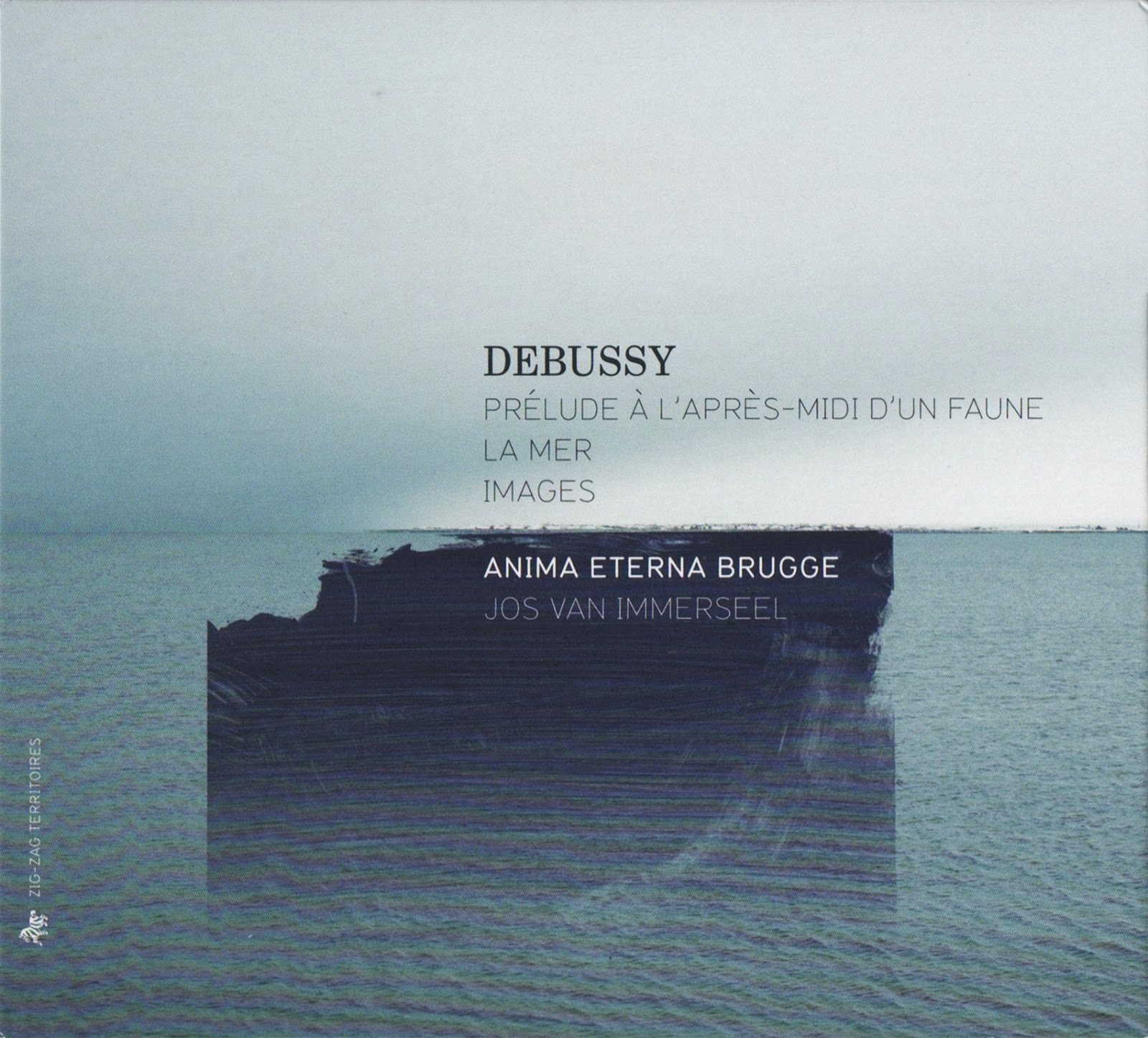 Debussy suddenly seems to be on the front line of the
period-instrument movement's steady advance through music history. This
disc from Jos van Immerseel and his Belgian orchestra arrives just a few
months after Simon
Rattle's London performances of La Mer and Prélude à l'Après-Midi d'un
Faune with the Orchestra of the Age of Enlightenment, and John Eliot Gardiner's Proms account of Pelléas et Mélisande with the Orchestre Révolutionnaire et Romantique. For this recording, Anima Eterna Brugge's
woodwind, brass, percussion and harps were French-made instruments of
Debussy's time; they're generally more abrasive and pungent than their
modern counterparts, and they combine with the gut strings to produce a
more open sound than we are used to today.
Debussy suddenly seems to be on the front line of the
period-instrument movement's steady advance through music history. This
disc from Jos van Immerseel and his Belgian orchestra arrives just a few
months after Simon
Rattle's London performances of La Mer and Prélude à l'Après-Midi d'un
Faune with the Orchestra of the Age of Enlightenment, and John Eliot Gardiner's Proms account of Pelléas et Mélisande with the Orchestre Révolutionnaire et Romantique. For this recording, Anima Eterna Brugge's
woodwind, brass, percussion and harps were French-made instruments of
Debussy's time; they're generally more abrasive and pungent than their
modern counterparts, and they combine with the gut strings to produce a
more open sound than we are used to today.
Van Immerseel's approach can seem a bit too deliberate; there's
something ponderous about Prélude à l'Après-Midi, while in La Mer he
seems determined to emphasise the work's symphonic credentials. In fact,
it's the orchestral Images that gains most from the brighter, rawer
colours of this performance, with the myriad subtleties of Debussy's
scoring more beguiling than ever. Where most conductors make the
three-part Ibéria their centrepiece, with Gigues before it and Rondes de
Printemps as the finale, Van Immerseel begins with Rondes and places
Ibéria last, following the order adopted by Debussy's friend and
assistant André Caplet for performances he conducted after the
composer's death. There's logic to that ordering, for Ibéria is
significantly longer than the other two movements put together, and
makes a substantial finale to the whole sequence; Van Immerseel resists
the temptation to turn it into a real orchestral showpiece, but there's
enough flair and imagination to make his performance compelling. (Andrew Clements / The Guardian)
Chouchane Siranossian / Jos Van Immerseel L'ANGE & LE DIABLE

Jos Van Immerseel returns to
chamber music and the accompaniment of young talents, two absolute
priorities for him. In Chouchane Siranossian he has found a worthy
partner, as gifted on the modern violin as she is on the Baroque
instrument, a pupil of Tibor Varga, then of Zakhar Bron, as well as a
disciple of Reinhard Goebel, whose first recording, on the Oehms label,
attracted great attention (winning a ‘Diapason Découverte’). Here it is
the Baroque violinist who engages in dialogue with the harpsichord of
Jos Van Immerseel in a Franco-Italian program juxtaposing the music of
the ‘Angel’ Leclair and the ‘Devil’ Locatelli, not forgetting Tartini’s
famous ‘Devil’s Trill’ Sonata . . . Indeed, all this music is
‘devilishly’ difficult to
play, but the Franco-Armenian violinist shows perfect mastery of it, combined with great inventiveness.
sábado, 19 de agosto de 2017
Claire Chevallier / Jos van Immerseel DVORÁK - GRIEG - BRAHMS Music for Piano Four Hands

Jos van Immerseel and Claire Chevallier have enjoyed a close
collaboration for many years now. Like Jos van Immerseel, Claire
Chevallier loves period pianos; like him, she is a researcher and
possesses her own collection of keyboard instruments. After its
recordings of works by Saint-Saëns for two pianos and works by
Rachmaninoff for four hands, the duo devotes a programme to the dance
with the famous Hungarian Dances of Johannes Brahms and the no less
celebrated Slavonic Dances of Antonín Dvořák. The much more rarely
played Norwegian Dances of Edvard Grieg complete this trip around
Europe.
A recording made on an authentic Carl Bechstein piano built in Berlin
in 1870, from the personal collection of Jos van Immerseel.
jueves, 15 de junio de 2017
Anima Eterna / Jos van Immerseel LUDWIG VAN BEETHOVEN Symphonies - Ouvertures
 It's
possible nowadays to get a cycle of the Beethoven symphonies to suit
every musical taste - from the traditional big-band performances on the
modern instruments of leading symphony orchestras, to the strictest of
historically informed accounts from specialist period bands. Jos van
Immerseel's accounts are close to the historically purist extreme of
that spectrum; his Belgian orchestra Anima Eterna is modestly sized.
There's much to admire in the performances too. His tempi are generally
well judged, the playing is full of character and instinctive
expressiveness, even if the pitch inflections in some of the woodwind
solos are an acquired taste, and textures are unfailingly transparent.
Yet there's something a bit too careful about it all, with a lack of
sheer emotional clout in, for instance, the first movement of the
Eroica, the finale of the Seventh Symphony, and through much of the
Ninth. This is hardly Beethoven as a composer breaking free of the
bounds of classicism, but much more someone with their feet still very
much anchored in the 18th century. (Andrew Clements / The Guardian)
It's
possible nowadays to get a cycle of the Beethoven symphonies to suit
every musical taste - from the traditional big-band performances on the
modern instruments of leading symphony orchestras, to the strictest of
historically informed accounts from specialist period bands. Jos van
Immerseel's accounts are close to the historically purist extreme of
that spectrum; his Belgian orchestra Anima Eterna is modestly sized.
There's much to admire in the performances too. His tempi are generally
well judged, the playing is full of character and instinctive
expressiveness, even if the pitch inflections in some of the woodwind
solos are an acquired taste, and textures are unfailingly transparent.
Yet there's something a bit too careful about it all, with a lack of
sheer emotional clout in, for instance, the first movement of the
Eroica, the finale of the Seventh Symphony, and through much of the
Ninth. This is hardly Beethoven as a composer breaking free of the
bounds of classicism, but much more someone with their feet still very
much anchored in the 18th century. (Andrew Clements / The Guardian)
Suscribirse a:
Entradas (Atom)

-
Music Is The Key will be closing soon. Over the last year maintaining this site and keeping it up to date has become an expensive and tim...

