
Mostrando entradas con la etiqueta György Kurtág. Mostrar todas las entradas
Mostrando entradas con la etiqueta György Kurtág. Mostrar todas las entradas
viernes, 22 de octubre de 2021

sábado, 21 de noviembre de 2020

miércoles, 14 de octubre de 2020

martes, 1 de septiembre de 2020

lunes, 27 de julio de 2020

lunes, 17 de febrero de 2020

viernes, 24 de mayo de 2019
HEINZ HOLLIGER - GYÖRGY KURTÁG Zwiegespräche

Zwiegespräche
is a meeting of spirits. “We compose the same way,” said György Kurtág
to Heinz Holliger on hearing this recording, which emphasises works for
oboe by these two major composers. Both of them reference the entire
history of music in their pieces, both incorporate dedications and
messages to friends and colleagues in the fabric of their work, and both
draw upon literature as an inspirational source. Both, moreover, love
the miniature as an expressive form; short pieces by Kurtág and Holliger
are interwoven. Holliger’s sequence Airs (2015/6) is inspired by seven texts by Swiss poet Philippe Jaccottet, whose voice is heard here. The release of Zwiegespräche
is timely. Heinz Holliger turns 80 on May 21, his creativity as
composer and his resourcefulness as instrumentalist undimmed. The album
concludes with Holliger’s Sonate für Oboe solo, composed in 1956, and still played by its author with absolute authority.
miércoles, 21 de noviembre de 2018
Ditta Rohmann SOLO CELLO PORTRAIT

Her program gives a selection from about a hundred years of Hungarian cello literature.
I first met Ditta in the student orchestra of the Basel Music Academy. I have been following her career since, as her sound and technique were getting ever richer, and as her unwavering interest in everything important, valuable and special has grown. When I came across musical or technical difficulties that other musicians were unable
to solve, I invited Ditta for concerts and first performances. Now, listening to this recording, I realized that when composing I always hear Ditta’s especially richly textured cello sound in my ears.
(Péter Eötvös)
domingo, 18 de noviembre de 2018
Hélène Desaint / Louis Lortie / Nathanaël Gouin / Ronald van Spaendonck ROBERT SCHUMANN - GYÖRGY KURTÁG
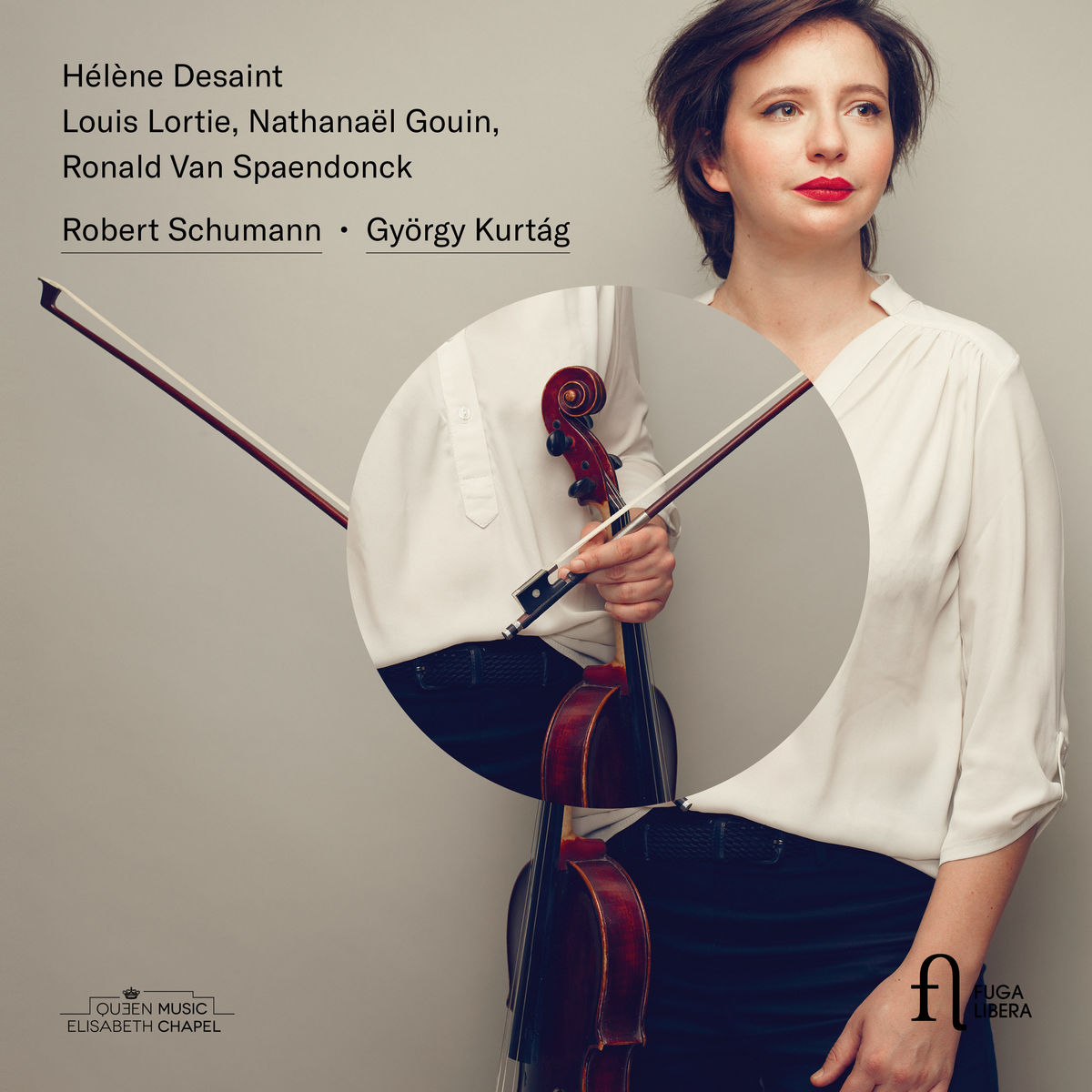
Hélène Desaint, Laureate of the Queen Elisabeth Music Chapel, presents a
recital with two facets that are an admirable illustration of her
personality: ‘This disc was born of my fascination with Schumann.
Everything about him captivates me: the tormented human being, the great
reader fascinated by the fantastical and the supernatural, the
brilliant and introverted composer, the poet who goes where words cannot
go, the music, powerfully evocative at once of human characters or
tableaux and of complex states of mind. In 1990, György Kurtág composed a
trio in homage to Schumann – a way of straddling the centuries and
opening up a dialogue between two styles, of reviving the imaginary
figures and short contrasting forms with which we are familiar in
Schumann. So it seemed an obvious idea to build a programme around these
two composers. The comparison seems all the more interesting to me
because I find in their music the same interiority, the same
concentration (in Kurtág’s work, this density goes so far as to permeate
every note), the same concision.’ (Hélène Dessaint)
martes, 22 de mayo de 2018
Österreichisches Ensemble für Neue Musik / Rüdiger Bohn / Claudia Barainsky GYÖRGY KURTÁG Botschaften des verstorbenen Fräuleins R.V. Trussowa JÖRG WIDMANN … umdüstert …
 In different ways the music of György Kurtág and Jörg Widmann can be described as an individual, productive dialogue with musical stimulations of the past. This is evidenced in Kurtág’s works by the great breadth of musical forms that he references, extending from the traditional triad by way of highly diverse canonic techniques onto the use of noise – mostly articulated in fragment-like miniatures or in cyclical compositions consisting of such miniatures. In contrast, Widmann is gravitated to the musical expressions of Romanticism and tends to connect their possibilities to his personal ways of sound exploration.
Kurtág’s cycle Messages of the Late Miss R.V. Troussova for soprano and chamber orchestra, op. 17 (1976–1980), which treats of the failure of human relations, is based on the poems by the Russian poet Rimma Dalos. In language as grotesque as it is drastic and at the limits of self-respect, it lays out one woman’s ideas about loneliness, exhibitionism, and deprivation.
Widmann focuses on the sculpting of sounds: individual instrumental textures of variable density alternate and thereby initiate a process of slipping in and out of different tonal qualities that grows ever thinner toward the end until it finally dissolves into quiet fragments. The word “umdüstert” occurred frequently in Romantic literature, and this fading out of the composition can certainly be read as an indication of an existential point of reference of the music.
martes, 6 de febrero de 2018
Elina Vähälä / Niek De Groot DUOS FOR VIOLIN AND DOUBLE BASS
 Dutch double bassist Niek de Groot is one of today's
leading soloists. Originally a trumpet-player he started playing the
double-bass at 18. Within an unusually short time he became principal
bass with several European ensembles, including a 10 year tenure as
first solo-bass with the Royal Concertgebouw Orchestra.
Dutch double bassist Niek de Groot is one of today's
leading soloists. Originally a trumpet-player he started playing the
double-bass at 18. Within an unusually short time he became principal
bass with several European ensembles, including a 10 year tenure as
first solo-bass with the Royal Concertgebouw Orchestra.
After his formal studies he further developed his skills at the Banff
Centre for the Arts, Canada. Niek's playing has benefited a great deal
also from attending masterclasses with eminent cellists Frans Helmerson,
Lluìs Claret, Laurence Lesser and in collaborations with Leonard
Bernstein, György Sebök and Mstislav Rostropovich.
Since 2006
Niek de Groot has dedicated himself entirely to chamber music and solo
performances. He performs regularly as a soloist and chamber musician at
the best known concerthalls and music festivals. A new well received
solo CD for NIMBUS was released in 2015. The first volume of the Hoffmeister solo-quartets and Rossini sonatas for BIS-records was released in 2017. The second volume will arrive later in 2018. A new recording with contemporary violin/bass Duos for AUDITE
is on the market since February 2018. His repertoire includes a great
deal of contemporary music and he has worked closely with composers such
as Kurtág, Stockhausen, Saariaho, Vasks and Gubaidulina.
For this recording, Finnish violinist Elina Vähälä and Dutch double
bass player Niek de Groot have chosen and performed seven pieces,
composed by six Europeans and one Korean. When a violin and a double
bass come together, two sound spheres collide: particularly in recent
times, many renowned composers have been inspired to create highly
original realisations of such encounters.
lunes, 31 de julio de 2017
Reinbert de Leeuw / Asko|Schönberg / Netherlands Radio Choir GYÖRGY KURTÁG Complete Works for Ensemble and Choir

Recorded
in Amsterdam’s Musikgebouw and Haarlem’s Philharmonie between March
2013 and July 2016, this 3-CD Set is a milestone in the documentation of
Hungarian composer György Kurtág’s s work and also a labour of love.
It brings together all of Kurtàg’s works for ensemble and for ensemble
and choir. The insightful and precise performances bear witness to
extensive preparation by the dedicated Asko/Schoenberg Ensemble.
Conductor Reinbert de Leeuw speaks of “learning Kurtág’s oeuvre step by
step, and performing these pieces repeatedly over a period of twenty
years.” De Leeuw consulted extensively with György and Márta Kurtág
before and after each session: “There were moments when I was
overwhelmed at first hearing”, says the famously-demanding Kurtág, “and
we could embrace the result immediately. But sometimes we were critical.
The fact that Reinbert always listened to our remarks and re-recorded
fragments or even whole pieces makes this publication authentic.” Works
heard here are presented in chronological order of composition,
beginning with the Four Capriccios (1959-1970, rev. 1993) and continuing with Four Songs to Poems by János Pilinszky (1975), Grabstein für Stephan (1978-79, rev. 1989), Messages of the late Miss R. Troussova (1976-80), …quasi una fantasia… (1987-88), Op. 27 No. 2 Double Concerto (1989-90), Samuel Beckett: What is the Word (1991), Songs of Despair and Sorrow (1980-1994), Songs to Poems by Anna Akhmatova (1997-2008), Colindă-Baladă (2010), and Brefs Messages (2011). Extensive
CD booklet includes all song texts with translations, an interview with
Reinbert de Leeuw, liner notes by Wolfgang Sandner and Paul Griffith,
and a statement by György Kurtág. (ECM Records)
martes, 27 de junio de 2017
Kim Kashkashian / Robert Levin / Eduard Brunner GYÖRGY KURTÁG Hommage à R.Sch. - ROBERT SCHUMANN
 Bartók serves as the link between Schumann and Kurtág: when Kurtág says
'My mother tongue is Bartók, and Bartók's mother tongue was Beethoven'
he is referring to the historically linked musical traditions of Germany
and Austria, which are his special concern. In addition to this general
connection, the works of Kurtág and Schumann reveal astonishing and
fascinating affinities in terms of both literary and musical
references..... --From the CD booklet notes by Hartmut Lück
Bartók serves as the link between Schumann and Kurtág: when Kurtág says
'My mother tongue is Bartók, and Bartók's mother tongue was Beethoven'
he is referring to the historically linked musical traditions of Germany
and Austria, which are his special concern. In addition to this general
connection, the works of Kurtág and Schumann reveal astonishing and
fascinating affinities in terms of both literary and musical
references..... --From the CD booklet notes by Hartmut Lückon Kashkashian: '... the best violist in the world.' --New York Daily News
'Her playing is notable for its songfulness, a weightless soaring that conveys a wealth of emotion.' --Philadelphia Inquirer
Kim Kashkashian / Netherlands Radio Chamber Orchestra / Peter Eötvös BÉLA BARTÓK - PETER EÖTVÖS - GYÖRGY KURTÁG

Typically impassioned, committed performances distinguish Kim
Kashkashian’s New Series recording of music for viola by three great
Hungarian composers. Kashkashian’s intense focus, superb craftsmanship
and explosive virtuosity are brought to bear on Béla Bartók’s final
work, on one of György Kurtág’s early pieces, and on an important new
work written especially for her by Peter Eötvös.
Interconnections between the composers and the interpreter are many.
Something akin to a line of transmission runs from Bartók to Eötvös via
Kurtág. Kurtág has famously said that his “mother tongue is Bartók”, and
his Movement for Viola and Orchestra was directly influenced by
Bartók’s Violin Concerto and Concerto for Orchestra. Peter Eötvös was
born, like Bartók, in Transylvania, befriended Kurtág in Budapest, and
his musical development was decisively influenced by the work of both
composers. “György Kurtág’s music”, Eötvös has noted, “is deeply rooted
in European tradition. The certainty and glowing intensity of his works
remind me of Van Gogh and Dostoyevsky. The increasing success of his
music comes on the one hand from the fact that his powerful, subjective
ability to express himself cannot be pigeonholed in any of the familiar
stylistic movements, and on the other hand, from the fact that his music
has an unusually vital relationship to the living and the dead.” A
similar claim might well be made for the musics of Eötvös himself and
Bartók, in which innovation and respect for the weight of tradition are
keenly balanced.
Kashkashian, who has worked closely with Kurtág, was instrumental in
bringing his music to the New Series and made the premiere recording of
his revised six-part cycle “Jelek” (ECM New Series 1508). She has also
worked under the baton of Eötvös and has, furthermore, been playing the
Bartók Viola Concerto for three decades now. In preparation for the
current project she went back to some of Bartók’s own sources,
“listening to a lot of the Hungarian folk music he collected to study
the articulation of melody, rhythm, phrasing.” (ECM Records)
domingo, 23 de octubre de 2016
Patricia Kopatchinskaja / Saint Paul Chamber Orchestra SCHUBERT Death and the Maiden
 "With the wonderful Saint Paul Chamber Orchestra we are presently
exploring Schubert's quatuor ‘Death and the maiden’. Of course we have
to include Schubert’s earlier song with the same title on the poem of
Matthias Claudius. This song belongs to the medieval tradition of the
dance of death. Therefore we also play "Toden Tanz" (with poor me
dancing), an ancient death dance written up by the German organ player
August Nörmiger (1560-1613). Schubert’s song and the slow movement of
his quatuor use the solemn rhythm of a Pavan, so we also play one of
Dowland’s Pavans from "Seaven Teares". Add to this "Moro lasso" a
madrigal about death by the famous Renaissance composer (and murderer!)
Gesualdo. In between we also refresh our ears with other unsettling
works by modern composers like György Kurtag and Heinz Holliger." (Patricia Kopatchinskaja)
"With the wonderful Saint Paul Chamber Orchestra we are presently
exploring Schubert's quatuor ‘Death and the maiden’. Of course we have
to include Schubert’s earlier song with the same title on the poem of
Matthias Claudius. This song belongs to the medieval tradition of the
dance of death. Therefore we also play "Toden Tanz" (with poor me
dancing), an ancient death dance written up by the German organ player
August Nörmiger (1560-1613). Schubert’s song and the slow movement of
his quatuor use the solemn rhythm of a Pavan, so we also play one of
Dowland’s Pavans from "Seaven Teares". Add to this "Moro lasso" a
madrigal about death by the famous Renaissance composer (and murderer!)
Gesualdo. In between we also refresh our ears with other unsettling
works by modern composers like György Kurtag and Heinz Holliger." (Patricia Kopatchinskaja)jueves, 5 de mayo de 2016
Cuarteto Casals METAMORPHOSIS Bartók - Kurtág - Ligeti
 It is sometimes said that the essence of ‘classical' music lies in the
principle of variation; but when the idea of incessant transformation of
the musical material irrigates scores like these quartets by three
eminent Hungarian composers of the 20th century, the resulting sonic
impressions are very different. The governing principle here is
metamorphosis, an idea as dear to Bartók as it was to the compatriots
who succeeded him.
It is sometimes said that the essence of ‘classical' music lies in the
principle of variation; but when the idea of incessant transformation of
the musical material irrigates scores like these quartets by three
eminent Hungarian composers of the 20th century, the resulting sonic
impressions are very different. The governing principle here is
metamorphosis, an idea as dear to Bartók as it was to the compatriots
who succeeded him.
“The Bartok Fourth Quartet receives a
relatively 'classical', even cool account - not as relentlessly
hard-driven as some other recent accounts of the piece but in itself
perfectly valid (and certainly not as exhausting). On the technical
elevel, it is practically perfect.” International Record Review, October 2010
“Bartók's piece has perhaps the most unsettling opening of any string quartet – a discomfiting premonition of the technical challenges ahead, from the furtive prestissimo to the biting pizzicatos of the allegretto, all navigated with sensitivity to the changing moodscape by the Quarteto Casals” The Independent, 30th July 2010
“Cuarteto Casals hold their big-boned, heart-on-sleeve sound in reserve for much of this disc, unleashing it only in the brutal blur of the second movement of Métamorphoses nocturnes.” The Independent on Sunday, 3rd October 2010
viernes, 8 de mayo de 2015
Tamsin Waley-Cohen SOLI Works for Solo Violin by BARTÓK, PENDERECKI, BENJAMIN, CARTER & KURTÁG

There is nothing like the experience of being completely alone on stage, just with my violin. It is the ultimate soul-baring communion both with myself and with the audience. And it is no coincidence that many of the works written for solo violin explore the depths of our shared human experience through this intense medium.
For musicians, composers and performers alike, sound is our medium. Through sound we must express everything we wish to communicate. The works on this disc take the violin to its expressive limits. The technical demands on the performer are always in the service of heightened expression, whether of ecstasy, pain, doubt, loneliness, desperation, or acceptance and peace. For me, this is at the heart of why I play the violin, and why I play music, to explore our inner life through the language of sound.
Each composer on this disc displays a great depth of knowledge and understanding of the instrument, not only how it can be played, but of how natural resonances interact, uniting or jarring or distorting, often using the open strings as building blocks. Although there are moments when the writing is at the edge of what is playable, it is always possible, and the struggle can even add to the content.
The recording process was extraordinarily intense, not only because I was alone in the hall. The emotional rawness of the material took its toll each day, so in the evening, to play a Kurtag miniature was a wonderful balm.I would like to say an enormous thank you to Nick Parker and Mike Hatch who produced and engineered this disc, and for the invaluable support they gave during the recording sessions. (Tamsin Waley-Cohen)
jueves, 5 de marzo de 2015
GYÖRGY KURTÁG Signs, Games and Messages
 Years have passed since György Kurtág’s last ECM recording, which
incorporated his “Jatékok (Games)” and “Bach Transcriptions”, made with
Kurtág and wife Márta playing piano together.
Years have passed since György Kurtág’s last ECM recording, which
incorporated his “Jatékok (Games)” and “Bach Transcriptions”, made with
Kurtág and wife Márta playing piano together.The birth of this newest album has been an arduous one, with the composer intensely and meticulously involved at every step of the way. And if “Games” are at the centre of this recording, too, they are often life-and-death games - echoing the endgame humours of Samuel Beckett’s universe and the anguish of Hölderlin - in a programme in which two song cycles are bridged by the “Signs, Games and Messages” for strings. (As England’s The Independent has observed, “György Kurtág never writes a note lacking musical intent, and never writes a note with which he has not lived and suffered.”) “Kurtág’s described all three cycles as “Works In Progress” and their formal boundaries are particularly fluid, even within the context of an oeuvre in which labyrinths of connecting threads (musical, literary, philosophical, epistolary) have become the norm.
Kurtág has consistently revised these works, reordered the movements, added new movements, set others aside, both for concert performances and in the realization of this album. Although “Signs, Games and Messages” includes among its numerous dedicatees an “Hommage à John Cage”, the tight control that Kurtág exerts over every grain of sound, every gesture, sigh and silence, makes his work the converse of “indeterminate”. And yet the way the pieces move, as chains of interlinked miniatures (only one of the 59 tracks here has a duration of more than three minutes), conveys a sense of living tissue as well as an “improvisational” freshness. “A whole world of expression and suggestion” is indeed “packed into these exquisite, crystalline forms” (The Guardian). (ECM Records)
miércoles, 16 de abril de 2014
Kim Kashkashian KURTÁG / LIGETI Music for Viola
 György Kurtág (b. 1926) and György Ligeti (1923-2006) were friends,
for more than sixty years. “For a long time, a lifetime, Ligeti led me
onward,” said Kurtág. “I followed him—sometimes right behind him and
other times years or even decades later. I call it my ‘Imitatio Christi’
syndrome. The first years of our friendship were marked not only by his
intellectual leadership. I oriented my taste according to his example.”
György Kurtág (b. 1926) and György Ligeti (1923-2006) were friends,
for more than sixty years. “For a long time, a lifetime, Ligeti led me
onward,” said Kurtág. “I followed him—sometimes right behind him and
other times years or even decades later. I call it my ‘Imitatio Christi’
syndrome. The first years of our friendship were marked not only by his
intellectual leadership. I oriented my taste according to his example.”
Yet how different are their respective oeuvres: Ligeti vastly
prolific, Kurtág parsimonious in his productions, strongly
self-critical, determined to justify every note (“Every tone has to be
deserved”). For parallel artistic allies one might have to look beyond
music: to literature perhaps, to Joyce’s cascading riverrun of language
and Beckett grimly squeezing drops of inspiration from a dry sponge.
Kurtág and Ligeti had a similar aesthetic relationship: sharing a
nationality – and a “mother tongue” in Bartók – their contrasting
temperaments took them to different places. Ligeti’s frame of reference
can be encyclopaedic, in the space of a single composition alluding to
higher mathematics and folk dance and welcoming any resultant
“strangeness”, Kurtág always more aphoristic, cryptic, terse, has built a
halting language out of miniatures, works which seem to take on a new
intensity when sequenced. His works can be quietly eruptive: Peter
Eötvös once referred to Kurtág as “a very shy volcano”, a
characterization that catches both the charm and force of his work.
György Ligeti appreciated the dark sounds of the viola, in his
introduction to the Sonata he wrote, “The viola is seemingly just a big
violin but tuned a fifth lower. In reality the two instruments are
worlds apart. They both have three strings in common, the A, D and G
string. The high E-string lends the violin a powerful luminosity and
metallic penetrating tone which is missing in the viola. The violin
leads, the viola remains in the shadow. In return the low C-string gives
the viola a unique acerbity, compact, somewhat hoarse, with an
aftertaste of wood, earth and tannic acid.”
The present album, recorded at the Propstei St Gerold in May 2011, finds Kashkashian exploring and contrasting the solo viola works of Kurtág and Ligeti. Kaskashian and producer Manfred Eicher determined the dramaturgical sequence of the present version of “Signs, Games and Messages” which leads naturally toward the Ligeti Sonata. Sandner: “In Kashkashian’s scrupulous reading, the Kurtág pieces and the movements of Ligeti’s Viola Sonata seem like the work of a single visionary artist”.
The present album, recorded at the Propstei St Gerold in May 2011, finds Kashkashian exploring and contrasting the solo viola works of Kurtág and Ligeti. Kaskashian and producer Manfred Eicher determined the dramaturgical sequence of the present version of “Signs, Games and Messages” which leads naturally toward the Ligeti Sonata. Sandner: “In Kashkashian’s scrupulous reading, the Kurtág pieces and the movements of Ligeti’s Viola Sonata seem like the work of a single visionary artist”.
Suscribirse a:
Entradas (Atom)

-
Music Is The Key will be closing soon. Over the last year maintaining this site and keeping it up to date has become an expensive and tim...

