jueves, 11 de septiembre de 2014

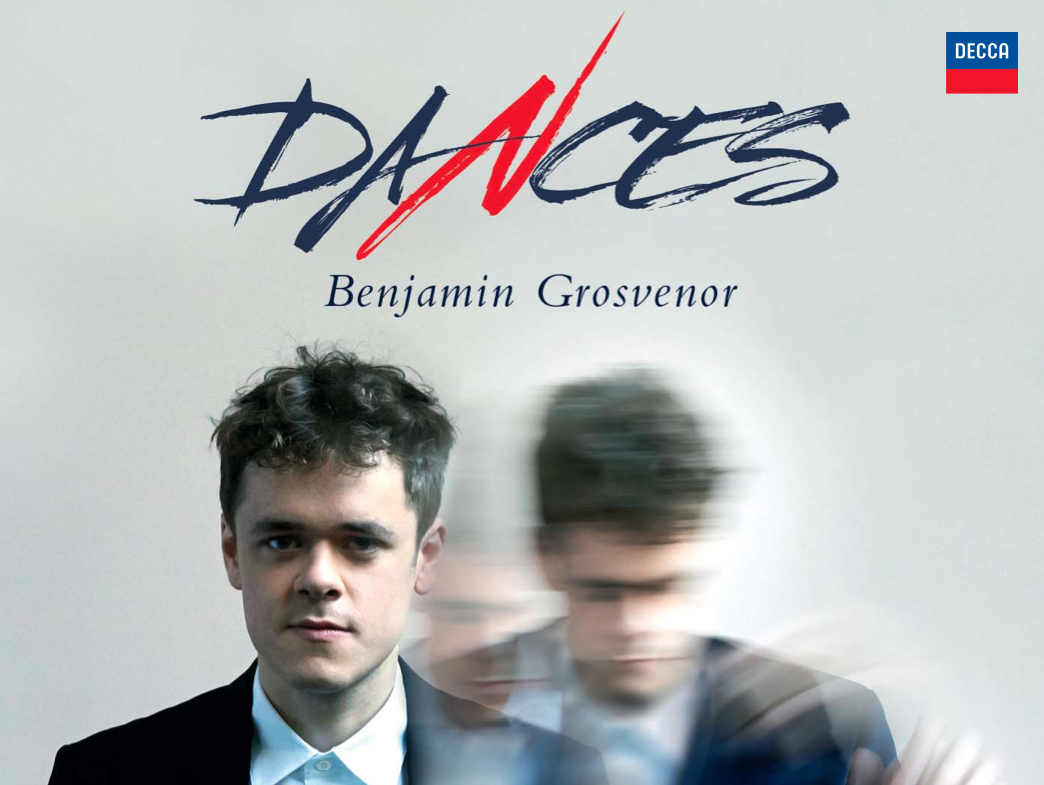
Benjamin Grosvenor DANCES


Benjamin Grosvenor’s selection, simply entitled ‘Dances’, is lovingly planned rather than random. Ranging from Bach to Morton Gould, there are subtle reminders that, even if Chopin does not follow Bach ‘as the night the day’, you still recall Chopin’s love of Bach. Early Scriabin remembers Chopin, his Mazurkas written long before he developed or regressed into an obsessive mysticism. Chopin, too, was central to Granados’s inspiration (his Escenas románticas end with a graceful bow and tribute to Chopin called ‘Spianato’). Finally, the Schulz-Evler Arabesques on The Blue Danube, the Albeniz-Godowsky Tango and Morton Gould’s Boogie Woogie Etude – a free blossoming into a glorious liberation.
Having recently celebrated a disc largely devoted to one of Janáček’s darkest utterances, it is with a spirit of uplift that I now find myself listening to performances that are carried forwards on an irresistible tide of youthful exuberance. With no need of the international competition circuit to lift or lower his career, Grosvenor bypasses that ever-controversial arena to give performance after performance of a surpassing brilliance and character. However hard the slog in the practice room (such dazzle and re creation result from intense discipline), there is a sense of joyful release, of music-making free from all constraint.
Grosvenor’s Bach (the Fourth Partita, the most substantial item on the disc) is a vivid contradiction of a quaint, long-held view that Bach was essentially an academic, once unaffectionately known as ‘the old wig’, who provided useful contrapuntal fodder for exams. Such views long ago toppled into absurdity and like, say, Schiff and Perahia (though with an entirely fresh stance of his own), Grosvenor gives us Bach, our timeless contemporary. What drama and vitality he finds as he launches the Overture, what a spring – even swagger – in his step in the Courante, what unflagging but unforced brio in the final Gigue. And then you remember his Sarabande, where his pace and energy are resolved in a ‘still small voice of calm’. Dry-as-dusts may rattle their sabres but, like Horowitz, who confounded the pundits with his crystalline Scarlatti, Grosvenor creates his own authenticity, revelling in music of an eternal ebullience and inwardness, and erasing all notion of faceless sobriety.
This is followed by a wide but relevant leap to Chopin. The Op 22 Grande Polonaise may pay tribute to Chopin’s early concert-hall glitter (his opening salvo in the Etudes, Op 10, is a reworking of Bach’s first Prelude, also in C major, from his ‘48’) but even here Chopin can reflect his cherished memories. Grosvenor keeps everything smartly on the move (he is the least sentimental of pianists), spinning the composer’s vocal line in the introductory Andante spianato with rare translucency and with decorations cascading like stardust. There is never a question of attention-seeking, of ‘what can I do with this?’. Such things have no place in Grosvenor’s lexicon and everything is as natural as breathing. Textures, too, are as light as air, after a commanding summons to the dance floor, and both here and in the more mature Op 44 Polonaise there is an almost skittish erasing of all possible opacity. Again, detail is as acute as ever, with flashing octaves complemented by a magically sensitive central Mazurka and a sinister close, suggesting a dark undertow to Chopin’s all-Polish defiance (for Schumann the Polonaises were ‘cannons buried in flowers’).
Three Scriabin Mazurkas from his Op 3 remember Chopin with their characteristic major-minor alternations, the Sixth with its gazelle-like leaps followed by the Fourth and Ninth, alive with an already distinctive voice. In Grosvenor’s hands the A flat Valse becomes one of Scriabin’s most intoxicating creations and so, too, do Granados’s Valses poéticos. And while there is nothing so specific as the above-mentioned term ‘spianato’, there is still a sense of a distant relation to Chopin.
Finally, the Schulz-Evler Arabesques on The Blue Danube, once described as ‘sending fabulous spangles of sound spinning through the air’ in its introduction, followed by Grosvenor’s seemingly inborn elegance and sophistication in the waltz proper. The Albeniz-Godowsky Tango may be less sultry and insinuating than some (I have Cherkassky’s winking and teasing magic in mind) but Grosvenor’s cooler view is exquisite in its own entirely personal way. Then on to a fizzing finish in Morton Gould’s Boogie-Woogie Etude, and a headlong charge with still enough colour and variety to bring even the most staid audience to its feet.
Benjamin Grosvenor may well be the most remarkable young pianist of our time. And for him, choosing from his already extensive repertoire music for future recordings will surely be a labour of love. Decca’s sound is excellent and this is a disc to prompt wonder and delight in equal measure.(Gramophone)

martes, 9 de septiembre de 2014

Gerald Finley / Thomas Sanderling SHOSTAKOVICH Six Romances on Verses by English Poets - Scottish Ballade - Suite on Poems by Michelangelo


Shostakovich’s songs continue to lag behind the rest of his output in terms of their representation on recordings and in concert, and the language barrier is clearly a prime reason. Getting over that barrier is fraught with complications, however, starting with the fact that Shostakovich himself was always more interested in the ethical content of his texts than in their poetic quality. No linguist or literary scholar himself, he was also far from a purist when it came to performances in non-Russian-speaking countries.
So there is much to be said for Gerald Finley’s reinstating of the original English-language texts of Six Romances on verses by Raleigh, Burns and Shakespeare, and his going back to the original Italian for the Michelangelo sonnets. That entails a few – though remarkably few – necessary adjustments to the composer’s rhythms. For the Suite the idea is not new. Fischer-Dieskau recorded the sonnets that way in 1987 (in the piano version with Aribert Reimann); hence Ondine’s description, ‘world premiere recording of the Italian version’, is not strictly speaking accurate. I’m not sure anyone can claim precedence for the Op 62 cycle but here again Ondine’s claim to world premiere status for the ‘orchestral version’ is shaky, given that Safiulin and Rozhdestvensky were there in 1986 (the two-CD reissue has admittedly eluded my searches but a reliable owner-friend has confirmed that it contains the Op 62a full orchestral version rather than the more commonly heard rescoring for chamber orchestra, Op 140).
With the performances themselves, things are much more straightforward. Finley and Sanderling are compelling advocates, and their subtlety makes for a refreshing change from the more stentorian delivery of certain old Soviet counterparts. For the Russian texts and vocal timbres, Sulejmanov on Capriccio and Leiferkus on DG are reliable back-ups. But this new disc has to be applauded for its initiative, as also for its top-notch sound quality; and given that the Safiulin and Fischer-Dieskau alternatives are practically unobtainable, anyone interested in acquiring it should not hesitate.(Gramophone)

domingo, 7 de septiembre de 2014

Gustavo Dudamel / Berliner Philharmoniker RICHARD STRAUSS Also Sprach Zarathustra (reuploaded)


Richard Strauss’s association with the Berlin Philharmonic lasted for over half a century.
The orchestra was formed in 1882 by an independent group of musicians and first played one of Strauss’s works in 1887, when Karl Klindworth conducted the 23-year-old composer’s F minor Symphony, a work which, dark and resplendent in its colouring, lacks the individuality of the Munich composer’s later output. If the performance proved only tolerably successful, the fact that it took place at all at such an early stage of Strauss’s career is remarkable. During the first three years of the orchestra’s existence, when its subscription concerts were conducted by Franz Wüllner, there were still no works by Strauss that the orchestra could have performed; and, by the time that such works did exist, Wüllner was already in Cologne, where he gave the world premieres of Till Eulenspiegel and Don Quixote with his Gürzenich Orchestra. In Berlin, meanwhile, Hans von Bülow had taken charge of the orchestra’s fortunes. He knew Strauss from Meiningen, acknowledging him as a “first-rate” conductor and an “exceptional musician” who had it in him “to assume the highest position of command with immediate effect”. And so Strauss was invited to conduct the Berlin Philharmonic. The concert agent Hermann Wolff, who was the orchestra’s éminence grise, even helped to sponsor Strauss’s appearance with the aid of an exceptional travel allowance – even as a young composer Strauss already enjoyed a certain cachet.
At his first concert with the Berlin Philharmonic on 23 January 1888 Strauss conducted his own symphonic fantasy Aus Italien. Press and public and, not least, Bülow were impressed by the atmospheric work, and Strauss was no less enthusiastic about the orchestra, describing the players in a letter to his father as “the most intelligent, fantastic and alert orchestra I know”. But there were also disagreements: in 1890, for example, Bülow refused to allow Strauss to conduct the local premiere of Don Juan and insisted on conducting it himself, comprehensively ruining it in the eyes of the mortified composer. Even so, this did not discourage Strauss, who, having fallen in love with the city, was determined to find a permanent position there, either with the Berlin Philharmonic or at the Lindenoper.
An opportunity arose in March 1894 after Bülow, already terminally ill, gave his final concert with the orchestra. Since Wolff was unable to find an eminent successor, he turned to the 30-year-old Strauss, who took over the orchestra’s ten subscription concerts during the 1894–95 season and suffered the worst fiasco of his career.
The devastating reviews took issue not only with his uninspiring appearance on the podium but also with his programmes: as was later to be the case with his own Berlin Tonkünstler Orchestra and the Lindenoper’s Königliche Hofkapelle, he conducted an above-average number of contemporary works that proved indigestible fare for the capital’s conservative middle-class audiences.
The contract was torn up prematurely, although contact between the two parties was not lost altogether. In 1908 they even undertook a triumphant concert tour of France, Spain and Portugal together. But by then Germany’s greatest living composer no longer needed to prove himself in Berlin, for he was now an internationally sought-after conductor and his symphonic poems were a regular part of the repertory. The Berlin Philharmonic’s principal conductors during this time – Arthur Nikisch and, from 1922, Wilhelm Furtwängler – were both important advocates of his work. (Furtwängler made his debut with the orchestra in 1917 conducting Don Juan.)
When Strauss moved to Vienna in 1919, his Berlin appearances became increasingly infrequent. Even so, the 1920s witnessed the premieres of two of his works in Berlin: his Hölderlin Hymns in 1921 and his symphonic studies Panathenäenzug in 1928. He himself returned to the Philharmonie podium in March 1933, and in the November of that year he shared the conducting duties with Furtwängler at a gala concert marking the launch of the Reich Culture Chamber. His dubious association with the Nazis culminated in 1936 with the first performance of his Olympic Hymn. His final concert with the orchestra took
place in April 1939, when the programme comprised Don Juan, the Symphonia domestica and the Burlesque for piano and orchestra.
The Strauss Memorial Concert in September
1949 was conducted by Sergiu Celibidache. During the decades that followed, Berlin’s Strauss tradition was shaped by Herbert von Karajan, whose recordings of this repertory continue to be regarded as benchmark performances.
But many of the visiting conductors who have had particularly close links to the Berlin Philharmonic have also privileged Strauss’s works in their programmes, most recently Gustavo Dudamel.
Dudamel was 22 when he first conducted
the music of Richard Strauss: Don Juan
with the Philharmonia Orchestra in London.
Since then, he has championed many of
Strauss’s songs, symphonic poems and concertos, including the Oboe Concerto
with the Berlin Philharmonic’s principal oboist, Albrecht Mayer. With the Simón Bolívar Symphony Orchestra, he has toured South and North America, as well as Europe, with Don Juan,
Till Eulenspiegel and the Alpine Symphony, taking the entire Venezuelan orchestra up into the Swiss mountains before the latter’s performance so that they could collectively experience the atmosphere and majesty of nature which Strauss had rendered into music.
In April and May 2012 Gustavo Dudamel conducted three performances of Also sprach Zarathustra in the Berlin Philharmonie, followed by four Berlin performances of Don Juan and 
Till Eulenspiegel in early 2013. The present release is his first audio recording with the orchestra.

sábado, 6 de septiembre de 2014

Anja Lechner / François Couturier KOMITAS - GURDJIEFF - MOMPOU Moderato Cantabile


After a decade of shared work in the Tarkovsky Quartet and an ongoing alliance in the Pergolesi Project (with singer Maria Pia De Vito), German cellist Anja Lechner and French pianist François Couturier unveil their new duo. The players approach the music from different vantage points: Lechner is a classical soloist with an uncommon interest in improvisation, Couturier a jazz musician travelling ever further from jazz. On Moderato cantabile they present their own arrangements of works by three fascinating outsiders from the margins of music history – G.I. Gurdjieff, Komitas, and Federico Mompou. To differing degree their music reveals influences from the east, both in terms of relationship to folk traditions and religious music, and philosophically. A contemplative air pervades the session. The programme has connections to Anja Lechner’s acclaimed account of Gurdjieff’s music on the earlier Chants, Hymns and Dances (with Vassilis Tsabropoulos), but the new duo has its own identity, and time spent in Armenia has deepened Lechner’s understanding of the contexts from which the music emerged: her cello assumes almost a singer’s role in these pieces, exploring the strong melodies. François Couturier’s compositions function as both contrasting and complementary elements. As a player, François has a long history of working with Mompou’s music. He has been influenced, furthermore, by his association with Anouar Brahem, and the sonorities of the Middle East are part of his palette. Moderato cantabile, a striking and unusual album, was recorded in the rich acoustics of the Lugano studio in November 2013 and produced by Manfred Eicher.
Franҫois Couturier is featured here both as player and composer and his pieces function as both contrasting and complementary elements. As the liner notes point out, “Years spent in the company of Tunisian oud master Anouar Brahem seem to have reinforced a contemplative element in Couturier’s own idiom as player, composer, arranger. A reflective patience is characteristic of much of his work. In his music, with or without a score, themes tend to be slowly unfolded and developed. His compositions are ‘evolutionary’, open to change in the moment, and his improvisations maintain a lyrical awareness and sense of form. Unlike many improvising contemporaries he is unafraid to broach the brink of silence – making him perhaps a natural interpreter for Mompou’s Música Callada.” Couturier has previously played arrangements of Mompou in jazz piano trio contexts, and the Catalan composer has been an important reference for him, just as the Transcaucasian Gurdjieff and the Armenian Komitas Vardapet have been important references for Lechner. The cellist first came to understand Komitas’s role in bridging Armenian secular and sacred music though her work with Tigran Mansurian. Her interpretations of Gurdjieff, meanwhile, had a powerful impact in Armenia, and inspired the foundation of the Gurdjieff Folk Instruments Ensemble. Once again on Moderato cantabile Lechner and Couturier, with their new arrangements of Komitas, Gurdjieff and Mompou, show us that this music responds to a freely interpretative approach. Moderato cantabile was recorded in the rich acoustics of Lugano’s Auditorio Radiotelevisione svizzera in November 2013, and produced by Manfred Eicher. Anja Lechner, born in Kassel, Germany, studied with Heinrich Schiff and Janos Starker. She has performed as soloist with orchestras including the Amsterdam Sinfonietta, the Armenian Philharmonic Orchestra, the Slowakische Philharmonie, and the Tallinn Chamber Orchestra, and plays chamber music with partners including pianists Alexei Lubimov, Silke Avenhaus and Kirill Gerstein, cellist Agnès Vesterman, violinist Patricia Kopatchinskaja, and clarinetist Reto Bieri. Lechner has premiered compositions by Tigran Mansurian, Valentin Silvestrov, Tõnu Kõrvits and Annette Focks amongst others. For 18 years she was the cellist of the Rosamunde Quartet, whose acclaimed ECM New Series albums embraced a scope of music from Joseph Haydn to Thomas Larcher. Her most recent recordings include Mansurian’s Quasi Parlando and Double Concerto with the Amsterdam Sinfonietta. In preparation is an album of solos and duos with Agnès Vesterman, playing compositions of Silvestrov. At home in all aspects of classical music, she is also fluent in diverse improvisational traditions, and has a long-running collaboration with bandoneonist Dino Saluzzi – documented in the film El Encuentro and on albums including Ojos Negros and Navidad de Los Andes. François Couturier began playing piano at the age of six. After completing studies in classical music and musicology in the early 1970s, he began improvising in earnest, initially taking his cue from Paul Bley, Chick Corea and Joachim Kühn. In 1980 he won France’s Prix Django Reinhardt which raised his international profile, and shortly thereafter joined John McLaughlin’s group, touring and recording with the English guitarist. Couturier’s first appearance on ECM was on Anouar Brahem’s Khomsa in 1994. From 2001, he toured widely with the oud player in trio with accordionist Jean-Louis Matinier, and is featured on the albums Le pas du chat noir and Voyage de Sahar. He also appears on Brahem’s forthcoming album Souvenance: Music for oud, quartet and string orchestra. His recordings with Anja Lechner include Nostalghia – Song for Tarkovsky and Tarkovsky Quartet which incorporate his compositions as well as group improvising. Il Pergolese features his arrangements of music of Giovanni Battista Pergolesi. Other Couturier recordings on ECM are Poros, duets with violinist Dominique Pifarély, and the solo piano album Un jour si blanc.

viernes, 5 de septiembre de 2014

Cuarteto Casals WOLFGANG AMADEUS MOZART String Quartets dedicated to Joseph Haydn


No one could accuse the Cuarteto Casals of being reticent in these three of the six quartets that Mozart dedicated to Haydn, the works in G: K387, E flat K428 and C K465. They launch into every movement with tremendous relish, on such a tide of rich, deep string tone that they could be playing Brahms or Dvořák, and it comes with equally full-blooded, expressive inflections. It is very involving to begin with, as such musical generosity draws you into the performance – welcomes you almost. But after a while it all seems a bit too obvious and generalised. The habit of shaping every phrase the same way, so that each of them is turned into a crescendo, which can be heard right from the outset in the opening movement of K387, starts to be fussy, while the scoops and touches of portamento seem to belong to a different style of performance altogether. The musicality and warmth of the playing are never in doubt; it's just that the Casals' approach perhaps doesn't suit Mozart as well as it might later composers.(Andrew Clements)

jueves, 4 de septiembre de 2014

Michala Petri / Chen Yue DIALOGUE East Meets West


Our Recordings' Dialogue: East Meets West features an unusual collaboration on a unique combination of instruments as Danish recorder virtuoso Michala Petri joins Chen Yue, a Chinese virtuoso on the Chinese xiao and dizi, both flutes, although the xiao is end-blown, whereas the dizi is more like a transverse flute; they are likewise made of different kinds of bamboo. As literature for this particular instrumental combination has been heretofore nonexistent, Petri and Chen have commissioned 10 pieces for the album, 5 each from Danish composers and Chinese composers. They have obtained a very interesting slate of results; in some cases the Chinese composers have turned up pieces, such as in Ruomei Chen's Jue, that are a tad more readily recognizable with avant-garde styles than the Danish ones, making clear that in China experimental composition has a bit more cachet and perceived freshness than in the West, where it is seen in some circles as being a little played out. Not so Mette Nielsen, whose lovely Stream incorporates well-adjudged elements of improvisation, whereas Chinese composer Li Rui's Peng Zhuang and Siqin Chaoketu's Yan Gui are strongly rooted in traditional Chinese folk idioms; Butterfly-Rain by Pernille Louise Sejlund is a beautiful wash of flute texture that has a programmatic sense of organization and belongs to neither side of the divide; this and the Chaoketu are obvious highlights. 
There are no other instruments used than those played by Petri and Chen; no piano accompaniment, traditional Chinese instrumental group, use of percussion, or anything else. As a result, Dialogue: East Meets West is a bit of a tightrope walk -- the high-pitched instrument players are on their own in putting across the entire 68-minute disc. And for that it never gets boring, although one may want to listen to Dialogue: East Meets West in two halves in order to ingest it more easily. One thing that is striking about the music of Harry Partch is that he built his own instruments and devised his own harmonic building blocks, and therefore created a kind of music from scratch that has no easy reference to other kinds of music. Petri and Chen have done much the same thing here; after awhile one moves away from the idea that these instruments are members of the flute family and into an area of listening that is of its own character and consisting of relatively light, distinctly feminine qualities. Dialogue: East Meets West is a disc that definitely rewards repeated exposure as details gradually reveal themselves, and while the composer commissions provide variety, there is no one piece that dominates the whole puzzle; it is a singular and pleasant, but by no means altogether unchallenging, musical journey that is an ideal offering for taking in the season of spring. (Uncle Dave Lewis)

martes, 2 de septiembre de 2014

Sergey Khachatryan / Kurt Masur / Orchestre National de France SHOSTAKOVICH Violin Concertos


It's probably unfair to compare Sergey Khachatryan's 2006 recording of Shostakovich's violin concertos accompanied by Kurt Masur leading the Orchestre National de France with David Oistrakh's classic recordings of the works: the 1956 Mitropoulos/New York Philharmonic First and the 1967 Kondrashin/ Moscow Philharmonic Second. Not only was Oistrakh the dedicatee for both works, he was far and away the greatest of Soviet violinists, and his virile, soulful, impassioned, and supremely virtuosic interpretations have an authenticity and immediacy that no subsequent violinist has yet touched. But although Khachatryan, like every other violinist who's ever played the works, can't really compare with Oistrakh, how does he compare with the other mere mortals who've taken on the works? In a word: okay -- not great, certainly, but okay. It's not his technique -- as his First Concerto cadenza amply demonstrates, the young Armenian is surely in the same league as the best of his contemporaries in sheer bravura virtuosity -- and it's not entirely his interpretations -- he seems to grasp the First's heart of darkness and expresses it with sympathy and compassion. It's that Khachatryan's interpretation of the Second has nowhere near the same depth of understanding as his First. Admittedly, the Second is a much more enigmatic work than the First, but Khachatryan seems unable to fathom its tone and the result is a performance that stands back too far from the piece to make a persuasive case for it. Masur's proficient but not especially insightful conducting and the Orchestre National de France's professional but inspired playing aren't much help to Khachatryan. In the end, they're are performances worth hearing from a violinist worth listening to -- but they're no match for Oistrakh's. Naïve's sound, while close and clean, lacks warmth and presence.
(James Leonard)