jueves, 3 de agosto de 2017

Martha Argerich / Daniel Barenboim MOZART - SCHUBERT - STRAVINSKY Piano Duos

It wasn’t really hype that dictated the word “super” precede the already luminous word “star” in this world. Meaningful distinctions must be made after all. Fame is one thing. Transcendent fame – or fame compounded by transcendent ability – is quite another.
Here are two of the great living superstars of classical piano completely living up to their transcendent reputations in performance together. Add to this live recording of their magnificent two-piano event from Berlin in April some priceless biographical information: that in 1949, a 7-year-old Daniel Barenboim and an 8-year-old Martha Argerich began their lives as piano prodigies in Buenos Aires.
“We sight-read and played with whoever was in town” Barenboim said. “We were two little wunderkinder” Argerich said. “We played children’s games under the table. I used to hide but he would find me.”
Here, then, from 60 years later is a virtuoso piano reunion to end virtuoso piano reunions – four-handed music by Mozart, Schubert and Stravinsky, played by a duo that hadn’t concertized together since the 1980s. Some were played on two pianos (Mozart, Stravinsky), Schubert was played by four hands on one piano.
Works performed are Mozart’s D-major sonata for two pianos K.448, Schubert’s Variations on an Original Theme in A-Flat major D. 813 and Stravinsky’s own arrangement for two pianists of “Le Sacre Du Printemps.”
All of which is performed on the kind of level that gives virtuosity a good name, no matter what peevish puritanism one might bring to the conversation. The piece that may well make this disc an enduring classic in two-piano performance is their searing pyrotechnic performance of Stravinsky’s two-piano arrangement of his “Le Sacre du Printemps.”
The composer once, famously, played it privately with Claude Debussy at the other piano. In this performance, the often astounding Argerich is playing the piece for the first time.
The result, incredibly then, is a level of performance which Barenboim claims left him “flabbergasted.”
You can take that and pass it around. I doubt strongly we’ll ever again hear the likes of this performance of Stravinsky’s two-piano version of “Le Sacre” in our time.
One of the year’s great classical discs. (Jeff Simon)

miércoles, 2 de agosto de 2017

Iñaki Etxepare BACH Y EL MAR - Cello Suites in Hondarribia

BACH. The meaning in German is brook. However he never reached the sea, he spent his life in just 100 km in the neighborhood of the cities Eisenach, Köthen, and Leipzig... know through the suites, the landscape, the customs and the people from the Bahia Txingudi in Euskadi, we want to take that Bach to the sea, being contemporary dance the visual support of that drop which makes the journey of the water cycle...

Creativity is one of the greatest expressions for finding that a town is alive. In this project that we show it, we create a legacy for the future, where the musical expression of the XVIII century is blend in our city Hondarribia with the natural environment, human, gastronomic, social, historical and landscaping of hte XXI century. The images that we can see create an historical archive that nowadays we can live and feel in this land, and with this, we can share it through the time with new technology to all the world. The proposal of Iñaki Etxepare create a musical journey through the water that cyclically is renewed, that creativity is near from us, and it is expanding artistically in all the world, to our land and to all the people who lives here.
The Hondarribia's wall open his doors to all those people who want to feel and to live some days or all his life in Hondarribia, a place with a lot of material to perceive the creativity that involves us every day, it is no far away, the mind and the soul of the human beings are alive in our days.
Enjoy Hondarribia! (Aitor Kerejeta)

Philippe Jaroussky / Emöke Baráth MONTEVERDI - SARTORIO - ROSSI La Storia di Orfeo

With Philippe Jaroussky’s new album, Storia di Orfeo, the French countertenor realises a long-held dream: to portray the mythic Orpheus – divine musician who ventures into the underworld to retrieve his beloved wife Eurydice from the clutches of death – in his many guises, an inspiration for the very first opera and beyond.
“This project, which was inspired by three key 17th-century operas, was conceived as a kind of opera in miniature or as a cantata for two solo voices and chorus, and features just two characters: Orpheus and Eurydice,” explains Jaroussky. “The three operas focus on different aspects of the story: Sartorio and Rossi depict the happiness of the young lovers and the scene in which Eurydice is bitten by the snake; Monteverdi, on the other hand, concentrates more on Orpheus’ search for Eurydice in the underworld, and the highpoint of his work is an aria that has remained without parallel in the history of opera: the magical ‘Possente spirto’, which I have the temerity to perform here as a countertenor, for the first time on record.” 
He is joined by sublime soprano Emőke Baráth and period-instrument ensemble par excellence I Barocchisti with Diego Fasolis at the helm. A journey to the beginnings of opera, to the Italian Baroque, to the underworld and back. (Warner Classics)

Orpheus, with or without his lute, is one of the most resonant figures in musical history, the inspiration for dramas from Monteverdi to Birtwistle. This cleverly assembled disc limits itself to the 17th century, and ranges from the Mantuan Orfeo of 1607 through to Antonio Sartorio’s little-known successor of 1672. The presiding genius is countertenor Philippe Jaroussky who sings gloriously (though he is arguably not best suited to Monteverdi’s high tenor hero in his lavish Possente spirto). Jaroussky is well matched by Emöke Baráth’s crystal-clear soprano. Sartorio’s post-Cavalli idiom is sweetly melodic; I was much more taken by the strong, eloquent extracts from Luigi Rossi’s Orfeo of 1647. (The Guardian)

martes, 1 de agosto de 2017

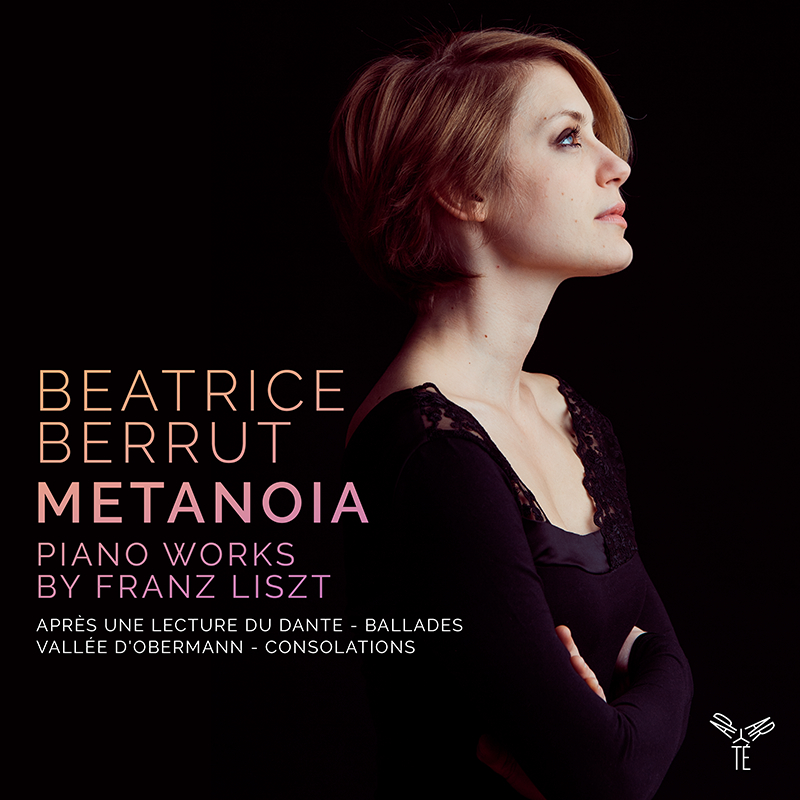
Beatrice Berrut METANOIA Piano Works by FRANZ LISZT

The Swiss concert pianist and Bösendorfer Artist Beatrice Berrut is presenting her newest album Metanoia, with selected pieces by Franz Liszt. Immerse yourself in the mystic sound universe of the Hungarian composer and genius and discover moments of virtuosity, human vulnerability and spiritual inspiration.

Music as healing, music as consolation, and also suffering as a direct inspiration of the act of creating music: at no time has this been more apparent than in the Romantic era, with composers such as Liszt, one of the most contradictory individuals of that period.
The first part of his life was devoted to triumphant tours to every corner of Europe, where he astonished and delighted audiences with his solo “recitals”, for which he composed strong, characterful, virtuosic works displaying his amazing abilities as a pianist. Later his life became more obscure, more visionary, opening the way for atonality, and finally leading him to adopt the Franciscan habit (his “mantle of renunciation”) and withdraw far from the worldly salons that had brought him fame in his youth. His life, with its shift from the glory of playing before aristocratic audiences to years punctuated by spiritual retreats behind the walls of a monastery, may be seen as an illustration of metanoia. In his life as in his work, Liszt managed to reconcile the extremes, thereby awakening archetypes that are rooted in the human subconscious: his music always represents a stylised struggle between good and evil, light and darkness. His writing, which may at times be described as Manichean, nevertheless explores all the pains and joys that a human soul can experience and creates an unbreakable thread between feelings that are very remote from each other. Thus he is in accord with the Jungian concept of healing, in that he “legitimises” and unifies those contradictions by assuming and exalting them. And indeed, what would joy be without sorrow?

Iñaki Etxepare / Marta Roma SAMUEL MAYNEZ Huapango

It seems that the word huapango comes from the náhuatl cuauhpanco that literally means over the wood platform; or, it could be a deformation of the word fandango that refers to the parties in which is played the huasteco son. 
There are opportunities on life which arise daily, weekly, monthly, yearly... and some just for once. The journey of life takes an artist to unknown places and triggers many circumstances that compose an artist’s path ful lling his life as well as his art... A few years ago some of Samuel Maynez ́s manuscripts came to our hands during a Cello pedagogy course in Mexico D.C. Back in Europe, we very much liked those manuscripts and we asked Samuel to keep on sending us his music. It was the beginning of a bounding and exciting musical relationship. 
When performing his music, both in Europe and Mexico, we had a great feedback from the audience. People were smiling after the concerts and that encouraged us to play and share Maynez’s music. The idea of recording a CD came to us naturally and we decided to include the music score in the CD and let fellow cello players know and play it themselves. Luckily for us we had the pleasure to count on Marta’s brother, Guillem Roma’s and Montse Bover’s great work on a video clip which completes the audio and the 12 piece’s music sheet print out. Again the circumstances are making this project to be a non stop creative process because while editing the CD that you’re holding now we are receiving more music by Maynez which will sure provide us with the need of sharing it with you in a near future. We hope you enjoy it! And see you next time... (Iñaki Etxepare & Marta Roma)

Joanna Klisowska / Giulio Tampalini CASTELNUOVO-TEDESCO The Divan of Moses Ibn Ezra

Mario Castelnuovo-Tedesco (1895-1968) wrote his song cycle “The Divan of Moses Ibn Ezra” in the last years of his life, a work of reflection on the human condition. Moses Ibn Ezra (1055-1138) was a Jewish poet who took refuge in Spain after the conquest of his land by the Berber Almoravids, an obvious and deep inspiration for the Jew Castelnuovo-Tedesco who experienced the same fate of exile when moving in 1939 to the USA, fleeing the Nazi threat.
The song cycle “Divan of Moses Ibn Ezra” is in English, a translation of the original Hebrew poetry. The work is divided in 5 parts, and describes the stages of human life and its fate: “Songs of Wandering”, “Songs of Friendship”, “Wine and the delights of Sons of Men”, “the World and its Vicissitudes” and “the Transience of the World”. The musical tone is elegiac, sometimes melancholy, a bittersweet reflection on a long life full of glory and despair.
A beautiful interpretation by soprano Joanna Klisowska, specialist in Early Music and 20th century repertoire, and master guitarist Giulio Tampalini.
The booklet contains excellent liner notes written by the famous composer Angelo Gilardino, in both English and Italian.

Collegium 1704 / Collegium Vocale 1704 / Václav Luks JAN DISMAS ZELENKA Responsoria pro hebdomada sancta - Lamentatio Ieremiae Prophetae

The music here was written for performance during Holy Week at the splendid Catholic court of Dresden in 1722. The example of Dresden stirred Johann Sebastian Bach to some of his most Italianate flights of opera-like music, and the composer of the Holy Week responsories heard here, the Bohemian-born Jan Dismas Zelenka (whom Bach himself admired), had an experimental, progressive spirit in much of his music. All the more of a surprise, then, to find that these pieces are written in an almost antique style. Each of the three Matins services is divided into three Nocturns, each of which is provided with three pairs of readings or lessons (given in chant) and three responsories, polyphonically set for a small choir (the two-singers-to-a-part forces heard here were apparently typical), with orchestral strings mostly doubling the vocal lines. The first of these is replaced here by one of Zelenka's settings of the Lamentations of Jeremiah, ZWV 53, a magnificent solo cantata for bass. After that, the entire two CDs' worth of music consists of the alternation between chant and chorus. The interest of the music, low-key indeed compared with something like the St. Matthew Passion but still displaying considerable skill and emotion, lies in the variety Zelenka achieves within this rather strict framework. The choral sections consist of similar elements: homophonic declamation, slow free polyphony, fugal passages, perhaps a short passage for solo voices. But each one has its own structure and flavor, evolving along with the story they tell. The Czech historical-performance groups Collegium 1704 and Collegium Vocale 1704 under Václav Luks do very well here, with a warmly blended yet precise sound from the singers that fits the music very well. This is not the place to start with Zelenka's choral music; one place might be the odd I Penitenti al Sepolchro del Redentore, ZWV 63. But it's a beautiful performance that will impress the composer's growing legion of fans. (James Manheim)