viernes, 20 de abril de 2018

Jean-Efflam Bavouzet HAYDN Piano Sonatas, Vol. 5

With the appearance of the fifth volume of his Haydn keyboard sonata survey, Jean-Efflam Bavouzet has now covered 22 sonatas (plus the F minor Variations), which by my reckoning means he’s about a third of the way through the entire cycle. It’s not unfair to say that when he completes it it’s likely to be a modern benchmark in this music. He’s already been hailed as a worthy successor to Alfred Brendel (Stephen Plaistow on Vol 3 – 12/11): high praise indeed, and well-earned as he journeys through these endlessly fascinating works. While perhaps often hidden from view to a greater extent than Haydn’s symphonies or quartets, they are nevertheless a never-quite-private diary of some of his most brilliant harmonic, rhythmic and metric jeux d’esprit.
Bavouzet continues to demonstrate his deep engagement with the sonatas through his ever-questing insistence on viewing the score merely as a working document, altering (as well as ornamenting) repeats, omitting codas and codettas on the first pass, and taking considered and personal decisions on tempo, dynamics, phrasing and so on. His thorough (and thoroughly absorbing) booklet-notes spell all this out and recount his first read-through of the Minuet of the A major Sonata, No 12. Mesmerised by the chromaticism of the Trio’s minor-key passage, he played it over and over, ever more slowly, eventually arriving at a tempo unsustainable within the context of the movement. He includes that experiment as an envoi to the disc, bringing to mind a parallel, perhaps, with the Nachtmusik at the centre of Symphony No 4 but introducing a remarkable, almost impressionistic haze to its undulating dissonances and, in so doing, reminding us again how much more there is to this music than we hear in those straight-backed, schoolmarmish performances we so often suffer from other quarters. (David Threasher / Gramophone)

Jean-Efflam Bavouzet HAYDN Piano Sonatas, Vol. 4

Christa Landon’s numbering of the sonatas to 62 in the Wiener Urtext edition is followed, though Georg Feder (The New Grove), who post-dates her, believes that only 47 can be fully authenticated – including the three early works on this disc. None contains dynamic markings, suggesting that they were written for harpsichord or clavichord. Jean-Efflam Bavouzet is right in not attempting to imitate these instruments but doesn’t always seek out the full potential of the music. Whereas Tzimon Barto shapes the first movement of No 38 (HobXVI/23) to explore its harmonic tensions and uncomfortable conflicts, Bavouzet offers an effortless flow of notes. Continue into the Adagio and here there is a greater awareness of its depths, not however repeated in the opening movement of No 30 (HobXVI/19). Nonchalantly too quick for Moderato, Bavouzet minimises melodic detail and understates cutting modulations; in the succeeding Andante, played Allegretto, he subdues Haydn’s adventurous use of both clefs for concertino-ripieno effects. Yet, in another change of outlook, he senses the drama surging through No 40, which bodes well for the F minor Variations (HobXVII/6).
And Bavouzet doesn’t disappoint. He leans towards passion, hewing close to Andreas Staier; but melancholy also surfaces through rubato, embellished repeats, control of line, pace and dynamics. Most thoughtfully, Bavouzet, like Staier, incorporates bars 146-150, a coda or bridge that is so often omitted, and adds an unpublished shorter version of the work too. This is a performance of stature with not a trace of the slick superficiality that mars matters elsewhere. (Nalen Anthoni / Gramophone)

Jean-Efflam Bavouzet HAYDN Piano Sonatas, Vol. 3

If, like me, you have been badly missing Alfred Brendel in Haydn since his retirement, let us celebrate a special moment: Volume 3 of Jean-Efflam Bavouzet’s Haydn project establishes him as a worthy successor. And better still, its scope is ambitious and is going to include many more sonatas than Brendel recorded, with each instalment arriving over the years, Bavouzet tells us, ‘like a postcard, despatched during my travels with scant respect for chronological considerations, but undertaken with the greatest passion for trying to convey to 21st-century ears the boundless treasures of this sublime music’.
I am out of sorts with the fortepiano at the moment, while admitting that this in-between instrument now has some fine practitioners. No, bring Haydn out from under the bell-jar and let him resound on the modern instrument. Nothing less, to my mind, is adequate for the C minor Sonata (HobXVI/20), which takes an honoured place here as the inspiration, indeed the fount, of classical piano sonatas in C minor to come – think of Mozart’s, Beethoven’s Op 10 No 1 and Schubert’s – as well as being one of Haydn’s best and perhaps also the first great sonata for the piano by anybody. Nothing of the interesting precursor about it in Bavouzet’s vividly characterised performance, which comes across as properly monumental and weighs in at nearly 26 minutes.
As before in the series, the linked questions of repeats and ornamentation have much occupied him. In his answers he has shown the courage of his convictions, and I have been delighted, as I hope others will be, not so much by the quantity of his decoration in ‘second’ repeats – which is not contentious – but by his much bolder decision to save the codettas (ie final bars) of some movements for second repeats only. In the finale of the C minor Sonata he is bolder still, taking his cue from Haydn’s unusual form-building and the high drama of the piano-writing: if I itemise his interpolation, at one unexpected point, of an unconventional cadenza that includes allusions to the previous movements, I’m sure I must anticipate some people’s concerned reaction. You can’t do that sort of thing in Haydn, can you? Yes you can, and perhaps you should. Do please listen to him.
The other three sonatas here are similarly characteristic, if lighter, and they leap off the page with Bavouzet’s touch and insights. The one in E flat numbered 45 by Hoboken is from 1766 and of an exceptional breadth and expressiveness for that time; brilliance and difficulty as well. The D major Sonata (HobXVI/14) is probably earlier still, with a concentrated finale that plays wittily with silence and a five-note motif that together form a five-bar phrase. Who else but Haydn could have written that?
Lovely sound, deriving from a Yamaha piano and sessions at Potton Hall in Suffolk in May this year. (Stephen Plaistow / Gramophone)

jueves, 19 de abril de 2018

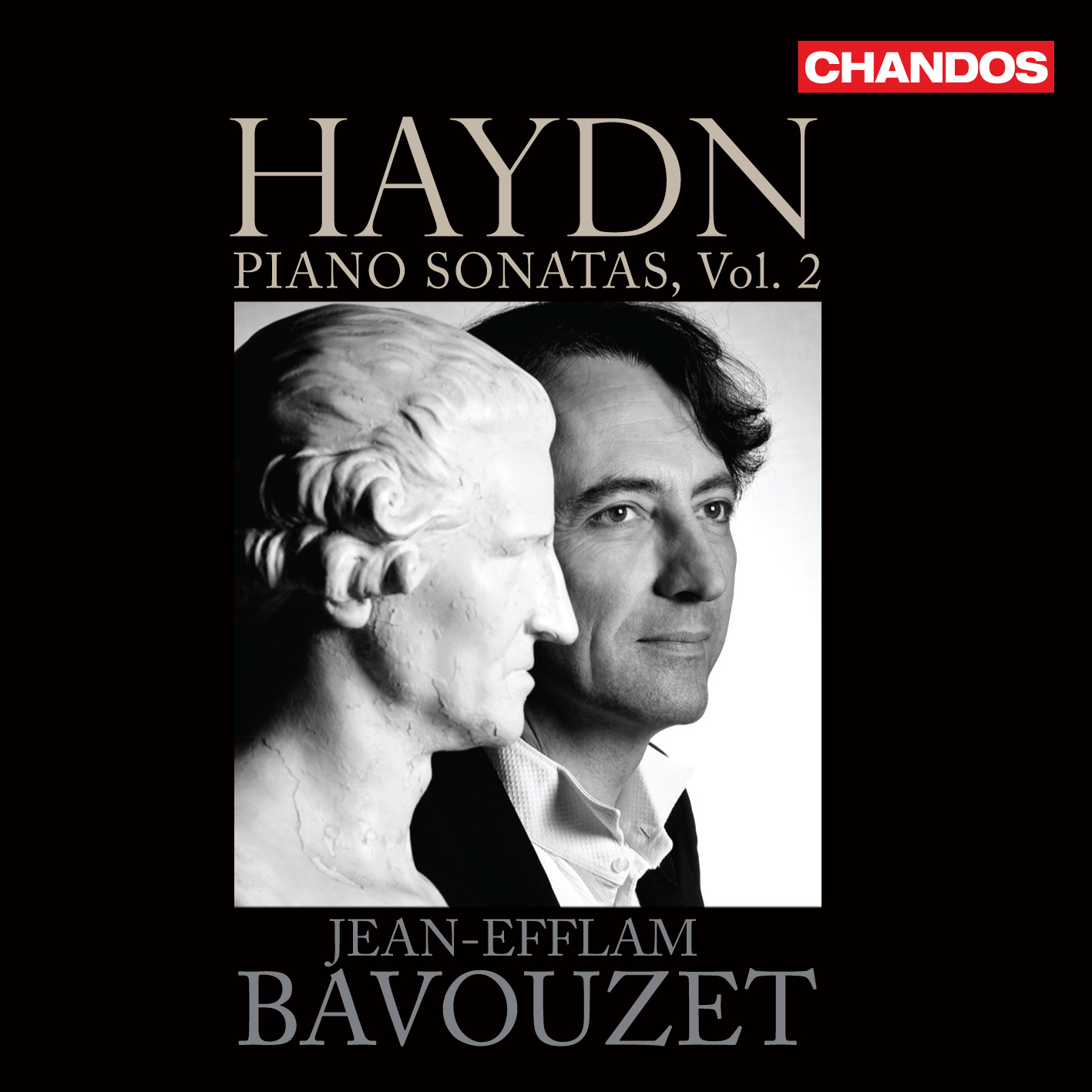
Jean-Efflam Bavouzet HAYDN Piano Sonatas, Vol. 2

The multi-award winning and ever-popular Jean-Efflam Bavouzet is back with Volume 2 of Chandos’ highly acclaimed Haydn Sonata series. This new release follows Bavouzet’s complete Debussy cycle and a number of recent concerto recordings – all of which have been extraordinarily well received by critics and audiences alike, picking up numerous awards along the way.
Many leading pianists have tackled these at times technically challenging classical sonatas by Haydn, but in Bavouzet’s own words, this is a composer who always left the door open for new interpretations: ‘One often forgets how little information Haydn left in the text of his keyboard works: few instructions on nuance and phrasing, and very minimal tempo indications. Playing them is all the more fascinating for that, but it is also arduous and even risky for the performer, who must, even more than usual, create his or her own world and internal logic, only hoping – in the absence of tangible proof – that he or she is not straying too far from the composer’s intentions, forever out of reach.’
For the recording Bavouzet brought in a specially selected Yamaha piano which he feels gives the sort of tonal quality he is looking for, and it shows in the programme for Volume 2 which includes the elegantly virtuosic Sonata in E minor, No. 19; Sonata in B flat major, No. 20; Sonata in G minor, No. 32; Sonata in C major, No. 48, and Sonata in D major, No. 50.

Jean-Efflam Bavouzet HAYDN Piano Sonatas, Vol. 1

Interesting that the most intelligent musicians, the deepest-thinking of them, all maintain Haydn as a private passion. Sure, pianists revere Bach as the purest of all composers. The theologian Karl Barth surmised as much: the angels, he supposed, played Bach in praise of the Almighty, while en famille he was sure they played Mozart. Barth, though, for all his theology, didn’t consider Haydn. Pianists such as McCabe, Brendel, Schiff, Staier, up to (most notably among recent discs) Leif Ove Andsnes and Marc-André Hamelin – all these musicians have indulged listeners with their love of Haydn’s sonatas, and now Jean-Efflam Bavouzet, acclaimed as a Debussy pianist (all five volumes of the French composer’s piano works, if I’m not mistaken, have been selected as Gramophone Editor’s Choices), has placed himself among their number.
Bavouzet’s approach to four of Haydn’s sonatas from in and around the 1770s is perhaps closer to that of Andsnes than it is to the nonchalant brilliance of Hamelin. The two minor-key sonatas on the present disc also feature in Andsnes’s selection (EMI, 5/99); the B minor work and the two major-key sonatas are on Hamelin’s first volume (Hyperion, 5/07). Clarity of line is paramount in this music and that is what Bavouzet delivers: he views the sonatas with sobriety but by no means dispassionately. While these are not “difficult” works in terms of breathtaking virtuosity, they require great reserves of control from a pianist. Bavouzet responds vividly to the turbulence of the C sharp minor Sonata and the hieratic unfolding of the B minor, and is equal to the sudden shifts of mood within movements, while the toccata-like writing that features in so much of Haydn’s keyboard writing never becomes hectoring or hammered-out. Discreet ornamentation adds allure to music that offers both majesty and sweetness, and ranges from the grand gesture to Haydn’s trademark high jinks, right down to the disconsolate minuet that draws the C sharp minor Sonata to its downbeat conclusion. I’ve mentioned some of my favourite Haydn pianists above, and Bavouzet joins them with the first disc in what I hope will be a long and comprehensive series. (David Threasher / Gramophone)

miércoles, 18 de abril de 2018

Hildur Guðnadóttir / Jóhann Jóhannsson MARY MAGDALENE

The unfortunate and unexpected passing of Jóhann Jóhannsson in early February, sent shockwaves through the film community, and lovers of modernist music at large. Not only was he flourishing and enjoying a fruitful career highlight since the indie world took his scores for mainly Denis Villeneuve-helmed films to the heart, but the death of any person at barely 48 years of age is a sad reminder of how fragile our existence can be. Jóhannsson is leaving behind a stunning body of work, ranging from independent studio albums in his native Iceland, that gained a loyal following due to their experimental sonic blends of traditional orchestration with contemporary electronic elements, to his recent film scores, which exposed so many traditional scoring aficionados to variety of post-modernist styles – all coming from an artist who always managed to encapsulate life from a different, more introverted angle that was singular only to him.
In 2017 Jóhannsson worked on a variety of film projects, including Darren Aronofsky’s controversial Mother and the much anticipated Blade Runner 2049. Both scores were subsequently rejected from their respective films, but apparently due to reasons amicable between him and the film directors. After completing Mary Magdalene in January, he was supposed to commence scoring work on the Marc Forster-directed Christopher Robin, a family friendly live action continuation of the Disney franchise based on A. A. Milne’s book Winnie the Pooh, as well as Johan Renck helmed mini-series about infamous Chernobyl disaster. But fate interfered and thus, Garth Davis’ biographical reimagining of a disciple of Jesus was the final film score Jóhannsson completed before his regrettable passing. We have one more on the way – a Nicolas Cage Sundance favourite, a shocker titled Mandy that will receive a proper, official release sometime later this year – and then, if his unused scores remain kept in the vault, impervious to the general public, the prospect of hearing another Jóhannsson score will be done forever.

Janine Jansen / Joris van Rijn / Benjamin Schmid 24 CAPRICCIOS FOR VIOLIN FROM THE NETHERLANDS

In 1998, the Rotterdam Arts Foundation commissioned 24 Dutch composers to write short works, or "capriccios", for solo violin, clearly with the idea of being a modern counterpart to the 24 caprices of Paganini. The one main rule was to compose acoustically, i.e. no use of electronics/remixing, overdubbing, or other outside means of sound besides the violin on its own and the violinist on her/his own. The Dutch music publishing house Donemus published these works in a single collected volume in 1999. All of these works received their premieres that same year at the International Gaudeamus Interpreters' Competition, which centered on the violin that year.
Starting just on presentation, in a very egalitarian spirit, the 24 works are divided equally among the album's three violinists, with each violinist playing 8 capriccios, divided equally among the two CDs, so that each violinist performs 4 of the capriccios on each CD. With perhaps a touch of chivalry as well, the album has a "ladies first" format, with a young pre-famous Janine Jansen, aged ~20, performing the first 4 capriccios on each CD. Joris van Rijn takes the second set of 4 on each CD, and Benjamin Schmid the last set of 4 on each CD. (The egalitarian division of the players doesn't extend to the list of composers, as only two female composers are represented in the collection, Caroline Ansink and Vanessa Lamm.)